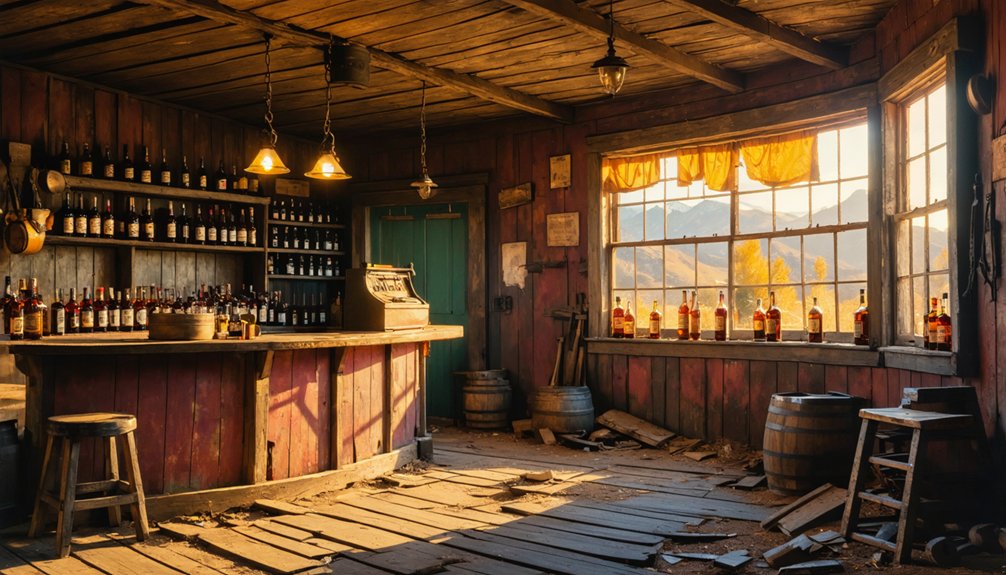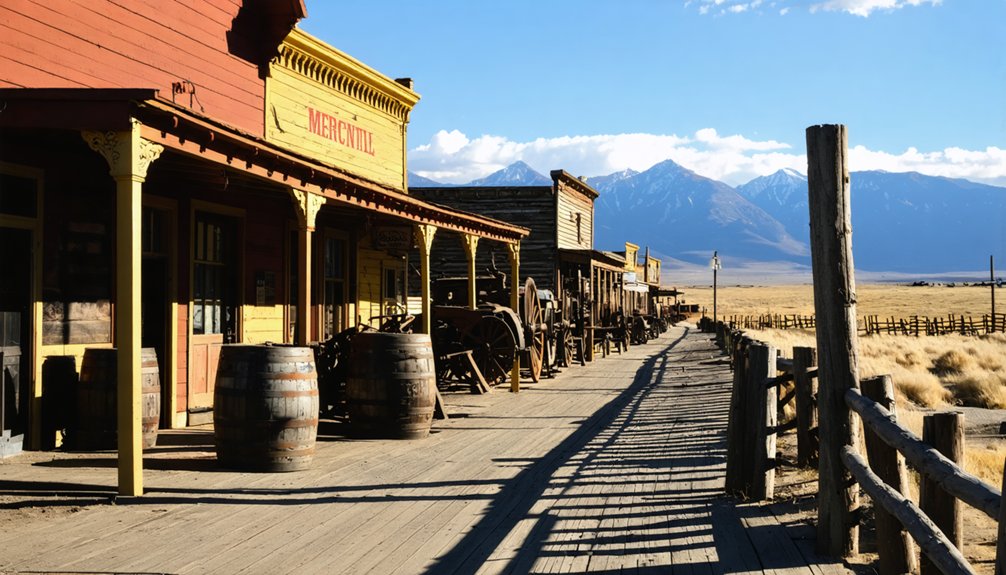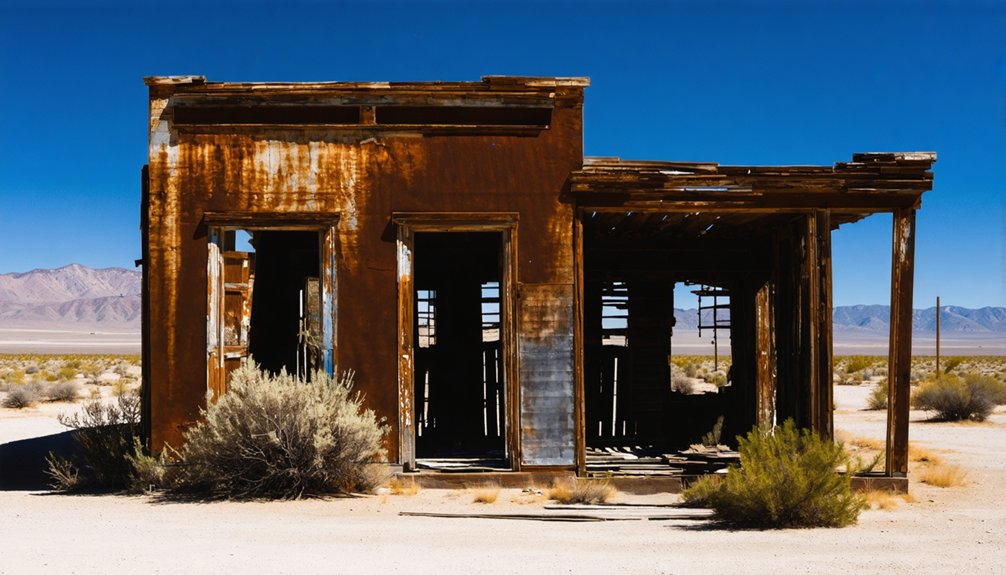
You’ll find several fascinating ghost towns near Barstow, with Calico Ghost Town being the crown jewel—just a few miles north off Interstate 15. This restored 1881 silver mining settlement features five original buildings from when the Silver King Mine made it California’s largest silver producer. For an authentic experience, head to Randsburg, “the living ghost town,” where 69 residents still call home among structures dating back to its 1895 gold rush days. Both destinations transport you back to California’s mining heyday, and there’s much more to discover about what awaits.
Key Takeaways
- Calico Ghost Town, founded in 1881, features restored buildings, mine tours, gold panning, and a scenic railroad near Barstow.
- Randsburg, established in 1895, remains a “living ghost town” with 69-77 residents and preserved historic buildings like the 1904 General Store.
- Most ghost towns are accessible via Interstate 15 and local roads, with Calico open daily 9 AM to 5 PM.
- These towns reflect California’s Gold Rush and mining heritage, with Calico producing $20 million in silver and Randsburg $60 million in gold.
- Visit during cooler months, bring water and supplies, and check for entrance fees or permits before exploring these remote desert locations.
Calico Ghost Town: A Silver Mining Legacy
When four prospectors struck silver in the Calico Mountains back in 1881, they couldn’t have imagined they’d just triggered one of California’s greatest mineral rushes.
You’d have witnessed over 500 mines operating simultaneously, extracting more than $20 million in silver ore through pioneering mining techniques of the era. The Silver King Mine alone became California’s largest silver producer, drawing 3,000 fortune-seekers from China to Greece to America’s frontiers.
But freedom came with volatility. When the Silver Purchase Act crashed prices from $1.31 to $0.63 per ounce in the 1890s, your boomtown dreams vanished overnight.
The discovery of colemanite mineral deposits temporarily boosted the town’s economic fortunes before its ultimate decline.
The abandoned mining town found new life when Walter Knott purchased it in the 1950s for architectural restoration, preserving five original buildings to reflect their 1880s appearance.
Randsburg: The Living Ghost Town
You’ll find Randsburg clinging to the Rand Mountain slope where three prospectors struck gold in 1895, transforming a hardscrabble claim into Southern California’s richest gold camp.
When you walk past the 1904 soda fountain still serving malts today, you’re tracing the footsteps of the 3,500 miners who once worked the Yellow Aster Mine‘s thundering 100-stamp mill.
Unlike Calico’s restored facades, Randsburg never died—it’s survived on grit and small-scale mining for over a century, earning its reputation as California’s “liviest ghost town.” The town’s aesthetic has remained largely unchanged for more than a hundred years, with minimal modernization preserving its authentic historical character.
The community continues to operate without modern conveniences like stoplights or gas stations, maintaining its early mining camp character.
Mining Heritage and History
While other desert camps faded into dust after their mines played out, Randsburg clung to life with the stubborn determination of its original prospectors.
You’ll discover mining techniques that evolved from simple two-stamp mills crushing ten tons daily in 1897 to the massive 100-stamp Yellow Aster operation producing $100,000 monthly by 1902. The town’s $60 million legacy began when prospectors traced placer gold to its source in 1895, establishing this as a “poor man’s camp” during the Depression.
Today’s visitors encounter historical artifacts throughout town—original buildings from the 1899 boom when 3,500 residents crowded these streets. Photographer C. W. Tucker documented the town and its mines during the gold rush era, creating a visual record that remained largely unknown until his collection was auctioned in 2011.
The Yellow Aster mine alone yielded 500,000 ounces before closing in 1933, leaving behind authentic remnants of freedom-seeking prospectors who carved opportunity from unforgiving desert. The Randsburg Railway Company began operations in January 1898, connecting the mines to Barstow’s reduction works and enabling the district’s rapid expansion.
Desert Town Exploration
Nestled between the stark beauty of Death Valley and the Sierra Nevada Mountains, Randsburg defies the fate of its neighboring ghost towns with a population of 69-77 souls who’ve chosen authenticity over amenities.
You’ll discover this living relic along Highway 395, where abandoned structures stand beside thriving businesses, creating an authentic Old West tableau unchanged for over a century.
Your exploration reveals:
- The 1904 General Store soda fountain serving legendary Black Bart Banana Splits
- White House Saloon where locals and travelers swap stories over cold drinks
- Antique shops and a desert museum showcasing mining equipment
- Bottle trees dotting the landscape where desert wildlife roams freely
There’s no gas station or stoplight to interrupt your journey backward in time—just genuine frontier spirit surviving on small-scale mining and tourism.
Originally established in 1896 during the gold and silver rushes, this desert settlement began as Rand Camp before evolving into the Randsburg you see today.
The town’s prosperity was built on the legendary Yellow Aster Mine, which produced nearly $25 million in gold from 1895 to 1933, making it one of California’s richest gold mines.
Getting to Calico Ghost Town From Barstow
Though Barstow itself holds memories of countless road trips along the Mother Road, the real treasure lies just a few miles north where Calico Ghost Town waits like an old friend you haven’t visited in years.
Your journey’s simpler than you’d think—just take Interstate 15 and exit at Ghost Town Road. The 4-mile detour winds through desert landscape that’ll transport you backward through time. The drive takes approximately two hours from Los Angeles if you’re coming from the west.
As you explore the ghost towns surrounding Bishop California, you’ll encounter remnants of a vibrant history that once thrived in the region. Each town tells its own story through the decay of buildings and the whispers of the past that echo through the empty streets. Don’t forget to bring your camera; the haunting beauty of these abandoned places is a photographer’s dream.
No buses or trains run here; you’ll need your own wheels for this adventure. Open daily from 9 AM to 5 PM (except Christmas), it’s best experienced in morning light when shadows stretch long across wooden boardwalks. Parking is available at the ghost town for visitors arriving by car.
For directions navigation and travel tips, your GPS will guide you to 36600 Ghost Town Road in Yermo, where freedom-seekers have wandered since mining days.
Exploring the Maggie Mine and Silver King History
You’ll step into the same tunnels where determined miners once blasted through 1,000 feet of rock in scorching 100-degree heat, chasing silver dreams that would yield $13 million from these mountains.
The Maggie Mine stands as the only safe passage into Calico’s underground world today, its blacklight mineral displays and antique exhibits bringing to life the story of two brothers who dug for nothing, only to watch a ten-year-old schoolboy discover a $65,000 silver pocket above their heads.
Just down the colorful slopes, the ruins of the Silver King Mine—California’s largest silver producer of the mid-1880s—remind you that fortunes were made and lost in these desert hills.
Touring Maggie Mine Today
The cool darkness of Maggie Mine’s entrance beckons visitors just as it once drew silver-seeking miners over a century ago.
You’ll explore 1,000 feet of authentic tunnels at your own pace, experiencing the same cramped passages where miners extracted $13 million in silver ore during the 1880s.
Your self-guided journey includes:
- Blacklight mineral displays revealing fluorescent specimens hidden in Calico Mountain rock
- Historical mining techniques demonstrations at the reconstructed assay office
- Antique equipment exhibits featuring stamp mills and ore processing tools
- Audio presentations throughout the drift detailing daily operations and working conditions
These Maggie Mine experiences run daily from 9 a.m. to 5 p.m., letting you wander freely through genuine 1880s workings—no velvet ropes or rushed tour groups, just you and authentic Western history.
Silver King Mine Legacy
While Maggie Mine offers an intimate glimpse into Calico’s underground world, it was the Silver King Mine that wrote the script for this entire mountain’s destiny.
When S.C. Warden, Hues Thomas, and John C. King staked their claim on April 6, 1881, they couldn’t have imagined they’d sparked California’s largest silver mining operation.
You’re walking through history shaped by King himself—the San Bernardino County sheriff who grubstaked these prospectors and maintained order as fortune-seekers carved 30 miles of tunnels beneath your feet.
The mine’s $13-20 million output transformed barren peaks into a thriving community of 1,200 souls.
Though silver prices crashed by 1896, historical preservation efforts—particularly Walter Knott’s 1950 restoration—ensure you’ll experience this silver mining legacy firsthand, where freedom-seeking prospectors once chased their dreams through calico-colored mountains.
Mining Exhibits and Artifacts
Stepping into Maggie Mine’s cool darkness, you’ll find yourself in the only Calico tunnel safe enough for modern explorers—a thousand-foot journey that once swallowed ten-hour shifts of miners working in 100-degree heat.
The reconstructed assay office reveals mining techniques that transformed raw ore into $13 million worth of silver, while blacklight displays illuminate minerals still hiding in the rock.
The exhibits showcase historical significance through authentic artifacts:
- Stamp mill samples demonstrating ore crushing methods
- Scheelite, tungsten, silver ore, and uranium specimens
- Antique mining tools engineered for 1890s extraction
- Educational photographs documenting Calico’s boom years
Audio narration brings miners’ voices back to life, letting you experience their world without government restrictions or modern safety regulations that’ve closed most historic tunnels forever.
Attractions and Tours at Calico
When visitors first arrive at Calico Ghost Town, they’re greeted by a collection of attractions that bring the 1880s mining era to life in ways that feel both educational and enchanting.
You’ll find Calico attractions ranging from the self-guided Maggie Mine Tour through 1000 feet of authentic silver mine tunnels, where blacklight displays reveal hidden minerals in the rock walls, to the playful Mystery Shack with its gravity-defying optical illusions.
Tour experiences include the scenic Calico Odessa Railroad winding through desert landscapes and hands-on Gold Panning Adventure where you’ll work an actual stream bed.
Each attraction runs daily from 9 AM to 5 PM, letting you explore at your own pace and discover what resonates with your adventurous spirit.
Shopping and Dining in an 1880s Setting
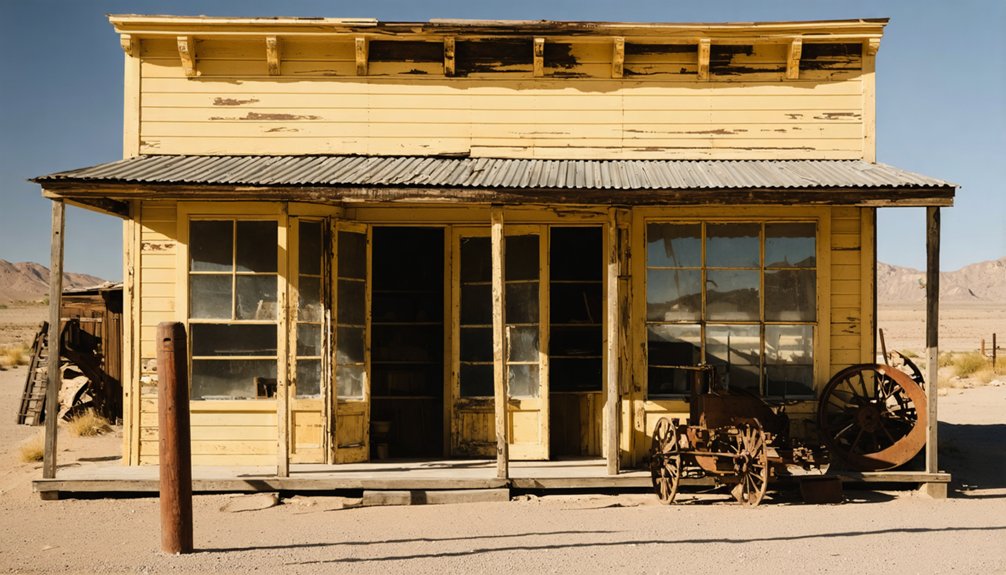
How often do you get to enjoy a hearty Buffalo Burger while sitting in a dining room that hasn’t changed much since silver miners gathered here over a century ago?
Calico’s historical dining scene transports you straight back to the 1880s. At Calico House Restaurant, you’ll savor homemade shepherd’s pie and pot roast from 8 AM to 5 PM daily, while Lil’s Saloon offers sarsaparilla in an authentic cowboy bar setting.
Your vintage shopping adventure includes fourteen unique establishments:
- Calico Woodworks and Lane’s General Store for frontier essentials
- Bath & Candle Shop for old-fashioned handcrafted goods
- Calico R & D Fossils & Minerals showcasing regional treasures
- Leather Works & Indian Trading Post featuring Western crafts
Between exploring nine specialty shops and grabbing hot dogs at the soon-to-open Silver Rush Burger, you’ll experience commerce exactly as pioneers did.
Annual Festivals and Special Events
Calico Ghost Town transforms throughout the year with five beloved festivals that’ll remind you of simpler times when communities gathered for genuine celebration.
You’ll find Easter Sunday brings egg hunts and craft rooms where kids roam freely. Mother’s Day weekend fills the air with bluegrass melodies and cloggers’ rhythms.
September’s Calico Days recreates 1880s mining camp life—you can watch burro races and miner competitions that’d make your great-grandfather proud.
October’s Ghost Haunt offers trick-or-treating without the suburban restrictions. November’s Holiday Fest features Santa and tree lighting under desert stars.
Each festival’s event schedules include gunfight shows and live music. Festival highlights vary by season, but admission stays affordable: typically $8-15 for adults, less for children, keeping traditions accessible.
Overnight Accommodations and Camping Options
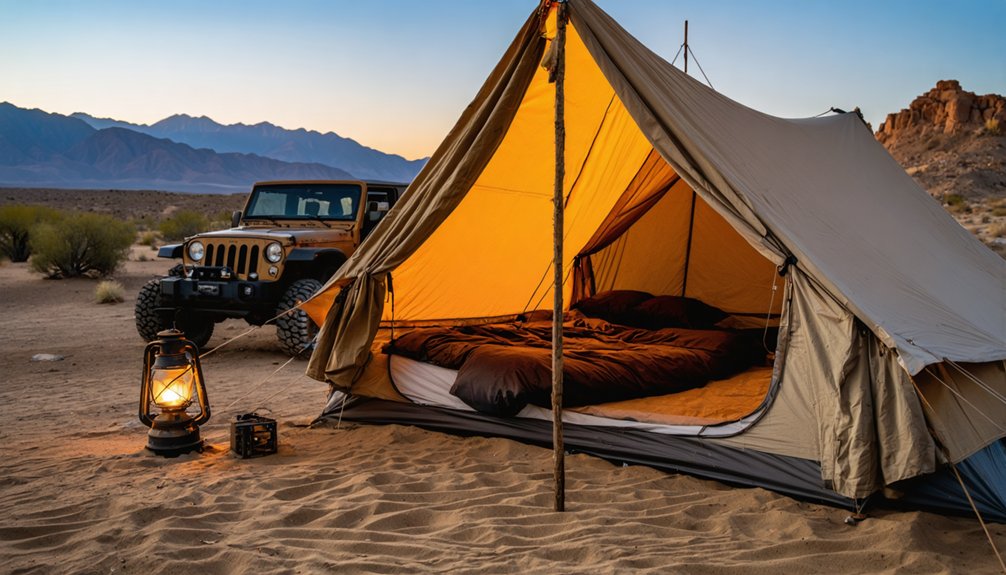
After a full day exploring silver mines and dusty saloons, you’ll want a place to rest your head that matches the spirit of your adventure.
After chasing ghosts through abandoned mines all day, even the toughest adventurer needs a proper place to crash.
Calico’s on-site campground lets you sleep under the same stars prospectors once gazed upon, while the Mini-Bunkhouse offers modern comfort with authentic charm at $160 nightly.
Your lodging options expand in nearby Barstow, 7-9 miles away:
- Travelodge by Wyndham Yermo sits closest at 3.5 miles ($89-$95)
- California Inn delivers solid 4.0 ratings from genuine travelers
- Budget Inn Barstow includes breakfast to fuel morning explorations
- Motel 6 welcomes road-weary pets without hesitation
Pack your camping essentials for Calico’s RV park, or choose air-conditioned freedom in town.
Either way, you’re stepping into history on your terms.
Nearby Attractions Along Route 66
Route 66 stretches through Barstow like a ribbon of American dreams, and you’ll find pieces of that history scattered along Main Street where mom-and-pop hotels still stand sentinel over decades of cross-country journeys.
You can’t miss the cardboard cutout cars perched on stone pedestals throughout town—quirky tributes to the classic vehicles that once rumbled past.
At the 1911 Barstow Harvey House, you’re standing where railroad travelers once rested, now serving as an Amtrak station and home to the Route 66 Mother Road Museum, reopening March 22, 2025.
Don’t overlook the 1930s Mojave Water Tank painted red in McDonald’s parking lot, or Rosita’s Restaurant, serving travelers since Rosa Griego opened it in 1948.
These Historic Landmarks aren’t just attractions—they’re touchstones of wanderlust.
Planning Your Ghost Town Road Trip
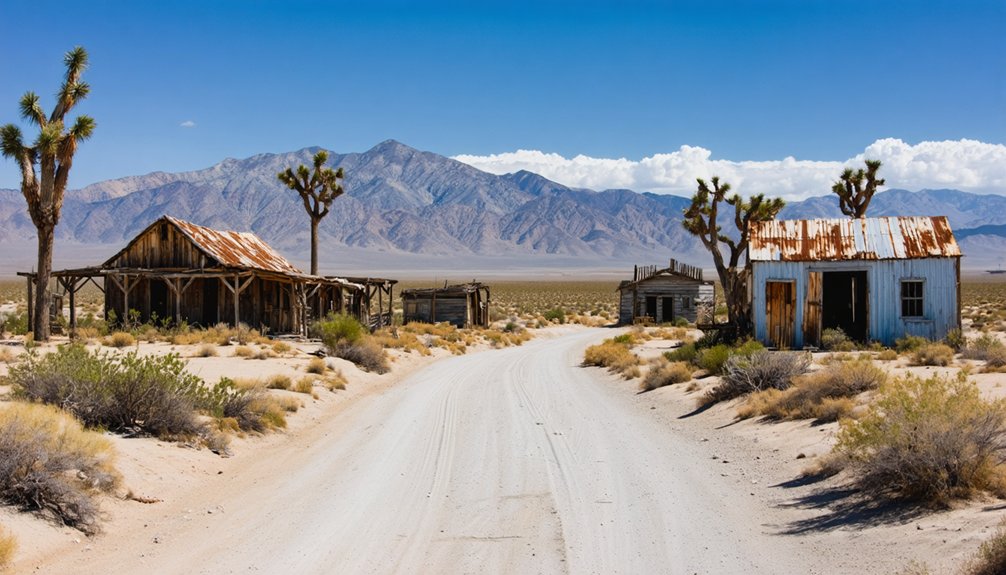
Before you pack your trunk and point your wheels toward the Mojave’s forgotten corners, you’ll want to map out a route that honors the geography of abandonment—these ghost towns don’t cluster conveniently like rest stops on a modern highway.
The standard itinerary flows from Bodie to Ballarat, Randsburg, Barstow, then Calico—each demanding different preparation levels:
- Ballarat requires remote Panamint Valley navigation; bring extra water for desert wildlife observation.
- Randsburg sits south of Ridgecrest in high-desert hills accessible via standard highways.
- Calico offers easy Interstate 15 access with RV camping and daily 9-5 hours.
- Spring visits reward ghost town photography enthusiasts with ideal lighting and festivals.
Rent a sturdy vehicle for unpaved approaches, verify road conditions beforehand, and carry essentials—freedom here means self-reliance.
Frequently Asked Questions
Are Dogs Allowed at Calico Ghost Town?
Yes, you’ll find welcoming dog policies at Calico Ghost Town. Your leashed companion can explore most pet-friendly areas with you, though you’ll pay $1 admission. Some shops restrict entry, but the freedom to wander together remains largely intact.
How Much Does Admission to Calico Ghost Town Cost?
Remember when eight bucks bought you freedom? Adult admission fees run $8, youth $5, kids under three free. You’ll find ticket discounts through three-attraction packages at $12, or snag that $50 annual pass for unlimited wandering.
Is Calico Ghost Town Wheelchair Accessible?
Calico’s main street offers wheelchair access down those weathered boardwalks you’ll remember, and ghost town facilities include accessible museums. However, you’ll find the historic mines and off-road buildings remain inaccessible due to rocky, stepped terrain.
Can You Find Real Silver or Gold While Panning at Calico?
Like dreams of striking it rich that faded with history, you won’t find real silver or gold panning at Calico. Despite its legendary mining history, you’ll only discover Iron Pyrite using traditional panning techniques—fool’s gold for your collection.
What Should I Wear When Visiting Ghost Towns in the Desert?
Wear sturdy, closed-toe boots and bring proper sun protection—I’ll never forget how my grandfather’s wide-brim hat saved him exploring abandoned mines. You’ll want layers too, since desert temperatures swing wildly between scorching days and freezing nights.
References
- https://www.visitcalifornia.com/road-trips/ghost-towns/
- https://www.tripadvisor.com/Attraction_Review-g33295-d126686-Reviews-or780-Calico_Ghost_Town-Yermo_California.html
- https://en.wikipedia.org/wiki/Calico
- https://parks.sbcounty.gov/park/calico-ghost-town-regional-park/
- https://www.youtube.com/watch?v=OsTV0s5Du5A
- https://wewhoroam.com/calico-ghost-town/
- https://events.thehistorylist.com/organizations/calico-ghost-town-yermo-california
- https://www.youtube.com/watch?v=ILv_uPHtpyM
- https://digital-desert.com/calico-ghost-town/
- http://www.visitcalicoghosttown.com/about-calico