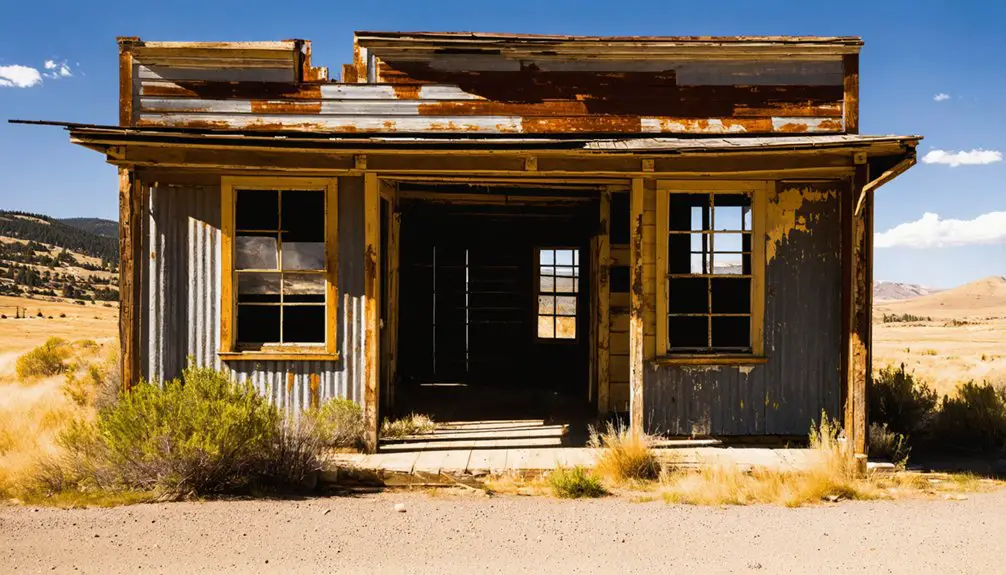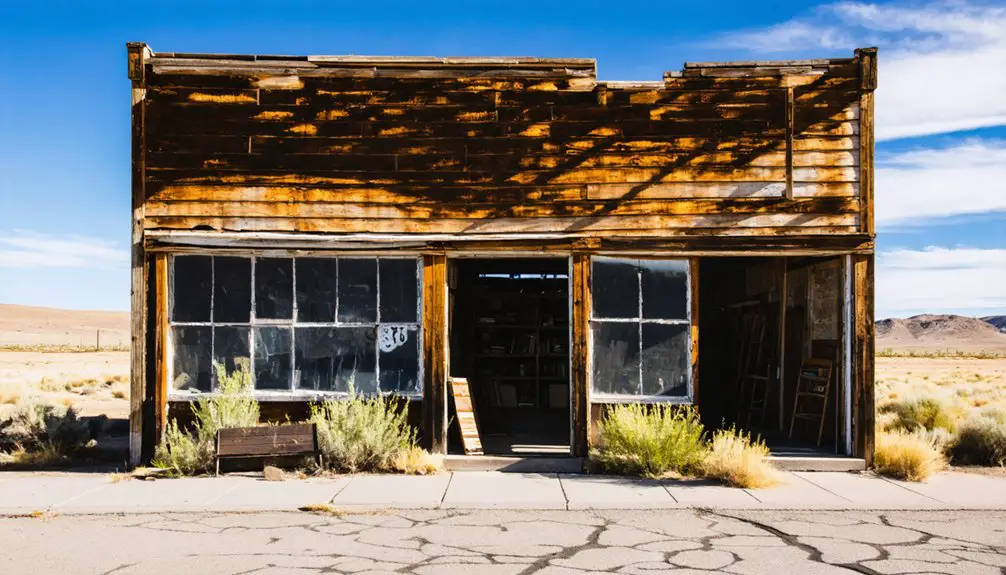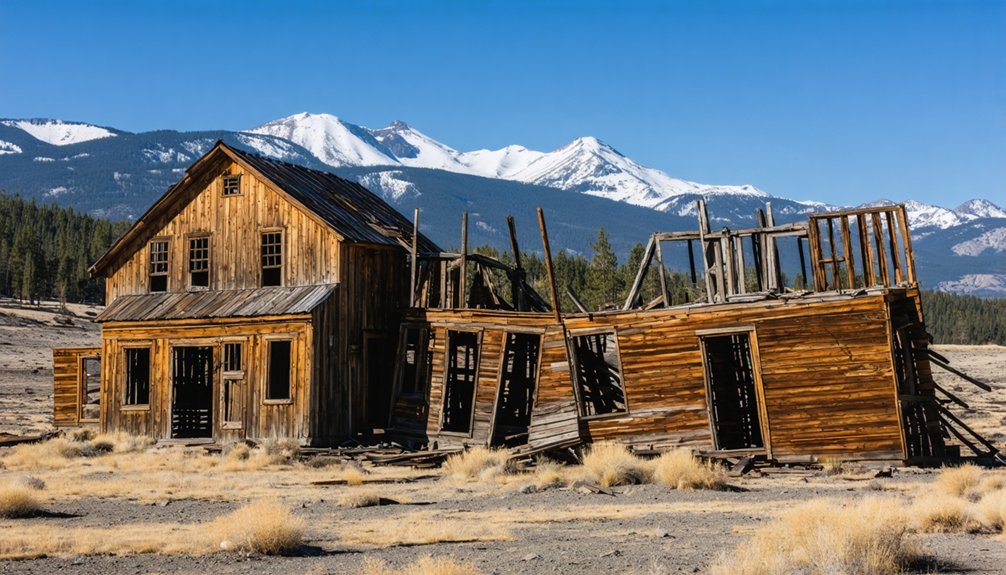
You’ll find several ghost towns within 80 miles of Bend, with Millican being the closest at just 25 miles east on U.S. Route 20. This abandoned settlement features remnants of a general store and gas station from its early 1900s peak of 60 residents. Other notable destinations include Shaniko (bypassed by railroad in 1911), Canyon City (1862 gold rush site), and Hardman, where gold operations closed in 1942. Oregon’s 256 documented ghost towns span diverse historical narratives, and proper trip planning reveals their fascinating stories.
Key Takeaways
- Millican, 25 miles east on U.S. Route 20, features an abandoned general store and peaked at 60 residents in early 1900s.
- Shaniko, Oregon’s most popular ghost town, declined after railroad bypass in 1911, dropping from 600 to 20-36 current residents.
- Canyon City began with 1862 gold discovery, peaked at 10,000 residents by 1864, producing $5 million annually during prosperity.
- Fort Rock offers a 67-mile southeastern route with paved roads, guided tours, and a homestead museum with thirteen historic structures.
- Hardman and Ashwood, established after 1862 gold discovery, faced abandonment when federal authorities closed gold operations in 1942.
Millican: The Closest Ghost Town to Bend
Millican sits approximately 25 miles east of Bend along U.S. Route 20, making it the most accessible ghost town for exploration in the region.
Understanding Millican history reveals a settlement named after cattle rancher George Millican, who established his ranch around 1880. The town peaked at 60 residents in the early 1900s, operating one of the world’s smallest post offices with just a dozen regular customers.
Named for rancher George Millican, this tiny settlement once housed 60 residents and operated one of the world’s smallest post offices.
Highway 20’s construction in the 1930s triggered mass exodus, leaving Billy Rahn as the sole resident by the mid-1940s. Bill Mellin purchased the town in 1945 and operated the general store and gas station for over 30 years until his murder in 1988. For nearly 70 years, it remained a peculiar single-family town.
Today’s ghost town exploration reveals only an abandoned general store and gas station remnants—frozen relics of a vanished high desert community. The Oregon Badlands Wilderness, spanning over 29,000 acres, lies adjacent to Millican and offers rugged high desert landscapes for outdoor enthusiasts.
Canyon City and Sumpter: Gold Rush Heritage
While Millican’s story reflects the challenges of high desert settlement, Oregon’s most dramatic boom-and-bust cycles unfolded in the gold-rich canyons east of the Cascade Range.
Canyon City history began June 8, 1862, when prospectors struck gold at Whiskey Gulch. Within ten days, 1,000 miners established camps. By 1864, Canyon City’s population exceeded 10,000—surpassing Portland as Oregon’s largest community.
The district produced an estimated $5 million annually during peak years, extracting over $26 million in total by 1880. You’ll find approximately 1,250 Chinese residents worked claims abandoned by whites, operating hydraulic operations into the 1900s.
Sumpter mining operations followed similar trajectories, transforming wilderness into thriving settlements before inevitable decline.
St. Thomas Episcopal Church, built in 1876, stands as Canyon City’s enduring symbol of gold rush prosperity. The town became Grant County seat in 1864, cementing its administrative importance during the mining boom. Today, Canyon City celebrates its heritage through the annual ’62 Days celebration, which began in 1922 to commemorate the original gold rush discovery.
Shaniko: Oregon’s Most Popular Ghost Town
- Oregon Trunk Railroad bypassed it in 1911, routing commerce to Bend instead.
- Downtown fires devastated the business district after losing railroad access.
- Passenger service ended in the 1930s; complete rail shutdown occurred by 1966.
- Population plummeted from 600 to today’s 20-36 residents.
- Navigation backup: Download offline maps and carry a road atlas for signal-dead zones
- Emergency provisions: Pack jumper cables, first aid kit, flashlight, and basic tool kit
- Vehicle maintenance: Verify spare tire accessibility, fluid levels, and tire conditions
- Self-sufficiency supplies: Stock water bottles, multi-tool, towels, and hand sanitizer
- Economic collapse – Mining operations exhausted their resources, like Greenhorn losing two-thirds of its population between 1900-1910.
- Transportation shifts – New railroad routes diverted commerce away from established settlements.
- Natural disasters – Catastrophic floods destroyed communities like Grant town in 1894.
- Resource depletion – Timber and mining towns vanished when profitable extraction ended.
- https://en.wikipedia.org/wiki/List_of_ghost_towns_in_Oregon
- https://www.visitoregon.com/oregon-ghost-towns/
- http://www.photographoregon.com/ghost-towns.html
- https://www.deviantart.com/austinsptd1996/journal/Six-Iconic-Ghost-Towns-Within-Oregon-1109696435
- https://bendbulletin.com/2025/10/28/spooky-oregon-haunting-histories-and-ghost-towns-abound/
- https://traveloregon.com/things-to-do/culture-history/ghost-towns/
- https://www.bendsource.com/news/ghost-towns-of-central-oregon-14722697/
- https://www.islands.com/1965417/millican-oregon-abandoned-hamlet-between-bend-high-desert-rugged-stillness/
- https://extranormaltrails.com/millican/
- http://www.photographoregon.com/Millican-Oregon.html
You’ll find the 1900-1902 Shaniko Hotel, massive brick wool warehouse, and authentic Old West structures along preserved boardwalks.
Shaniko earned its reputation as the “Wool Capital of the World” during its peak prosperity at the turn of the 20th century.
The town experiences peak visitor traffic during summer months when historical businesses open and festivals bring the ghost town to life.
Hardman and Ashwood: Central Oregon’s Hidden Settlements
Beyond Shaniko’s well-preserved boardwalks, two lesser-known settlements tell equally compelling stories of Central Oregon’s volatile mining history.
Hardman history began with gold’s discovery on July 4, 1862, when prospectors established Independence at the confluence of Raw Dog and Yellow Dog settlements.
Gold fever sparked at the Raw Dog and Yellow Dog junction on Independence Day 1862, birthing what would become Hardman.
You’ll find the town cycled through names—Dairyville in 1870, Dogtown by 1876—before postmaster David Hardman secured its final identity in 1878.
The stagecoach depot brought prosperity through the 19th century, supporting three general stores and two hotels by 1900.
Four buildings remain today, including a rustic church.
The town maintains a small population of 20-30 residents who preserve its frontier character.
The Odd Fellows Hall, constructed in 1870, stands as one of Hardman’s most notable historic structures.
Ashwood establishment followed in 1865 as another mining hub.
Fire consumed the original town in 1898, though residents rebuilt.
When federal authorities shuttered gold operations in 1942, both settlements faced inevitable abandonment, their high-altitude locations offering no alternative economies.
Planning Your Ghost Town Road Trip
You’ll need proper preparation before exploring Central Oregon’s high desert ghost towns, where distances span 25 to 80 miles from Bend and elevations reach 4,400 feet.
Start with Fort Rock’s accessible 67-mile southeastern route, which provides paved roads suitable for standard vehicles and includes guided tours during the May-to-September season.
Millican’s 25-mile journey via Highway 20 offers the shortest trip, while Shaniko’s 80-mile northern route along Highway 97 can anchor a multi-day circuit when you base operations in Bend or La Pine.
The Fort Rock Valley Homestead Museum features thirteen historic structures including cabins, a doctor’s office, a church, a general store, and a school relocated from various homestead sites. These abandoned settlements reflect the economic shifts that occurred when mining and lumber industries declined across the region, leaving behind remnants of Oregon’s frontier history.
Essential Trip Preparation Items
Before setting out to explore abandoned settlements scattered across Central Oregon’s high desert, verify your vehicle documentation meets legal requirements and accessibility needs. Your trip essentials should include a valid driver’s license, current registration, and spare key stored separately.
This packing checklist guarantees you’ll navigate remote terrain safely:
Complete pre-trip maintenance including oil changes and battery inspection.
These preparations provide you freedom to explore without dependency on unreliable services.
Recommended Ghost Town Routes
With your vehicle prepared and supplies packed, five distinct routes connect Bend to Central and Eastern Oregon’s abandoned settlements.
Route Highlights include the Shaniko loop, just 1.5 hours north via Highway 97, accessing the 1901 wool capital’s standing structures.
Eastern travelers can pursue the Blue Mountains Mining Trail, spanning Galena’s 1865 gold camp and Greenhorn’s seven remaining homes.
The Southeastern Oregon Backroads traverse 100+ miles from Jordan Valley through Burns to Bend, passing Rome’s pillars and Arock’s 1922 petroglyph site.
Northern Grasslands circuits reach Hardman and Lonerock via The Dalles.
Sherman County’s direct drives offer Sherar’s Bridge (established 1860) and McDonald’s former river crossing.
Each route’s Historical Significance traces distinct eras—stagecoach lines, mining rushes, railroad bypasses—through self-guiding maps and ranger resources.
Oregon’s Ghost Town Legacy: 256 Abandoned Communities
Oregon harbors 256 documented ghost towns scattered across its diverse landscape, a count compiled by Professor Stephen Arndt that reveals the state’s dramatic cycles of boom and bust.
These abandoned communities span from Grant to Sherman to Josephine counties, with abandonment dates ranging from 1894 through the 1990s.
The abandonment reasons varied dramatically across Oregon’s frontier:
Oregon legally defines these sites as incorporated cities lacking sufficient electors while maintaining historical significance for exploration.
Frequently Asked Questions
Are Ghost Towns Near Bend Safe to Visit With Children?
You’ll find managed sites like Fort Rock offer excellent child safety with restrooms, guided tours, and maintained trails, while unmaintained locations like Millican lack supervision. Choose preserved ghost town activities over abandoned properties for family adventures.
What Is the Best Time of Year to Visit Oregon Ghost Towns?
Visit Oregon ghost towns in spring or early fall when you’ll find ideal weather, accessible roads, and fewer crowds. Fall foliage enhances scenic exploration while mild temperatures let you appreciate these sites’ historical significance comfortably and safely.
Do I Need Special Permits to Explore Abandoned Buildings in Ghost Towns?
Ah, bureaucracy’s endless embrace! You’ll need to verify exploration regulations and land ownership before entering structures—many sites sit on private or federal land. Always follow safety guidelines, respect posted boundaries, and consult local authorities regarding trespassing laws.
Can I Camp Overnight Near Ghost Towns Close to Bend?
You can camp overnight near Bend’s ghost towns using dispersed BLM sites in surrounding high desert areas. Bring appropriate camping gear and check current camping regulations, as permits may be required and fire restrictions apply year-round.
Are There Guided Tours Available for Ghost Towns Near Bend?
No formal guided tours exist for ghost towns near Bend. You’ll need to pursue self-guided exploration of sites like Millican, Shaniko, and Shevlin, discovering their historical significance independently through archival research and personal investigation.