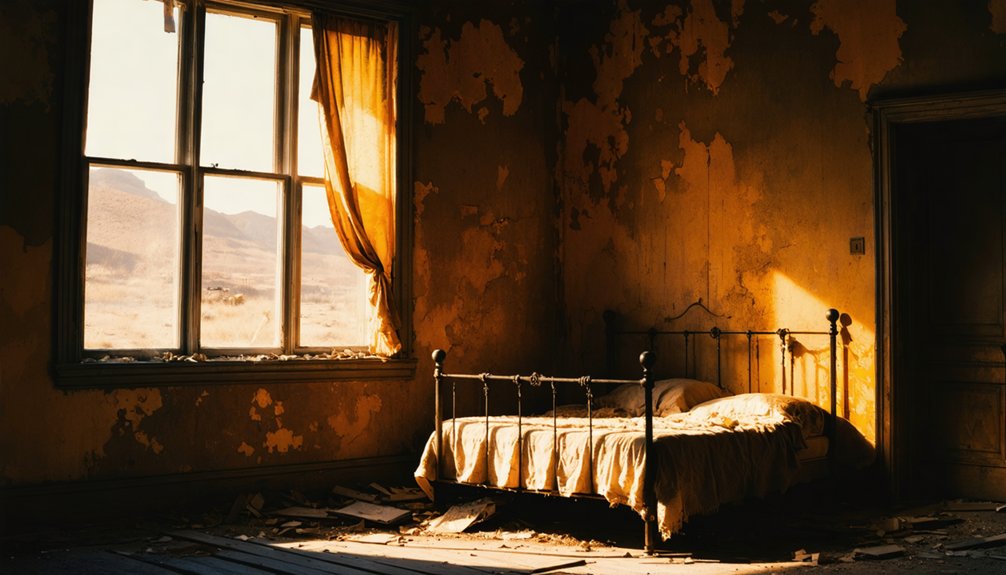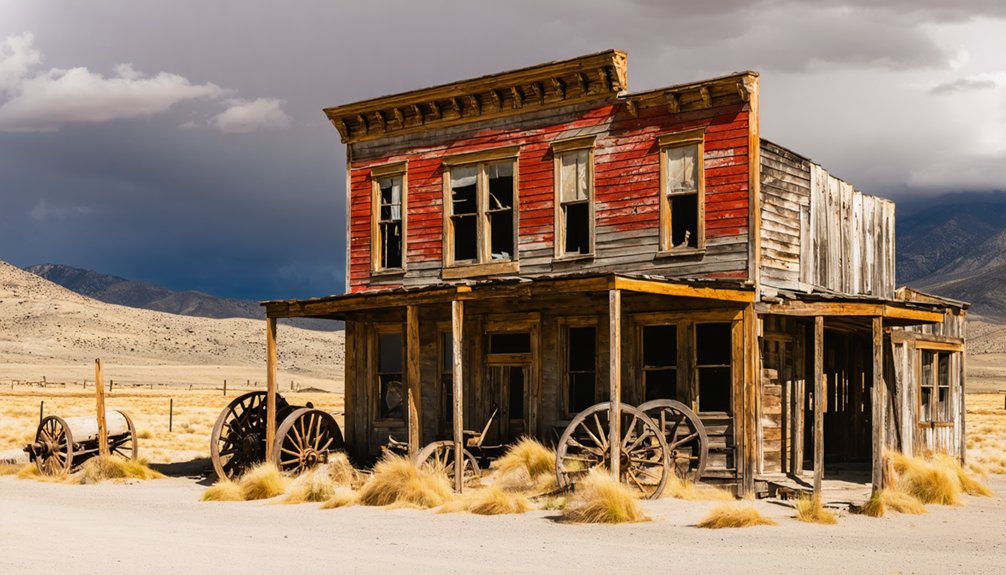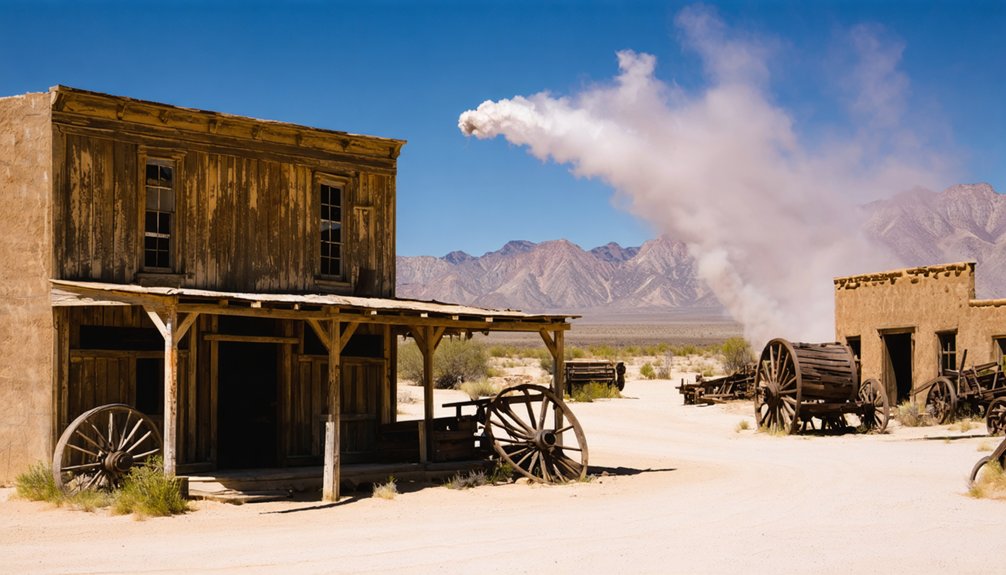
You’ll find Terlingua, the most significant ghost town near Big Bend National Park, just minutes from the park’s west entrance. This former mercury mining hub thrived from 1903 until 1945, when the Chisos Mining Company ceased operations. Today, you can explore crumbling adobe structures, the historic St. Agnes Church, and a cemetery with over 400 graves. The town’s surprisingly transformed—it now hosts 10,000 visitors annually for its famous chili cook-off while maintaining authentic ruins alongside modern accommodations and dining in repurposed mining buildings.
Key Takeaways
- Terlingua, the primary ghost town near Big Bend, features decaying adobe homes, St. Agnes Church, and Perry Mansion from its mining era.
- The town declined after Chisos Mining Company ceased quicksilver operations in 1945, leaving 23 miles of subsurface tunnels and industrial remnants.
- Visitors can explore 2-3 dozen sandstone structures, the 40-foot Scott Furnace, and a cemetery with approximately 400 graves of miners.
- Terlingua offers modern amenities including dining at Starlight Theatre restaurant, accommodations in Ghost Town Casitas, and a trading post with artisan goods.
- The ghost town hosts 10,000 annual visitors for the championship chili cook-off and celebrates cultural events like Día de los Muertos.
Terlingua: America’s Most Famous Desert Ghost Town
When the Chisos Mining Company shuttered its quicksilver operations in 1945, Terlingua’s transformation from bustling mining camp to desert ruin began almost immediately.
You’ll find decaying adobe homes, the skeletal remains of St. Agnes Church (built 1913), and Perry Mansion still standing in this segregated village’s Anglo section. The cemetery holds miners who succumbed to influenza rather than mercury poisoning—their graves now share space with recent burials.
Terlingua’s crumbling adobe walls and weathered graves tell stories of miners who survived mercury only to fall to disease.
Cultural significance emerged in 1967 when Terlingua hosted the first championship chili cook-off, establishing local legends that draw 10,000 visitors annually.
Today’s population of 267 supports quirky attractions: the Starlight Theatre occupies the old cinema, while the jail serves as restrooms.
The town sits strategically between Big Bend National Park and Big Bend Ranch State Park, making it an ideal base for exploring the region’s natural wonders. Visitors can explore over 150 miles of trails within Big Bend National Park, along with four campgrounds and exceptional opportunities for hiking, canoeing, and horseback riding.
This authentic boot hill cemetery and revitalized company store prove that ghost towns don’t always stay dead.
Mining History and the Rise of Terlingua
During the mid-1880s, prospectors stumbled upon cinnabar ore deposits in the Terlingua area, setting in motion a mining boom that would transform this remote corner of the Chihuahuan Desert.
The Marfa and Mariposa camp emerged first, establishing a post office in 1899.
Chicago industrialist Howard E. Perry changed everything when he founded the Chisos Mining Company in 1903, acquiring land rich in mercury ore as debt repayment.
His operation dominated cinnabar extraction, processing more quicksilver than all competitors combined.
Labor dynamics centered on 200-300 mainly Mexican workers who built this company town from scratch.
By 1913, you’d find a commissary, hotel, doctor, and telephone service.
The community reflected segregated living conditions, with Mexican families residing east of the store while Anglos settled to the west.
World War I brought unprecedented prosperity—the company earned $2,000 daily during peak years.
The Chisos Mining Company maintained continuous operations for four decades, cementing Terlingua’s position as part of the third-largest mercury-producing district in the United States.
What Remains: Exploring the Ruins and Historic Sites
You’ll find Terlingua’s physical remnants scattered across two primary zones: the ghost town proper off Ivey Road, where 2-3 dozen sandstone structures stand roofless along both sides of the main road, and Terlingua Abajo several miles south, where hillside homes have crumbled to rubble near a cemetery marked by PVC crosses and concrete headstones.
The Chisos Mining Company‘s infrastructure—from ore processing sites like La Noria to homesteader cabins at River Road East—dots the backcountry accessible via maintained high-clearance roads. These ruins preserve the mining camp’s 1903-1940s operational footprint, with the ghost town cemetery holding 530 graves (98 identified) and abandoned 1930s vehicles rusting between thick-walled buildings whose wooden door frames still frame the desert wind. The structures were built using flat sandstone stacked without mortar, a construction method that has allowed many walls to remain standing despite decades of abandonment. Among the vintage relics sits a deteriorating truck at Dugout Wells, believed to be a 1924 Ford Model TT.
Mining Company Infrastructure Remnants
The skeletal remains of mining operations stand as monuments to the mercury boom that once drove thousands to this remote corner of Texas.
At Chisos Mining Company, iron grates cover 23 miles of subsurface workings, while 2-3 dozen mortarless sandstone buildings crumble nearby.
Whit-Roy’s steel crusher and concrete hoppers reveal industrial-scale mining techniques steps from Buena Suerte’s roofless limestone row houses.
Mariscal Mine produced 1,400 flasks of quicksilver—one quarter of America’s total output between 1900-1943.
The towering Scott Furnace, standing 40 feet tall and built from local clay bricks, processed cinnabar ore by heating it to release elemental mercury through multiple condensers.
These ruins tell stories beyond economics: they’re laboratories of ghost town ecology, where gravel, brush, and time reclaim what humans abandoned.
Walk freely among furnace foundations and head frames, tracing the arc of ambition through rusting metal and decomposing adobe. Visible tailings piles mark the landscape around processing buildings, offering tangible evidence of extraction operations that once defined the region’s economy.
Cemetery and Burial Grounds
Beyond rusted machinery and collapsing adobe, Terlingua’s burial grounds preserve the region’s most intimate history.
You’ll find the one-acre Terlingua Cemetery west of Highway 170, where approximately 400 souls rest—90 percent of Hispanic heritage. The burial practices here reflect frontier necessity: dirt mounds, weathered wooden crosses, homemade markers scratched rather than engraved.
Mercury miners, bootleggers, murder victims, and influenza casualties from 1903 onward share this National Register site.
The cultural significance endures through Día de los Muertos celebrations and year-round offerings—beer bottles, Grateful Dead CDs, candles.
You’ll spot quirky tributes: a hobbit-themed grave, Boss Bird’s chicken statue, a three-foot T-Rex. Epitaphs like “Another good man done gone” reveal the stories and character of those who rest here.
The cemetery dates back to the early 1900s, when it served the hardy individuals of Terlingua’s mercury mining community.
Nearby, Lajitas Cemetery and Terlingua Abajo offer similar glimpses into Big Bend’s hardscrabble past, while Juan de Leon’s isolated roadside grave marks unsolved violence from decades past.
Modern Amenities in a Ghost Town Setting
You’ll find Terlingua’s ghost town ruins interwoven with working businesses—the old Chisos Mining Company store now houses Terlingua Trading Company, while crumbling adobe walls frame a BBQ trailer and a cafe serving iced coffee among the remnants.
Historic structures that once served miners have been converted into restaurants, bars, and lodging options ranging from air-conditioned casitas to unique stays in repurposed buildings.
This seamless blend of 1900s ruins and modern services means you can grab grilled cheese steps from a preserved jail cell, then retire to a yurt overlooking the Chisos Mountains.
Accommodations and Dining Options
While ghost towns typically evoke images of abandoned structures and tumbleweeds, Terlingua’s ruins now host a surprising array of modern accommodations and dining venues.
You’ll find Terlingua accommodations ranging from Ghost Town Casitas with queen-size beds and cascading showers to yurts and tiny homes, all equipped with A/C, kitchenettes, and mini-fridges. These units sit seconds from downtown, minutes from Big Bend’s entrance.
For dining experiences, you can sip beer alongside locals on the Starlight Theatre’s porch or explore restaurants repurposed from early 20th-century mining structures.
The old Chisos Mining Company store now operates as a trading company and gift shop. Between meals, you’ll discover art galleries and bars interspersed among the ruins, all offering sweeping views of the Chisos Mountains and Mexico’s primitive landscape.
Historic Buildings Repurposed Today
The Starlight Theatre stands as Terlingua’s most successful architectural resurrection, transforming from a silent movie house and company store into a bustling restaurant where diners eat beneath exposed wooden beams and original ceiling rafters.
This adaptive reuse demonstrates how mining-era structures can serve modern commerce while maintaining their historic character. You’ll find thick sandstone walls—built without mortar by Chisos Mining Company workers—now housing contemporary bar operations and dining service.
Beyond the Starlight, other stone buildings with intact roofs shelter visitors exploring the ghost town‘s 2-3 dozen structures.
Historic preservation here isn’t about roping off the past; it’s about letting you walk through original wooden doorframes, examine rusted mining equipment, and experience authentic frontier architecture that’s stood for over a century in West Texas’s unforgiving climate.
Trading Post and Shops
Among the weathered mining ruins, Terlingua Trading Company occupies the original Chisos Mining Company store where trappers, settlers, miners, and cowboys once stocked their provisions.
Today you’ll find the trading company history preserved in these corrugated steel and adobe walls, now stocked with local artisan goods alongside essentials for modern desert travelers.
The Starlight Theatre area shops offer front porches where you can share stories with locals over cold beer, surrounded by primitive Texas landscape ruins.
Big Bend Art Studio operates nearby, blending contemporary gallery space with ghost town authenticity.
These trading posts and gift shops create a functioning community minutes from Big Bend National Park, where you’ll discover unique wares amid abandoned structures—modern retail interspersed with early 20th-century remnants, serving today’s independent explorers.
The Annual Chili Cook-Off Tradition
Today, you’ll find two rival November cookoffs drawing thousands to Terlingua’s desert landscape:
- Original Terlingua International Championship (“Behind the Store”) – maintaining Tolbert’s legacy
- CASI Terlingua International Chili Championship – attracting up to 10,000 attendees annually
- Qualifying system – cooks earn points at sanctioned events from October through September
This cookoff culture celebrates Texas’s state dish with cast iron pots, secret recipes, and campfire gatherings.
For over 50 years, chili heads worldwide have descended on this ghost town, transforming rivalry into tradition while supporting causes like ALS research.
Location and Access to Big Bend Region
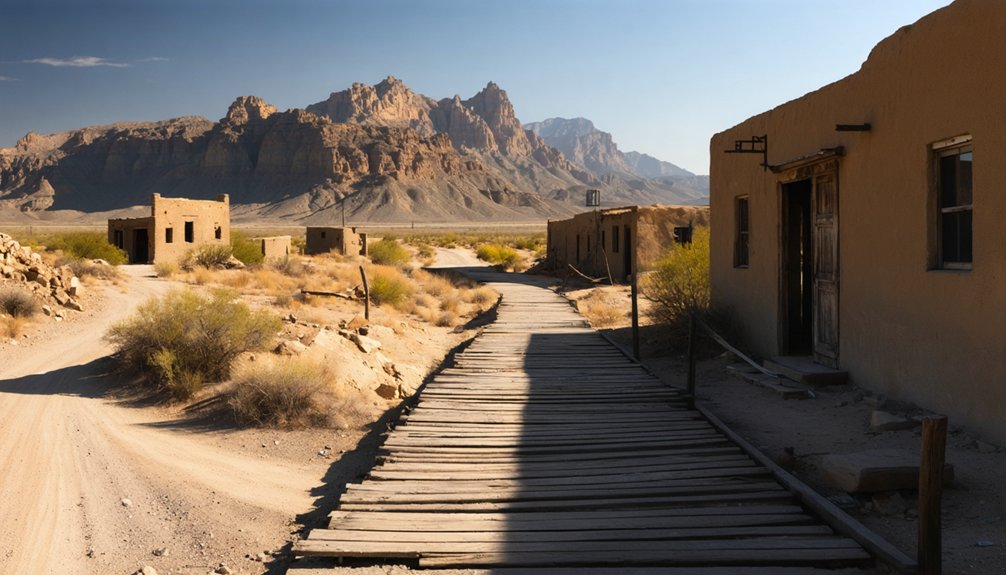
Straddling the remote expanses of Brewster County at coordinates 29.25° N, 103.25° W, Big Bend National Park occupies 801,163 acres along 118 miles of the Rio Grande border with Mexico.
Park access requires deliberate planning—you’ll navigate TX 118 from Alpine, US 385 through Marathon (70 miles south to headquarters), or FM 170 from Presidio. Persimmon Gap’s north entrance sits 28 miles from Panther Junction, while Maverick’s western gate lies 23 miles out.
Three highways converge on remote wilderness—each route demanding hours of intentional travel through West Texas vastness before reaching park boundaries.
Regional logistics demand self-sufficiency: stock fuel, provisions, and water before entering. The nearest electric charging stations wait 130 miles away in Fort Stockton.
Five paved roads thread through elevations ranging from 2,717 to 5,679 feet, connecting isolated destinations where cell service vanishes and independence becomes necessity.
Planning Your Visit to Terlingua Ghost Town
Since its transformation from bustling mercury mining camp to preserved ruin, Terlingua Ghost Town sits 4.6 miles west of the TX-118 junction along FM-170, accessible via a half-mile drive down Ivey Road where you’ll park on the left near the sprawling complex of sandstone structures.
Plan your exploration with these essentials:
- Timing and Safety: Visit during daylight hours wearing sturdy footwear for uneven terrain scattered with metal and glass debris from decades of abandonment.
- Ghost Town Photography: Capture two dozen mortarless sandstone buildings, 1930s-era cars, and Perry’s mansion overlooking the camp—all without entry fees or restrictions.
- Extended Experience: Combine ruins exploration with Terlingua Cemetery visits, Starlight Theatre dinners, and river trips while watching for local wildlife among deteriorating structures.
Explore respectfully, entering intact buildings cautiously.
Frequently Asked Questions
Are There Other Ghost Towns Near Big Bend Besides Terlingua?
You’ll discover La Noria’s German-founded ruins and River Road East homesteader remains along Tornillo Creek. These lesser-known sites offer compelling ghost town history beyond Terlingua, with nearby attractions including abandoned structures accessible through backcountry exploration.
In addition to these intriguing sites, there are also fascinating ghost towns near New River Gorge that reveal stories of early settlers and their daily lives. Exploring these areas allows you to step back in time while enjoying the stunning natural scenery of West Virginia. From old mining towns to deserted railway camps, each location holds remnants of history waiting to be uncovered.
Can You Camp Overnight in Terlingua Ghost Town?
Yes, you can camp overnight in Terlingua Ghost Town with available RV sites, tent camping, and rentals. No special overnight permits are needed—just book ahead during peak season and follow standard camping regulations.
Is Cell Phone Service Available in Terlingua?
Cell service in Terlingua’s spotty at best—T-Mobile and Verizon cover 100%, but you’ll find weak, inconsistent signals. AT&T reaches 95% coverage. For reliable Terlingua connectivity, don’t count on your phone working consistently.
What Wildlife Might I Encounter While Exploring the Ruins?
You’ll encounter desert wildlife like roadrunners, lizards, and jackrabbits among the ruins. Historic fauna including coyotes and hawks still inhabit these areas. Watch for rattlesnakes in rocky crevices, and you might spot javelinas near old water sources.
Are Guided Tours of the Ghost Town Available?
No guided excursions exist—you’re free to explore Terlingua’s historical significance independently. Since the 1900s mercury boom, self-guided tours let you wander the cemetery and mining ruins at your own pace, preserving authentic discovery.
References
- https://sweptawaytoday.com/2023/03/10/my-favorite-spots-in-terlingua-ghost-town-near-big-bend-national-park/
- https://www.tripadvisor.com/Attraction_Review-g56758-d105953-Reviews-Terlingua_Ghost_Town-Terlingua_Texas.html
- https://www.ghosttowncasitas.com
- https://ghosttowntexas.com
- https://bigbendguide.com/raiders-of-the-lost-park-the-ruins-of-big-bend/
- https://austinghosts.com/terlingua-ghost-town/
- https://visitbigbend.com/terlingua/
- https://www.legendsofamerica.com/tx-terlingua/
- https://www.dallasites101.com/blog/post/terlingua-texas-ghost-town-guide/
- https://www.tshaonline.org/handbook/entries/terlingua-tx