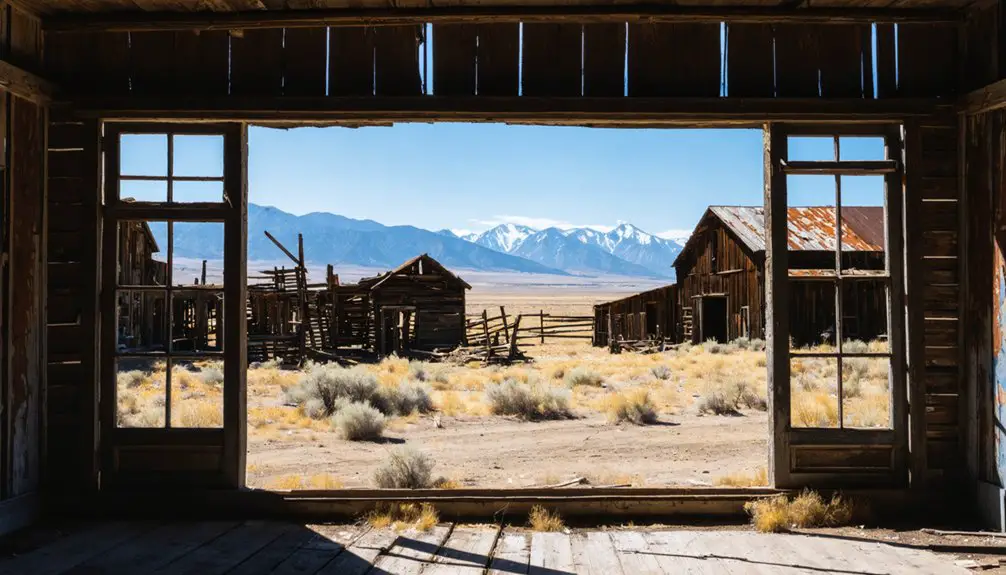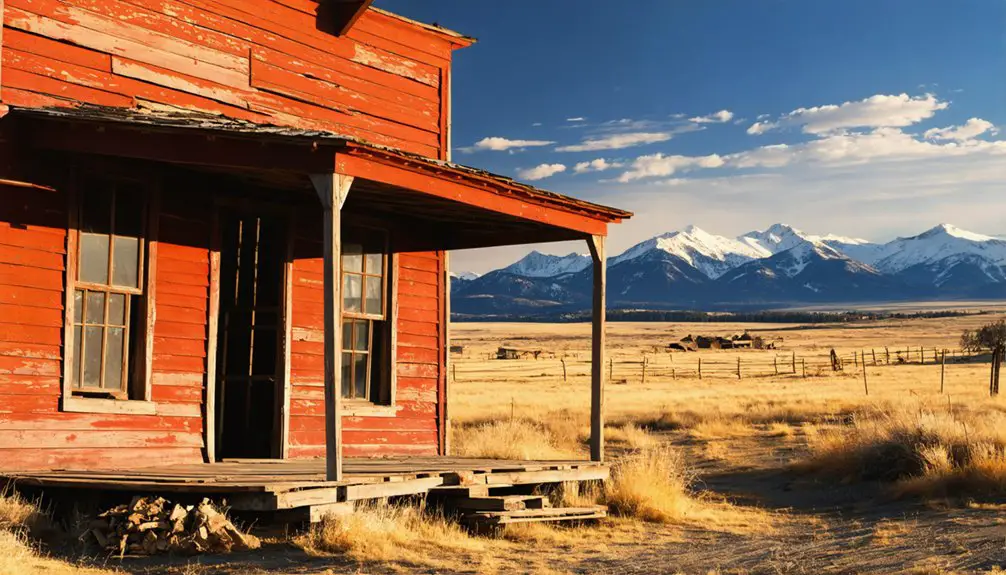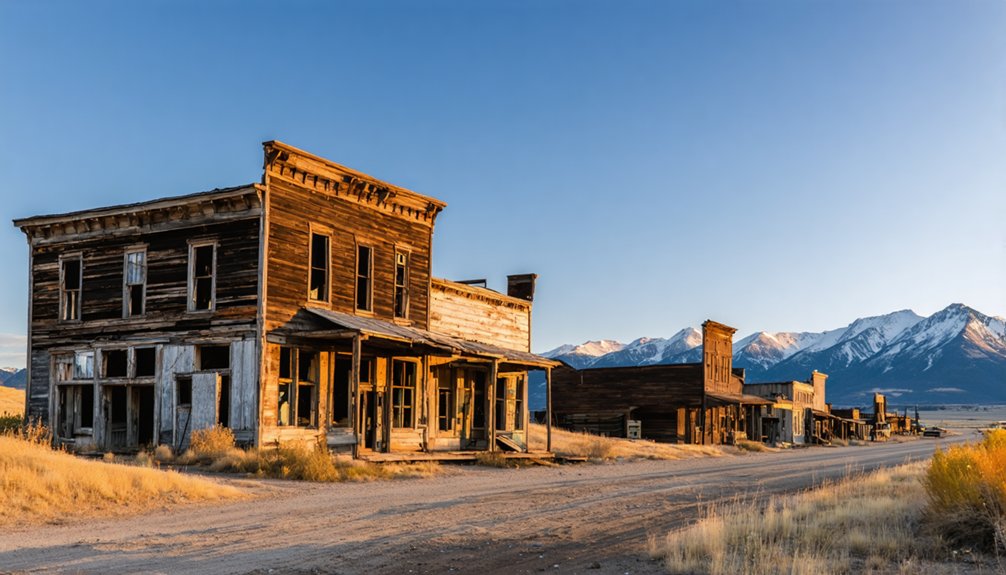
You’ll discover over a dozen ghost towns within 100 miles of Billings, starting with Coulson just one mile east—the area’s original 1877 steamboat settlement. Carbon County alone offers six documented sites including Washoe and Bear Creek, both former mining towns accessible via maintained roads. Stillwater County’s chromium mining camps like Lake Camp and Benbow Mine reveal wartime industrial history through preserved buildings and foundations. The best exploration window runs June through September when mountain roads become passable, and strategic planning of your route will reveal the complete narrative of Montana’s frontier rise and fall.
Key Takeaways
- Coulson, located one mile east of Billings, was the area’s first settlement established in 1877 before Billings existed.
- Carbon County features six ghost towns including Bean, Bear Creek, Bowler, Ewing, Fox, and Washoe from mining and railroad eras.
- Stillwater County contains abandoned chromium mining sites like Lake Camp and Benbow Mine, significant to World War II industrial efforts.
- Most ghost towns resulted from boom-bust cycles after the Northern Pacific Railroad’s 1882 arrival shifted settlement patterns.
- A 600-700 mile exploration loop from Billings is best June through September, requiring high-clearance vehicles and strategic fuel stops.
Coulson and Rimrock: Yellowstone County’s Forgotten Settlements
Just one mile east of modern Billings, the ghost town of Coulson marks where Yellowstone County’s first permanent settlement took root in 1877.
Just one mile east of Billings lies Coulson, Yellowstone County’s first permanent settlement established in 1877.
Named after the Coulson Steamboat Packet Company, this riverside community began when Perry McAdow operated his store from a tent.
Coulson history reveals a short-lived steamboat city that predated Billings, serving as the valley’s primary settlement before businesses and residents migrated westward.
Today, nothing remains except a commemorative plaque and the area’s first cemetery, where stories have been preserved for nine decades.
The cemetery became a romanticized symbol of frontier life, though the reality of early settlement differed from popular mythology.
While Rimrock significance receives less documentation in historical sources, it stands among the region’s 19th-century abandoned sites.
These forgotten settlements represent your county’s earliest attempts at taming the Yellowstone Valley frontier.
The name Coulson also appears in various other contexts, including as a surname and place name across English-speaking regions.
Carbon County Ghost Towns Within Easy Reach
South-central Montana’s Carbon County harbors six documented ghost towns—Bean, Bear Creek, Bowler, Ewing, Fox, and Washoe—all positioned within a two-hour drive from Billings.
Exploring these abandoned settlements provides a unique glimpse into the region’s rich history. For those looking for more adventure, there are several ghost towns to explore near Butte, each with their own stories and remnants waiting to be uncovered. Whether you’re interested in photography, history, or simply the thrill of discovery, these sites offer an unforgettable experience.
For those venturing beyond Carbon County, there are also numerous abandoned sites near Ennis Montana that promise intriguing explorations. These forgotten locales often reveal remnants of past lives and industries, each waiting to share its own story. Visitors can immerse themselves in the haunting beauty of these places, capturing stunning photographs and making memories in the process.
These settlements emerged from mining operations and railroad expansion, then faded as resources depleted and rail lines relocated.
Carbon County’s accessible ghost town sites:
- Ewing heritage lives within Big Horn Canyon National Recreation Area as a ghost ranch, offering minimal but historically significant structural remains.
- Washoe significance dates to 1903 when the Bartels family established this company mining town.
- Fox and Bear Creek retain visible mining equipment and building foundations for documentation.
- Bean and Bowler require property permission checks before exploration.
You’ll find varying preservation levels across these locations—some well-maintained, others dangerously deteriorated.
Four-wheel-drive vehicles improve access during ideal seasonal conditions.
Montana’s mining heritage includes legends of outlaws and hidden treasures that add mystique to these abandoned settlements.
Nearby Junction City in Yellowstone County represents another abandoned settlement from the same era of Montana’s development.
Stillwater and Park County Abandoned Sites
Moving northeast from Carbon County, Stillwater County presents chromium mining landscapes that shaped Montana’s wartime industrial contribution.
Stillwater County’s chromium mines stand as monuments to Montana’s critical role in America’s wartime metal production.
Lake Camp stands as a pristine ghost town where you’ll find the original school, recreation center, store, and boarding houses—structures that housed mining families from the 1880s through 1961.
The Benbow Mine gained strategic importance during World War II when German shipping disruptions created urgent demand for domestic chromium.
You can access these sites through annual tours coordinated by the Museum of the Beartooths, which use all-terrain vehicles to reach remote locations.
Chromium was first discovered in Stillwater County during the 1880s, establishing the foundation for an industry that would become vital to national defense decades later.
Concrete foundations and building depressions mark where entire communities once thrived, documenting an industrial era that predated Stillwater County’s 1913 establishment and defined regional development for generations. Similar to Garnet Ghost Town, these abandoned settlements provide historical insights into mining life and the communities that developed around Montana’s extractive industries.
Historical Context of Regional Settlement Decline
When the Northern Pacific Railroad reached Billings in 1882, it released settlement patterns that would define the region’s subsequent abandonment cycles for over a century.
You’ll find the area’s ghost towns emerged from predictable boom-bust sequences:
- Railroad speculation (1873-1882): Panic of 1873 crashed land values, halting construction for three years
- Homestead challenges (1909-1920): Despite 65% claim success rates, drought devastated settlements by 1917
- Resource depletion cycles: Gold camps collapsed in the 1860s; Glendive’s oil boom ended by 1954
- Indigenous conflicts: Open warfare with Sioux, culminating in Custer’s 1876 defeat, emptied valley areas
The railroad’s land acquisition methods utilized scrip to secure nearly 30,000 acres for the new townsite, fundamentally reshaping settlement priorities in the Yellowstone Valley.
The harsh winter of 1886-1887 decimated cattle operations throughout the region, forcing ranchers to abandon remote outposts and consolidating survivors into fewer, more sustainable operations.
These economic downturns concentrated survivors westward, costing Montana congressional representation.
You’re witnessing freedom’s harsh arithmetic—each abandoned townsite marks where opportunity calculations failed.
Planning Your Ghost Town Exploration Route
Understanding why settlements failed matters less than knowing how to reach them before weather, vandalism, or nature reclaims what remains. Your best route from Billings forms a 600-700 mile loop: northwest to Garnet (120 miles, 2.5 hours), south to Bannack State Park (230 miles total), then east through Castle Town and Milwaukee Road sites.
Plan three to four days between June and September when gravel roads stay passable.
Fuel stops require strategic planning—fill tanks in Billings, Philipsburg before Garnet’s 12-mile dirt access, and Dillon near Bannack. Remote eastern towns like Barber, Buffalo, and Glentana sit beyond cell coverage zones.
Pack offline maps, water, and bear spray. High-clearance vehicles handle the Castle Mountains and abandoned railway corridors where pavement surrenders to Montana’s reclamation timeline. Many Milwaukee Road towns feature grain elevators and churches that mark their agricultural heritage. Consider joining ghost tours that explore Montana’s haunted history, as many abandoned settlements carry their own eerie tales of spirits tied to the state’s tragic past.
Frequently Asked Questions
Are Any Ghost Towns Near Billings Considered Dangerous to Visit?
Coulson Ghost Town isn’t structurally dangerous, but you’ll need safety precautions for abandoned wells and crumbling grain elevators nearby. Watch for local wildlife on remote access roads, and respect private property boundaries when exploring freely.
What Caused Most Ghost Towns Around Billings to Be Abandoned?
Mining booms collapsed due to resource depletion and economic decline from falling ore prices. You’ll find silver and gold exhaustion, combined with world wars draining labor forces, caused widespread abandonment across Montana’s mining communities by the 1940s.
Can You Take Artifacts From Ghost Town Sites Near Billings?
No, you can’t legally take artifacts from ghost town sites near Billings. Federal and state laws impose legal restrictions protecting artifact preservation, with violations bringing fines up to $10,000 and potential jail time under the Antiquities Act.
Which Ghost Town Near Billings Is Best for Photography?
Bannack State Park offers you Montana’s best-preserved ghost town photography, though it’s 250 miles from Billings. Photography tips include shooting during golden hour for best lighting on weathered wood structures and capturing authentic nineteenth-century mining architecture.
Exploring abandoned sites near Philipsburg Montana can also provide unique photographic opportunities, especially for those interested in the stories behind the remnants of mining history. Each location tells a tale of its own, showcasing the rugged beauty of the Montana landscape intertwined with the echoes of the past. The contrast between natural scenery and dilapidated structures creates compelling compositions that are perfect for any photography enthusiast.
Do Any Ghost Towns Near Billings Have Reported Paranormal Activity?
Yes, you’ll find paranormal sightings documented at several locations. Garnet Ghost Town reports mysterious occurrences in preserved buildings, while the Dude Rancher Lodge’s haunted history stems from bricks salvaged from a former epidemic hospital site.
References
- https://en.wikipedia.org/wiki/List_of_ghost_towns_in_Montana
- https://www.flatheadrealestate.com/flathead-lake/the-top-spooktacular-haunted-houses-and-towns-in-montana/
- https://usghostadventures.com/billings-ghost-tour/
- https://www.youtube.com/watch?v=BQH5LghhkVs
- https://visitmt.com/things-to-do/ghost-towns
- https://www.duderancherlodge.com/blog/haunted-places-around-billings
- https://fwp.mt.gov/stateparks/bannack-state-park
- https://montanahistoriclandscape.com/tag/coulson-montana/
- https://en.wikipedia.org/wiki/Coulson
- https://www.hmdb.org/m.asp?m=168157