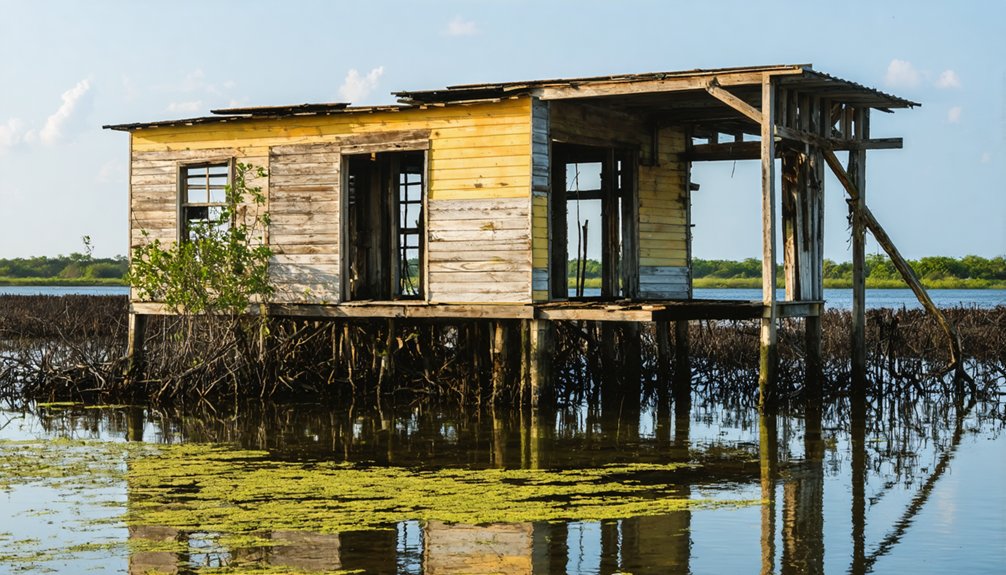
You’ll discover Stiltsville’s seven remaining structures rising from Biscayne Bay’s waters seven miles offshore, the ghostly remnants of twenty-seven buildings that thrived from the 1930s until Hurricane Andrew struck in 1992. Eleven miles from Islamorada, Indian Key’s ruins mark Dade County’s first county seat, destroyed in 1840 after Jacob Housman’s decade-long challenge to Key West’s salvage monopoly. Just south, you can explore Matheson Hammock’s Depression-era coral stone buildings, where William J. Matheson’s 1930 conservation vision still echoes through the tropical hardwood hammock that bears his name.
Key Takeaways
- Stiltsville, seven miles offshore in Biscayne Bay, once had twenty-seven buildings but only seven structures remain after hurricanes.
- Crawfish Eddie founded Stiltsville in 1933, which flourished with illegal gambling and social clubs before Hurricane Andrew’s 1992 destruction.
- Indian Key, eleven miles offshore from Islamorada, served as Dade County’s first county seat before its 1840 destruction.
- Jacob Housman established Indian Key in 1831, challenging Key West’s salvage monopoly until Chief Chekika’s warriors ended the settlement.
- Both abandoned settlements are accessible only by boat and managed through National Park Service permits and educational programs.
Stiltsville: Miami’s Abandoned Floating Neighborhood
Seven miles offshore from Miami’s bustling coastline, a cluster of weathered structures rises from the shallow waters of Biscayne Bay on wooden pilings, marking what remains of Stiltsville—a settlement that evolved from a single Depression-era barge into a floating neighborhood of twenty-seven buildings by 1959.
You’ll discover a place born from Crawfish Eddie’s 1930s bait shop, where entrepreneurs exploited the one-mile offshore distance to operate beyond law enforcement’s reach.
Rum running and illegal gambling flourished before social clubs transformed the area into an entertainment destination. The Quarterdeck Club earned Life magazine coverage in 1941, while the notorious Bikini Club offered free drinks to swimsuit-clad women until authorities shut it down in 1965.
Stiltsville’s evolution from lawless gambling den to glamorous social clubs captured national attention before authorities finally intervened in the mid-1960s.
Hurricanes systematically dismantled this floating haven, leaving only seven structures standing after Andrew’s 1992 assault. Hurricane Donna in 1960 destroyed many early structures, including homes like the Nichols family residence. The Stiltsville Trust, formed in 2003 as a tax-exempt corporation, now manages the remaining structures through an agreement with Biscayne National Park.
The History Behind the Bay’s Wooden Structures
Though some historians trace the flats’ earliest shacks to 1922, the documented story of Stiltsville begins in 1933 when Crawfish Eddie Walker anchored the first structure above state-owned submerged land—a simple platform perched on wooden pilings ten feet above water that rarely exceeded three feet at low tide.
These stilt structures allowed you to claim territory beyond government reach, selling bait, beer, and crawfish chowder where land-based laws couldn’t touch you.
By 1937, fishing buddies Thomas Grady and Leo Edward expanded this renegade village. The 1950s transformation from rough shacks to proper lodges marked the historical significance of this floating community, peaking at 27 buildings by 1960.
Lawyers, bankers, and Miami’s elite discovered freedom here—weekend residents living by their own rules on reinforced concrete pilings. During the Prohibition era, Stiltsville became known for speakeasies and a unique social scene that attracted prominent Miami businessmen seeking weekend retreats. Hurricane Andrew in 1992 devastated the settlement, leaving only seven structures standing from what was once a thriving maritime community.
Visiting Stiltsville Through Biscayne National Park
Today you can reach these historic structures only by boat, maneuvering one mile south from Cape Florida’s tip to the sandy shallows where seven buildings still stand on their pilings.
The National Park Service controls access through a permit system administered by the Stiltsville Trust, transforming what was once unregulated territory into managed parkland.
You’ll find boat tours available for booking, offering the sole practical option for most visitors to explore these rehabilitated structures.
The Trust coordinates educational programs within the buildings, preserving their legacy while restricting the casual drop-ins that defined Stiltsville’s heyday.
Current visiting guidelines emphasize marine resource education over the freewheeling entertainment that once characterized these platforms above Biscayne Bay’s seagrass beds.
From its origins with Crawfish Eddie Walker in the 1930s, the settlement expanded to twenty-seven structures by 1960 before hurricanes and fires triggered its long decline.
The exclusive Quarterdeck Club, established in 1941, operated as an invite-only gentlemen’s club that attracted local politicians and prominent figures.
Matheson Hammock and Key Biscayne’s Forgotten Past
When William J. Matheson donated 85 acres of tropical hardwood hammock in 1930, he preserved a fragment of old Florida that developers couldn’t touch.
You’ll find his vision along Old Cutler Road, where coral stone structures built by the Civilian Conservation Corps still stand—survivors of the 1945 hurricane that brought 12-foot waves crashing through.
The Matheson History extends beyond this park to Key Biscayne, where he’d been cultivating coconut groves since 1908. His death in May 1930 didn’t end the family’s conservation legacy; son Hugh later donated 680 acres that became Crandon Park.
Today, you can walk the original roadway remnants through West Matheson’s rare hammock forest, though controversial development proposals threaten what remains of this pre-boom ecosystem. The park’s mile of frontage on Biscayne Bay offers visitors a glimpse of South Florida’s natural coastline as it once existed. His widow Harriet and children Anna, Hugh, and Malcolm continued his philanthropic work, with William’s will establishing the Matheson Foundation dedicated to research and education.
Indian Key: Dade County’s Original Settlement
Long before Miami claimed Dade County’s administrative center, Indian Key—a sliver of coral rock 11 miles offshore from present-day Islamorada—served as the region’s first county seat.
You’ll find its stone foundations still marking where Jacob Housman built his wrecking empire in 1831, challenging Key West’s maritime salvage monopoly. The early settlement thrived on strategic positioning along Florida’s reef-strewn coastline, housing warehouses, wharves, and a well-stocked store.
Dr. Henry Perrine arrived in December 1838 with plans to cultivate tropical plants using a government grant, awaiting the war’s end before developing agricultural projects on the mainland.
But on August 7, 1840, Chief Chekika‘s warriors destroyed everything, killing thirteen residents and ending Housman’s ambitions. By 1844, the county seat relocated to Miami.
Today, you can paddle through mangrove channels to reach Indian Key Historic State Park, where crumbling cisterns and building foundations whisper stories of Florida’s territorial frontier. The island earned its place on the National Register of Historic Places in 1972, recognizing its significance to Florida’s early settlement history.
Frequently Asked Questions
Are There Any Other Ghost Towns in South Florida Worth Exploring?
You’ll find abandoned communities like Rattlesnake’s cannery site, Chosen’s hurricane ruins, and Osceola’s vanished company town offering historical significance. These settlements dot Lake Okeechobee’s shores and inland routes, rewarding your independent exploration beyond mapped trails.
Exploring ghost towns near Bryce Canyon unveils a rich tapestry of stories intertwined with the rugged landscape. These relics of the past invite visitors to step back in time, offering glimpses into the lives of those who once thrived in these remote areas. As you wander through the remnants, you’ll uncover artifacts and remnants that echo the region’s fascinating history.
Can You Kayak to Stiltsville Without Taking a Guided Tour?
Like charting your own course through maritime history, you can independently paddle kayaking routes to Stiltsville from Bill Baggs. No guided tour required—just navigate 1.5 miles across open bay to explore this offshore settlement’s fascinating Stiltsville history yourself.
What Caused the Original Residents to Abandon Their Stiltsville Homes?
You’ll find hurricane damage progressively destroyed Stiltsville structures from the 1950s onward, while economic decline followed post-1965 regulations banning commercial operations and rebuilding. National Park expansion in 1980 ultimately forced remaining residents’ departure by 1999.
Are the Remaining Structures Safe to Walk on During Tours?
Walking these weathered platforms feels like stepping through time—while park rangers control tour access, safety concerns persist given the structures’ age. You’ll find structural integrity varies, with officials determining which spaces you’re permitted to explore.
How Much Do Boat Tours to Stiltsville Typically Cost?
Tour pricing for Stiltsville ranges from $50-$186 for small groups and $795-$895 for private charters. You’ll find these rates preserved across historical records, while boat rentals offer independent exploration beyond scheduled departures.
References
- https://elixir666.rssing.com/chan-80290057/article629.html?nocache=0
- https://thesunshinerepublic.com/2024/10/22/floridas-eerie-abandoned-places-you-can-explore-2/
- https://secretmiami.com/spooky-ghost-towns-florida/
- https://www.atlasobscura.com/places/stiltsville
- https://www.narcity.com/miami/florida-tour-through-stiltsville-miami-lets-you-explore-a-neighborhood-on-water
- https://www.clickorlando.com/features/2025/01/06/this-crazy-florida-ghost-town-was-built-on-the-water-heres-where-to-find-it/
- https://abandonedfl.com/city/south-florida/key-biscayne/
- https://www.wlrn.org/culture/2016-06-07/dade-county-birthplace-now-a-keys-ghost-town
- https://www.stiltsvilleshop.com/pages/the-story-of-stiltsville
- https://www.noblehousehotels.com/blog/the-story-of-stiltsville-old-miamis-raciest-neighborhood/