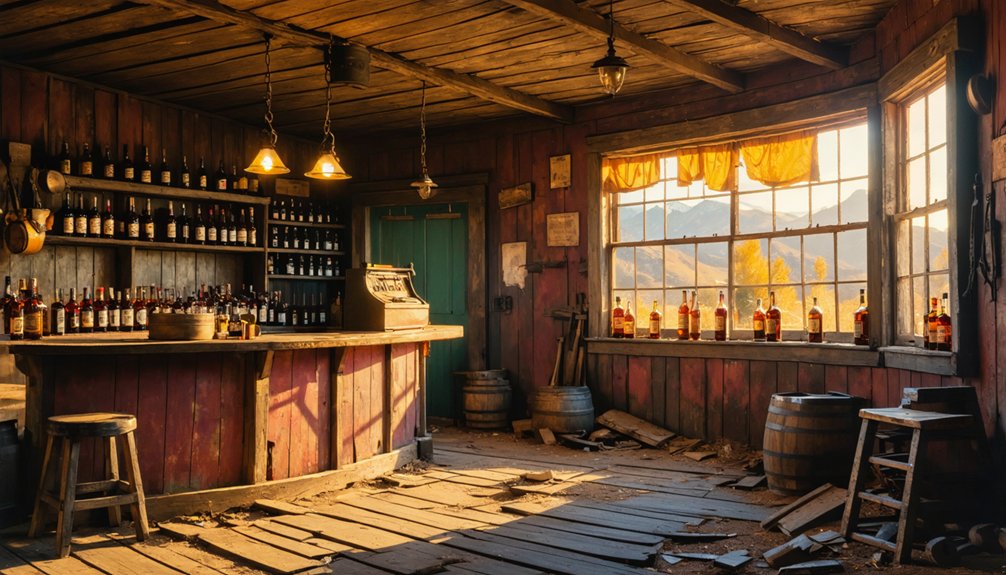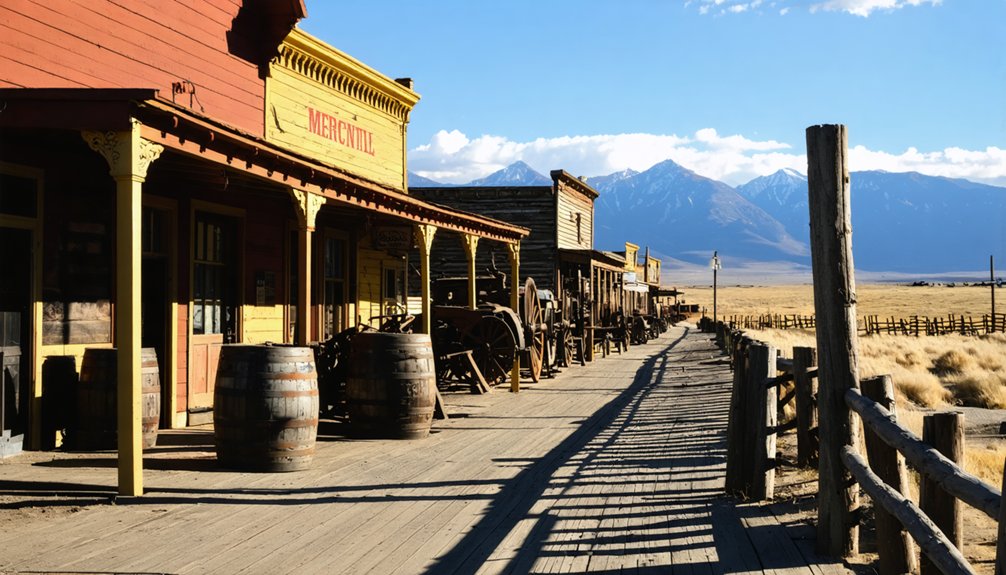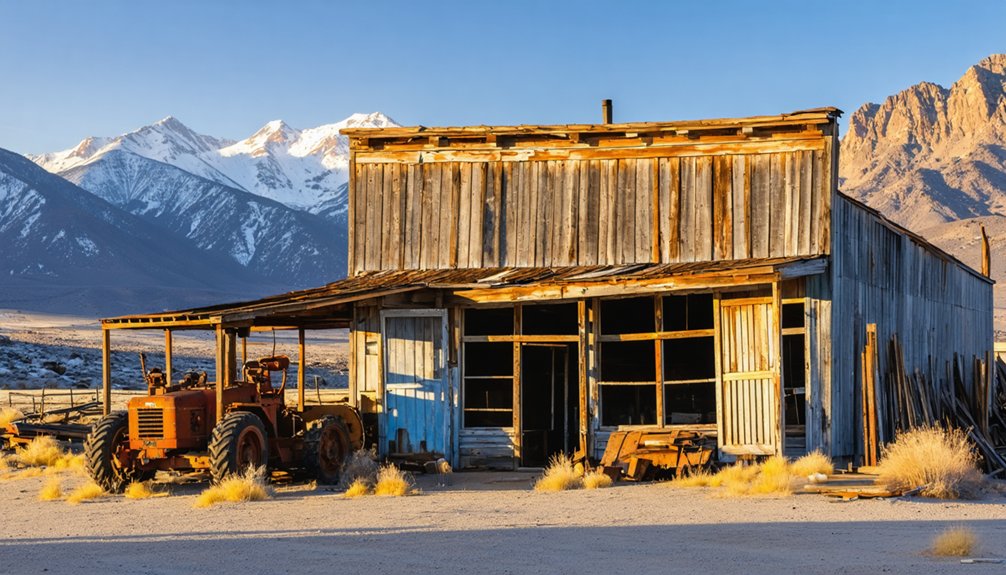
You’ll discover remarkable ghost towns within an hour of Bishop, each preserving California’s volatile mining past. Cerro Gordo, perched at 8,500 feet, produced $500 million in silver and lead, fueling Los Angeles’s early growth. Darwin saw 3,500 residents and 80 unsolved murders before smallpox and arson reduced it to 85 souls. Benton’s historic hot springs and 1872 Wells Fargo store still stand, while Lundy’s ruins recall its 500 gold-rush residents. The landscape reveals even more dramatic stories of boom, bust, and human ambition.
Key Takeaways
- Cerro Gordo, discovered in 1865, was California’s leading silver producer with over 4,000 miners extracting $500 million in minerals.
- Darwin experienced a silver boom reaching 3,500 residents by 1877 before smallpox and fire reduced population to 85.
- Benton, founded in 1862, peaked at 5,000 residents during the 1864 silver boom and features an 1872 Wells Fargo store.
- Lundy was established in 1879 for gold mining, reaching 500 residents before an 1887 fire destroyed 25 commercial buildings.
- Historic Saline Valley Salt Tram remains visible near Keeler, spanning 13.5 miles and hauling 60-100 tons of salt daily.
Cerro Gordo: Silver Mining Legacy at 8,500 Feet
When Pablo Flores and his companions discovered silver-rich ore in the Inyo Mountains in 1865, they couldn’t have predicted their find would become California’s answer to Nevada’s legendary Comstock Lode.
Pablo Flores’s 1865 discovery in the Inyo Mountains would rival Nevada’s Comstock Lode as California’s silver bonanza.
Perched at 10,000 feet, Cerro Gordo transformed into California’s preeminent silver and lead producer during the decade following the Civil War.
You’ll find evidence of revolutionary mining techniques throughout the 30 miles of tunnels, where Mortimer Belshaw’s 1868 blast furnace changed everything.
Over 4,000 miners extracted nearly $500 million worth of minerals from these mountains, producing 4.4 million ounces of silver and 37,000 tons of lead.
The settlement’s silver became Los Angeles’s economic lifeline until prices crashed in 1888, leaving only 30-40 residents in a once-thriving town. By 1874, Cerro Gordo delivered over $2 million in minerals to Los Angeles, fueling the city’s rapid growth and development.
The town’s social fabric included establishments like Lola Travis’s Dance Hall, known as the Palace of Pleasure, which catered to the entertainment needs of the mining community.
Darwin: From Boom Town to Ashes
While Cerro Gordo’s miners extracted fortune from the high peaks, another silver rush was building on Death Valley’s western edge.
Darwin exploded from tent town to 3,500 residents by 1877, with the Modoc Mine producing 10 tons of daily bullion.
You’ll find this wasn’t some orderly settlement—isolation from Independence bred lawlessness, with 80 unsolved murders between 1874-1877.
Mining accidents and violence defined daily life.
Then disaster struck. The 1878 smallpox epidemic emptied businesses. An 1879 arson fire destroyed 14 establishments.
Despite community resilience, Darwin’s population crashed to 85 by 1880.
The early 1900s brought unexpected revival when copper deposits previously discarded as worthless became valuable, drawing new investors and miners back to the hills.
Today, 30-35 independent souls inhabit this semi-ghost town, living off-grid among mining remnants. The town attracts artists, writers, and musicians who’ve made this desolate landscape their creative refuge.
No stores, no gas—just freedom and scattered ruins testifying to boom-and-bust extremes.
Benton: the Semi-Ghost Town With Hot Springs
You’ll find Benton Hot Springs about 35 miles northeast of Bishop, where Native Americans first used the thermal springs centuries before the town’s 1862 founding.
The settlement exploded to 5,000 residents during the 1864 silver boom, transforming into Mono County’s largest population center and an essential supply hub for nearby Blind Spring Hill mines.
Today’s population of roughly 190 preserves remnants of that era, including the 1872 Wells Fargo General Store, an 1860 cemetery holding 132 burials, and the still-operating hot springs that started it all.
The Carson and Colorado Railroad arrived in 1883 at Benton Station, four miles east of the original town site, eventually leading to the decline of the old town as the railroad stop assumed the Benton name.
Benton’s reputation as a “town without law” earned it notoriety during its wild mining days, and modern ghost hunters now seek out its reportedly haunted locations.
Silver Boom History
Gold brought the first prospectors to the hills surrounding Benton in 1862, but silver kept the town alive for decades. Dr. Partz’s 1865 discovery on Blind Spring Hill transformed the region’s economic impact, with ore containing silver, copper, and iron valued at $1,500 per ton. The silver mining operations generated $9 million during the Civil War period alone.
You’ll find evidence of five major mines—Comanche, Diana, Kerrick, Cornucopia, and Boraska—that operated through 1879. The Diana mine featured a 4-stamp mill and reduction furnace, while other sites built additional smelters. The mining camp on Blind Spring Hill supported up to 1,000 men, with water imported from Benton springs.
When the Carson and Colorado Railroad reached Benton in 1883, transportation costs plummeted. Silver mining sustained the town’s economy until around 1890, outlasting nearby Bodie’s briefer prosperity. The town once served as a Wells Fargo stagecoach stop, connecting it to other regional boomtowns.
Historic Hot Springs
You’ll find the ancient rituals of bathing evolved into Victorian-era bathhouses that attracted Hollywood celebrities like Fred MacMurray through the 1950s.
Today’s pumice stone structures mark where those bathhouses stood. The hot springs now heat the entire townsite, creating an unexpected green oasis in the high desert.
The town was established around 1863 following silver discovery in the nearby Blind Springs Hills, quickly growing to become the largest settlement in the county by 1865.
The General Store was established in 1868 by JR Morrison, serving the community alongside the Old Wells Fargo agency for over a century.
You can access the pools if you’re staying at the Inn or camping, continuing a tradition spanning millennia.
Cemetery and Notable Burials
While exploring Benton’s dusty streets, you’ll encounter the town cemetery positioned among the weathered remnants of 19th-century stores and homes.
Cemetery exploration reveals weathered headstones and newer replacement plaques marking 19th-century mining era burials, maintained despite the town’s semi-ghost status.
Among the historical figures buried here, you’ll find Robert Morrison, a storekeeper who died in 1871 during a posse pursuit of Nevada State Prison escapees. He was shot and killed at what’s now called Convict Lake, where 27 escaped convicts—including murderers and train robbers—made their final stand.
Another notable grave belongs to E.S. Taylor, partner of Bodie’s namesake William Bodie.
Taylor died in a cabin siege after killing ten Paiutes during 1860s frontier conflicts that marked Benton’s violent early years.
Tramway: Engineering Marvel of the Salt Trade
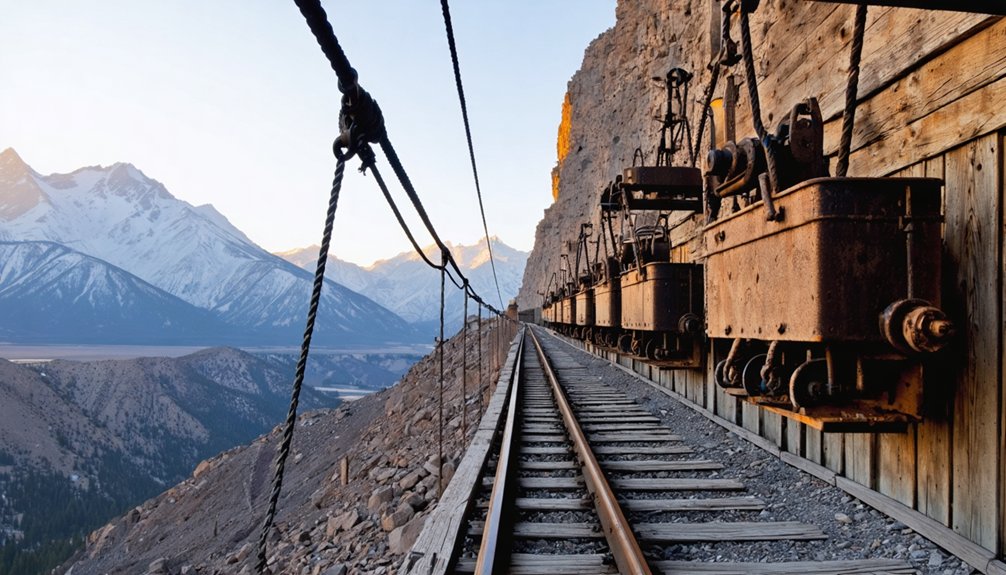
You’ll find remnants of one of the early 1900s’ most ambitious desert engineering projects stretching across the Inyo Mountains—a 13½-mile aerial tramway that hauled salt from Saline Valley to Owens Valley at 20 tons per hour.
The system’s ⅞-inch traction cables pulled 800-pound carriers loaded with 700 pounds of 99% pure salt at 6 mph, while 1⅛-inch suspension cables bore the weight across terrain so steep that construction teams needed eight horses to move 5,000-pound equipment loads.
Today, you can still spot the skeletal towers marking the ridgeline, silent testimony to the infrastructure that moved tens of thousands of tons of salt between 1913 and 1930.
Salt Transport Infrastructure
Between 1911 and 1913, the Saline Valley Salt Company constructed one of the most ambitious aerial tramways in the American West, spanning 13.5 miles across the unforgiving Inyo Mountains.
You’ll find this historic tramway revolutionized salt transport, slashing costs from $20 per ton to just $4. The Trenton Iron Company built this engineering feat using one million board feet of lumber, with cables suspended 700 feet over Daisy Canyon’s crumbling 70-degree slopes.
You’d witness 800-pound carriers hauling 700 pounds of salt each, achieving 20 tons per hour. Eight workers managed the operation—two at each terminal, two at control stations, and four line riders maintaining the route.
The system used telephone connections and gong signals for coordination, with carriers auto-releasing at endpoints. Operations peaked at 60-100 tons daily.
Cable System Specifications
The tramway’s cable system represented cutting-edge engineering for its era, though complete technical specifications remain scattered across archival records and site surveys.
You’ll find the remnants of this industrial achievement stretching across Inyo County’s rugged terrain, where cable specifications pushed 1910s technology to its limits. These engineering marvels transported salt across thirteen miles of desert landscape, defying gravity and geography.
Key aspects of the cable infrastructure include:
- Heavy-gauge steel cables designed to withstand extreme temperature variations and constant tension
- Multiple support towers positioned strategically across canyons and ridges
- Counterweight systems maintaining proper cable tension throughout daily operations
- Drive mechanisms powered by gravity and carefully calibrated brake systems
- Bucket carriers suspended from the main cable, each hauling salt loads downslope
Researchers continue documenting these specifications through field surveys and historical mining records.
Ridge Skeleton Remains
Stark against the skyline, weathered tower foundations mark where the Saline Valley Salt Tram once conquered impossible terrain between 1912 and the early 1930s.
You’ll spot the skeleton remains on the mountain ridge above the ghost town of Tramway, visible along Highway 136 three miles west of Keeler.
This tramway engineering achievement hauled 25-30 tons of salt daily, ascending 7,000 feet to the Inyo Mountains crest before descending 5,000 feet to the Southern Pacific Railroad terminal.
The ridge history tells of White Smith’s 1908 vision to transport salt and supplies where roads couldn’t reach.
When cars suspended hundreds of feet in air became more reliable than the flash flood-prone “Pearly Gates” road, the tram proved essential until Smith’s death ended operations.
Lundy: Gateway to Mono County Mining History
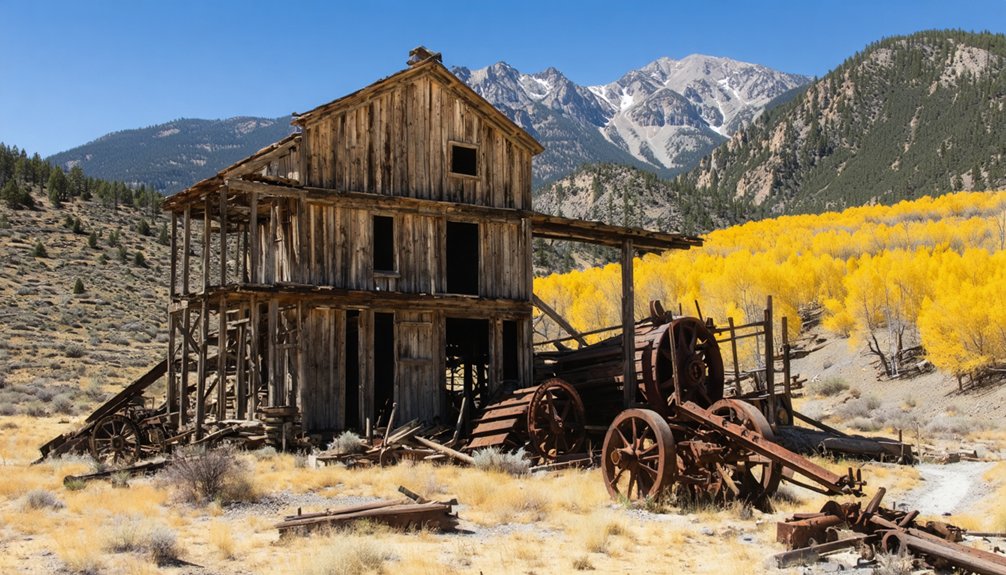
Named after sawmill operator William O. Lundy, this remote settlement emerged in 1879 when gold discoveries sparked the May Lundy Mine’s formation.
You’ll find its town history rooted in timber operations that supplied nearby Bodie’s booming camps.
The town’s mining legacy flourished rapidly:
- Population surged to 500 residents by spring 1881
- Telegraph connected to Bodie; telephone line reached Bennettville in 1882
- Weekly newspaper Homer Mining Index published until 1884
- Wells Fargo agency and post office served the community
- August 6, 1887 fire destroyed 25 commercial buildings, ending growth
You can still explore this scenic alpine location where avalanches once devastated mines and homes along Mt. Scowden’s slopes.
The suspicious midnight blaze at May Lundy Hotel marked the town’s decline when businesses never rebuilt.
Pumice Mill: Industrial Remnants in the White Mountains
Rising from the Tablelands near Fish Slough, this multi-story pumice processing facility stands as a ghostly industrial monument on the western margin of the White Mountains.
You’ll find it 5.2 kilometers northeast of Laws, where massive conveyors, sifters, and hoppers still dominate the landscape. This volcanic mining operation extracted and processed tuff through multiple levels of shaking and sorting equipment until economics forced its closure.
The mill’s framework tells the story of pre-WWII industrial pumice processing, when White Mountains mining peaked between 1869-1877.
Similar to the nearby Hidecker Pumice Mine, workers here handled vast quantities of volcanic material for industrial applications.
You can explore the extensive remains today, climbing the intact structure while the White Mountains rise behind you—a photogenic representation of California’s lesser-known extraction industries.
Frequently Asked Questions
What Permits or Fees Are Required to Visit Ghost Towns Near Bishop?
Most ghost towns won’t chain your wallet—Laws Railroad Museum runs free, while Bodie State Historic Park requires standard California day-use fees. Cerro Gordo’s permit requirements involve overnight reservation costs. Remote sites need no fees, just capable vehicles.
If you’re looking for ghost towns to visit in California, don’t overlook the stunning remnants of the Gold Rush. Each site offers a glimpse into the past, showcasing everything from vintage storefronts to dilapidated mines. Exploring these historical locations can provide a unique adventure for those intrigued by the stories of California’s early settlers.
Are Ghost Town Roads Accessible by Regular Vehicles or Only 4WD?
Road conditions vary considerably among ghost towns near Bishop. You’ll access Laws and Benton with regular vehicles, while Cerro Gordo demands 4WD. Vehicle recommendations depend on your destination—Bodie requires high-clearance during winter.
What Safety Precautions Should Visitors Take When Exploring Abandoned Mining Structures?
Never enter abandoned mining structures—they’re death traps with unpredictable site hazards. Stay outside, watch for open shafts, and assess structural integrity from a distance. Bring companions, tell others your plans, and pack emergency supplies.
Which Ghost Towns Near Bishop Allow Camping on Site?
You won’t find camping on-site at most nearby ghost towns. Bodie prohibits it entirely, while Cerro Gordo offers only bunkhouse lodging. However, Calico Ghost Town provides full camping regulations and ghost town amenities with hookups available.
What Is the Best Time of Year to Visit High-Elevation Ghost Towns?
Late September through early October offers ideal conditions—you’ll dodge scorching summer heat and winter road closures while enjoying stunning fall colors. For photography tips, capture structures during golden hour when seasonal weather provides crisp, clear lighting.
References
- https://nvtami.com/inyo-county-california-ghost-towns/
- https://lonepinechamber.org/history/ghost-towns-of-the-lone-pine-area/
- https://www.mountwhitneyforum.com/ubbthreads.php?ubb=showflat&Number=58239
- https://californiahighsierra.com/trips/explore-ghost-towns-of-the-high-sierra/
- https://www.youtube.com/watch?v=dQxSH3XBdXY
- https://www.atlasobscura.com/things-to-do/bishop-california/ghost-towns
- https://www.barbaranusselphotography.com/blog/2017/4/20/wildflowers-and-ghost-towns-a-road-trip-through-central-california
- https://en.wikipedia.org/wiki/Bodie
- https://nvtami.com/2022/10/11/lessor-known-mono-inyo-ghost-towns/
- https://www.youtube.com/watch?v=ItfFOpZ8no8