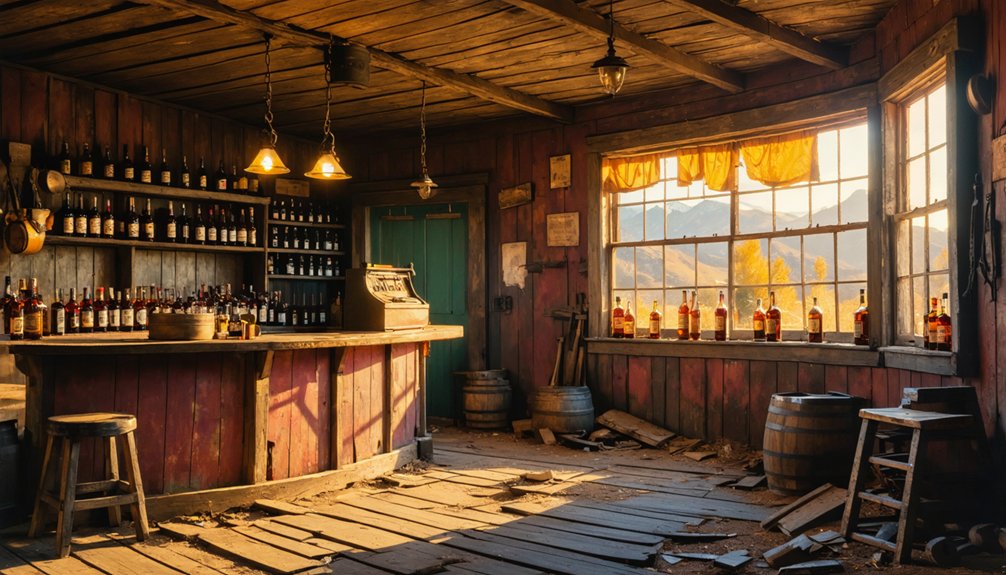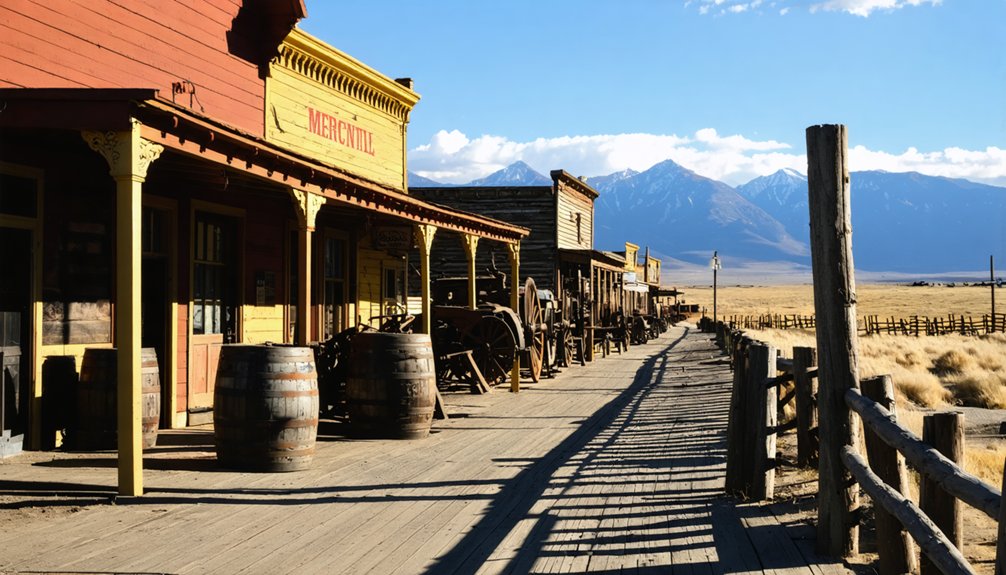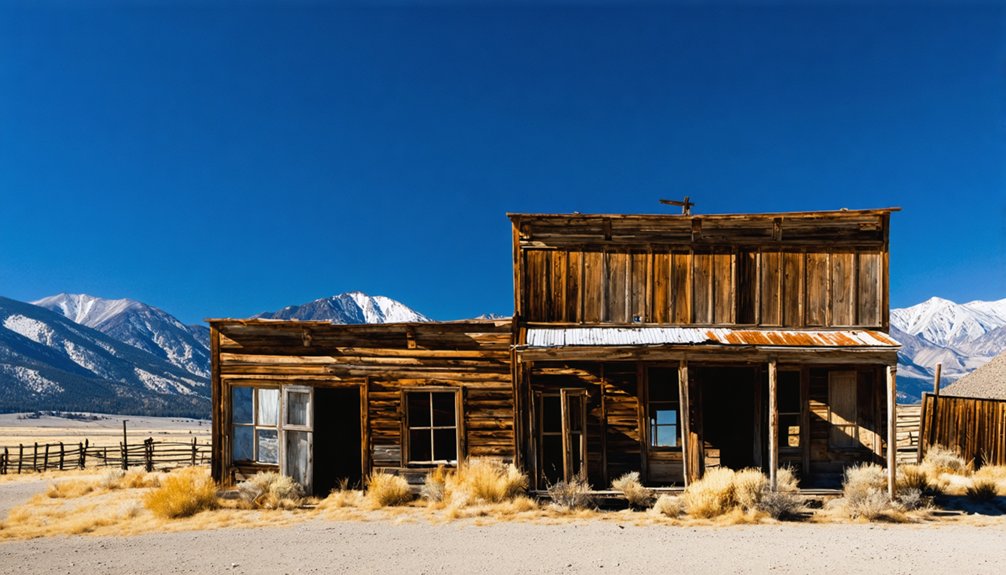
You’ll find several ghost towns within 50 miles of Bodie State Historic Park, including Dogtown (7 miles south of Bridgeport, established 1857), Masonic (10 miles northeast with three distinct settlements founded by Freemasons in 1862), and Chemung (2.5 miles from Masonic at 8,600 feet elevation). Aurora, once Nevada’s second-largest city with 5,000-10,000 residents during 1862-1863, produced over $27 million in gold before complete abandonment. For Mojave Desert alternatives, Randsburg remains a living ghost town while Ballarat offers authentic decay in Panamint Valley, though both require strategic planning for harsh geography and limited infrastructure.
Key Takeaways
- Dogtown sits seven miles south of Bridgeport on Highway 395, established in 1857 with placer mining remnants and historical markers.
- Masonic lies ten miles northeast of Bridgeport in the Bodie Hills, featuring three town sections and accessible mill ruins via 4×4 roads.
- Chemung perches at 8,600 feet, 2.5 miles southwest of Masonic, producing over $1 million in gold before closing in 1938.
- Aurora, once Nevada’s second-largest city, produced $27 million in gold but now shows only concrete foundations and a maintained cemetery.
- Randsburg and Ballarat offer additional Mojave Desert ghost town experiences, with Randsburg still inhabited and preserving its authentic mining character.
Exploring Bodie State Historic Park
Perched at 8,375 feet elevation in California’s Eastern Sierra, Bodie State Historic Park preserves the largest unrestored ghost town in the American West.
You’ll find approximately 2,000 weathered structures maintained in “arrested decay,” exactly as residents left them when the mining boom ended. This philosophy of Bodie Preservation means interiors remain untouched, offering an authentic glimpse into 1870s frontier life without modern reconstruction.
Your Visitor Experience includes self-guided walking tours through deserted streets, the Standard Mill stamp tour showcasing $14 million in processed gold and silver, and free history talks at the museum. The town’s transformation occurred after the Standard Company purchased the mine in 1877, turning Bodie from a small settlement into a thriving boomtown. The Bodie Foundation offers specialized tours including Twilight Tours that allow exploration of the ghost town after regular closing hours, though reservations must be made two weeks in advance.
You’ll pay $8 for adults, with year-round access available. However, winter visits require skis, snowshoes, or snowmobiles due to heavy snowfall at this remote location.
Dogtown: The Barren Remnants of Early Mining Days
Seven miles south of Bridgeport on State Highway 395, Dogtown’s scattered ruins mark California’s first major gold rush to the Sierra Nevada’s eastern slope.
German prospector Cord Norst and his Native American wife Mary established this settlement in 1857, attracting roughly 100 miners who employed placer and hydraulic mining techniques that created the gravel fields you’ll observe today.
The camp’s community dynamics shifted dramatically when richer deposits emerged at nearby Monoville on July 4, 1859, prompting most residents to relocate.
Chinese miners arrived in the 1860s, reworking tailings for a decade while operating stores and maintaining gardens.
Though Dogtown and Monoville produced several million dollars in gold, the Norsts remained, homesteading their original claim.
A marble marker near the dugout houses marks the grave of pioneer Peter Johann Anderson, whose lonely death affected many friends in the community.
The initial discoveries near Bloody Canyon had yielded little gold, yet prospectors persisted in their search throughout the region.
California Historical Landmark No. 792 now designates this barren site.
Masonic: A Scenic Stop in the High Sierra
Ten miles northeast of Bridgeport in Mono County’s Bodie Hills, Masonic’s scattered ruins occupy three distinct terraces carved into a canyon near the Nevada border.
Masonic History began in 1862 when Freemasons discovered gold and established three sections: Upper Town (Lorena), Middle Town, and Lower Town (Caliveda).
The Pittsburg-Liberty Mine, founded July 4, 1902, drove the town’s 1906 boom with ore assaying $35 to $800 per ton. A 10-stamp mill and aerial tramway followed in 1907.
Population peaked near 1,000 before declining around 1909-1911 when ore depleted. By 1920, the population had dwindled to 12 residents as mining operations nearly ceased.
You’ll find Scenic Views throughout the site, accessible via 4×4 roads, with mill ruins, tram works, and foundations remaining. Lumber was transported nearly 50 miles from Mono Lake to support construction of the town’s buildings.
The Chemung Mine operated into the 1950s-60s before final abandonment.
Chemung: Remote Ghost Town Adventure
Just 2.5 miles southwest of Masonic, Chemung ghost town clings to an 8,600-foot ridge overlooking Bridgeport Valley, representing one of the Bodie Hills’ most remote mining settlements.
Chemung history began in 1909 when Stephen Kavanaugh discovered a gold vein, establishing operations that produced over $1 million in ore before closing in 1938 due to legal troubles and depressed gold prices. The mine’s structures were torn down and rebuilt three times throughout its troubled operation. Ore concentrates were transported to Bodie, though deteriorating roads significantly increased operational costs.
You’ll find the ruins by following Masonic Road 5.2 miles from Highway 182, where weathered structures with corrugated aluminum siding mark the former mill site.
Ghost town legends claim a poltergeist—allegedly the mine owner who fell down a shaft—haunts the location on Saturday nights, with reports warning visitors about weekend disturbances and unexplained disappearances in this isolated Sierra Nevada setting.
Aurora: From Boomtown to Nothingness
You’ll find Aurora’s transformation from Nevada’s second-largest city, with 5,000-10,000 residents in 1862-1863, to its complete disappearance among the most dramatic collapses in mining history.
The town produced over $27 million in gold before vein exhaustion, an 1864 boundary ruling placing it definitively in Nevada, and devastating litigation halved its population by 1865, leading to ghost town status by 1919.
While buildings were demolished for bricks during World War II and vandals further damaged remnants in the 1970s, you can still observe concrete foundations of the Magnum mill and mining evidence above the original townsite near the maintained cemetery.
Samuel Clemens, better known as Mark Twain, worked in one of Aurora’s mills during the town’s peak mining years.
Today, only foundations remain scattered across the desert landscape, with the historic cemetery serving as the primary attraction for visitors exploring what little survives of this once-thriving settlement.
Aurora’s Peak Population Era
After gold deposits were discovered in fall 1860, Aurora transformed from a settlement of fewer than 100 residents into a thriving boomtown that would briefly rival the region’s most significant mining camps.
You’ll find that population dynamics shifted dramatically as the mining boom accelerated. By April 1861, 1,400 residents pushed town lot prices to $1,500.
The Wide West Vein discovery in spring 1863 triggered Aurora’s zenith, with estimates placing the population between 5,000 and 10,000 residents that summer.
The town’s infrastructure expanded to accommodate this surge: 760 houses, 20 stores, 22 saloons, and 16 quartz mills operated simultaneously.
Four newspapers documented the era, while Aurora became the eastern Sierra slope’s second-largest city behind Virginia City, generating $27 million in gold by 1869.
Complete Disappearance and Abandonment
The exhaustion of rich bonanzas in the Wide West Vein on Last Chance Hill by 1864 triggered Aurora’s rapid economic collapse, compounded by bitter litigation over vein ownership that destabilized the mining economy throughout that same year.
Stock manipulation halved the town’s population by 1865, while stamp mills shut down almost entirely. By 1870, gold and silver deposits were completely mined from shallow operations rarely exceeding 100 feet deep, prompting mass residential abandonment.
Most residents departed, leaving buildings and stores intact. Despite brief 20th-century revival attempts—including Goldfield Consolidated Mining Company’s 500-ton cyanide mill—economic decline and mining failures persisted.
Aurora was officially declared a “ghost” by 1919. World War II-era brick scavenging and 1970s vandalism decimated remaining structures, leaving only the cemetery and weathered mill foundations today.
Mining Remnants Above Townsite
When prospectors discovered promising gold deposits near Bodie in 1859, they couldn’t have anticipated the immense wealth that would later emerge from Bodie Bluff’s treacherous underground networks.
Above the commercial district, you’ll find mining artifacts that reveal the operation’s scale—hoists and the remnants of the Standard Stamp Mill, which produced over $14 million across 25 years.
The replacement mill’s wood framing and corrugated steel sheets still stand, showcasing the innovative gondola system designed by San Francisco’s cable railway inventor. These structures hold tremendous historical significance, demonstrating how miners crushed ore at one ton per hour.
Since 1962’s state historic park designation, you can explore the Standard Mill through $5 guided tours, experiencing firsthand the complex, dangerous processing that extracted over 10,000 tons during peak production.
Historic Toll Stations Along the Aurora-Walker Lake Road
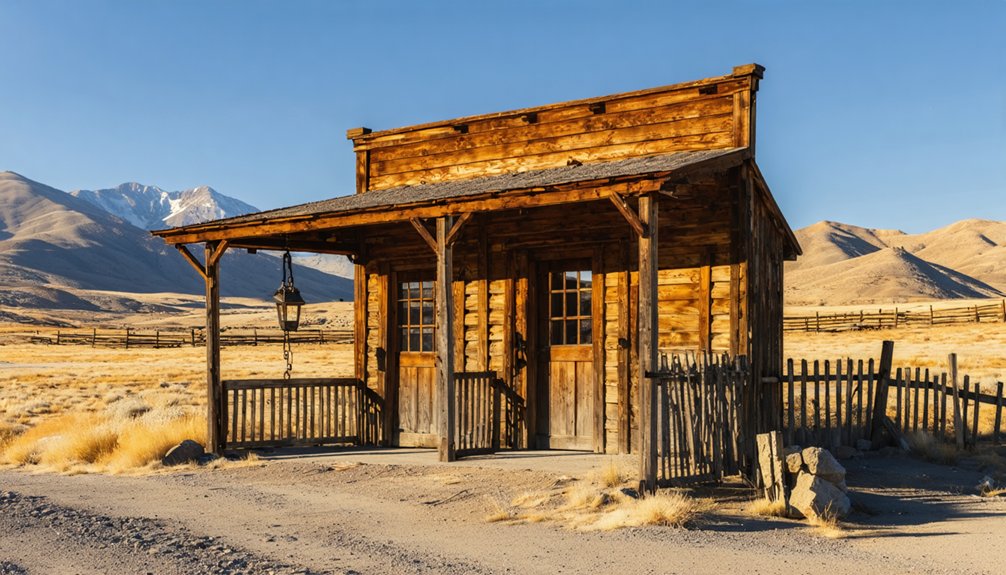
Between Aurora and Walker Lake, you’ll find remnants of the toll station network that serviced the mining boom of the 1860s-1890s.
Blanchard’s Station sat midway between Bodie and the state line on the Aurora-Bodie toll road, where Hank Blanchard operated two stage stops during the 1880s-1890s, with two to three stages running daily in each direction.
Sunshine Station (also called Halfway House) provided the second critical rest point positioned halfway between the mining camps of Bodie and Aurora on this same route.
Blanchard and Summit Stations
In 1878, a toll road franchise application set in motion the development of Blanchard Station, a critical waystation connecting Bodie’s mining operations to Nevada’s commercial centers. The route wound through Bodie Gulch’s narrow canyon, where sheer rock walls created challenging passage conditions.
You’ll find the operator’s background as an experienced teamster proved essential—he’d previously transported mortar at $4 per ton to Virginia City’s 1876 reconstruction efforts. The station maintained welcoming policies during its 1880s-1890s operational period, never refusing travelers regardless of status.
Beyond toll road management, the operator pursued diversified interests, including 1877 prospecting expeditions on Mount Grant with claims valued at $80 per ton.
Summit Station complemented Blanchard’s role, both serving the Bodie-to-Aurora corridor’s freight and passenger traffic.
Aurora-Walker Lake Route
As Aurora’s mining population surged to between 5,000 and 10,000 residents during 1862-1863, establishing it as Nevada’s second-largest city, the route connecting this boomtown to Walker Lake evolved into a critical commercial corridor supported by strategically positioned toll stations and way stations.
You’ll find Five Mile House served as the primary stage stop after 1878, originally mapped as Lone Star Rancho in 1860 before territorial surveys redesignated it 5 Mile Ranch in 1862.
The infrastructure reflected Aurora’s mining heritage through Dickinson’s Toll Gate operations south of Five Mile House by 1867, with J.J. Welch managing toll collection in 1875.
Daily Alta California documented the route’s “better natural mountain roads” in 1863, though today only ghostly legends and scattered foundations mark these once-vital commercial outposts.
Randsburg: A Living Ghost Town in the Mojave Desert
Gold fever struck the slopes of Rand Mountain in 1895, transforming a barren stretch of Mojave Desert into one of California’s most profitable mining districts.
Randsburg history showcases explosive growth from initial discovery to over 3,500 residents by 1899, with the Yellow Aster Mine producing an estimated $60 million in gold.
Despite devastating fires in 1898 and mining’s end after World War II, you’ll find Randsburg attractions remarkably preserved along Highway 395.
Today’s 69-77 residents maintain this living ghost town‘s authentic character. You can explore the two-room jail, browse the 1904 soda fountain at the general store, and examine mining equipment scattered throughout town—tangible evidence of individual prospectors who built fortunes without government interference.
Ballarat: Desert Ghost Town Worth the Detour
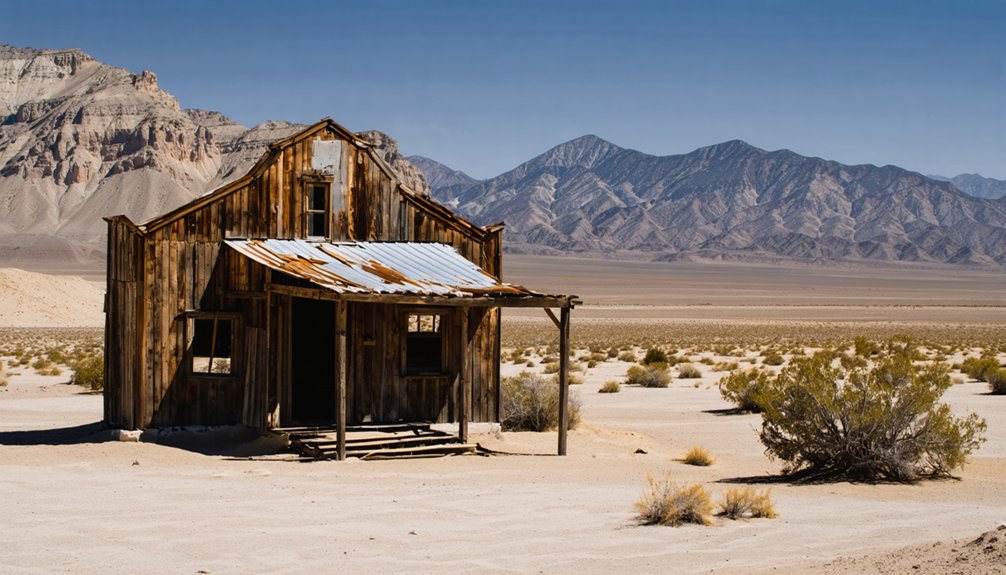
You’ll find Ballarat at the base of the Panamint Mountains in Panamint Valley at 1,079 feet elevation, accessible via the road leading to Barker Ranch.
Founded in 1897 by Australian immigrant George Riggins as a supply point for nearby canyon mines, this desert outpost once supported 400-500 residents with seven saloons, three hotels, a Wells Fargo station, post office, school, jail, and morgue between 1897 and 1905.
Today, minimal remains mark this unincorporated Inyo County community: the foundation of Shorty Harris’s cabin north of the main road, an adjacent intact miner’s shack, ruins, a graveyard, and a general store operated by sole full-time resident “Roc.”
Location and Access Route
While Ballarat sits over 200 miles from Bodie, this unincorporated community in Inyo County merits inclusion among California’s notable ghost towns due to its remote desert setting and contrasting geography.
You’ll find Ballarat in Panamint Valley at 1,079 feet elevation, nestled at the base of Death Valley‘s Panamint Mountains—approximately 150 miles northeast of Bakersfield in the Mojave Desert.
To reach this site of Ballarat history, you’ll travel 45 miles east from Ridgecrest on Highway 178, then turn at the marked historical marker (N36° 02.019 W117°16.896).
The graded Ballarat Road extends 3.6 miles from this turnoff, maintained by a mining company and suitable for RVs.
You’ll need extra water and provisions, as no services exist nearby in this isolated desert location.
Historic Buildings and Features
At its peak from 1897 to 1905, Ballarat supported 400-500 residents with infrastructure that included 7 saloons, 3 hotels, a Wells Fargo station, post office, school, jail, and morgue—though remarkably, no church ever graced this desert settlement established in 1896 as a supply stop for Panamint Valley prospectors.
Today’s mining heritage survives through Frank ‘Shorty’ Harris’s cabin foundations visible north of the main road, where he lived intermittently until his 1934 death.
You’ll find another well-preserved miner’s shack nearby, while Chris Wicht’s saloon has deteriorated completely. The old graveyard remains among scattered ruins.
Historic preservation efforts are minimal—the town exists as authentic decay rather than manufactured attraction. Neil Cummins’s 1960s revival attempt left a cinder-block store, now operated by Ballarat’s sole full-time resident alongside original foundations and mud structures that housed diehard prospectors.
Hidden Gems: Mono-Inyo Region Ghost Towns
Beyond Bodie’s well-trodden paths, the Mono-Inyo region harbors five exceptional ghost towns that receive minimal visitor traffic despite their historical significance.
Cerro Gordo history dominates the region, where miners extracted 4.5 million ounces of silver from 37 miles of tunnels at 8,500 feet elevation. The 1871 American Hotel and 1877 Hoist Works remain intact at California’s most well-preserved ghost town, which peaked at 4,800 residents.
Beveridge artifacts present the highest density of mining relics, including:
- Complete 5-stamp mill with operational steam engine
- Original bed frames and logbooks hidden beneath cookware
- Aerial tram station connecting inaccessible canyon operations
Montgomery City’s stone walls and Blind Spring Hill’s waterless mining camp demonstrate the extremes prospectors endured.
The 1912 Tramway hauled 25-30 tons of salt daily across 7,000-foot elevation changes.
Planning Your Eastern Sierra Ghost Town Road Trip
Discovering these remote ghost towns requires strategic planning since the Eastern Sierra’s harsh geography and limited infrastructure create accessibility challenges most guidebooks underestimate.
Bodie State Historic Park serves as the logical anchor point, positioned 12 miles east-southeast of Bridgeport at 8,379 feet elevation and accessible via Highway 270, which converts to a 3-mile dirt road that closes during winter months (typically November through April).
Your road trip essentials must include high-clearance vehicle capability, extra fuel, water reserves, and emergency supplies for mountain conditions at elevations exceeding 8,000 feet.
Ghost town photography opportunities abound across 110-170 preserved structures operating under arrested decay policy, though you’ll need sturdy footwear for uneven terrain and sunscreen for high-desert exposure.
Verify road conditions before departing since seasonal closures affect accessibility.
Frequently Asked Questions
What Caused Bodie’s Decline After 1880?
You’ll find Bodie’s decline stemmed from depleted gold reserves after 1879’s peak production, an economic downturn during the Panic of 1893, and a population shift as miners left for competing booms in Montana, Arizona, and Utah.
How Much Gold Did Bodie Produce During Its Peak Years?
Bodie’s gold mining operations produced between $95-100 million in gold and silver bullion during peak years from 1876-1941, with 1879 marking maximum output. This economic impact transformed Bodie into a thriving 10,000-person boomtown virtually overnight.
When Was Bodie Designated a National Historic Site?
Before Bodie became California’s preserved ghost town, you’ll discover its National designation occurred July 4, 1961. This Bodie history milestone recognized its mining significance, predating the 1962 State Historic Park status that maintains its arrested decay.
exploring the history of nadeau reveals the rich cultural tapestry of the region and how it contributed to the development of the surrounding areas. As settlers arrived and established their foothold, they paved the way for industries that would shape the local economy. The legacy of these early inhabitants can still be seen in the remnants of buildings and artifacts that tell their stories.
What Is the “Arrested Decay” Preservation Approach at Bodie?
Arrested decay means you’ll find Bodie’s buildings stabilized against collapse through preservation techniques like roof repairs and foundation work, while interiors remain untouched since 1962, maintaining their authentic abandoned condition without restoration.
How Many Ghost Towns Exist in the Nevada-California Region Combined?
Looking to explore abandoned settlements? You’ll find over 1,000 ghost towns combined across Nevada and California, though broader definitions identifying mining camps and historical sites push estimates beyond 1,600 locations with historical significance.
References
- https://www.insp.com/stories/top-6-ghost-towns-in-the-west/bodie-california/
- https://californiathroughmylens.com/bodie-ghost-town/
- https://en.wikipedia.org/wiki/List_of_ghost_towns_in_California
- https://californiahighsierra.com/trips/explore-ghost-towns-of-the-high-sierra/
- https://www.visitcalifornia.com/road-trips/ghost-towns/
- https://nvtami.com/2021/10/22/bountiful-bodie-california-ghost-town/
- https://www.tripadvisor.com/ShowTopic-g32617-i2702-k5420542-Bodie_v_other_ghost_towns-Lee_Vining_California.html
- https://nvtami.com/2022/10/11/lessor-known-mono-inyo-ghost-towns/
- https://www.willowspringsresort.com/guide-to-bodie-state-historic-park
- https://www.visitmammoth.com/directory/bodie-state-historic-park/