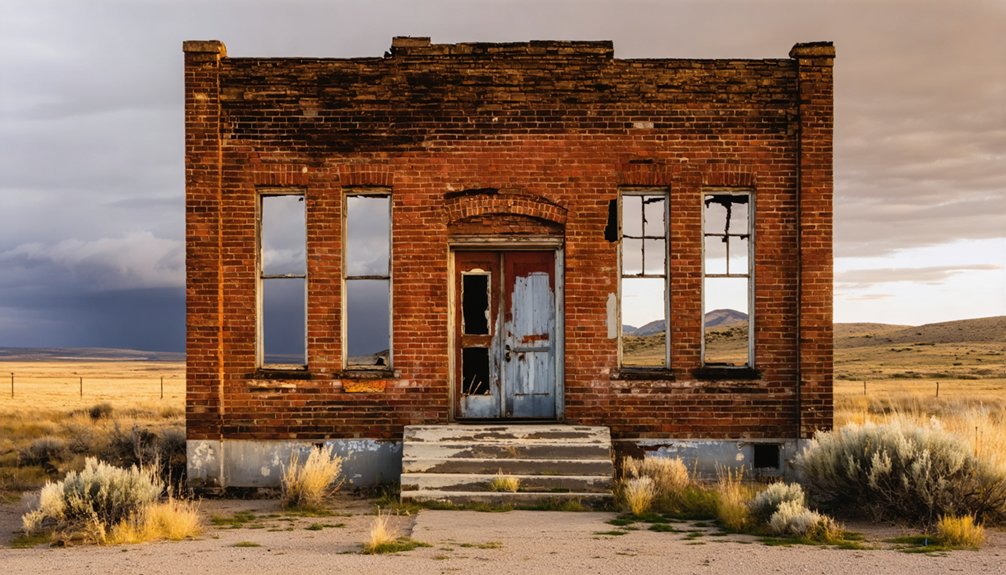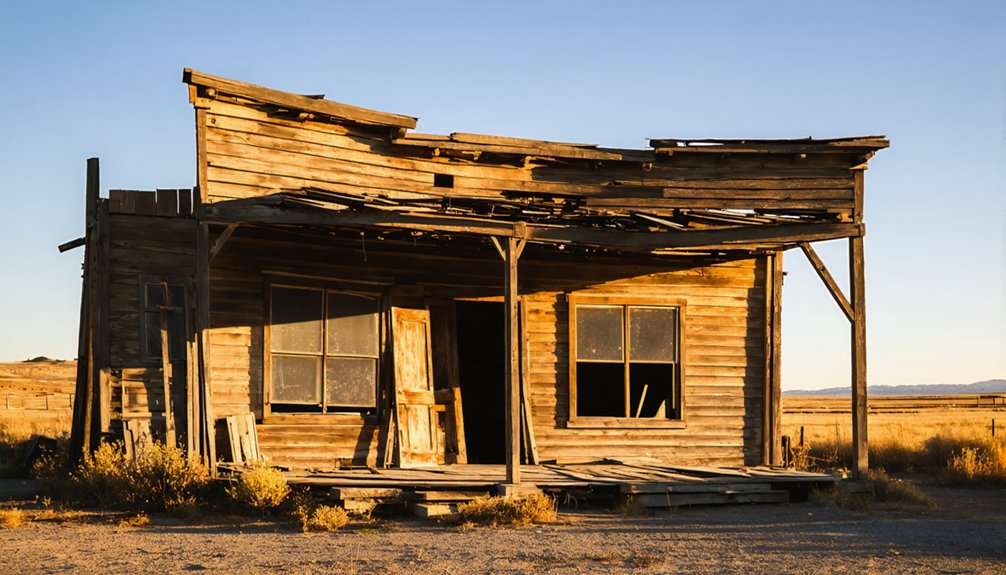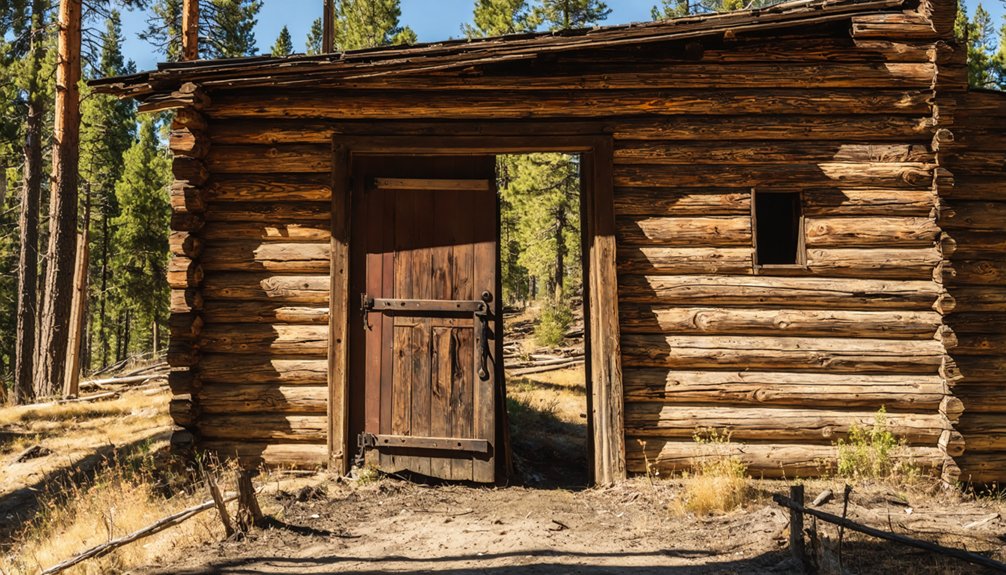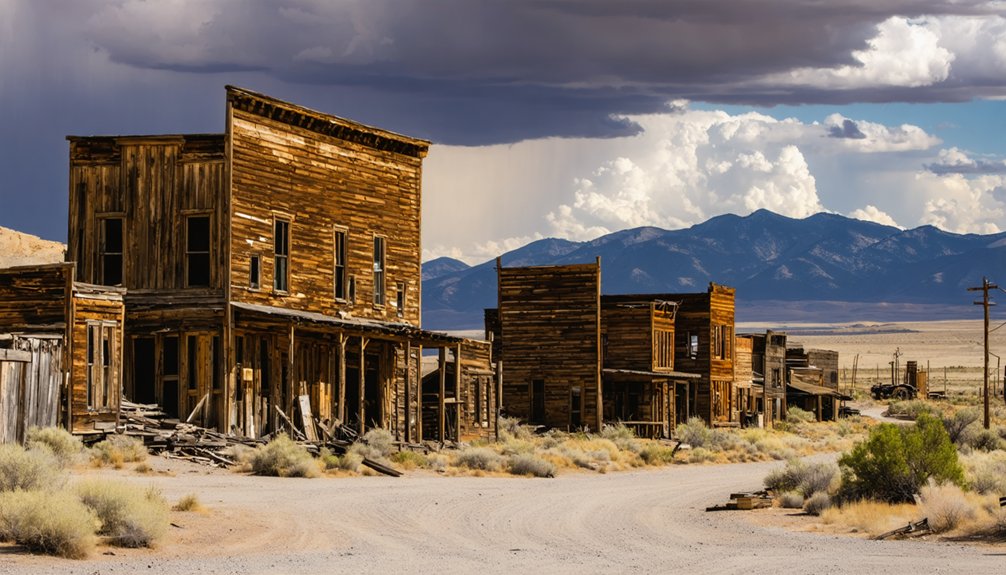
You’ll find six major ghost towns within 100 miles of Boise, remnants of Idaho’s 1862-1880 mining boom. Placerville and Rocky Bar showcase Southwest Idaho’s gold rush heritage, while Silver City in Owyhee County preserves over 70 original buildings from its $60 million mining legacy. Bayhorse features the state’s best-preserved stamp mill and charcoal kilns, and Custer offers National Register-designated structures with seasonal guided tours. These settlements once matched Boise’s population before ore exhaustion transformed them into living museums of frontier enterprise.
Key Takeaways
- Silver City: Founded in 1863, peaked at 2,500 residents in the 1880s, with 70 privately-owned buildings remaining from 250 mines.
- Placerville: Established December 1, 1862, population peaked at 5,000 by 1863 before declining to 400 by 1870.
- Rocky Bar: Founded December 1863, grew to 2,500 residents by 1864, declined after an 1892 fire and transportation issues.
- Custer: Established 1879 with peak population of 1,000, now offers guided tours and listed on National Register of Historic Places.
- Bayhorse: Features preserved stamp mill ruins, six beehive charcoal kilns, and produced over $10 million in silver and lead.
Placerville: Boise Basin’s Golden Legacy
In late 1862, prospectors struck rich placer gold deposits in the Boise Basin, triggering a rush that transformed a remote wilderness into one of Idaho’s first major settlements.
You’ll find Placerville’s history began when thousands flooded the basin, establishing a townsite on December 1st. By early summer 1863, the population swelled to 5,000, supporting 300 buildings including 13 saloons and numerous shops.
The mining techniques of the era proved effective—4,500 claims were recorded by July 1864, and the Pioneer Mill became the region’s first ten-stamp operation. Miners in dry gulches earned between 50 cents to $5 to the pan during the initial boom years.
However, most rich placer ground was exhausted by 1870. Chinese miners then reworked the depleted deposits using alternative methods. The town’s population had declined to less than 400 by this time, never regaining its boom-era status.
Today, historic buildings around the plaza preserve this golden legacy.
Rocky Bar: Southwest Idaho’s Mining Relic
Rocky Bar emerged as one of southwest Idaho’s most significant mining camps when H.T.P. Comstock established it near Bear Creek mines in December 1863.
You’ll find Rocky Bar history intertwined with territorial ambitions—it served as Alturas County’s first seat and contended for Idaho’s capital alongside Idaho City. The town’s population swelled to 2,500 by 1864, matching Boise’s size.
Mining technology drove Rocky Bar’s prosperity. The first five-stamp mill arrived in 1864, crushing five tons of ore daily. By 1866, six additional mills gave South Boise diggings Idaho’s leading milling capacity.
By 1866, six stamp mills positioned South Boise diggings as Idaho’s premier ore processing center, crushing tons of precious metal daily.
However, miscalculated transportation costs and depleted reserves caused mill failures by late 1866. An 1892 fire destroyed most structures.
Though rebuilt, Rocky Bar never recovered its boom-era status, eventually becoming the ghost town you can visit today. Among its colorful residents was Peg Leg Annie, famous for selling whiskey with a shotgun across her lap after losing her legs while saving a friend in a blizzard. Charles Sprittles, known as the Mayor of Rocky Bar, remained the last year-round resident until his death in 1964.
Silver City: Owyhee County’s Crown Jewel
While Rocky Bar represented southwest Idaho’s mining ambitions, the Owyhee Mountains to the west produced what became Idaho’s most storied silver camp.
Silver City’s mining heritage began in 1863 when prospectors discovered gold, followed by silver deposits near War Eagle Mountain in 1864. You’ll find this ghost town exploration reveals Idaho’s richest mining district—over 250 mines extracted more than $60 million in precious metals across 70 years of operations.
At 6,200 feet elevation, Silver City served as county seat from 1866 to 1934, supporting 2,500 residents at its 1880s peak.
The town boasted Idaho’s first daily newspaper, early telegraph service, and 12 ore-processing mills. The historic Owyhee County courthouse, built in 1867, stands as one of Silver City’s most significant structures from the boom period.
Today, 70 privately-owned buildings remain accessible via a single mountain road, listed on the National Register since 1972. The name Silver City refers to several mining locations across the American West, though Idaho’s Owyhee County version stands among the most well-preserved.
Bayhorse: Best-Preserved Mill Town in the West
When you arrive at Bayhorse, you’ll find Idaho’s best-preserved mill town anchored by its 1882 stamp mill, which features original rock-built sides and interpretive signage explaining its conversion to flotation processing in the 1920s.
The site offers well-maintained trails connecting the townsite to six beehive charcoal kilns located down the road, though none remain fully intact after their abandonment in 1896. Restoration efforts are visible at the mill, with ongoing work to preserve this significant historical structure.
These structures produced over $10 million worth of silver and lead during peak operations, with the mill’s skeletal remains and surrounding kilns providing tangible evidence of the Yankee Fork Mining District‘s industrial scale. A devastating fire in 1889 destroyed many of the town’s original structures, reshaping the settlement’s architectural landscape.
Historic Mining Mill Ruins
The three-story gravity-fed mill ruins at Bayhorse stand as the centerpiece of Idaho’s best-preserved mill town, a demonstration of the engineering ingenuity that transformed this remote canyon into a bustling silver and lead production center.
You’ll find the skeletal remains of this gravity-fed structure alongside the stone Wells Fargo building, Bayhorse Saloon, and scattered cabins—remnants of an operation that employed 10 workers and processed ore using advanced mining techniques of the 1880s.
The mill operated in tandem with a nearby smelter until 1889, when water shortages and declining silver prices forced closure.
Beyond the ruins, five or six well-preserved charcoal kilns dot the outskirts, ghostly legends whispering through their stone archways about the 48 men who produced 80,000 bushels of fuel here.
The town’s origins trace back to 1864 when small gold veins were first discovered in the area, though it was the significant silver strike of 1872 that truly established Bayhorse as a major mining center.
Located along the Salmon River Scenic Byway, Bayhorse now operates as part of the Land of the Yankee Fork State Park, dedicated to preserving the region’s mining heritage.
Exploring Trails and Kilns
Six charcoal kilns stand sentinel at Bayhorse’s outskirts, their stone archways and partial walls representing some of Idaho’s best-surviving examples of 19th-century industrial architecture.
You’ll find these structures fenced for kiln preservation, though their entrances and stonework remain clearly visible. Trail exploration connects the main town site to these kilns across well-maintained paths within the state park boundaries.
The gravel road provides year-round access to this historically significant site.
You’re free to wander marked trails linking preserved buildings—assay offices, blacksmith shops, and log cabins—while interpretive signs explain their original purposes.
Though some structures are locked to protect interiors, you’ll encounter board-and-batten construction, clapboard siding, and steeply pitched roofs throughout.
Idaho’s Department of Parks and Recreation maintains these trails, balancing public access with ongoing stabilization efforts.
Bonanza: Silver Boom Settlement of Custer County
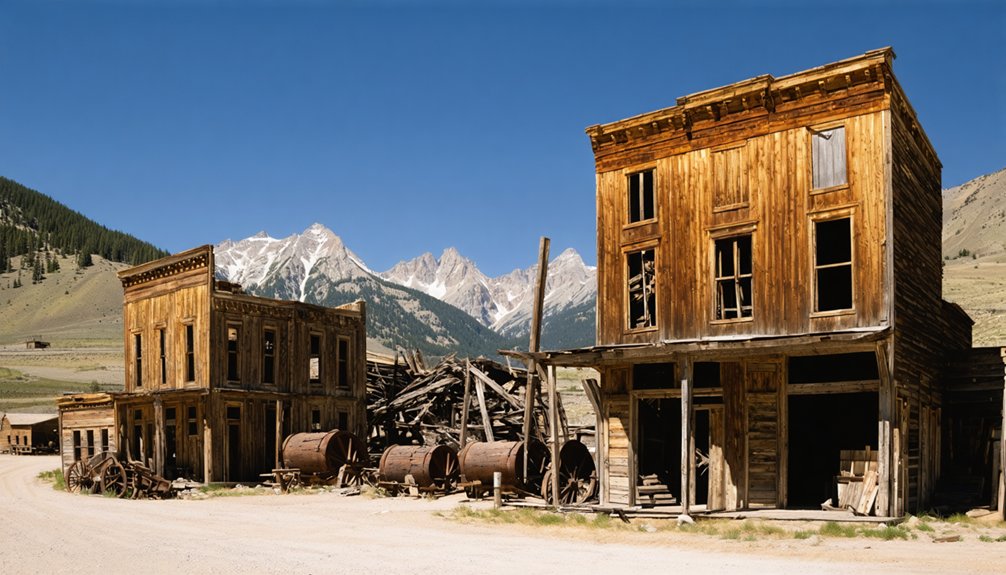
Prospectors struck gold in the Yankee Fork area of Custer County in 1867, though they’d work the claims on a small scale for nearly a decade before Bonanza emerged as a formal settlement.
You’ll find Bonanza’s history began in earnest during 1878, when mill construction transformed prospecting camps into Idaho’s first Yankee Fork town. The General Custer Mill, completed in December 1880, revolutionized local mining techniques with its 20-stamp steam-powered plant and six 500-gallon settling pans.
A 3,200-foot aerial tram carried ore from mine to mill, processing gold, silver, and lead. The settlement thrived until 1897, when fire devastated the town. Most residents relocated to nearby Custer.
Custer: National Register Historic Mining Town
You’ll find Custer among Idaho’s best-preserved mining camps, established in 1879 when gold speculators laid out the townsite alongside the General Custer Mill.
The settlement sustained nearly two decades of active mining operations, peaking at 1,000 residents during the early 1880s boom before declining to ghost town status by 1910.
Since its 1981 listing on the National Register of Historic Places, the 29-acre historic district has welcomed visitors to explore seven contributing buildings maintained through the Land of the Yankee Fork State Park.
Gold Rush Origins 1879
Gold’s discovery in the Yankee Fork area in 1867 set the stage for what would become one of Idaho’s most significant mining operations, though it wasn’t until 1876 that prospectors uncovered a substantial vein near the Yankee Fork River.
This find transformed Custer history forever when the General Custer Mining Company formed in 1879, bringing investor George Hearst into the venture.
The town’s mining infrastructure rapidly expanded through:
- George Toponce’s toll road from Challis, enabling equipment transport
- A 20-stamp steam-powered mill completed December 1880
- A 3,200-foot aerial tram connecting mine to mill
- Six 500-gallon settling pans for ore processing
Samuel Holman filed early claims and plotted community lots, while the one-street settlement stretched half a mile below the mill site, attracting boarding houses, stores, and fortune-seekers.
Two Decades of Prosperity
Community development flourished with over 100 commercial buildings, a schoolhouse, jail, and Miners Union Hall.
Main Street bustled with businesses serving local miners and supplying distant camps at Sunbeam, Loon Creek, and Thunder Mountain.
After Bonanza’s devastating fires in 1889 and 1897, Custer became the district’s business and social center.
The town’s Chinatown anchored the southern end, while a baseball team provided recreation for hardworking miners.
Restored Town Tours Available
After receiving National Register of Historic Places designation in 1981, Custer’s 29-acre historic district opened to public exploration through partnerships between the Challis National Forest and preservation organizations.
You’ll discover seven contributing properties that represent Idaho’s early lode mining heritage, maintained by the Land of the Yankee Fork Historical Association and Idaho Department of Parks and Recreation since 1990.
Your guided experiences include:
- Free walking tours from Memorial Day to Labor Day featuring miner tales in the schoolhouse museum
- Self-guided access to the old saloon, jail, residences, and cemetery with interpretive signage
- Historical insights about mining camp life within Land of the Yankee Fork State Park
- Exploration of surrounding mines and the Yankee Fork Gold Dredge
Buildings open seasonally, though you’ll find 24-hour access to the grounds year-round.
Frequently Asked Questions
What Permits or Fees Are Required to Visit These Ghost Towns?
You won’t need permits or encounter visiting fees at most Idaho ghost towns near Boise. Ghost town regulations follow standard national forest rules—simple access via public lands guarantees your freedom to explore these historic sites independently.
Are These Ghost Towns Safe for Children and Families to Explore?
Safety varies considerably by location. You’ll find family activities and guided tours at restored Custer, while Bonanza’s unstable structures demand extra safety precautions. Silver City and Bayhorse offer moderate accessibility with proper supervision and water supplies.
What Is the Best Time of Year to Visit Idaho Ghost Towns?
Summer’s your best season for exploring Idaho’s ghost towns, when sunny skies and warm weather conditions make roads accessible and historic buildings open. You’ll navigate mountain routes safely while experiencing restored structures with operational guided tours from Memorial Day through September.
Can Visitors Camp Overnight Near Any of These Ghost Town Sites?
You can camp overnight near all these ghost towns through dispersed camping on surrounding national forest lands. Check specific camping regulations for each area, and note that nearby facilities are minimal or nonexistent at remote sites.
How Far Is Each Ghost Town From Boise and Driving Conditions?
Placerville sits closest at roughly 40 miles with paved driving routes, while Silver City requires 60+ miles through unpaved sections. Bayhorse and Bonanza/Custer demand 100+ miles with variable road conditions requiring high-clearance vehicles.
References
- https://en.wikipedia.org/wiki/List_of_ghost_towns_in_Idaho
- https://patch.com/idaho/boise/idaho-ghost-towns-you-need-see
- https://www.thegoldminehotel.com/ghost-towns-and-haunted-places-in-idaho
- https://idaho-forged.com/idahos-ghost-towns-eerie-yet-approachable/
- https://history.idaho.gov/wp-content/uploads/2018/08/0064.pdf
- https://www.boisestatepublicradio.org/show/idaho-matters/2024-10-31/ghost-towns-idaho
- https://visitidaho.org/things-to-do/ghost-towns-mining-history/
- https://yellowpinetimes.wordpress.com/2024/05/12/idaho-history-may-12-2024/
- https://westernmininghistory.com/towns/idaho/placerville/
- https://history.idaho.gov/wp-content/uploads/2018/09/Placerville_Historic_District_84001029.pdf