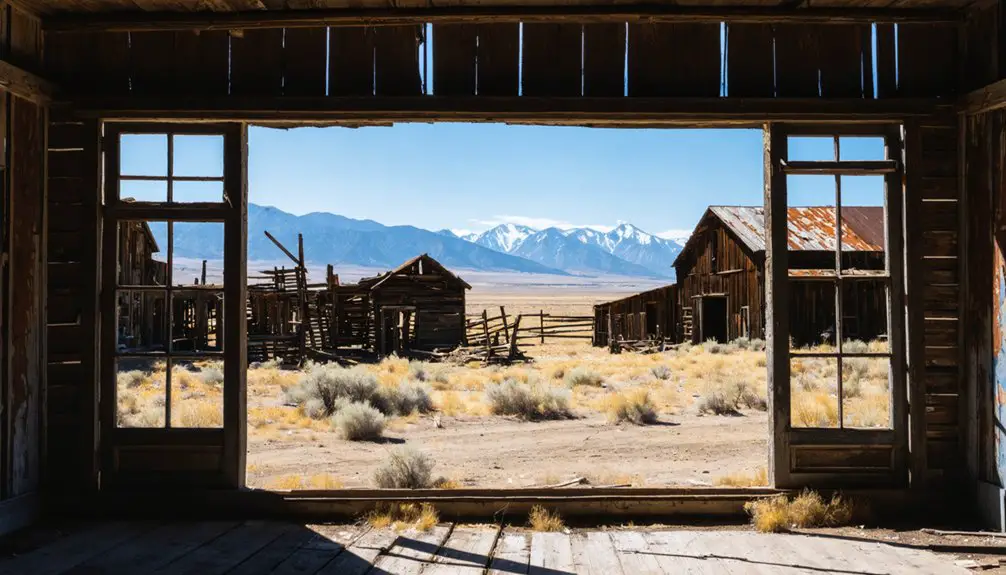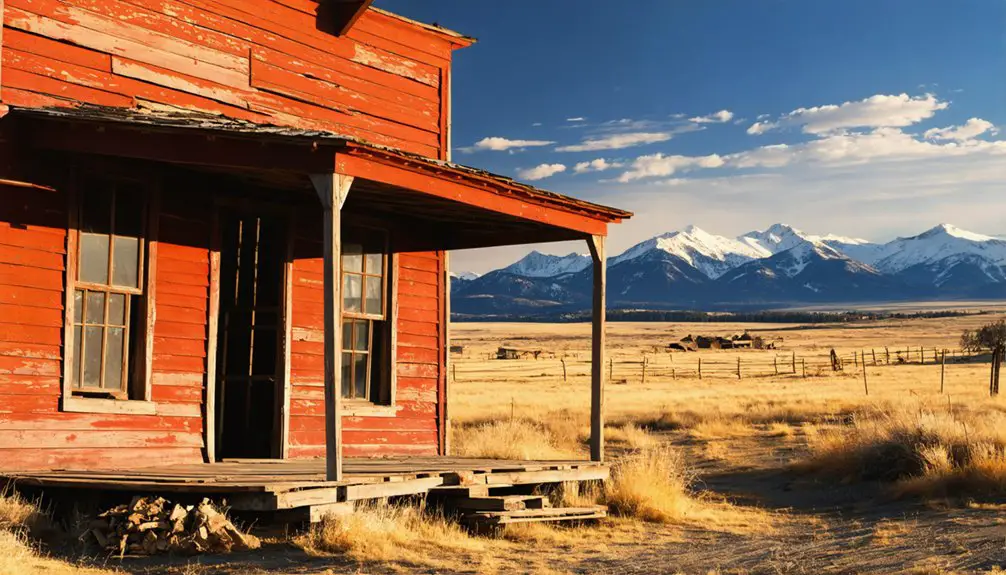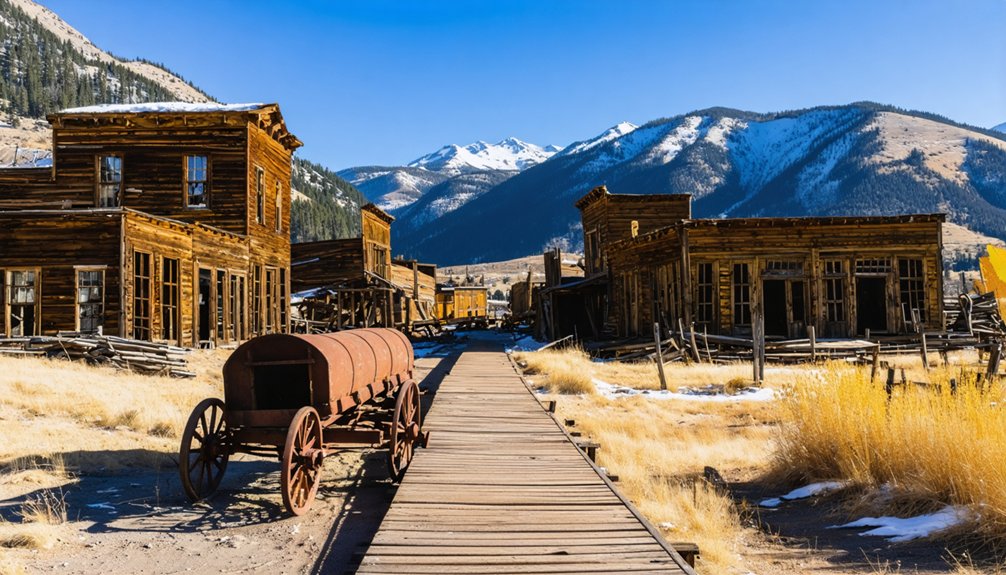
You’ll find several remarkably preserved ghost towns within 90 minutes of Bozeman, including Bannack State Park with over 50 original structures from Montana’s 1862 gold rush, and Virginia City, which served as territorial capital in 1865. Elkhorn showcases silver mining heritage from the 1880s, while Nevada City displays extensive Old West artifacts. The best visiting window runs May through October for ideal access to these sites, where gold panning opportunities and guided tours reveal the state’s mining legacy in greater detail below.
Key Takeaways
- Bannack State Park, Montana’s first territorial capital, features over 50 original structures and offers gold panning opportunities year-round.
- Virginia City and Nevada City preserve authentic Old West buildings and artifacts from the 1863 Alder Gulch gold rush era.
- Elkhorn features preserved structures like Fraternity Hall and Gillian Hall within Montana’s smallest state park in the Elkhorn Mountains.
- Bozeman is within 90 minutes of Virginia City, Bannack, and Pony, with May to October being optimal visiting months.
- Weekend loops can connect multiple ghost towns including Bannack, Elkhorn, and Granite for comprehensive historical exploration.
Bannack State Park: Montana’s Best Preserved Mining Town
When prospectors discovered gold along Grasshopper Creek on July 28, 1862, they triggered Montana’s first major gold rush and established what would become the territory’s best-preserved mining town.
A single gold discovery on Grasshopper Creek in 1862 sparked Montana’s first major gold rush and created a legendary mining town.
Within a year, over 3,000 fortune-seekers flooded the area, transforming wilderness into Montana’s first territorial capital in 1864. Bannack history reflects the boom-and-bust cycle characteristic of Western mining camps—thriving one decade, abandoned by the 1940s.
Ghost town preservation began when citizen groups, including the Southwestern Montana Mining Association, initiated protection efforts in the late 1940s.
The Beaverhead County Museum Association donated the site to the state in 1954, stipulating it maintain its authentic ghost town atmosphere.
Today, you’ll find over 50 original structures standing along Main Street at 5,837 feet elevation, spanning 1,529 acres. The historic log and frame buildings showcase Montana’s formative years as a frontier mining territory. The park remains open year-round, offering visitors access to this remarkably preserved piece of Montana’s mining heritage.
Virginia City and Nevada City: Twin Gold Rush Destinations
After the Fairweather party struck gold in Alder Gulch in 1863, over 10,000 prospectors surged into a fourteen-mile stretch of southwestern Montana within months, creating what would become the Rocky Mountains’ richest placer gold strike.
Virginia City emerged as the territorial capital in 1865, while Nevada City developed alongside six other settlements.
The historical significance of these twin towns reflects Montana’s volatile gold mining era:
- Virginia City peaked at 5,000 residents by mid-1864, featuring Victorian storefronts and straight-platted streets.
- Vigilante justice prevailed when road agents terrorized miners, leaving Boot Hill graves as stark reminders.
- Population collapsed from 30,000 to mere hundreds after gold dwindled and railroads bypassed the area.
Today, Virginia City preserves authentic structures while Nevada City displays relocated buildings from the Bovey family’s restoration efforts. Nevada City houses one of the largest collections of Old West artifacts outside the Smithsonian. The Montana Heritage Commission now manages over 250 buildings and artifacts acquired from the Bovey assets in 1997, maintaining the towns as premier heritage tourism destinations.
Exploring Elkhorn and Castle Town
The discovery of silver in the Elkhorn Mountains around 1872 set in motion a mining boom that would transform a remote Montana wilderness into a thriving industrial settlement.
Anton Holter plotted the town around his mining claim, naming it after the surrounding peaks. The 1878 Bland Allison Act fueled explosive growth, pushing the population to 2,500 by the 1880s.
Elkhorn History shows the mine ultimately produced $14 million in silver before depths reached 1,000 feet with declining ore quality.
Abandonment Factors converged brutally: silver prices crashed in 1893, wiping out 75% of residents within two months. A devastating diphtheria epidemic from 1888-1889 had already killed dozens of children and elderly. The Elkhorn mine closed permanently in 1900 after exhausting its most productive veins of silver, gold, and lead.
Today, Fraternity Hall and Gillian Hall stand preserved within Montana’s smallest state park, accessible an hour south of Helena. The surrounding area displays numerous decaying log cabins that mark the former residential districts of this once-bustling mining community.
Karst’s Camp: From Dude Ranch to Ghost Town
While Elkhorn’s fate tied to silver’s collapse, Pete Karst built a different kind of enterprise in the Gallatin Canyon—one that capitalized on Yellowstone National Park‘s growing allure rather than mineral extraction.
Arriving from Wisconsin in 1898, Karst established Montana’s first dude ranch in 1901 on land awarded as back payment from the Cooper Tie Company.
Pete Karst transformed surplus timberland into Montana’s pioneering dude ranch, converting industrial debt into hospitality innovation.
His operation transformed frontier hospitality:
- Guest capacity: 25 cabins accommodated up to 600 tourists annually at $12.50 weekly
- Transportation: Karst Stage (founded 1902) evolved from horse-drawn to motorized units by 1916
- Recreation: Montana’s first ski tow, constructed in 1935, extended the season beyond summer
The ranch also featured amenities including a bar and a brothel, catering to the diverse entertainment needs of early frontier visitors.
By 1908, the Karst Stage Stop Inn opened in Gallatin Canyon, establishing a reliable hub for travelers and freight operations that supported the growing tourism industry.
Karst’s legacy endures through preserved cabins within modern subdivisions.
The historical significance of this gateway to Yellowstone demonstrates early tourism’s pioneering spirit.
Planning Your Ghost Town Adventure From Bozeman
Bozeman’s strategic position in southwestern Montana places you within 90 minutes of three premier ghost towns—Virginia City, Bannack, and Pony—each representing distinct chapters in Montana’s 1860s mining rushes.
Ghost town accessibility peaks May through October when Bannack State Park‘s visitor center operates and mountain routes remain passable. You’ll maximize your exploration by linking Bannack (2.5 hours southwest), Elkhorn, and Granite in a weekend loop that covers Montana’s most significant mining settlements.
Historical preservation varies dramatically across sites. Bannack maintains over 50 original structures including the schoolhouse and Masonic Lodge, while Virginia City functions as a living history museum with guided tours and steam train access to Nevada City.
Garnet offers authentic miner cabins without commercial development. Check seasonal road conditions before departure—winter snows restrict access to higher-elevation sites like Garnet and Elkhorn. Both Bannack State Park and Virginia City provide opportunities for gold panning experiences, allowing visitors to try their hand at the activity that sparked these settlements. Virginia City served as Montana’s territorial capital during its peak mining years in the 1860s.
Frequently Asked Questions
What Was the Peak Population of Ghost Towns Near Bozeman?
You’ll find Elkhorn reached the highest peak population at 2,500 residents during the 1880s, demonstrating significant historical significance before economic decline from depleted silver deposits forced abandonment. Zortman followed with 2,000 people during gold mining’s prosperous era.
Are Ghost Town Buildings Near Bozeman Safe to Explore?
State parks like Bannack and Elkhorn maintain safe exploration paths with guided tours, but you’ll need safety precautions at remote sites where building conditions deteriorate. Abandoned mines and structural decay pose real risks requiring careful assessment.
Can You Camp Overnight at Ghost Town Sites Near Bozeman?
You can’t camp at Granite Ghost Town State Park, but you’ll find primitive camping opportunities near Garnet Ghost Town outside the half-mile radius, where you can experience historical significance while following BLM regulations.
Which Ghost Towns Near Bozeman Allow Gold Panning for Visitors?
Want authentic mining history you can touch? You’ll find gold panning available exclusively at Bannack State Park among Bozeman-area ghost towns, where you’re free to pan Grasshopper Creek’s sands just like 1862 prospectors did.
How Many Ghost Towns Are Within Two Hours of Bozeman?
You’ll find five ghost towns within two hours of Bozeman: Bannack, Virginia City, Nevada City, Elkhorn, and Granite. Each offers unique ghost town history and nearby attractions, preserving Montana’s territorial capital legacy and mining heritage.
References
- https://en.wikipedia.org/wiki/List_of_ghost_towns_in_Montana
- https://bozemanmagazine.com/articles/2022/10/01/115204-top-10-montana-ghost-towns
- https://bozemanmagazine.com/articles/2017/10/02/102695-a-couple-montana-ghost-towns-within-haunting
- https://www.mountain-home.com/blog/vacation-planning/guide-montana’s-ghost-towns
- https://southwestmt.com/pdfs/Southwest-Montana-Ghost-Towns-Printable-Map.pdf
- https://www.geotab.com/ghost-towns/
- https://blog.visit-bozeman.com/blog/ghost-town-tours-near-bozeman
- https://visitmt.com/things-to-do/ghost-towns
- https://fwp.mt.gov/stateparks/bannack-state-park
- https://montanastateparksfoundation.org/parks/bannack-state-park/