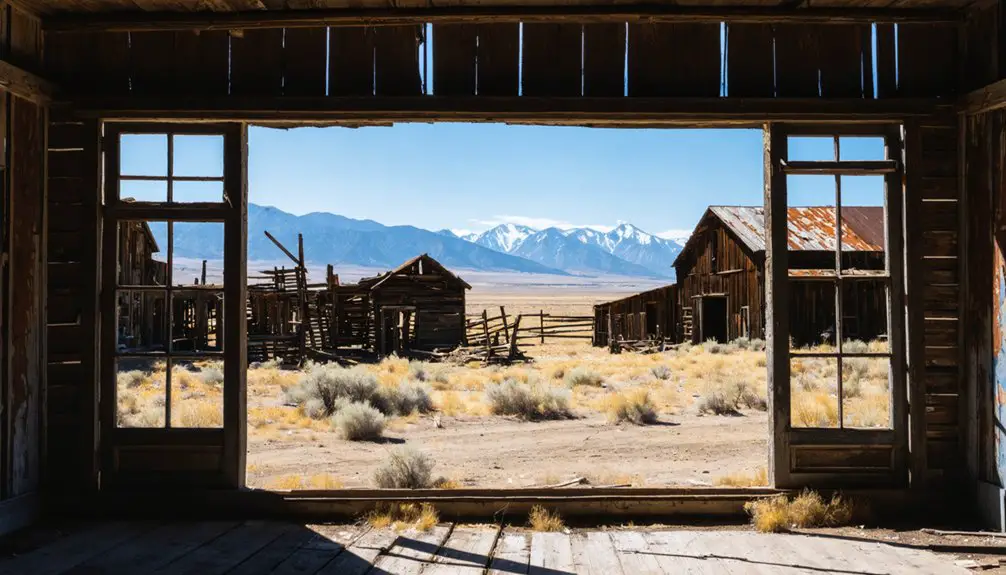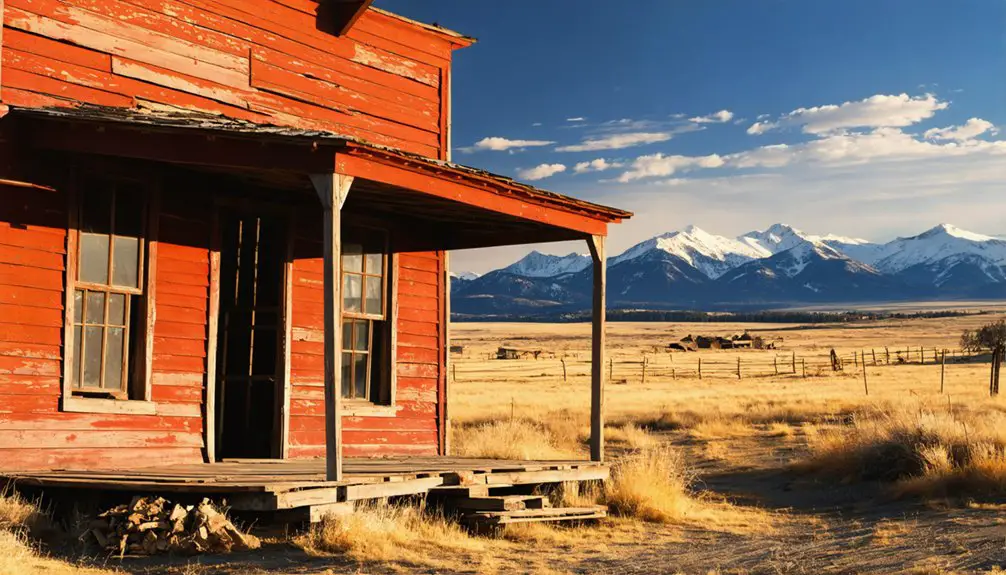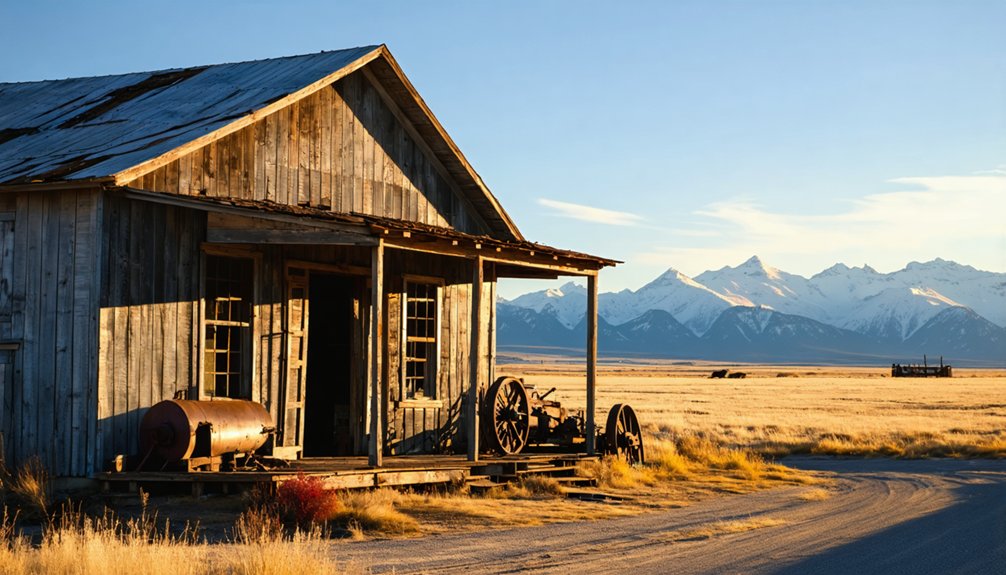
You’ll discover exceptional ghost towns within an hour of Butte, starting with Silver Bow Creek’s seventeen remaining headframes right at the city’s doorstep. Head south along the Pioneer Mountains Scenic Byway to Coolidge, where Montana’s largest mill once processed 750 tons daily before abandonment in 1935. Elkhorn State Park preserves the stunning 1893 Fraternity Hall, while Granite Ghost Town showcases remnants from when it housed 18 saloons. Bannack and Rimini offer additional exploration opportunities, each revealing unique chapters of Montana’s mining heritage that shaped the region’s boom-and-bust cycles.
Key Takeaways
- Elkhorn State Park features a preserved Greek Revival Fraternity Hall built in 1893, showcasing Montana’s silver mining heritage near Butte.
- Granite Ghost Town State Park contains remnants of 18 saloons and four churches from a boom town that emptied in 1893.
- Coolidge, 25 miles south of Wise River, offers Montana’s last large-scale silver operation ruins, accessible only during summer months.
- Rimini, 12 miles west of Helena, dates to 1864 and generated $700 million in ore by 1928 with preserved historic buildings.
- Bannack State Park preserves over 50 original buildings from Montana’s first territorial capital, established in 1862 during the gold rush.
Silver Bow: Mining Heritage at Butte’s Doorstep
When gold glimmered along Silver Bow Creek in the 1860s, prospectors couldn’t have imagined they were standing at the edge of what would become one of America’s greatest mining districts.
You’ll find Silver Bow’s story etched into every abandoned headframe and mill site near Butte. The 1875 discovery of silver in black rock at the Travona Mine breathed new life into a nearly ghost town of just 61 souls.
By 1880, trans-Atlantic investors poured capital into the Alice and Lexington mines, transforming rudimentary mining techniques into industrial-scale operations. William A. Clark recorded ownership of the Original Lode in 1873, eventually selling the mine to Anaconda Company in 1910.
The Utah & Northern Railroad began construction in 1881, connecting Butte’s mineral wealth to distant markets and cementing its role as a major distributing center. Today’s seventeen remaining headframes stand as monuments to this cultural heritage—a tribute to the independent miners who carved fortunes from Montana’s richest hill before copper claimed its throne.
Coolidge: A Summer Stop Along the Pioneer Mountains Scenic Byway
You’ll find Coolidge twenty-five miles south of Wise River, tucked into the high wilderness along the Pioneer Mountains Scenic Byway where an electric-powered mill once processed Montana’s last large-scale silver operation.
The site’s elevation and remote location make it accessible only during summer months, when you can explore the multi-level mill ruins, abandoned buildings, and the old mine portal scattered among empty streets.
Founded in 1914 by William R Allen, the town was named after Calvin Coolidge and quickly grew to a population of 350 with modern amenities like telephone service and electricity.
The town’s infrastructure expanded with a school district and post office by 1922, serving the growing mining community.
Plan your visit between June and September, as snow closes the scenic byway and leaves this ghost town isolated in the Pioneer Mountains for the rest of the year.
Historic Mining Camp Remains
The Coolidge ghost town sits along the Pioneer Mountains Scenic Byway at 7,600 feet elevation, where silver-hungry prospectors discovered rich veins in 1872 within the Elkhorn Mining District.
You’ll find remnants of what was once Montana’s largest mill—a massive 200-foot-wide, 750-foot-long structure that processed 750 tons of ore daily.
Historic structures still dot the landscape, including collapsed bunkhouses, the boarding house foundation, and weathered cabins that housed 350 residents during the camp’s 1920s heyday.
Mining artifacts scatter the area: rusted ore carts, cable remnants from the 35-mile power line, and tunnel entrances marking six miles of underground workings. The town’s last narrow-gauge railroad, completed in 1917, once connected the Elkhorn Mine to Divide, Montana.
The 1927 dam failure and Great Depression transformed this thriving operation into abandoned ruins by 1935, leaving you to explore Montana’s last large-scale underground silver mining legacy. The Boston-Montana Development Company invested $5,000,000 into the Elkhorn mine project beginning in 1911, bringing large-scale development to the remote mountain site.
Scenic Byway Access Route
Reaching Coolidge requires traversing the Pioneer Mountains Scenic Byway, a 49-mile federally designated route that cuts through Beaverhead-Deerlodge National Forest from Highway 43 at Wise River to Highway 278 west of Dillon.
You’ll navigate mountain meadows, lodgepole pine forests, and switchbacks revealing scenic vistas of granite peaks exceeding 10,000 feet. The paved road accommodates passenger vehicles year-round until December 1, when seasonal closure begins.
A marked gravel spur branches toward Coolidge, requiring a steep three-mile climb unsuitable for trailers. From the parking lot, you’ll walk a flat half-mile trail to the ghost town.
Nine Forest Service campgrounds dot the route, with hiking trails threading throughout the wilderness. The byway passes Polaris and nearby Elkhorn Hot Springs, offering natural hot pools after your exploration. Along the northern section, you’ll encounter Maverick Mountain Ski Area, known for its impressive 2400-foot vertical drop. The route crosses a 7,800-foot divide between Wise River and Grasshopper Creek, offering panoramic views of the surrounding wilderness.
Best Summer Visiting Times
Summer transforms Coolidge into an accessible mountain retreat, with late June through August offering your most reliable window for exploration.
You’ll find snowmelt clears the 7,800-foot elevation trailhead, making the narrow dirt spur road passable for standard vehicles. July and August deliver the most stable conditions for your visit, though you’ll want mosquito management essentials—repellent’s non-negotiable during early season.
Plan your 1-mile roundtrip hike during mid-summer’s extended daylight, giving you ample time to examine mill ruins and railroad remnants. The cooler mountain temperatures keep summer activities comfortable without oppressive heat. The tree-lined trail parallels a creek showcasing Montana’s silver mining heritage.
Late August reduces insect annoyance considerably. You’ll appreciate clear skies revealing the ghost town’s skeletal remains against Pioneer Mountain peaks. The town once housed 350 residents with electricity and telephone service during its peak years. Combine your exploration with nearby Elkhorn Hot Springs or blue-ribbon trout fishing along the byway.
Southern Cross: Deer Lodge County’s Mining Remnant
Perched at 7,000 feet on Cable Mountain’s slopes, Southern Cross emerged from Montana’s mineral-rich earth in 1866, though its discoverers let their initial claim lapse before relocating it in the early 1870s.
You’ll find this ghost town‘s mining history spans seventy years, from 1872 to 1942, extracting $600,000 in mineral wealth primarily from gold-bearing polymetallic veins. The geological features included pyrite, chalcopyrite, and magnetite deposits within limestone replacement veins.
At its peak, community life buzzed with 500 residents living in this company town overlooking Georgetown Lake. Anaconda Copper Mining Co.’s ownership stake underscores Southern Cross’s economic impact on Deer Lodge County.
Today, its historical significance endures as weathered remnants tell tales of Georgetown District‘s prosperous mining center aspirations.
Elkhorn State Park: Fraternity Hall and Old West Remnants
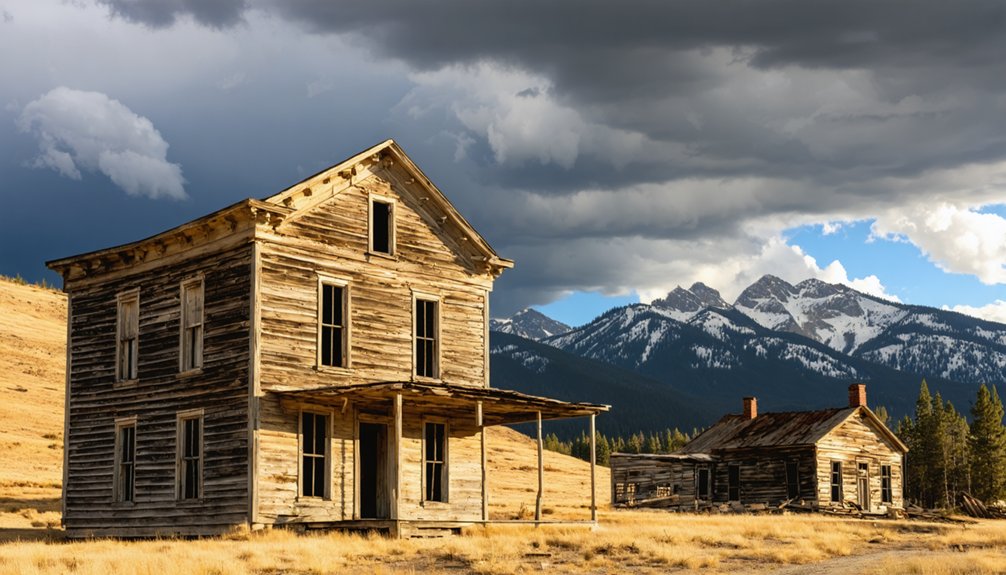
You’ll find Elkhorn State Park preserving two remarkable structures from Montana’s silver boom era: the 1893 Fraternity Hall with its ornate cantilevered balcony and Gillian Hall, both standing as monuments to a town that once housed 2,500 residents.
The modified Greek Revival Fraternity Hall, registered on the National Register of Historic Places in 1975, remains one of Montana’s most photographed buildings, its false front and original fixtures intact since construction began in May 1893.
Unlike many ghost towns reduced to foundations and rubble, you can walk through both floors of Fraternity Hall year-round, exploring the same spaces where miners attended dances, lodge meetings, and theater productions before silver prices collapsed and closed the mines by 1900.
Historic Buildings Still Standing
Twenty-two miles northeast of Boulder, Montana, Elkhorn State Park preserves one of the region’s most authentic ghost town experiences.
For those interested in exploring more remnants of the past, there are several ghost towns near Billings Montana that offer a glimpse into the old frontier lifestyle. Each location tells its own story, showcasing the unique histories of the settlers who once inhabited these areas. Visitors can wander through dilapidated structures and learn about the challenges faced by these communities during their prime.
Another remarkable site is the mining town of Elkhorn, where crumbling buildings and rusted equipment stand as silent witnesses to a bustling past. Exploring ghost towns in Montana’s landscape reveals the harsh realities of life in a frontier territory, where dreams of prosperity often met with hardship. Each step through these abandoned streets invites reflection on the resilience of those who dared to establish a community amidst the isolation.
You’ll find Fraternity Hall standing prominently among the surviving structures, its ornate cantilevered balcony and false front evidence of 1890s craftsmanship. Built by the Fraternity Hall Association in 1893, this two-story frame building served multiple purposes—theatrical performances and dances on the first floor, lodge meetings upstairs for groups like the Masons and Knights of Pythias.
The architectural significance of this 28-foot-wide structure lies in its simulated pilaster and arch treatment, unique among Montana’s ghost towns.
Recent preservation efforts by local societies have stabilized the foundation and protected windows with plywood, fighting against threats from renewed mining activity and population growth that’s swelled from eight to over twenty-five residents.
Silver Mining Boom History
Fraternity Hall rose on Main Street in May 1893, a bold architectural statement during what would prove to be Elkhorn’s twilight years as a silver mining powerhouse.
You’re standing where boom towns lived fast and died hard. The mine had already peaked, population dropping from its height, yet the community still built this Greek Revival gathering place with ornate balconies and false fronts.
The mine operated full-time until 1900, but production kept tapering. When it sold in 1901, the new Elkhorn Silver Mining Company briefly processed old dump piles before water influx and plummeting silver prices shuttered operations permanently.
Accessing the Ghost Town
When you navigate the backcountry roads 22 miles northeast of Boulder, Montana, you’ll enter Elkhorn State Park, where Fraternity Hall commands the landscape like it’s still waiting for Saturday night’s dance to begin.
This isn’t your sanitized tourist trap—it’s authentic ghost town exploration through a preserved 19th century mining landscape. Montana FWP maintains access while respecting the site’s integrity, allowing you to witness architectural details like the ornate cantilevered balcony and simulated pilasters up close.
Historical preservation efforts have kept this National Register landmark accessible since 1975, though you’ll need to plan ahead for backcountry conditions.
The park asks you to practice leave-no-trace principles and respect wildlife, ensuring future wanderers can experience the same raw connection to Montana’s mining past.
Granite Ghost Town State Park: Silver Boomtown of the 1890s
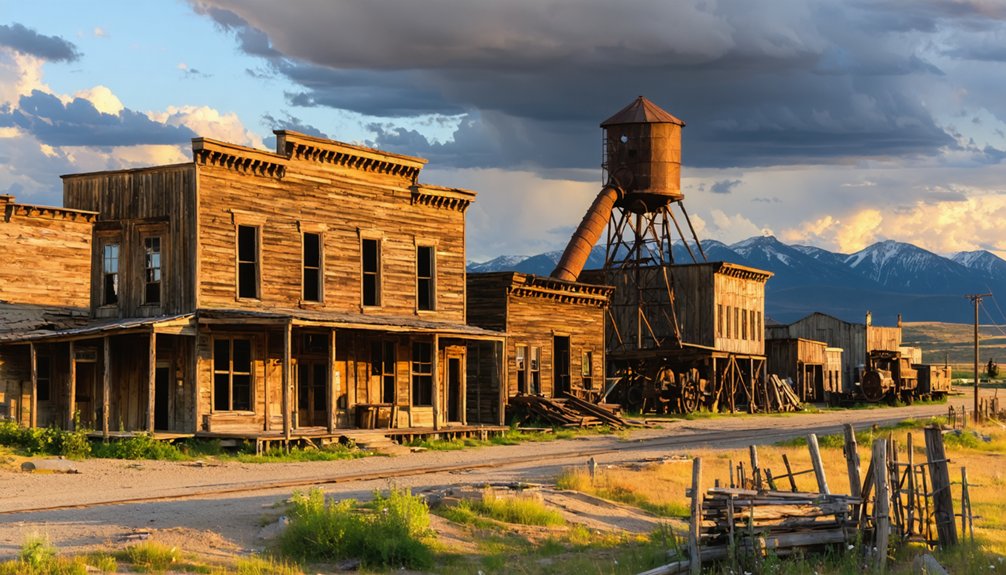
By 1890, you’d find 18 saloons, four churches, and America’s longest aerial tramway snaking down the mountainside.
Then the Sherman Silver Purchase Act‘s 1893 repeal crashed silver prices. The town emptied overnight—August 1, 1893—with residents hauling their possessions down the mountain.
Today, you’ll explore preserved remnants: the three-story Miners’ Union Hall, hospital, and superintendent’s house amid hiking trails threading through ruins.
Comet: Jefferson County’s Forgotten Settlement
The late 1880s saw twenty-two saloons serving thirsty miners, while the 1930s brought Montana’s second-largest operation employing 300 men.
WWII’s nonessential mining ban ended it permanently in 1941.
Today, you’ll discover two dozen crumbling buildings on private land.
Respect the owners, snap photos, and leave only footprints among the sagebrush-covered remains.
Rimini: Accessible Ghost Town From the Butte Region
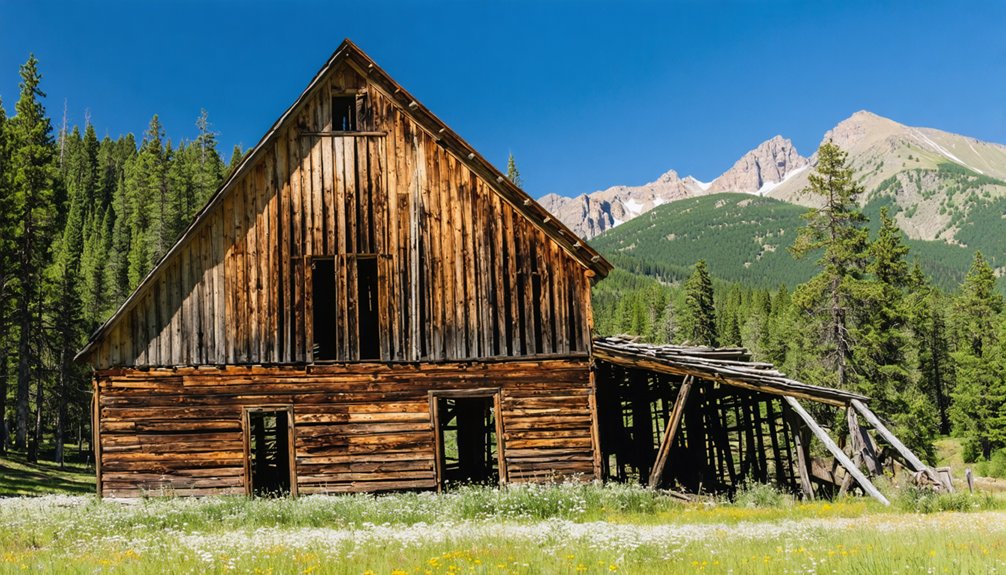
While Comet slumbers in obscurity, Rimini offers ghost town explorers something rare: easy access and remnants you can actually reach.
Located just 12 miles west of Helena via Highway 12, this semi-ghost town sits in Ten Mile Creek Valley with Rimini history dating to 1864’s silver discoveries.
Just 12 miles west of Helena, Rimini’s silver legacy began in 1864 in the scenic Ten Mile Creek Valley.
Rimini mining generated an estimated $700 million in ore by 1928, supporting over 100 operations before the 1926 closure of Porphyry Dike mine ended commercial extraction.
You’ll find interpretive signs guiding your self-directed exploration among:
- The 1904 schoolhouse, now serving as community hall
- Moose Creek Ranger Station’s 1908 log construction
- False-front commercial buildings and restored miners’ cabins
Peak population reached 300 residents in 1890, shipping 400 tons weekly.
Today’s handful of permanent inhabitants share this National Forest setting with weekend visitors seeking mountain solitude.
Bannack State Park: Montana’s Best-Preserved 1800s Town
On July 28, 1862, prospectors struck gold along Grasshopper Creek, and within months Montana’s first boomtown erupted from the sagebrush.
You’ll find over 50 original buildings standing along Main Street today, their weathered logs and frames untouched by modern reconstruction.
This Bannack history remains authentic because the 1954 donation stipulated preserving its ghost town atmosphere rather than creating a theme park.
Ghost town preservation here means no replacement construction—just stabilization of what miners left behind.
You’ll walk through Montana’s first territorial capital, where Sidney Edgerton governed in 1864.
The state park operates year-round, with summer tours from Memorial Day through Labor Day.
Visit during July’s third weekend for Bannack Days, when reenactors bring the 1862-1890 period back to life.
Virginia City and Nevada City: Living History Near Butte
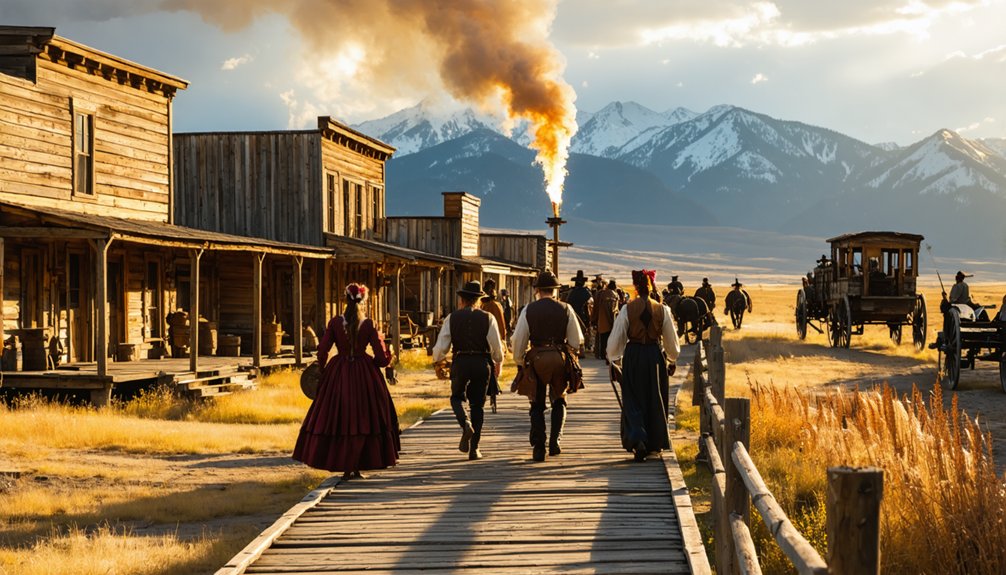
Just 84 miles southeast of Bannack, another gold strike in spring 1863 created what became the richest placer discovery in the Rocky Mountains.
Alder Gulch’s first three seasons alone yielded $30 million in gold, spawning Virginia City and Nevada City one mile apart.
Virginia City served as Montana Territory’s capital from 1865 to 1875, while Nevada City now houses the largest Old West artifact collection outside the Smithsonian.
Montana’s territorial capital from 1865-1875, Virginia City neighbors Nevada City’s remarkable artifact collection rivaling the Smithsonian’s Old West holdings.
You’ll find over 100 preserved buildings from the 1863-1900s era.
Living history interpreters demonstrate frontier skills on summer weekends:
- Blacksmiths forge tools using authentic 1860s equipment
- Period-dressed dealers run faro games in restored saloons
- Craftspeople weave using antique looms
These towns preserved their Victorian character because gold depletion left residents unable to remodel—your gain.
Frequently Asked Questions
What Should I Bring When Visiting Ghost Towns Near Butte?
Picture yourself wandering through weathered wooden structures—you’ll need sturdy hiking essentials like boots and water, plus camera gear to capture Bannack’s crumbling facades. Don’t forget offline maps, since cell service disappears completely out there.
Are Ghost Towns Near Butte Safe to Explore With Children?
Yes, state-managed sites like Virginia City and Nevada City prioritize ghost town safety with maintained structures and child friendly activities like arcade machines and summer shows. You’ll find freedom exploring preserved buildings while avoiding hazardous abandoned areas.
Can You Camp Overnight at Ghost Town Sites Near Butte?
You’ll find camping regulations vary wildly—Bannack welcomes overnight campers with improved sites and fire rings, while Garnet strictly prohibits it. Granite lacks facilities too, but surrounding BLM lands offer dispersed camping without overnight permits needed.
What’s the Best Time of Year to Visit Butte Area Ghost Towns?
Summer’s your best bet for exploring Butte’s ghost towns, offering warm weather considerations and ideal access to remote sites. You’ll find seasonal attractions like Virginia City’s live shows, plus comfortable conditions for wandering abandoned mining camps freely.
As you venture further, the history of Square Butte ghost town reveals tales of a once-bustling mining community now resting in tranquility. It’s fascinating to imagine the lives of those who once roamed the streets, their stories etched into the remnants of old buildings. Each visit offers a glimpse into the past, making it a captivating stop for history enthusiasts and explorers alike.
Do I Need a Four-Wheel Drive Vehicle for Ghost Towns?
You’ll navigate two worlds: Virginia City and Bannack welcome standard vehicles on paved roads, while Garnet demands four wheel drive to conquer steep, rugged terrain. Road conditions vary dramatically—check specific destinations before adventuring into Montana’s backcountry.
References
- https://en.wikipedia.org/wiki/List_of_ghost_towns_in_Montana
- https://visitmt.com/trip-ideas/small-towns-ghost-towns
- https://www.youtube.com/watch?v=BQH5LghhkVs
- https://southwestmt.com/thegreatoutdoors/ghosttowns/
- https://southwestmt.com/ghosts/ghost-towns/
- https://visitmt.com/things-to-do/ghost-towns
- https://fwp.mt.gov/stateparks/granite-ghost-town
- https://buttearchives.org/story-of-butte-sample-tour/
- https://ahgp.org/mt/silver_bow_county_montana_1921.html
- https://www.mininghistoryassociation.org/ButteHistory.htm