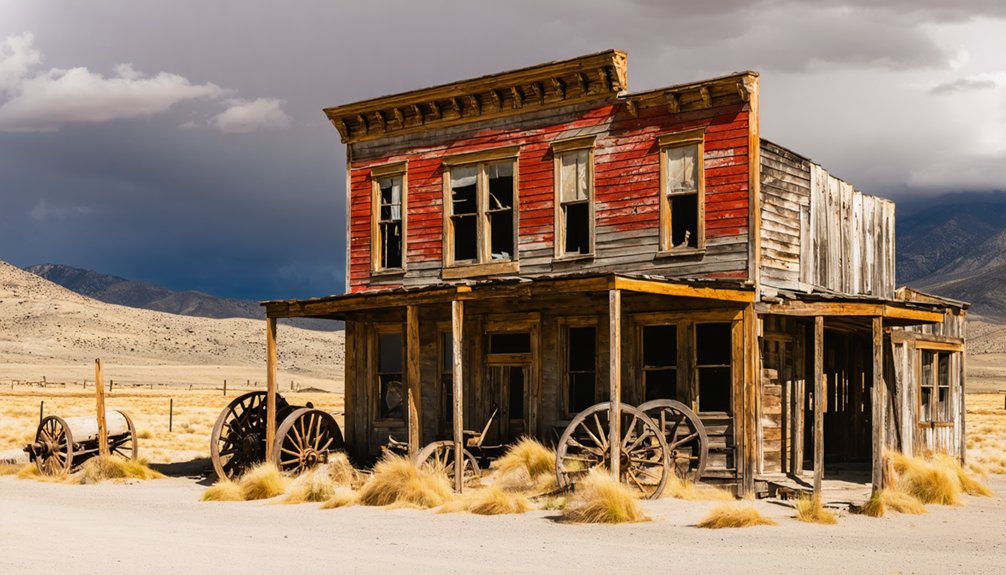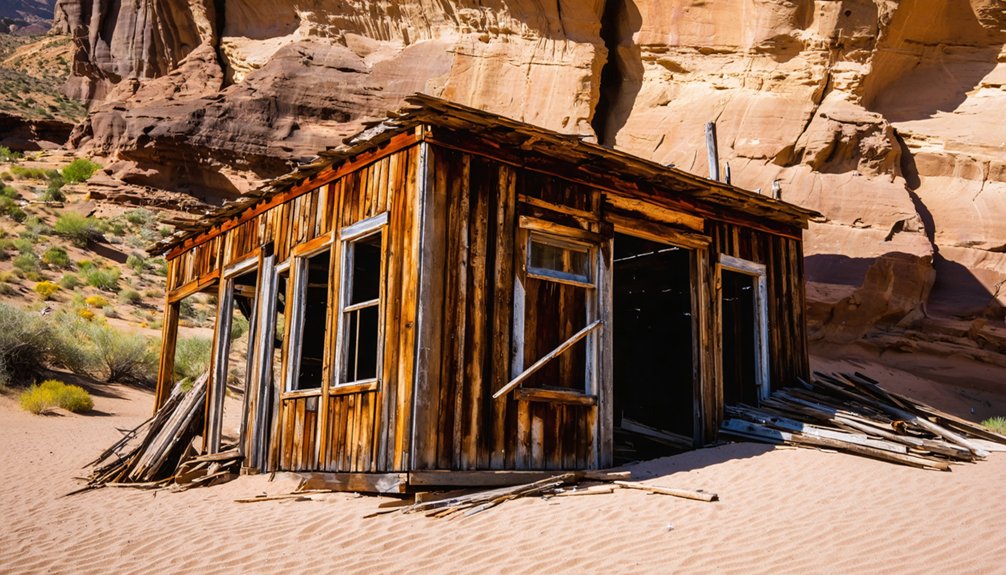
You’ll discover several ghost towns within driving distance of Canyonlands National Park, each telling unique stories of Utah’s past. Cisco, located 30 miles north along Highway 128, was once a thriving railroad stop that processed over 100,000 sheep annually. Sego Canyon’s coal-mining remnants sit northeast of the park, while Home of Truth’s unusual religious settlement ruins lie in Dry Valley. You’ll also find Aldridge 11 miles east of Capitol Reef and Caineville 20 miles from Fruita. Proper preparation and respectful exploration will help you uncover their fascinating histories.
Key Takeaways
- Cisco Ghost Town, located 30 miles north of Canyonlands along Highway 128, was a major railroad stop and sheep-processing center.
- Sego Canyon Ghost Town, established in 1908, features a surviving brick building, collapsed cabins, and cemetery from its coal-mining era.
- Home of Truth in Dry Valley was founded in 1933 by religious followers who believed the location was Earth’s axis.
- Essential gear includes GPS devices, one gallon of water per person daily, sturdy boots, and high-clearance 4WD vehicles for access.
- November offers ideal visiting conditions with pleasant weather and minimal crowds; early mornings are recommended year-round to avoid heat.
Home of Truth
In 1933, Marie Ogden led 21 followers from Boise, Idaho, to establish Home of Truth in Utah’s remote Dry Valley near Church Rock.
These truth seekers believed they’d found Earth’s axis and Christ’s prophesied return site. Ogden claimed divine messages via typewriter, dictating construction of 23 buildings across three portals. Residents surrendered possessions, embraced strict pescatarian diets, and prepared for apocalypse.
Divine typewriter revelations guided construction of 23 buildings where believers awaited Christ’s return at Earth’s supposed axis.
The colony peaked at 100 members by 1935 but crumbled rapidly.
When Ogden refused to bury deceased follower Edith Peshak, promising resurrection instead, authorities intervened in 1937. Followers attempted to preserve Peshak’s body with milk and eggs. Daily rituals included giving the deceased member salt baths. Failed prophecies and national controversy scattered the faithful. By decade’s end, only ghostly whispers remained.
You’ll find the ruins 45 minutes south of Moab off Highway 191.
Respect this fragile site—it’s part of our shared heritage.
Cisco Ghost Town
Cisco Ghost Town sits just 30 miles north of Canyonlands along Highway 128, where crumbling buildings and rusted machinery mark what was once a thriving 1880s railroad watering stop.
You’ll find abandoned structures from Cisco’s peak era as an oil producer and sheep-shipping hub, though many buildings are now privately owned and fenced off for restoration. The town’s decline accelerated in the 1970s when Interstate 70 bypassed the community, draining away the automobile traffic that had sustained it. During its heyday, the town processed over 100,000 sheep annually as a major provisioning and shipping center for livestock.
Plan your visit as a brief roadside stop after exploring Canyonlands, respecting posted signs that request you photograph from the road to preserve ongoing conservation efforts.
Historic Railroad Town Origins
Approximately five miles north of present-day Interstate 70, the weathered structures of Cisco stand as remnants of Utah’s railroad expansion era.
You’ll discover a town born in the 1880s as a water-filling station for the Denver and Rio Grande Western Railroad. Steam locomotives required frequent stops, and Cisco’s location provided essential access to Colorado River water for refueling engines along this significant transportation route.
The railroad history transformed this isolated desert landscape into a thriving community. Ranches and farms emerged to supply provisions, while wool production peaked at 100,000 sheep sheared annually.
This economic impact extended beyond livestock—natural gas and oil discoveries in 1924 made Cisco Utah’s largest petroleum producer, swelling the population to 200 residents by the 1940s before inevitable decline followed technological progress. The town’s fate was sealed when Interstate 70 bypassed Cisco, contributing to its transformation into the ghost town visible today. By the 1990s, many buildings had fallen into decay due to environmental factors and abandonment.
Abandoned Structures and Ruins
Today’s Cisco tells a sobering story of abandonment through its decaying structures scattered across the desert landscape.
You’ll discover abandoned architecture from multiple eras, including a dilapidated post office, a 1944-era general store, and a partially collapsed one-room schoolhouse. The relentless sun accelerates urban decay while vandalism affects nearly every building.
Notable remnants include:
- Gas station featured in 1971’s “Vanishing Point”
- Film locations from “Thelma and Louise”
- Rusting vehicles and RVs littering the townsite
- Early 20th-century shacks and oil equipment
While artist Eileen Muza’s 2015 purchase brought limited restoration—including an Airbnb shed and artist residency spaces—you’ll need to respect new fencing protecting private areas. Muza renovated spaces using salvaged materials from the site, maintaining the town’s original aesthetic while improving livability.
Exercise caution exploring these fragile structures, as wind damage and deterioration pose safety risks throughout this atmospheric ghost town. A lonely graveyard remains on the outskirts, adding to the town’s haunting character.
Visiting After Canyonlands Tour
After exploring Canyonlands National Park, you’ll find Cisco Ghost Town makes an intriguing detour along your return route to Moab.
Take Highway 128 to Old Highway 6/50, where you’ll spot roughly 100 derelict structures against reddish hills. This abandoned railroad stop offers excellent ghost town photography opportunities from the roadway.
However, respect the current access limitations. New fencing restricts entry to private areas, so photograph from the road only. While camping has occurred here, it’s led to trash accumulation and property damage. Honor posted signs and stay off private land.
You can extend your Canyonlands exploration by continuing southeast to Cisco Landing and Fish Ford on the Colorado River. Nearby Fisher Towers, just 25 miles away, features dramatic vertical cliffs and distinctive hoodoos worth visiting. The town’s transformation into an artists’ haven has brought new life while preserving its haunting character for responsible visitors. Interestingly, the town’s name inspired the networking company Cisco, which took its name from San Francisco and depicts the Golden Gate Bridge in its logo.
Sego Canyon Ghost Town
Hidden among the dramatic rock walls of eastern Utah, Sego Canyon Ghost Town stands as a monument to the rise and fall of coal mining in the American West.
Sego history began in 1908 when Henry Ballard discovered coal seams, establishing what became a thriving mining community. Sego mining operations peaked under the Chesterfield Coal Company before diesel engines replaced coal-powered trains, shutting down operations by 1955.
From Ballard’s 1908 coal discovery to diesel’s dominance, Sego Canyon thrived and vanished within half a century.
Today, you’ll find compelling remnants of this vanished settlement:
- One surviving brick building and towering company store walls
- 6-7 collapsed stone cabins built against canyon walls
- A small cemetery with marked and unmarked graves
- 1940s-era vehicles slowly returning to earth
Respect this fragile site by staying on established paths and preserving what remains for future explorers.
Aldridge Ghost Town
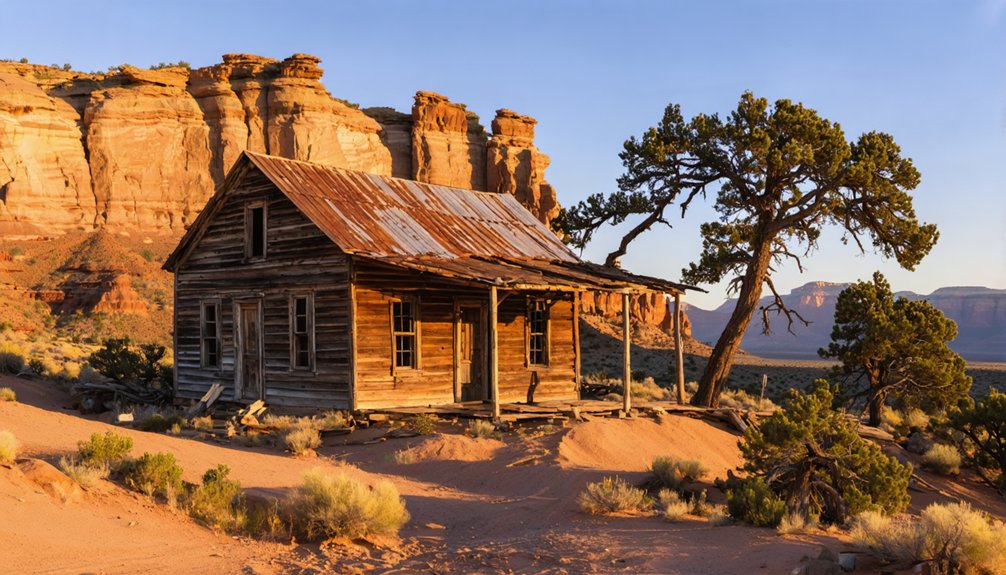
While Sego Canyon tells the story of Colorado’s mining boom, Aldridge Ghost Town reveals a quieter chapter of Utah’s settlement history.
You’ll find this abandoned settlement eleven miles east of Capitol Reef National Park headquarters along Utah State Route 24, where Pleasant Creek once promised fertile farmland.
Aldridge history began in 1882 when Mosiah and fellow pioneers established an agricultural community. By 1890, they’d built a substantial settlement, but Aldridge agriculture faced insurmountable challenges.
Poor soil quality couldn’t sustain crops, forcing complete abandonment by 1900.
Today, you can explore this unincorporated ghost town responsibly. When visiting, respect the fragile site—take only photographs and leave artifacts undisturbed.
Aldridge stands as a tribute to pioneers who faced environmental realities beyond their control.
Caineville
Along Utah’s remote Highway 24, you’ll discover Caineville approximately 20 miles east of Fruita, where the Fremont River carved both opportunity and disaster for early settlers.
Caineville history began in 1882 when Elijah Cutler Behunin established this LDS settlement. By the early 1900s, the community supported several families who’d dug irrigation canals and cultivated crops along the river’s banks.
Caineville flooding ultimately sealed the town’s fate:
- 1896 marked the first major flood
- Destructive floods occurred every two to three years by 1900
- The 1909 deluge prompted mass exodus
- Periodic erosion claimed homes and arable land
Today, you’ll find remnants of this pioneer settlement in one of Utah’s most isolated regions.
Few hardy residents remain, maintaining the area’s fascinating frontier heritage while respecting its natural restoration.
Clifton/Kitchenton
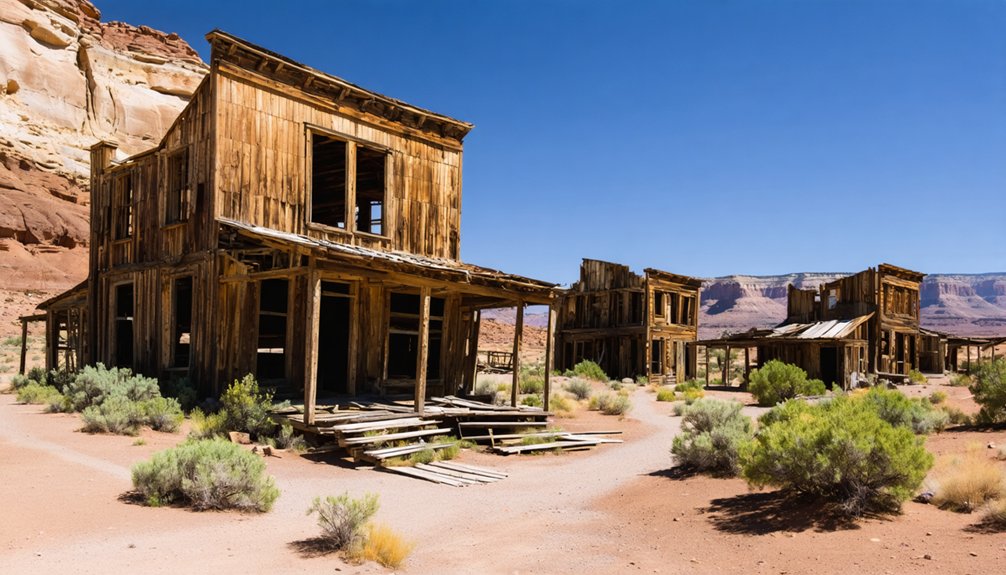
Continuing eastward along Highway 24 from the flood-ravaged remains of Caineville, you’ll encounter the scattered ruins of Clifton (also known as Kitchenton) near milepost 112 in the Deep Creek Mountains.
Founded around 1889 by Bert Averey during Utah’s mining boom, Clifton history reflects the brief prosperity typical of frontier mining camps.
The Kitchenton mines once supported enough activity to warrant formal district recorders and administrative staff.
Planning Your Ghost Town Adventure
Timing your ghost town exploration properly enhances safety and protects these fragile sites from damage caused by extreme weather conditions.
You’ll need specific gear like sturdy footwear, navigation tools, and desert essentials to explore remote locations responsibly.
Strategic planning allows you to combine national park visits with nearby ghost towns, maximizing your experience while minimizing environmental impact through efficient route selection.
Best Times to Visit
While Canyonlands National Park welcomes visitors year-round, your ghost town exploration experience will vary dramatically depending on when you arrive.
Spring visitation (April-May) brings ideal temperatures and wildflowers but crowds that’ll limit your solitude.
Summer challenges include extreme heat exceeding 100°F—dangerous for remote ghost town exploration without proper hydration and early-morning starts.
Fall adventures offer the sweet spot: moderate 60s-90s temperatures and thinning crowds from September through November.
Winter solitude delivers empty trails and authentic isolation, though freezing temperatures demand self-sufficiency.
For best ghost town exploration, consider these periods:
- November: Balances pleasant weather with minimal crowds
- September-October: Comfortable hiking conditions post-summer heat
- Early mornings year-round: Avoid parking hassles and heat
- January-February: Maximum solitude for experienced winter explorers
Essential Gear and Supplies
Exploring ghost towns near Canyonlands demands preparation that exceeds typical national park visits. Your gear essentials start with wayfinding tools—GPS devices, offline maps, and a compass become critical when cell service vanishes on remote desert roads.
Pack at least one gallon of water per person daily, plus purification methods for extended trips. Your supply checklist must include sturdy boots for traversing unstable ruins, layered clothing for temperature swings, and thorough first aid supplies.
A high-clearance 4WD vehicle isn’t optional for reaching sites like Aldridge or Sego Canyon. Include recovery gear—spare tire, tow strap, shovel—and extra fuel for distances between services.
Don’t forget emergency signaling devices and headlamps for exploring structures. These preparations protect both you and these fragile historical sites.
Combining Parks and Towns
With proper gear secured, you can now design an itinerary that maximizes both natural wonders and historical discoveries. The Moab region‘s clustering creates efficient multi-destination routes connecting park history with frontier settlements.
Strategic stopping points include:
- Highway 211 to Needles District – Home of Truth provides natural waypoint access
- Sego Canyon – Combines ghost town exploration with ancient petroglyphs one hour from Moab
- Cisco – Positioned between Arches and Canyonlands for convenient exploration
- Multi-day circuits – Allow extensive experiences across cultural significance sites
You’ll discover southeastern Utah’s resource-dependent communities and religious experiments while respecting fragile archaeological resources.
Check seasonal road conditions before venturing into remote areas. These ghost towns document mining legacies and communal settlements that shaped the region’s development, offering freedom to explore beyond conventional park boundaries.
Frequently Asked Questions
Are Any Ghost Towns Near Canyonlands National Park Privately Owned or Restricted?
You’ll find most ghost towns near Canyonlands aren’t under private ownership or restricted access. However, Aldridge sits within Capitol Reef National Park, so you’ll need to follow federal park regulations when exploring there.
If you’re intrigued by ghost towns near Capitol Reef, you’ll discover unique histories and remnants of the past. Each site offers a glimpse into the lives of those who once called these places home. Be sure to carry plenty of water and a camera to capture the haunting beauty of these abandoned areas.
What Safety Precautions Should Visitors Take When Exploring Abandoned Ghost Town Structures?
Like testing ice before crossing a frozen pond, you’ll need to assess structural integrity before entering buildings, stay alert for wildlife encounters in dark corners, avoid climbing unstable surfaces, and always inform someone of your exploration plans.
Can You Camp Overnight Near These Ghost Towns Outside Canyonlands National Park?
You’ll find dispersed camping opportunities on BLM land near ghost towns like Cisco and Sego Canyon, but you’ll need to research specific camping regulations and verify whether overnight permits are required before setting up camp.
Which Ghost Town Is Closest to Canyonlands National Park Entrance Gates?
Sego Ghost Town sits closest to Canyonlands’ entrance gates, approximately 30-40 miles north. You’ll discover fascinating ghost town history and nearby attractions while exploring responsibly. Remember to preserve these cultural sites for future adventurers seeking historical freedom.
Do Any Ghost Towns Require Four-Wheel Drive Vehicles for Safe Access?
While specific vehicle requirements for ghost towns near Canyonlands aren’t documented in available sources, you’ll want to research off road access conditions beforehand. Many remote Utah ghost towns do require four-wheel drive for safe exploration.
References
- https://www.utahsadventurefamily.com/5-ghost-towns-in-utah-for-families/
- https://www.utahlifemag.com/blog/post/4-ghost-towns
- https://www.myutahparks.com/basics/history/historic-towns/
- https://foacp.org/unearth-the-spooky-stories-forgotten-places-of-southeastern-utah/
- https://www.visitutah.com/things-to-do/history-culture/ghost-towns
- https://capitolreefcountry.com/ghost-towns/
- https://www.brycecanyoncountry.com/widtsoe-ghost-town/
- https://www.hannahhendersontravel.com/grafton-ghost-town-utah/
- https://welovetoexplore.com/tag/ghost-towns/
- https://www.tripadvisor.com/Attractions-g28965-Activities-c47-t14-Utah.html