You’ll discover eight ghost towns within 50 miles of Carlsbad, each documenting southeastern New Mexico’s extractive economy from the 1880s railroad boom through potash industrialization. Sites like Tyrone—completely erased by open-pit mining—and Orogrande’s scattered mining camps illustrate how copper price collapses and depleted ore seams transformed thriving communities into abandoned settlements. Primary access routes include US-285 to Malaga and NM-82 to Loco Hills, though high-clearance vehicles prove essential for less-maintained segments. These ruins preserve architectural evidence and settlement patterns that reveal the region’s complex evolution from frontier agriculture to industrial resource exploitation.
Key Takeaways
- Eight ghost towns lie within a 50-mile radius of Carlsbad, accessible for day trips via routes like US-285 and NM-82.
- High-clearance vehicles are recommended for less-maintained roads, especially after rain, with weak cell coverage beyond US-285.
- Seven Rivers is accessible via Brantley Lake roads along Pecos River floodplains and Guadalupe Mountains terrain.
- Malaga is reachable on US-285, while Loco Hills lies along NM-82 among varied geographic features.
- Visitors should bring water and offline maps due to limited cell service in remote ghost town areas.
Historical Mining Heritage of Eddy County
The mining heritage of Eddy County began modestly in 1904 when workers first extracted bat guano from Carlsbad Cavern, approximately 18 miles southwest of the town of Carlsbad.
You’ll find only seven documented historic mines existed before oil’s discovery in 1909 near Dayton. The cultural impact intensified when the Pecos Valley Railroad arrived on January 10, 1891, enabling you to transport crops, cattle, and minerals efficiently.
Mining innovations transformed the region dramatically after 1923’s major oil strike and Dr. V. H. McNutt’s 1925 potash discovery. These developments attracted investors and settlers who recognized the county’s mineral wealth potential. By 1938, the county’s oil production reached a value of $32 million annually. Eddy County remains an important designation for this region within the United States.
Geographic Location and Accessibility
Eight ghost towns scattered across Eddy County lie within a 50-mile radius of Carlsbad, making them accessible for day trips from New Mexico’s southeastern regional hub.
You’ll find varied geographic features across this territory—from Pecos River floodplains at Seven Rivers and Malaga to rugged Guadalupe Mountains changes near the settlement bearing that name.
Primary access routes include:
- US-285 corridor serving Malaga (20–25 miles southeast)
- NM-82 reaching Loco Hills (25–30 miles northeast)
- Brantley Lake roads accessing Seven Rivers area (25–30 miles northwest)
- Ranch tracks approaching remote Duval and Globe sites
- Black River vicinity routes south-southwest of Carlsbad
Accessibility challenges increase with distance from paved highways.
You’ll need high-clearance vehicles for less-maintained segments, particularly after precipitation. These southeastern settlements join over 400 ghost towns scattered throughout New Mexico, primarily originating from mining activities.
Cell coverage weakens beyond the US-285 corridor, requiring self-reliance when exploring outlying sites. Pack essentials like water and offline maps since service may be unreliable in remote locations.
Tyrone: The Model Company Town Swallowed by Progress
Unlike the scattered settlements near Carlsbad that faded through economic attrition, Tyrone in Grant County met a more dramatic fate—built with architectural grandeur in 1915, only to be erased entirely by the very industry that created it.
Phelps Dodge Corporation commissioned architect Bertram Goodhue to design this Spanish Colonial Revival showcase, eliminating saloons and vice to create a progressive model among Company Towns.
You’ll find no ruins to explore here; the 1921 copper price collapse initially abandoned Tyrone, but 1960s open-pit expansion physically consumed the townsite.
Where Goodhue’s stone facades once stood, Freeport-McMoRan’s Tyrone Operations now extracts ore from the earth. The mine generates around 100 million pounds of copper annually through solution extraction and electrowinning methods.
The original development included a business and residential sections, a school, and a hospital, with the entire project exceeding one million dollars in construction costs.
This complete erasure distinguishes the Tyrone Legacy from typical ghost towns—progress didn’t bypass it; progress devoured it entirely, prioritizing mineral wealth over architectural heritage.
Orogrande and the Scattered Mining Camps
If you travel southwest from Carlsbad along U.S. 54, you’ll encounter Orogrande, a settlement that transformed from Jarilla Junction into a gold-rush boomtown following the 1905 discovery of a six-ounce nugget at the base of the Jarilla Mountains.
Contemporary accounts document several thousand residents who erected approximately 100 houses and constructed a 55-mile water pipeline from the Sacramento River, establishing infrastructure that far exceeded the district’s actual ore reserves.
Today’s near-ghost town retains a post office and scattered residences among the remnants of its brief prosperity, while collapsed mining camps like Bryce mark the hillsides of Cornucopia Canyon. The post office serves both locals and military personnel from nearby Fort Bliss. The old school building stands approximately 100 yards off the highway at the north end of town, serving as a visible landmark of Orogrande’s educational past.
Mining Camp History
Tucked into the Jarilla Mountains of Otero County along a mineralized belt within major Southwestern tectonic provinces, Orogrande—originally known as Jarilla Junction—emerged from decades of sporadic prospecting to become one of New Mexico’s most ambitious mining ventures.
The district’s infrastructure tells the story of mining technology adapting to harsh terrain:
- A three-rail gravity tram connecting Cinco de Mayo and Iron Duke mines used descending loaded cars to haul empties uphill
- Railroad spurs reached satellite camps Brice (1898) and Ohaysi, linking iron workings across the mountains
- Southwest Smelting and Refining’s 250-ton copper matte smelter (1905) centralized ore processing
- Water scarcity drove prices to $3 per barrel, creating economic impacts that constrained growth
- The 1890 Grizzly Bear patent signaled organized claim development
Between 1905 and 1913, the district produced over $1 million in gold and silver, a sum equivalent to more than $30 million in today’s currency.
Visiting Orogrande Today
Although the Jarilla mining boom ended nearly a century ago, Orogrande persists as an unincorporated community of roughly fifteen families straddling U.S. Highway 54.
You’ll find a post office, scattered occupied homes, and derelict structures alongside the iconic schoolhouse standing 100 yards off the highway. Tourism sources label it an “almost ghost town.” Full services lie 36 miles north in Alamogordo or 49 miles south in El Paso.
Orogrande exploration extends into the surrounding Jarilla Mountains via rough dirt roads requiring high-clearance vehicles. Nearby camps like Bryce reveal foundations and tailings, but mining safety demands caution: open shafts, unstable adits, and collapse hazards persist.
Portions adjoin Fort Bliss military ranges and active claims, making posted boundaries non-negotiable. Many of the abandoned mines in the area fall under the jurisdiction of the Bureau of Land Management. Cellular coverage remains spotty beyond the highway corridor.
San Antonio and the Railroad Boom Era
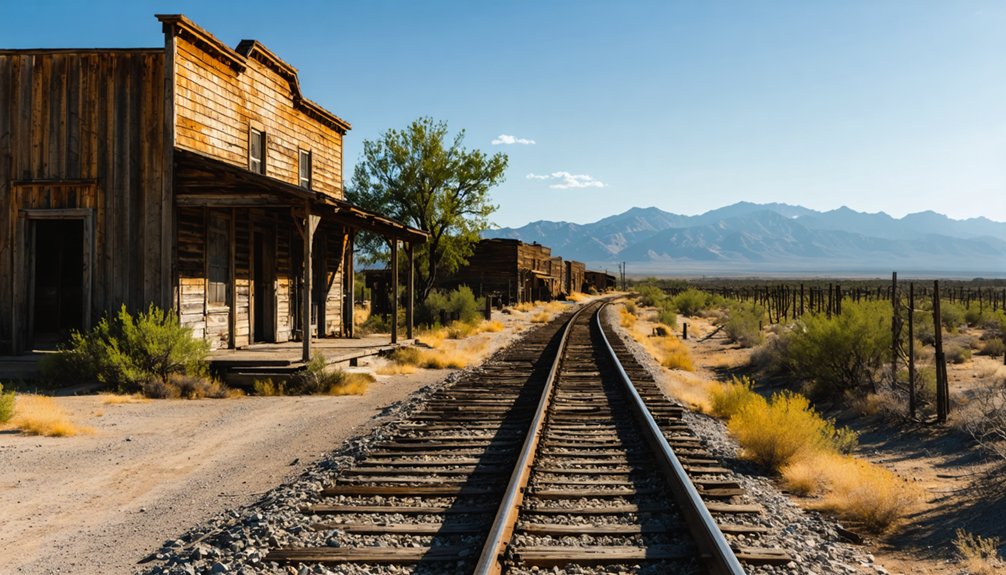
You’ll find San Antonio’s transformation during the railroad boom era represents a stark contrast to the city’s eventual abandonment.
When the Atchison, Topeka and Santa Fe Railway extended tracks through this region in the early 1880s, the town emerged as a vital water stop and supply center for mining operations in the nearby Oscura Mountains.
Contemporary accounts from railroad officials and mining engineers documented San Antonio’s rapid growth from a collection of tents to a thriving community with multiple mercantile establishments, saloons, and support services for prospectors seeking silver and gold deposits in the surrounding hills.
San Antonio’s Railroad Origins
The early obstacles included:
- San Antonio & Mexican Gulf Railroad chartered in 1850 to reach Gulf ports 130 miles away, yet construction stalled for years.
- Austin’s 1871 rail connection to Galveston prompted the U.S. Army to relocate operations, costing San Antonio military commerce.
- State land grants of 5,120 acres per mile failed to accelerate local construction.
- Political marginalization as state capital shifted to Austin, citing San Antonio’s border vulnerability.
- Isolation persisted through the 1860s while competitors secured essential links.
Mining and Economic Decline
When surveyors for the Atchison, Topeka & Santa Fe Railway prospected the Carthage (San Pedro) coal field in the 1870s and 1880s, they identified one of central New Mexico’s most promising mineral resources.
The San Pedro Coal & Coke Company, established in July 1881, transformed San Antonio into a transportation hub linking mines, smelters, and markets. Carthage coal fueled coke ovens near San Antonio and powered locomotives across the region, generating wage employment that supplemented subsistence agriculture.
At its peak, the town’s population reached approximately 1,250 residents. Yet by 1925, exhausted seams and declining demand rendered the mines unprofitable. Closure of the railroad branch line triggered economic shifts that stripped San Antonio of its primary income source, scattering miners and merchants and leaving behind only remnants of its brief industrial prosperity.
Valverde and Borderland Settlement Stories
Nestled along the Rio Grande approximately twenty miles south of Socorro, Valverde emerged around 1820 as a Hispanic farming settlement under Spanish and Mexican governance, joining a constellation of borderland villages—Plaza Viejo, Geronimo, La Mesa, and Tiffany—that sustained themselves through irrigated agriculture and ranching on the floodplain.
Valverde history centers on its role as a crossroads where Indigenous populations, Mexican settlers, and U.S. military forces converged. The 1862 Battle of Valverde marked the Confederacy’s first victory in Union territory, embedding the site in borderland conflicts narratives.
Valverde stood where Indigenous peoples, Mexican colonists, and American military interests collided in the contested borderlands of the nineteenth century.
- Battle site near Valverde Ford hosted Union-Confederate engagement on February 21, 1862
- Fort Craig’s proximity tied settlement to military supply networks
- 1929 floods destroyed San Marcial and damaged surrounding villages
- 1937 inundation buried Valverde under silt for over a year
- Post office closure in 1937 marked administrative abandonment
Architectural Remnants and Physical Evidence
While borderland settlements like Valverde vanished beneath floodwaters and silt, architectural evidence in nearby Carlsbad preserves tangible connections to nineteenth-century frontier commerce and governance.
You’ll find the Trinity Building’s 1892 brick construction exemplifies architectural styles characteristic of late frontier development, housing First National Bank of El Paso alongside Sheriff Pat Garrett’s offices. The structure’s distinctive brickwork patterns utilized local materials supplemented by Texas rail shipments, demonstrating regional building practices.
Its historical significance earned National Historic Landmark designation in 1965, despite prolonged neglect. Restoration from 2007-2009 maintained original vault systems and transom windows, offering you physical documentation of territorial banking infrastructure.
These preserved elements provide authentic counterpoints to vanished settlements, grounding regional narratives in verifiable material culture rather than mere historical speculation.
Mining Industry’s Role in Settlement Patterns
Unlike the gradual agricultural settlement that shaped earlier Pecos Valley communities, the 1925 discovery of potash deposits fifteen miles east of Carlsbad catalyzed immediate industrial transformation and demographic realignment across southeastern New Mexico.
You’ll find that labor dynamics drove settlement evolution along distinct patterns:
- Company-controlled housing clusters concentrated workers near mine shafts rather than dispersed homesteads
- Santa Fe Railroad’s 20-mile spur fixed linear settlement nodes between Carlsbad and potash operations
- 1930s consolidation into IMC Fertilizer centralized production, triggering camp abandonment
- Technological gains reduced underground labor needs, eroding single-industry town viability
- Price downturns and standby periods before 1988 recovery produced cyclical out-migration
This transportation-focused development shifted population from traditional ranching villages to rail-linked industrial hubs, setting conditions for eventual ghost-town formation.
Visiting Ghost Towns: What to Expect and Preservation Efforts
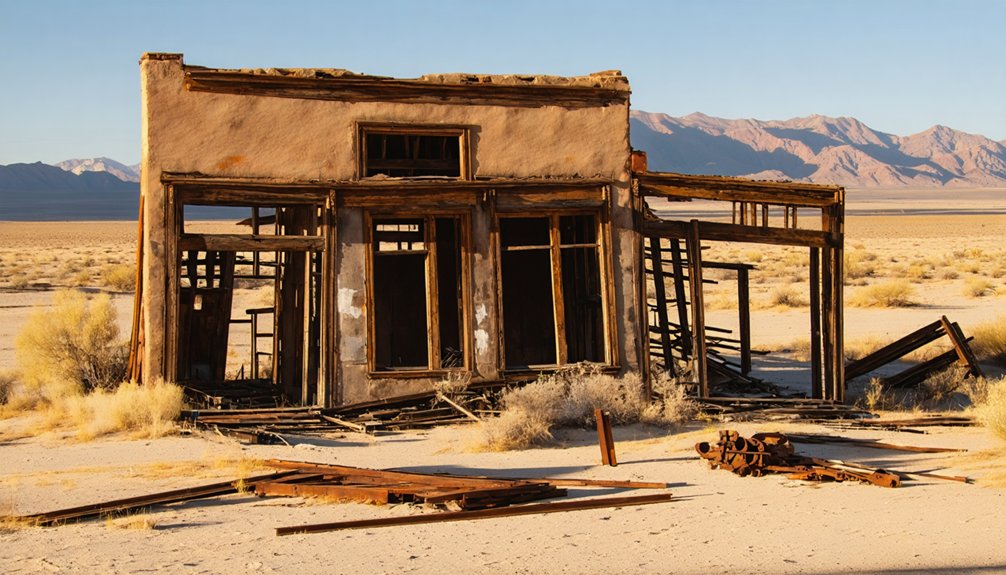
Before you set out to explore the ghost towns scattered across the potash belt east of Carlsbad, you’ll need realistic expectations about site conditions and access challenges. Many locations exist as barren sites or rubble-strewn parcels with roofless structures unsafe for entry.
Safety precautions include carrying extra water, avoiding unstable buildings, and checking weather forecasts for flash floods.
Visitor etiquette demands respecting private property boundaries, leaving artifacts undisturbed, and honoring National Register protections against vandalism.
You’ll find self-guided walking tours at some interpreted sites, though cell coverage remains unreliable.
Federal and state agencies have stabilized select schoolhouses and chapels, supporting heritage tourism through marked routes and interpretive materials that balance public access with preservation mandates.
Frequently Asked Questions
Are There Guided Tours Available for Ghost Towns Near Carlsbad?
No dedicated guided explorations depart from Carlsbad for ghost towns—you’ll chart your own course through history. Local tour companies focus on caverns instead. Primary sources confirm southeastern New Mexico’s ghost towns reward self-reliant, independent travelers seeking authentic discovery.
As you venture to explore abandoned sites near Ruidoso, you’ll uncover remnants of the past that tell stories of old mining towns and forgotten communities. Each location offers a unique glimpse into the region’s history, perfect for those who appreciate adventure off the beaten path. Pack your camera and be prepared to document the haunting beauty of these silent witnesses to time.
As you traverse the ghost towns surrounding Roswell New Mexico, you’ll find intriguing landmarks and artifacts that reveal the area’s rich heritage. Each ghost town holds its own secrets, from stories of early settlers to tales of abandoned dreams. The eerie landscapes and weathered structures create an atmosphere that invites exploration and reflection on the lives once lived there.
What Is the Best Time of Year to Visit These Ghost Towns?
Late spring (April–May) and early fall (September–October) offer the best seasons for visiting, balancing moderate temperatures, extended daylight, and reliable road access while minimizing heat stress and monsoon risks—critical weather considerations for remote exploration.
Can I Camp Overnight at Any of the Ghost Town Locations?
You’ll find virtually zero ghost town amenities for overnight stays. Camping regulations strictly prohibit unauthorized access on most private properties near Carlsbad, though you can secure landowner permission or choose nearby BLM dispersed camping sites.
Are the Ghost Towns Safe to Explore With Children?
Ghost town child safety depends on careful site selection and supervision. You’ll need exploration tips including avoiding unstable structures, watching for wildlife, bringing ample water, and choosing interpreted sites with established paths rather than unmanaged ruins.
Do I Need Special Permits to Photograph the Abandoned Buildings?
You’ll need permits for commercial photography on private property or state lands, though personal snapshots from public roads typically don’t require authorization. Photography regulations vary by land ownership; equipment considerations like tripods or crews often trigger permit requirements regardless of intent.
References
- https://newmexicotravelguy.com/new-mexico-ghost-towns/
- https://www.newmexico.org/places-to-visit/ghost-towns/
- https://klaq.com/glenrio-ghost-town-texas-new-mexico/
- https://www.newmexicoghosttowns.net/counties
- https://nmplates.com/NewMexicoTowns.htm
- https://en.wikipedia.org/wiki/List_of_ghost_towns_in_New_Mexico
- https://www.newmexico.org/places-to-visit/ghost-towns/map/
- https://www.youtube.com/watch?v=_DizImYWjw0
- https://www.co.eddy.nm.us/248/About-Eddy-County
- https://agmc.info/wp-content/uploads/simple-file-list/New-Mexico-documents/New_Mexico_Mining_History.pdf