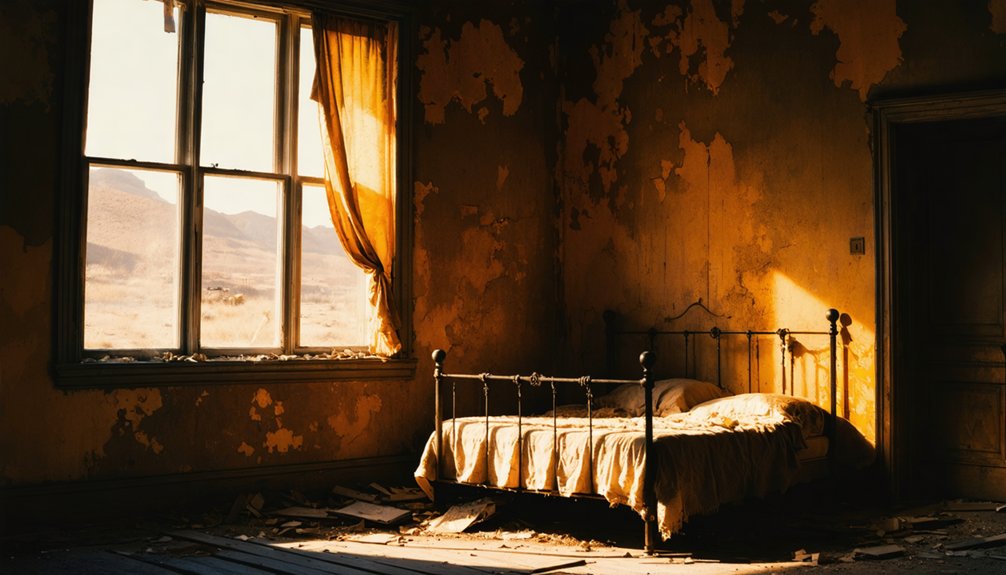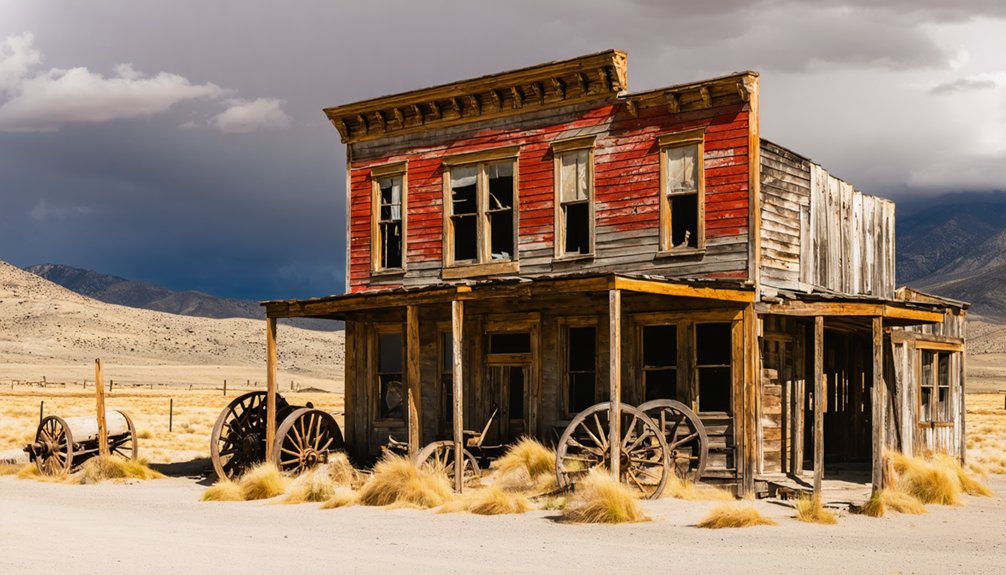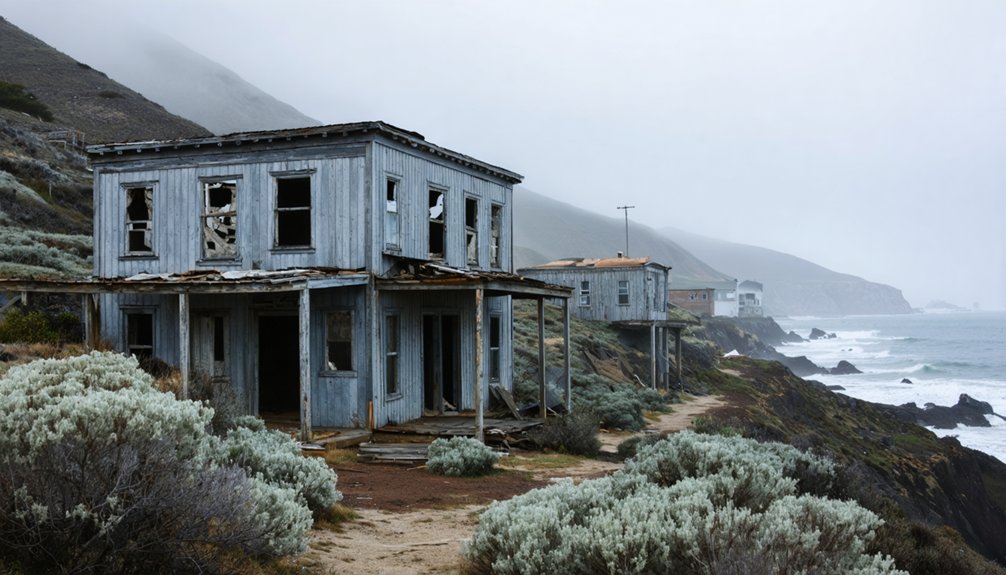
You’ll find ghost towns in three distinct zones radiating from Channel Islands National Park: preserved 1880s-1900s ranch complexes like Scorpion and Smuggler’s on Santa Cruz Island itself, Purissima’s flood-abandoned 1850s agricultural settlement 200 miles north along Purisima Creek near Half Moon Bay, and Mojave Desert mining camps including Calico (200 miles east) and Bodie State Historic Park (300 miles northeast at 8,379 feet elevation). Each site documents California’s boom-and-bust cycles through ranching, maritime industries, and mineral extraction between 1850-1920, with routes requiring strategic planning across coastal, island, and desert terrain.
Key Takeaways
- Channel Islands National Park preserves abandoned ranches from 1885–1906, including Scorpion Ranch and Smuggler’s Ranch House on Santa Cruz Island.
- San Miguel Island features Lester Ranch ruins with cement-lined cisterns and collapsed structures from the early 1900s ranching era.
- Remnant fishing camps from the 1850s–1900s mark seasonal occupation zones utilized by multiethnic maritime labor crews across the islands.
- World War II military lookout stations, barracks, and radar installations remain as relics across nine Channel Islands locations.
- Mainland ghost towns like Calico and Bodie lie 200 miles inland, requiring a two-day Ventura stay for island ferry access.
Understanding the Channel Islands’ Unique Geographic Position for Ghost Town Exploration
Channel Islands National Park occupies a strategic position 12 to 70 miles off California’s southern coast, creating a unique spatial relationship with the mainland’s historical settlement patterns.
The Channel Islands’ offshore positioning provides critical geographic context for understanding mainland coastal settlement development and abandonment patterns.
You’ll find the park’s geography establishes a compelling base for exploring abandoned settlements along the Ventura and Santa Barbara County coastlines. Ghost town accessibility improves when you understand the islands serve as offshore reference points for steering coastal exploration routes.
The archipelago’s isolation mirrors the remoteness that defined many mainland communities now abandoned. You can trace transportation corridors that once connected coastal settlements to inland resources, revealing why certain towns thrived while others failed.
Historical records document the region’s boom-and-bust cycles, where maritime trade, ranching, and resource extraction shaped settlement viability. The park achieved national park designation on March 5, 1980, marking a turning point in regional conservation efforts that influenced coastal land use patterns. The 1969 Santa Barbara oil spill dramatically altered coastal development patterns and contributed to the abandonment of certain industrial settlements in the region. This geographic framework helps you identify promising ghost town locations worth investigating.
Abandoned Ranches and Maritime Settlements Within the Park Boundaries
You’ll find Channel Islands National Park preserves several documented ranch complexes spanning 1885–1906, distributed across Santa Cruz and San Miguel islands in distinct settlement zones.
The archipelago’s ranching infrastructure concentrated at three key sites: Scorpion Ranch (1887) and Smugglers Ranch House (1889) on Santa Cruz’s eastern sector, plus Lester Ranch (1906) on windswept San Miguel.
These abandoned settlements reveal spatial patterns linking sheltered anchorages to grazing lands, with archival records and standing ruins documenting the shift from Chumash villages through Euro-American ranching to eventual National Park incorporation.
Smuggler’s Ranch served as headquarters for managing the island’s eastern operations, housing laborers who worked the olive orchards and vineyards that characterized the era’s self-sufficient agricultural system.
The Lester Ranch house stood as the island’s largest structure, measuring 125 feet long and constructed from salvaged shipwreck materials before burning down in 1967 during Navy weapons testing.
Historic Island Ranch Ruins
Five major islands within Channel Islands National Park preserve scattered remnants of 19th and early 20th-century ranching complexes, their stone foundations and wind-scarred ruins documenting a century-long period when livestock operations fundamentally reshaped these offshore environments.
You’ll find San Miguel’s Lester Ranch ruins—125 feet of double-walled construction from salvaged shipwreck lumber—burned in 1967 during Navy weapons testing. Only cement-lined cisterns, collapsed chimneys, and metal hardware remain. Waters constructed the island’s first road, which now serves as a hiking trail for park visitors.
On Santa Cruz Island, Smuggler’s Ranch House stands as exceptional ranching heritage: two-story rock masonry incorporating limestone from adjacent quarries, surrounded by tool sheds, stables, and corrals. The restored ranch house, built in 1889, originally served agricultural and hunting purposes before the island’s eventual transfer to park management.
The National Park Service now manages these sites for cultural preservation, protecting structures that witnessed George Nidever’s 1850s livestock expansion and the subsequent overgrazing that buried earlier homesteads beneath advancing sand drifts.
Abandoned Fishing Camp Remains
Scattered along accessible coves and reef-adjacent shorelines, the remnant fishing camps of Channel Islands National Park mark seasonal occupation zones where Chinese, Japanese, Aleut, and Euro-American crews harvested abalone, fish, and pinnipeds from the 1850s through the early 1900s.
You’ll find collapsed camp pads, bottle debris, iron hardware, and eroded footpaths above productive kelp forests—physical evidence of intensive commercial extraction that preceded federal protection.
These sites hold significant cultural significance, documenting multiethnic maritime labor and the shift from exploitative industries to conservation management.
Archaeological preservation efforts prove challenging where fishing camp deposits intermingle with Native Chumash middens spanning 13,000 years.
Federal interest in protecting these islands and their resources was documented as early as 1915, when calls emerged for protective measures for channel seals, sea birds, and food fishes.
Today’s controlled access protects these layered archaeological zones from further disturbance while revealing how unrestricted resource extraction ultimately necessitated the regulatory boundaries you navigate within.
Military Lookout Post Relics
When the War Department mobilized coastal defenses following Pearl Harbor, nine military lookout stations materialized across the Channel Islands by May 27, 1942, transforming remote island peaks into nodes of a continuous surveillance network stretching from Anacapa to San Nicolas.
You’ll find military relics scattered across these windswept outposts—crumbling lookout towers, decaying barracks, and rusted radio antenna foundations where seven-man crews maintained 24-hour surveillance.
Each station bore distinct telegraph call signs: NSK1 for Anacapa, NPK4 for San Miguel.
Beyond coastal surveillance, the Navy established radar installations on Santa Barbara and Santa Rosa Islands, where sixteen wood-frame structures housed detection equipment and personnel.
The radar site included a buried concrete radio building and operations bunker alongside a generator house and storage facilities.
Personnel rotated on a schedule of two weeks on, one week off, reporting maritime activity and submarine sightings to headquarters in San Diego.
These installations dissolved after Midway diminished Japan’s Pacific threat, leaving skeletal infrastructure where government surveillance once governed ocean approaches.
Purissima: California’s Forgotten Coastal Ghost Town Near Half Moon Bay
About 400 miles north of Channel Islands, you’ll find Purissima’s remnants near Half Moon Bay, where early 1850s homesteaders transformed José María Alviso’s former rancho lands into one of San Mateo County’s first coastal farming settlements.
By the 1860s, the Dobbels family had assembled roughly 1,000 acres and employed 50 men to cultivate wheat, barley, and potatoes, while lumber mills processed Santa Cruz Mountains redwood at Purissima Canyon’s mouth.
The catastrophic January 1862 flood that devastated California destroyed Purissima Creek’s fields and buildings, initiating decades of repeated crop failures and infrastructure damage that ultimately reduced the town to the “ghostly and deserted” ruins documented in the 1939 Federal Writers’ Project guide.
Purissima’s Mid-1800s Agricultural Origins
Nestled along the fertile bottomlands of Purisima Creek approximately four miles south of present-day Half Moon Bay, the village of Purissima emerged in the early 1850s as one of the San Mateo County coast’s earliest agricultural settlements.
You’ll find this community developed on José María Alviso’s Rancho Cañada de Verde y Arroyo de la Purisima, where vague land-ownership status attracted independent-minded settlers seeking farming opportunities beyond established authority.
The agricultural landscape supported crop farming, livestock raising, and complementary logging operations that served Half Moon Bay and San Francisco markets.
Settlement patterns followed the canyon corridor, with farmsteads radiating from a central cluster housing a general store, blacksmith shop, and hotel.
1862 Flood and Decline
Although Purissima’s agricultural foundations appeared solid through the 1850s, the catastrophic January 1862 flood of Purisima Creek marked the settlement’s first existential crisis.
You’ll find archival accounts documenting how floodwaters swept away fields and buildings in the low-lying creek area, exposing the townsite’s vulnerability to overflow and unstable riparian soils.
The flood impact strained limited local capital needed for rebuilding agricultural infrastructure. Yet 1862 wasn’t an isolated event—the settlement remained plagued with floods and crop failures throughout subsequent decades.
This environmental instability eroded soil productivity, discouraged new investment, and undermined the ranching economy that sustained the community.
Calico Ghost Town as a Classic Southern California Desert Detour
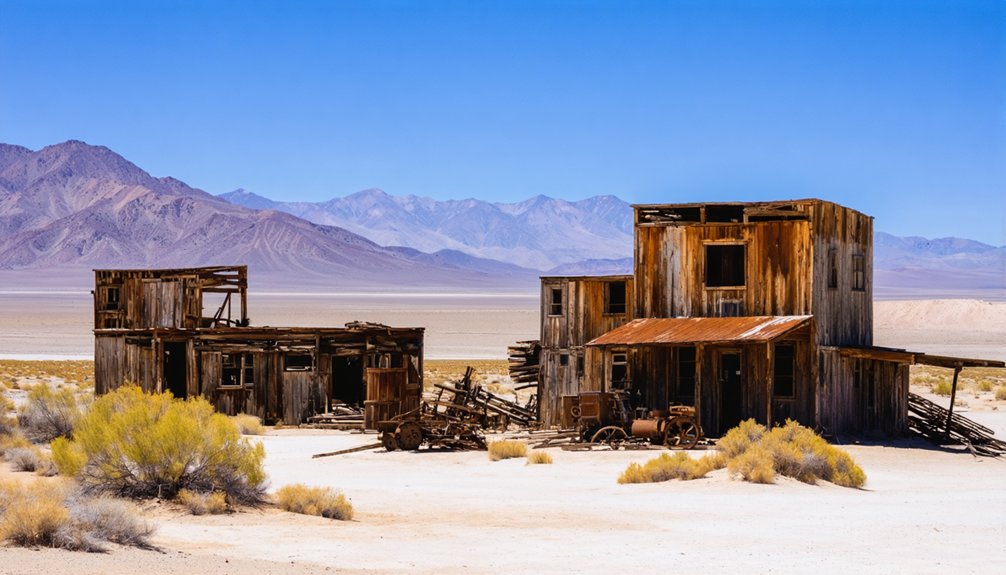
Three miles north of Interstate 15, midway between Barstow and Yermo, Calico Ghost Town occupies a strategic position in California’s Mojave Desert that transforms it into an accessible detour for travelers journeying between Southern California’s coastal attractions and the state’s interior destinations.
You’ll find Calico history preserved through Walter Knott’s 1951 restoration, which reconstructed the 1880s silver mining camp using archival photographs as architectural blueprints. The site operates daily from 9 AM to 5 PM as a San Bernardino County Regional Park, offering ghost town tourism that’s become California’s most visited historic mining settlement.
Five original structures stand alongside meticulously rebuilt false-front stores and saloons, while the Maggie Mine’s 1,000-foot public tunnels let you explore passages that yielded $13 million in silver ore.
Bodie State Historic Park and the Eastern Sierra Ghost Town Circuit
High above the Mono Basin at 8,379 feet, Bodie State Historic Park anchors the Eastern Sierra ghost town circuit as California’s premier preserved Gold Rush settlement, positioned 13 miles east of Highway 395 along a graded road that climbs from sagebrush flats into the wind-scoured eastern Sierra Nevada.
You’ll find 110–170 structures maintained in “arrested decay”—stabilized but unrestored, interiors still stocked with original artifacts from the 1880s boomtown that housed 8,000–10,000 residents.
Eastern Sierra Ghost Town Circuit Highlights:
- Aurora (Nevada border): Scant foundations mark this 1860s rival camp
- Masonic (northeast of Bridgeport): Stone ruins amid pinyon forest
- Lundy (Lake Lundy): Mill remnants along a glacial canyon
- Benton (Highway 120): Scattered frame structures, active ranching
Bodie preservation sets the standard for ghost town tourism across Mono County’s mining heritage landscape.
In addition to Bodie, there are several ghost towns near Arches National Park that offer a unique glimpse into the past. These forgotten settlements, now crumbling relics of a bygone era, attract history enthusiasts and adventurers alike. Exploring these sites provides a fascinating contrast to the iconic natural beauty of the surrounding landscapes.
Planning Your Combined Channel Islands and Ghost Town Road Trip Itinerary
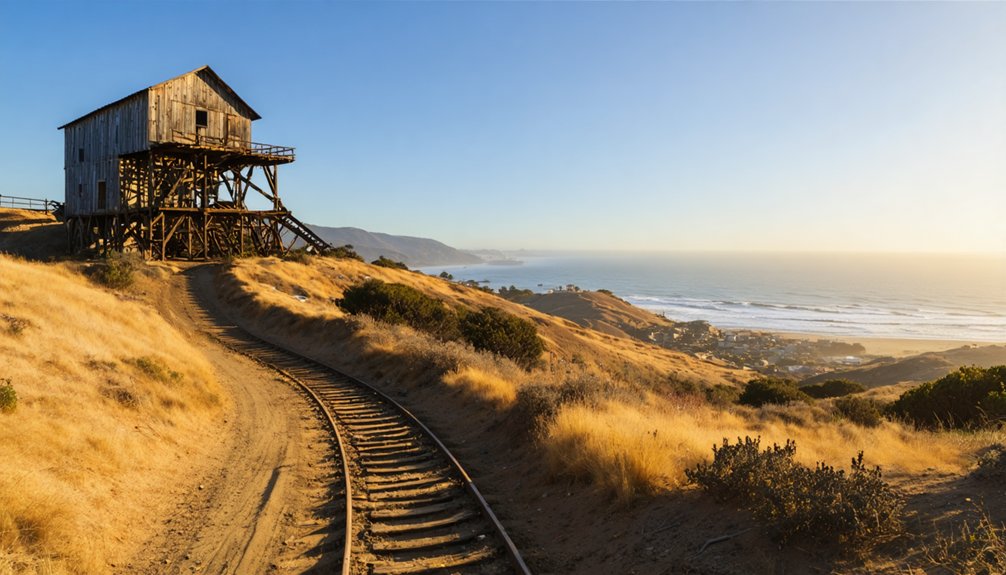
Bridging the 200-mile gap between Ventura’s island-ferry docks and the Mojave’s scattered mining camps requires strategic sequencing that accounts for marine departure schedules, desert thermal windows, and the 3,000–5,000-foot elevation swings separating coastal Channel Islands National Park from high-desert ghost towns like Randsburg and Ballarat.
Anchor two days in Ventura for Santa Cruz or Anacapa crossings, then pivot inland through Bakersfield toward Calico and Randsburg before nightfall. Late spring and autumn offer calm Channel Islands seas paired with sub-90°F desert afternoons.
Reserve ferries weeks ahead; confirm Ballarat road conditions via Ridgecrest ranger stations. This 5–7-day loop demands full fuel tanks, backup water caches, and flexible timing—marine fog or flash-flood closures can compress or expand segments unpredictably, rewarding those who embrace route improvisation over rigid itineraries.
Frequently Asked Questions
Are Guided Ghost Town Tours Available From Ventura or Santa Barbara Harbors?
No guided ghost town tours sail from these harbors—you’ll find only Channel Islands boat trips focused on island history and marine adventures. Authentic ghost towns lie inland, requiring overland freedom to explore California’s desert and mountain archives independently.
Can I Camp Overnight at Abandoned Ranch Sites on the Channel Islands?
No, you can’t camp at abandoned ranch sites. Camping regulations restrict overnight stays to designated campgrounds only—Del Norte, Scorpion, and beach zones—protecting both island safety and fragile historical resources throughout the archipelago.
What Ghost Towns Existed Historically on the California Channel Islands Themselves?
The islands hosted ranch-based historic settlements—Scorpion Ranch, Smugglers Cove, Vail & Vickers headquarters—rather than true towns. You’ll find these abandoned complexes shaped island ecology through livestock operations, documented in archival records and archaeological surveys today.
Which Ghost Town Is Closest Driving Distance From Channel Islands Boat Harbors?
Mentryville stands nearest at 70–80 miles from Channel Islands Harbor—you’ll trade coastal breezes for canyon oilfields in 1.5–2 hours. This ghost town history showcases California’s petroleum past among local attractions, documented through preserved 19th-century structures.
Do Any Ghost Towns Require Permits or Reservations to Visit Year-Round?
Most ghost towns you’ll explore operate without year-round permit requirements. Bodie State Historic Park charges entrance fees and occasionally restricts winter access, while Ballarat and Calico use informal visiting guidelines rather than mandatory reservation systems.
References
- https://www.flyingdawnmarie.com/new-blog/silver-city-ghost-town
- https://www.youtube.com/watch?v=bz6XtozCSMg
- https://www.visittheusa.com/experience/5-us-ghost-towns-you-must-see
- https://parks.sbcounty.gov/park/calico-ghost-town-regional-park/
- https://www.visitcalifornia.com/road-trips/ghost-towns/
- https://www.tripadvisor.com/Attractions-g28926-Activities-c47-t14-California.html
- https://paintyourlandscape.com/2012/10/30/the-town-that-man-could-neither-tame-nor-sustain-bodie-ca/
- https://www.nps.gov/subjects/abandonedplaces/ghost-towns.htm
- https://en.wikipedia.org/wiki/Channel_Islands_National_Park
- https://www.nps.gov/articles/nps-geodiversity-atlas-channel-islands-national-park-california.htm