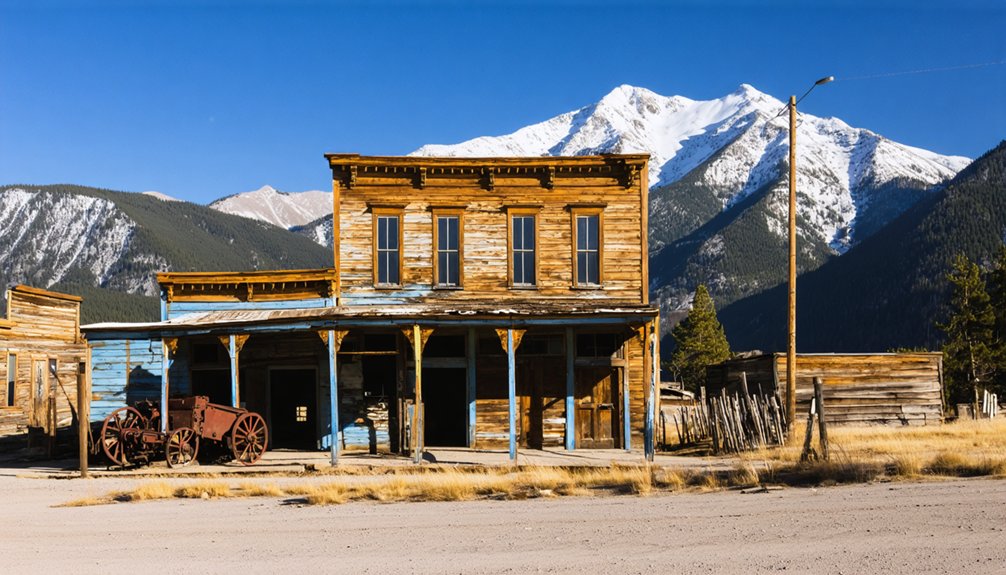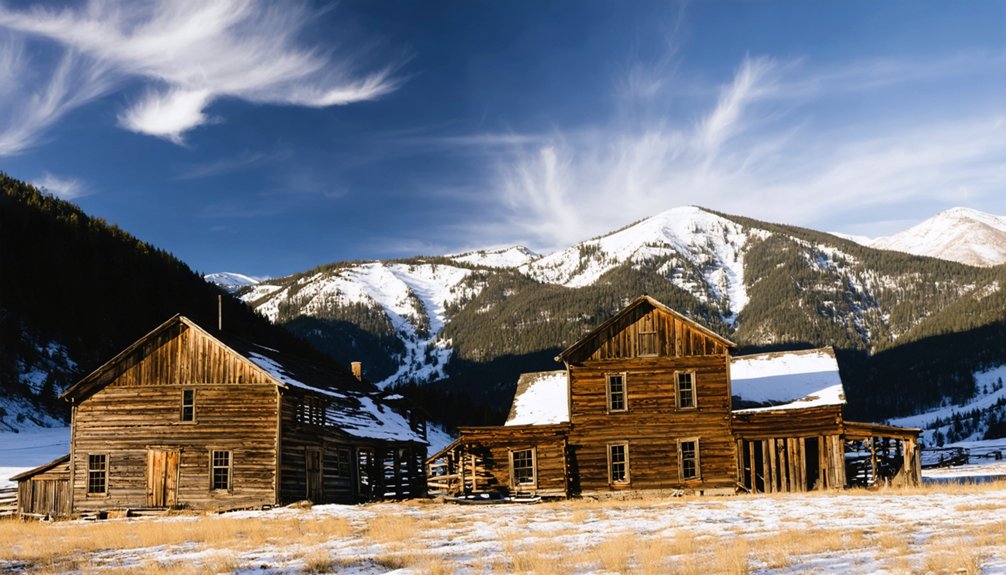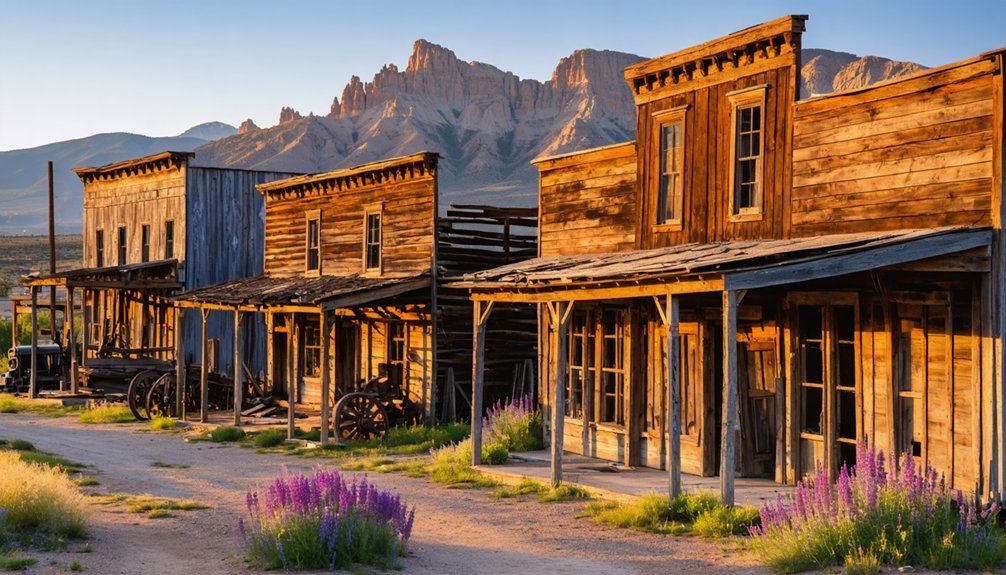
You’ll find Colorado’s most accessible ghost towns within 90 minutes of Colorado Springs, clustered around the Cripple Creek–Victor Mining District. St. Elmo stands out with 43 intact structures along its original 1880s Main Street, while Goldfield offers Gothic architecture and wooden sidewalks just off paved CO 67. These settlements emerged during the 1870s prospecting rush but largely emptied after 1893’s silver devaluation. Access varies from standard vehicles on maintained roads to high-clearance 4WD for remote mine camps, with summer providing the most reliable conditions for exploration.
Key Takeaways
- El Paso County features historic ghost towns like St. Elmo, Goldfield, Cripple Creek, and Victor from Colorado’s 1870s mining boom.
- St. Elmo preserves 43 original structures along its 1880s Main Street with an operational general store and restored schoolhouse.
- Goldfield offers accessible exploration via paved CO 67, featuring Gothic architecture, wooden sidewalks, and reported paranormal activity.
- Summer provides optimal visiting conditions, while winter snow blocks high-elevation routes and afternoon thunderstorms require morning departures.
- Bring offline GPS, paper maps, high-clearance 4WD for remote sites, extra water, layered clothing, and emergency supplies.
El Paso County’s Rich Ghost Town Legacy
El Paso County’s ghost town legacy emerged from Colorado’s late nineteenth-century mining boom, when silver discoveries transformed the region’s settlement patterns and economic landscape.
You’ll find remnants of communities like Gwillimsville, Hamilton, and Hancock scattered across the territory, each representing the county’s robust Mining Heritage. These settlements sprang up rapidly during the 1870s prospecting rush, complete with railroad stations, processing mills, and supporting infrastructure.
Prospecting fever built entire towns overnight—with railroad stations, mills, and infrastructure sprouting across El Paso County’s mining territory.
The 1893 silver devaluation triggered widespread abandonment, forcing an Economic Shift that left entire towns deserted overnight. Some communities adapted through ranching and agriculture, while others simply vanished. Many mining towns also served as mill towns, processing ore from nearby camps, and when the mines closed, these mill towns abandoned their operations as well.
Today’s ghost towns—from Old Zounds to McFerran—preserve physical evidence of this volatile period, offering you tangible connections to Colorado’s frontier past through remaining structures, railroad beds, and cemetery sites. These abandoned settlements’ cemeteries serve as lasting markers of the communities that once thrived, honoring generations of workers and their families who built their lives around the mining industry.
Goldfield and Other Nearby Abandoned Settlements
The town’s mining legacy extends beyond ore extraction into labor conflicts.
Camp Goldfield hosted National Guard troops during regional strikes, and authorities detained miners in a “bull pen” outside city limits.
Today, you’ll find the Gothic-style town hall still standing amid golden fields, wooden sidewalk remnants, and scattered mine sites—tangible evidence of Colorado’s industrial past.
The location has attracted paranormal investigators who report hearing mournful voices and witnessing apparitions throughout the abandoned structures.
Unlike typical frontier settlements, Goldfield’s union-led government outlawed prostitution and required licenses for all businesses.
The Cripple Creek–Victor Mining District
Southwest of Pikes Peak, a volcanic intrusion created one of North America’s richest gold deposits—the Cripple Creek–Victor Mining District.
You’ll find this legendary landscape once yielded over 21 million ounces from more than 500 mines, earning its historical significance as America’s second-largest gold mining district.
The 1891 discovery at Poverty Gulch transformed cattle ranches into the “$300 million cow pasture,” spawning Cripple Creek and Victor—the latter dubbed “City of Mines” for shafts honeycombing its streets.
During the 1890s boom, this district minted over 30 millionaires and modernized rapidly with electricity and telephones.
Two railroads connected Cripple Creek by 1895, linking the mountain gold camp to Colorado Springs and expanding access for both miners and supplies.
Though peak production ended around 1904, gold mining never truly stopped here.
Modern open-pit operations continue extracting wealth from these volcanic hillsides, while historic structures remind visitors of frontier prosperity.
Cripple Creek’s prosperity supported seventy-five saloons, two opera houses, eight newspapers, and even a stock exchange by the turn of the century.
From Gold Rush Boom to Silent Ruins
Cripple Creek and Victor represent rare survivors in a landscape littered with failed dreams. Throughout the Pikes Peak region, you’ll find ghost town history written in collapsed cabins and overgrown trails where thousands once sought fortune.
The “Pikes Peak or Bust” fever of 1858 triggered a pattern repeated across the Rockies: prospectors rushed in, tent camps evolved into boomtowns with schools and newspapers, then populations vanished when ore ran out.
Mining techniques shifted from simple placer panning to costly hard-rock operations, but falling prices and depleted deposits doomed most camps. Towns like Vicksburg peaked at 700 residents before emptying completely.
Today you’ll discover weathered false-front buildings, rusted mine machinery, and foundations marking where hope once flourished—tangible reminders of Colorado’s boom-and-bust cycle. Railroads expanded into the Colorado mountains, connecting remote mining camps to the outside world and enabling both the rapid growth and eventual abandonment of frontier settlements. Preservation of these sites is encouraged to ensure future visitors can experience this unique glimpse into Colorado’s mining heritage.
What to Expect When Visiting Ghost Towns
When you explore ghost towns near Colorado Springs, you’ll encounter varying conditions from well-preserved wooden structures to scattered foundation stones barely visible among sagebrush.
Access ranges from paved roads leading to maintained sites like South Park City to rugged four-wheel-drive trails requiring high-clearance vehicles for remote locations such as Animas Forks.
Mountain elevations between 8,000 and 12,000 feet mean summer visits offer the most reliable access, while winter snow closures and afternoon thunderstorms during monsoon season can restrict your exploration window.
For a more accessible introduction to the Old West, the Ghost Town Museum in Colorado Springs offers a reconstructed experience with artifacts from miners and cowboys without requiring mountain travel. The museum also features interactive activities including gold panning and butter churning that bring pioneer life to hands-on reality.
Accessibility and Trail Conditions
Ghost towns near Colorado Springs present varied accessibility conditions depending on their historical preservation status and geographic location.
You’ll find paved roads leading to St. Elmo via County Road 162 and Ashcroft along Castle Creek Road, while Silver Plume sits directly off I-70 with minimal off-roading required.
Trail maintenance varies considerably across sites, with gravel and dirt surfaces common throughout the region. These paths can turn muddy during wet weather and snowy in winter months.
For wheelchair access, you’ll encounter challenges on natural terrain with uneven surfaces.
However, El Paso County’s Trailability Program offers TerrainHopper reservations for Bear Creek and Fountain Creek parks.
Contact visitor centers beforehand to assess current conditions, particularly during inclement weather when standard accessibility becomes compromised.
Preserved Structures vs. Ruins
Once you arrive at a Colorado ghost town, the spectrum of preservation will shape your entire experience. Near Colorado Springs, you’ll encounter everything from complete ruins—scattered foundations and collapsed cabins at Bowerman or Hancock—to largely intact streetscapes at St. Elmo, where original false-front storefronts retain 19th-century wallpaper and flooring.
Preservation techniques vary dramatically: Animas Forks features stabilized roofs and shatter-resistant windows, while museum-style sites like South Park City offer reassembled buildings with curated interiors. Specialized structures, particularly jails built with thick timbers, often outlast residential buildings.
Interpretive panels and outdoor audio guides boost visitor engagement at partially ruined sites, letting you reconstruct town layouts despite minimal standing structures. Museum settings in Colorado Springs preserve original siding and artifacts that field conditions would destroy.
Seasonal Weather Considerations
- Winter/early spring: Deep snow blocks most high-elevation routes; many towns become completely inaccessible until June.
- Summer: Afternoon thunderstorms bring lightning, hail, and flash flooding on unpaved roads—plan morning departures.
- Year-round risks: Sudden weather shifts occur even on clear days; pack layers and rain gear.
- Road conditions: 4×4 high-clearance vehicles essential; mud and water crossings common after storms.
Getting There: Roads, Trails, and Vehicle Requirements
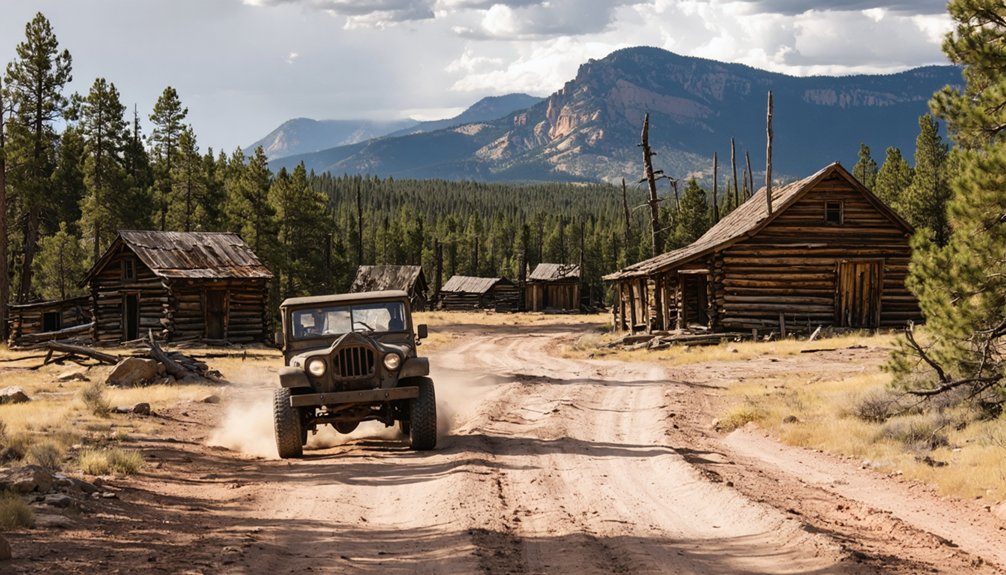
Accessing ghost towns near Colorado Springs requires matching your vehicle to the road ahead.
Tourist-friendly sites like Goldfield reach via paved CO 67, with standard 2WD adequate in dry conditions. Remote mine camps demand high-clearance 4WD—rutted Forest Service spurs and shelf roads like Phantom Canyon present serious access challenges.
Road conditions deteriorate rapidly during mud season and summer monsoons, when washouts and rockfall multiply. Vehicle clearance becomes critical on washboarded historic routes; low sedans risk costly underbody damage.
Seasonal restrictions close higher-elevation roads through winter, while gates protect roadbeds during thaw. Trail markings often vanish on backcountry tracks, and cell coverage disappears miles before you arrive.
Weather impacts can strand unprepared travelers, with recovery fees reaching hundreds of dollars. Conservative ghost town navigation prioritizes driving safety over ambition—know your route, check forecasts, and respect road maintenance closures.
St. Elmo and the Best-Preserved Towns Within Driving Distance
Among Colorado’s scattered mining camps, St. Elmo stands as the benchmark for historic preservation.
You’ll find 43 intact structures lining the original 1880s dirt Main Street, creating one of the state’s most complete ghost town experiences. The Saint Elmo Historic District’s National Register status confirms its architectural integrity.
What makes St. Elmo exceptional:
- Dense commercial core with false-front storefronts, hotel, and residences preserving the 1880–1922 railroad-era streetscape
- Operational general store in original building, plus restored schoolhouse with period exhibits
- Chalk Creek setting surrounded by visible mine sites and fir-covered slopes at 10,000 feet
- Accessible recreation on former mining grades for off-road vehicles and hiking
Despite the 2002 fire destroying six buildings, St. Elmo remains Colorado’s most visually cohesive mining town.
High-Elevation Ghost Towns in Central Colorado
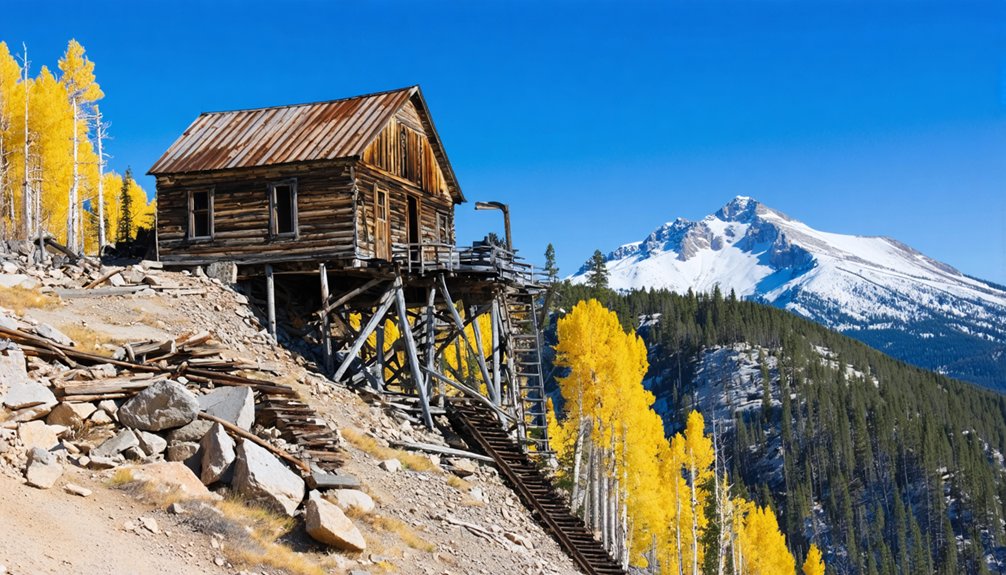
While most Colorado ghost towns cluster between 8,000 and 10,000 feet, the state’s highest-elevation mining camps pushed beyond 11,000 feet into alpine terrain where nine-month winters and snowpack depths exceeding 20 feet eventually forced abandonment.
Independence, accessible via Independence Pass, sits near 11,000 feet where gold discoveries on July 4, 1879 sparked rapid growth to 1,500 residents. Severe 1899 snowstorms cut supply lines, triggering mass evacuation.
Gold rush prosperity crumbled overnight when relentless blizzards isolated Independence’s 1,500 residents, forcing desperate evacuation in 1899.
These high altitude settlements required extraordinary determination—miners faced October-through-May snow seasons and constant avalanche threats.
Animas Forks, along the Alpine Loop near Silverton, reached 11,200 feet and housed over 1,000 people despite frequent avalanches.
Carson, positioned near the Continental Divide at 12,000 feet, exemplifies Colorado’s extreme mining history. Each site preserves wood-frame buildings documenting the state’s most audacious resource extraction ventures.
Ghost Town Museum: An Indoor Alternative
For visitors seeking Colorado’s ghost town heritage without traversing remote mountain roads or unpredictable high-country weather, the Ghost Town Museum at 400 S. 21st Street offers a fully indoor alternative on Colorado Springs‘ west side.
Founded in 1954, this preservation project rescues authentic buildings and historic artifacts from abandoned Pikes Peak region settlements, assembling them inside an 1899 Colorado Midland Railway stone building.
Your indoor exploration includes:
- Authentic storefronts and boardwalks recreating an 1880s–1900s mining town
- Thousands of period artifacts from regional ghost towns, including tools, household goods, and commercial fixtures
- Seasonal gold panning (May–September) with running sluices simulating prospector techniques
- Interactive stations featuring butter churns, printing presses, and antique arcade games
This year-round, weather-proof venue provides convenient access to Colorado’s frontier heritage without lengthy backcountry drives.
Planning Your Ghost Town Adventure
You’ll find the best conditions for exploring ghost towns near Colorado Springs from late spring through early fall, when unpaved roads are passable and high-elevation sites like those in the Cripple Creek–Victor district become accessible.
One of the lesser-known adventures in the area includes exploring abandoned mines near South Fork Colorado, where you can delve into the region’s rich history of mining. These sites often offer breathtaking views and a glimpse into the past, making them a must-see for history enthusiasts. Remember to bring appropriate gear, as some of these mines can be challenging to access.
Your vehicle choice matters: while St. Elmo accommodates standard cars, remote sites such as Animas Forks demand high-clearance or 4×4 capability due to steep mining roads and creek crossings.
Pack essential mountain safety gear—water, layered clothing, offline maps, and emergency supplies—since cell coverage disappears quickly and services remain sparse beyond the Woodland Park corridor.
Best Seasons For Visits
Timing your ghost town expedition around Colorado’s dramatic seasonal swings can mean the difference between an easy roadside stop and a full backcountry commitment.
Each season reshapes access to ghost town history and seasonal photography opportunities near Colorado Springs.
Optimal visiting windows:
- Late September–early October delivers peak aspen color around mining sites, mild weather, reduced crowds, and reliable high-country access before snowfall.
- July–August opens maximum routes to remote camps above 9,000 feet, though afternoon thunderstorms demand early starts and lightning awareness.
- Mid-October–November offers “spooky season” solitude at lower elevations like Cripple Creek, while high passes close unpredictably.
- Winter transforms accessible sites into snowshoe destinations, requiring avalanche knowledge and backcountry skills for any high-elevation exploration.
Essential Gear And Vehicles
The rusted frames and weathered timbers scattered across Colorado’s high country demand more than curiosity—they require vehicles and equipment matched to the hostile terrain that isolated these mining camps in the first place.
High-clearance 4×4s with low range handle the rocky shelf roads and steep Alpine Loop approaches that standard sedans can’t navigate. Gear recommendations include tow straps, shackles, traction boards, full-size spare, tire plug kit, and portable compressor for the puncture-prone mining routes.
Pack redundant navigation tools—offline GPS plus paper maps—since cell coverage vanishes in these canyons. Load double your expected water, layered clothing for rapid temperature swings, and sun protection rated for high elevation.
Verify vehicle capabilities against route difficulty ratings and confirm seasonal road openings with county agencies before departure.
Frequently Asked Questions
Are Ghost Towns Near Colorado Springs Safe to Explore With Children?
Ghost town safety varies considerably—remote sites pose serious risks from unstable structures, open mine shafts, and harsh mountain conditions. You’ll find kid friendly exploration at managed sites like Colorado Springs’ Ghost Town Museum, offering controlled heritage experiences without backcountry hazards.
Can I Camp Overnight at Ghost Town Sites Near Colorado Springs?
You’ll rarely find legal overnight camping directly at ghost town sites—54% of Colorado is private land. Check camping regulations and ownership first, then practice ghost town etiquette by using designated dispersed sites nearby on public land.
Do I Need Permits to Visit Ghost Towns in El Paso County?
You don’t need permits for passive exploration on public land or with landowner permission. Permit requirements kick in only for construction, grading, or site disturbance. Respect exploring etiquette: leave artifacts untouched and honor property boundaries.
What Wildlife Might I Encounter When Exploring Remote Ghost Town Areas?
Like shadows emerging from canyon walls, your remote exploration may reveal chipmunks, deer, and various bird species. Rattlesnakes inhabit desert areas, while high-elevation sites harbor specialized alpine wildlife. You’ll encounter fewer large mammals near heavily-trafficked zones.
Are Metal Detectors or Artifact Collecting Allowed at Colorado Ghost Towns?
Metal detecting regulations and artifact preservation laws heavily restrict collecting at Colorado ghost towns. You’ll face federal ARPA rules on public land, municipal codes prohibiting retention, and private-property barriers—most artifact collecting remains illegal without permits.
References
- https://en.wikipedia.org/wiki/List_of_ghost_towns_in_Colorado
- https://www.uncovercolorado.com/ghost-towns-near-me-colorado/
- https://alissapeterson.com/blog/discover-the-spookiest-colorado-ghost-towns
- https://www.colorado.com/articles/colorado-ghost-towns
- https://www.uncovercolorado.com/ghost-towns/
- https://www.americansky.co.uk/colorado-holidays/exploring-colorados-ghost-towns
- https://www.geotab.com/ghost-towns/
- https://www.pikes-peak.com/attractions/ghost-town-museum/
- https://borderzine.com/2012/11/smelter-town-–-a-personal-look-at-a-ghost-town-firmly-embedded-in-el-paso-history/
- https://janmackellcollins.wordpress.com/category/colorado-ghost-towns-2/