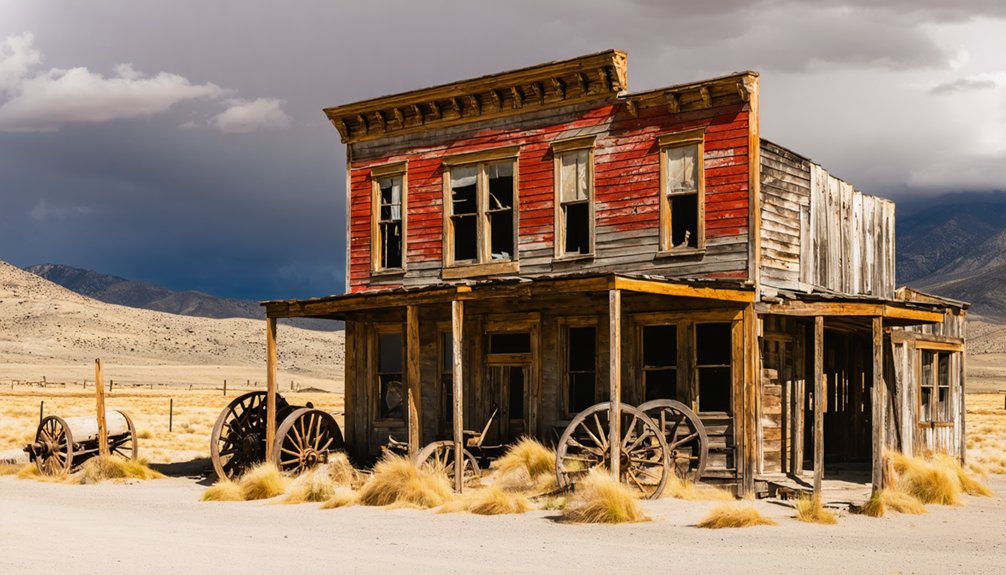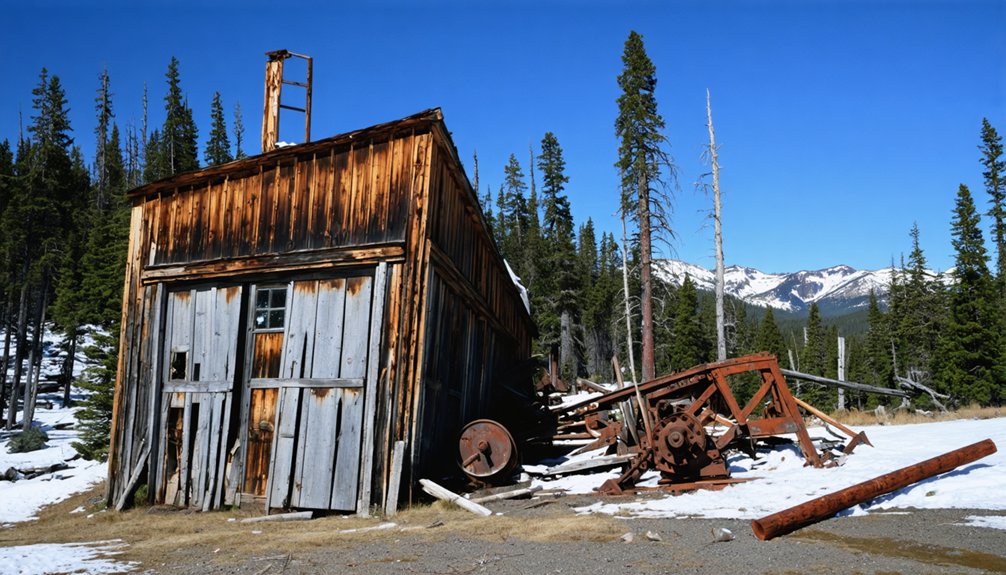
You’ll find several fascinating ghost towns within 90-150 miles of Crater Lake National Park, each preserving Oregon’s gold rush heritage. Sumpter, the “Queen City,” boomed after 1895 with hard-rock mining and railroad access. Granite maintains thirty residents among original 1862 structures, while Bourne’s remnants include the Cougar Stamp Mill from the 1888 rush. Central Oregon’s high desert belt features abandoned homesteads from 1900-1920, including Fort Rock’s preserved museum and isolated Millican. The complete exploration reveals essential planning tips for maneuvering these remote historical sites.
Key Takeaways
- Sumpter features authentic mining history with an 1897 railway, sixteen saloons, and an opera house from its gold rush boom years.
- Granite offers Oregon’s most authentic ghost town experience with original buildings and a small population of thirty maintaining mining heritage.
- Bourne contains weathered cabins and the historic Cougar Stamp Mill, abandoned since 1950 after fraudulent schemes caused its collapse.
- Central Oregon’s High Desert ghost towns include a museum with thirteen homestead structures and isolated settlements like Millican and Wagontire.
- Visit July through October, bring offline maps and extra water, and avoid unstable structures when exploring these remote locations.
Sumpter: The Queen City of the Sumpter Valley
In the early 1860s, prospectors from the American South traced glittering flakes of gold to McCully and Cracker Creeks, establishing a rough settlement they christened Fort Sumter after the embattled Civil War stronghold.
The spelling later shifted to Sumpter, and you’ll find its real transformation began around 1895 when hard-rock mining technology revealed deeper veins.
Sumpter’s transformation from placer camp to hard-rock mining center came in 1895 when new technology unlocked the mountain’s hidden wealth.
The Sumpter Valley Railway‘s arrival in 1897 connected you to markets and capital, triggering a genuine mining boom.
By the turn of the century, you could’ve walked plank-paved streets past sixteen saloons, seven hotels, three newspapers, and an opera house.
Sumpter history shows a town supporting thousands during peak years, earning its “Queen City” nickname as the valley’s commercial heart—until the devastating 1917 fire erased nearly a hundred buildings overnight.
Real estate speculation reached fever pitch during the boom, with property values soaring so dramatically that lots purchased for modest sums resold for substantial profits within months.
Today, you can explore the preserved Sumpter Valley Dredge at Sumpter Dredge State Park, a massive remnant of the dredging operations that continued extracting gold from the valley until 1954.
Granite: Oregon’s Most Authentic Ghost Town Experience
A glint of color in Granite Creek on July 4, 1862, launched what would become Oregon’s most authentically preserved ghost town, where the past remains visible in every weathered board and crumbling foundation.
Originally named Independence, this boomtown swelled to 5,000 residents before federal wartime orders shuttered its gold operations in 1942. The Granite history you’ll encounter isn’t manufactured nostalgia—it’s genuine decline frozen in place.
By 1960, only two souls remained among the abandoned hotels and silent storefronts. Today’s population of thirty maintains this mining legacy without sanitizing it. The Outback and The Lodge remain the only two businesses still operating in town.
You’ll find crumbling false-front buildings, weathered cemetery headstones, and that rare authenticity missing from commercialized attractions. The original schoolhouse, church, general store, and Town Hall still line the main street. No gift shops soften the reality here—just unvarnished history.
Bourne and the Cougar Stamp Mill: Remote Mining Ruins in the Elkhorns
While Granite showcases preservation through persistent residents, Bourne tells its story through absence—a ghost town where fraud hastened the inevitable collapse of boom-era optimism.
You’ll find this remote settlement deep in the Blue Mountains, where gold discovery along Cracker Creek sparked eastern Oregon’s 1888 rush.
The Bourne history transformed when Massachusetts lawyer Jonathan Bourne purchased the rich E and E mine in 1899, prompting the town’s 1900 renaming.
During its peak prosperity, the population reached 1,500 residents, with hotels, stores, and saloons filling every corner of the bustling streets.
Then came Wallace White—a con artist whose grand residence overlooked the valley he’d systematically plunder. His 1904 midnight escape with investor funds ended operations abruptly.
White built his prominent house to attract potential investors, using the mansion as bait for his fraudulent mining investment schemes that would eventually steal millions globally.
The 1937 flood obliterated what remained, though weathered cabins and the Cougar Stamp Mill still mark this mining legacy.
Zero residents have called it home since 1950.
Central Oregon’s High Desert Ghost Town Belt
Dryland homesteaders bet their futures on Central Oregon’s high desert between 1900 and 1920, leaving behind a scattered belt of abandoned settlements when precipitation proved too sparse and growing seasons too short.
You’ll find Fort Rock Valley’s ghost town museum preserving thirteen original homestead structures—houses, cabins, church, schoolhouse—relocated from failed claims across the basin at 4,400 feet elevation.
East along the Bend–Burns corridor, Millican stands nearly empty, once a crucial waystation when travelers needed fuel every fifteen miles.
Today only Hampton’s single gas station serves that entire desert stretch, while Brothers maintains roughly sixty residents and a century-old stage stop.
Wagontire, sixty-five miles south of Burns, sometimes counts its population on one hand, embodying the isolation that defeated homesteaders’ dreams.
These abandoned settlements reflect the economic shifts that characterized Oregon’s frontier development throughout the 19th and early 20th centuries.
The Fort Rock Valley Historical Society established the museum in 1988 to preserve this homesteading heritage for future generations.
Planning Your Ghost Town Road Trip From Crater Lake
Ghost towns scattered across southern and eastern Oregon demand careful route planning from your Crater Lake base, since most abandoned settlements sit sixty to one hundred miles apart on highways that skirt national forest boundaries and cross high desert basins.
Exploring remote regions can lead to intriguing discoveries, such as abandoned places near Lake Clark that offer a glimpse into the past. These forgotten sites provide a unique opportunity for photography and exploration, attracting adventurers and history enthusiasts alike. Plan your visit carefully to ensure you make the most of these hidden treasures.
Route preparation begins with downloading offline maps and identifying fuel stops in Klamath Falls, Medford, or Bend before venturing into dead zones.
Safety tips include packing extra water, informing contacts of your itinerary, and carrying a full-size spare with recovery gear for gravel roads. A satellite phone or emergency beacon provides critical communication capability when cellular service fails in remote areas.
You’ll navigate best during July through October when snowmelt opens forest routes, though late-season wildfires may force detours.
Respect posted land boundaries and avoid entering unstable structures where rotted floors and concealed mine shafts pose serious hazards to explorers. Many ghost town buildings feature rotted floors and unstable foundations that deteriorated after mining operations ceased within twenty years of initial settlement.
Frequently Asked Questions
Are Any Ghost Towns Near Crater Lake Safe to Explore With Children?
Like prospectors weighing risk against reward, you’ll find no truly safe ghost towns immediately near Crater Lake. Distant Sumpter offers managed trails with *family safety* and *historical significance*, but you’re still traversing crumbling timber and rusted iron independently.
Can I Camp Overnight in or Near These Ghost Towns?
Overnight camping *inside* ghost towns is typically prohibited, but you’ll find dispersed camping on nearby BLM or Forest Service lands. Check local camping regulations and secure overnight permits where required before setting up camp.
Do Ghost Towns Near Crater Lake Require Entrance Fees?
Most ghost towns near Crater Lake don’t charge entrance fees since they’re on public land or abandoned. You’ll encounter fee structures mainly at Crater Lake itself, while entrance policies for historic townsites typically allow free exploration and discovery.
What Wildlife Might I Encounter When Visiting Remote Ghost Towns?
You’ll encounter diverse wildlife species around these remote sites, from black bears and elk to chipmunks and raptors. Ghost town ecology attracts animals seeking water, shelter, and prey near abandoned structures, clearings, and riparian corridors year-round.
Are the Roads to These Ghost Towns Accessible by RV?
The open road narrows as you pursue Oregon’s vanished settlements. RV accessibility varies—main highways accommodate larger rigs, but final approaches demand smaller vehicles. Scenic routes through Elkhorns and canyon corridors restrict width, turning radius, and overnight freedom considerably.
References
- https://www.visitoregon.com/oregon-ghost-towns/
- https://www.legendsofamerica.com/or-sumpter/
- https://thatoregonlife.com/2025/09/elkhorn-scenic-byway-ghost-town-fall-road-trip/
- https://bendbulletin.com/2025/10/28/spooky-oregon-haunting-histories-and-ghost-towns-abound/
- https://www.youtube.com/watch?v=1aD3fNfDXrY
- https://traveloregon.com/things-to-do/culture-history/ghost-towns/
- https://westernmininghistory.com/towns/oregon/sumpter/
- https://traveloregon.com/things-to-do/culture-history/ghost-towns/sumpter-2/
- https://www.historicsumpter.com/history/
- https://visiteasternoregon.com/northeast-oregon-road-trip-2-sumpter-to-baker-city-to-richland-to-halfway/