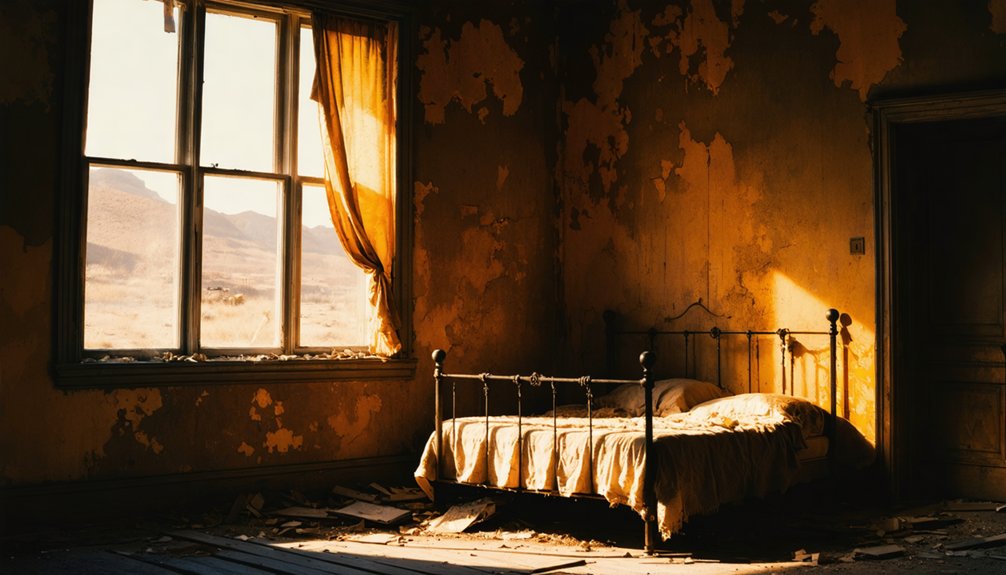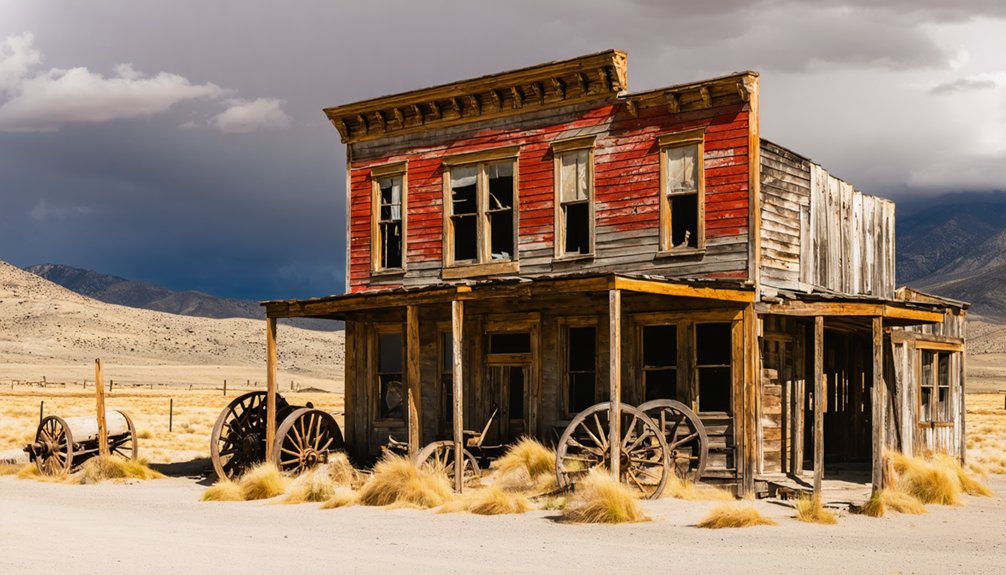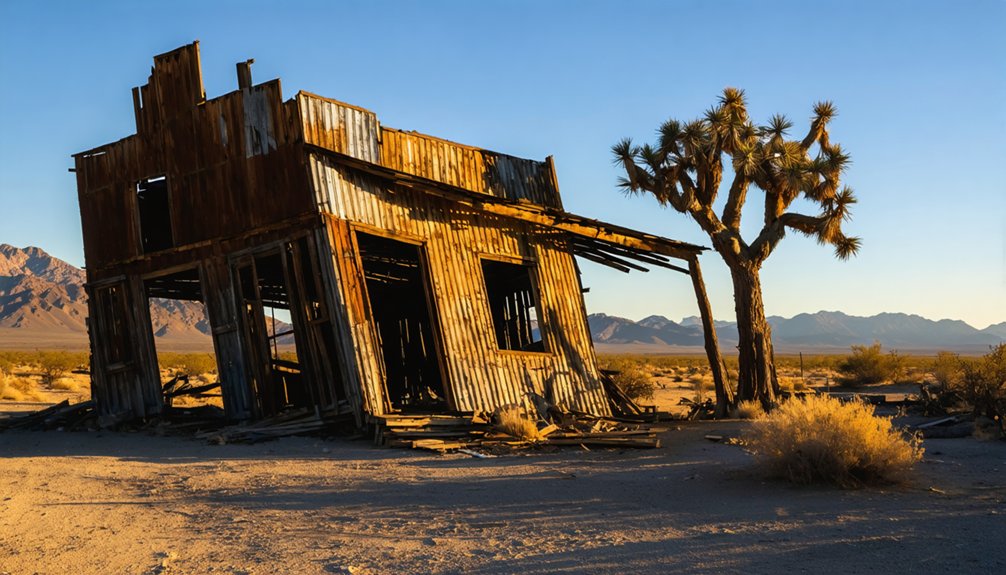
You’ll find several remarkable ghost towns surrounding Death Valley National Park, each telling stories of mining booms from the 1870s-1920s. Rhyolite stands as the most accessible and photographed, featuring the iconic Bottle House and Cook Bank ruins from its 1904-1911 heyday. Ballarat served as a supply hub in Panamint Valley, while remote Panamint City‘s silver camp saw over fifty shootings before its 1876 abandonment. Chloride City, Skidoo, and the fraudulent Leadfield scheme represent countless other camps where fortunes were made and lost across this unforgiving desert landscape.
Key Takeaways
- Rhyolite, founded in 1904, features iconic ruins including the Cook Bank and Bottle House made from 50,000 beer bottles.
- Ballarat served as a mining supply hub with 400-500 residents, featuring adobe ruins, a cemetery, and possibly operational general store.
- Panamint City was a violent 1873 silver town with over fifty shootings before a flash flood destroyed it in 1876.
- Skidoo, at 6,000 feet elevation, maintained mining operations through the 1910s using a 23-mile water pipeline from Telescope Peak.
- Leadfield was a fraudulent 1925 scheme by C. C. Julian that collapsed within eighteen months due to low-grade ore.
Rhyolite: The Crown Jewel of Death Valley Ghost Towns
In the rugged Bullfrog Hills of Nye County, Nevada, just beyond Death Valley’s eastern boundary, the ghost town of Rhyolite stands as the most spectacular reminder of the region’s frenzied mining era.
Rhyolite history began in 1904 when prospectors Frank “Shorty” Harris and Ernest “Ed” Cross discovered gold, sparking explosive growth that transformed a two-tent camp into a 4,000-resident metropolis within six months.
The town’s Rhyolite architecture reflected genuine urban ambition—the three-story John S. Cook Bank cost $90,000, while the community supported hotels, foundries, electric plants, and schools serving 250 children. The innovative Bottle House, constructed in 1905 using 50,000 beer bottles, showcased the resourcefulness of early settlers and remains one of the town’s most photographed structures today.
Yet prosperity proved fleeting. After the 1906 San Francisco earthquake and 1907 financial panic strangled investment, the Montgomery Shoshone Mine closed in 1911, and power shut off by 1916, leaving Rhyolite’s dramatic ruins to captivate photographers and adventurers. Steel magnate Charles M. Schwab purchased the Bullfrog Mining District in 1906, bringing three trains and modern conveniences like electric street lights and concrete sidewalks to the booming town.
Ballarat: A Living Relic in Panamint Valley
West across Death Valley from Rhyolite’s grand stone facades, Ballarat presents a starkly different vision of mining-era survival in Panamint Valley. Founded in 1896–1897 at 1,079 feet elevation, this supply hub served mines throughout the Panamint Range, peaking at 400–500 residents during its boom years.
Ballarat history centers on the Ratcliff Mine, which produced 15,000 tons of gold ore between 1898–1903, sustaining seven saloons, three hotels, and a Wells Fargo station—but no church. The Buster Brown mine added to the area’s wealth, with production from 1927-1942 amounting to $250,000.
Fifteen thousand tons of gold ore fueled seven saloons and three hotels—but Ballarat’s miners built no church.
After mine closures around 1903 and the 1917 post office shutdown, Ballarat became home to desert prospectors like Seldom Seen Slim and Shorty Harris. Shorty Harris lived in Ballarat until his death in 1934, cementing his status as one of the town’s most legendary figures.
Today, you’ll find crumbling adobe ruins, a cemetery, and perhaps one resident maintaining the general store—embodying the “desert rats” culture that refused to abandon the Panamint frontier.
Panamint City: Remote Silver Camp in Surprise Canyon
High in Surprise Canyon at 6,000 feet elevation, Panamint City sprang to life in 1873 after prospectors R.C. Jacobs, W.L. Kennedy, and R.B. Stewart struck rich silver ore.
Panamint history reveals a settlement founded on bandit-backed claims, where outlaws forced partnerships with legitimate discoverers. The camp’s mining challenges extended beyond extracting ore—operators cast raw silver into 450-pound balls to thwart bandits during transport to Los Angeles, 200 miles distant.
What you’ll discover in this remote canyon:
- Main street stretching 1.5 miles lined with 50 buildings, including a dozen saloons and the Bank of Panamint
- Cemetery documenting over fifty shootings and high mortality from accidents and violence
- Crumbling stamp mill smokestacks standing among scattered foundations
Wells Fargo refused service here, deeming conditions too dangerous for their agents.
By 1876, most residents had abandoned Panamint City for other mining camps as the ore bodies proved smaller than initially hoped. A flash flood that same year washed away much of the remaining town, hastening its complete abandonment.
Chloride City: One-Year Wonder of the Funeral Mountains
Silver lured prospector August J. Franklin to Chloride Cliff Mine in August 1871, establishing one of Death Valley’s oldest eastern operations.
Though early ore assayed at $200–$1,000 per ton, the 180-mile mule-train haul to San Bernardino killed profitability within two years.
Despite rich silver ore valued up to $1,000 per ton, the grueling 180-mile transport to market doomed the operation within two years.
The 1905 Bullfrog boom revived interest, and Chloride City sprang up practically overnight.
You’ll find remnants of Chloride City mining infrastructure—three stamp mills, an assay office, blacksmith shop, and a surviving “cousin Jack” dugout—scattered across the arid Funeral Mountains slopes.
Water hauled three miles from Keane Springs sustained operations through early 1906.
By year’s end, the camp was abandoned.
Later mercury discoveries in 1938 brought temporary activity, but ghost town infrastructure remains as testimony to mining’s brutal economics.
The Panic of 1907 devastated mining investment throughout the region, forcing consolidation attempts that ultimately failed to save struggling operations.
Today, only a single grave marker for James McKay and scattered foundations mark where the bustling camp once stood.
Greenwater and Death Valley Junction: Copper Dreams and Borax Reality
Standing in the Greenwater Valley today, you’ll find only scattered ruins where miners once paid $15 per barrel for hauled-in water during the 1906–1909 copper boom that national mining press hyped as the “Greatest Copper Camp on Earth.”
Twenty miles northwest, Death Valley Junction tells a different story—it evolved from a Pacific Coast Borax Company railroad junction into a company town where the narrow-gauge Death Valley Railroad met the standard-gauge Tonopah & Tidewater, processing colemanite ore through calcining plants that operated decades longer than Greenwater’s copper mines. The Tonopah & Tidewater Railroad reached Death Valley Junction by 1907, establishing a critical spur line to the Lila C camp that replaced the famous twenty-mule team ore transport system. The Lila C Mine was discovered in 1884 and named after Coleman’s daughter before Francis Marion Smith began mining operations there in 1907.
The junction’s industrial infrastructure later gave rise to the Amargosa Opera House, transforming a borax hub into an unexpected cultural landmark in the desert.
Greenwater’s $15 Water Barrels
Economic pressures compounded when the Ash Meadows Water Company’s ambitious 27-mile pipeline, capitalized at $3,000,000, failed after spending $200,000.
The project never delivered a single drop:
- Rusted pipe sections abandoned in the desert
- Empty promise of reliable municipal supply
- Continued dependence on expensive wagon freight
High-grade copper couldn’t offset these infrastructure failures.
Death Valley Junction Transformation
While Greenwater’s copper promoters chased visions of another Butte, the Amargosa basin’s real fortune lay in humbler white crystals.
Borax deposits had sustained operations since the 1880s, their stable demand and workable grades outlasting every metal boom. When copper speculation crested at Greenwater—fueled by F. Augustus Heinze’s $275,000 claim purchase—Death Valley Junction emerged not as a mining camp but as a company town anchoring regional borax extraction.
The Tonopah & Tidewater and Death Valley railroads solved transportation challenges that had crippled earlier remote operations, transforming the junction into a desert logistics hub.
While the 1907 financial panic ended Greenwater’s marginal copper ventures, borax shipments continued for decades.
You’ll find Death Valley Junction‘s warehouses and worker housing still standing—monuments to patient industrial mining that outlived flashier metal dreams by generations.
Amargosa Opera House Legacy
- Hand-painted Renaissance murals covering every interior surface, creating permanent spectators for live performances.
- Decades of one-woman shows in absolute isolation, defying commercial theatrical conventions.
- Preservation of the 1923 hotel and hall complex as functioning cultural infrastructure rather than archaeological ruin.
Hidden Gems: Leadfield, Skidoo, and Other Forgotten Camps
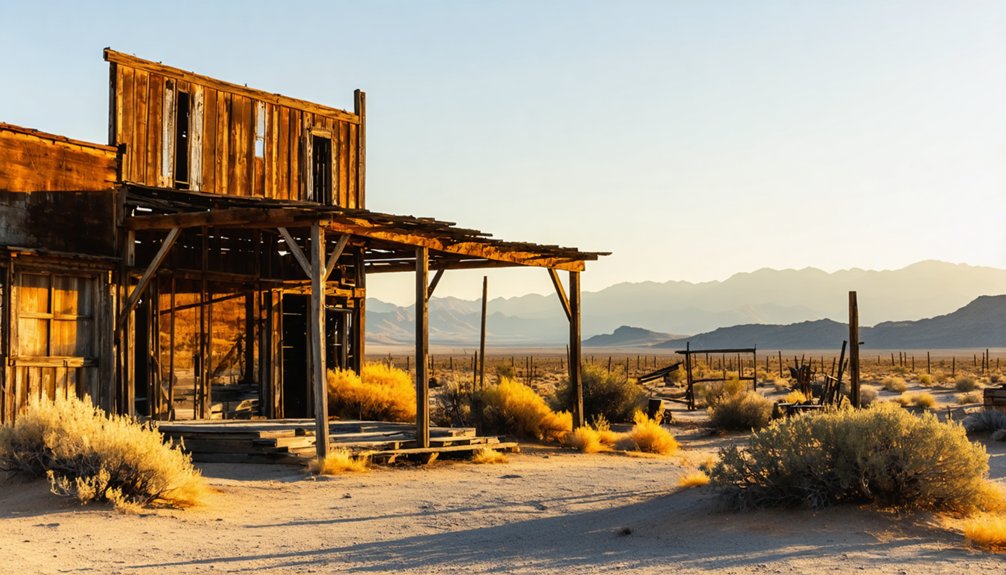
Beyond the well-trodden paths to Rhyolite and other major Death Valley ghost towns, several remote camps reveal the region’s most dramatic boom-and-bust cycles.
Leadfield history exemplifies spectacular fraud—promoter C. C. Julian platted 1,749 lots in upper Titus Canyon during 1925–1926, luring 300 residents before reality struck. Low-grade lead ore and $18-per-ton hauling costs to Beatty killed profitability; the post office closed by February 1927.
Leadfield collapsed within eighteen months as promoter C. C. Julian’s fraudulent scheme met the harsh economics of remote desert mining.
Skidoo operations proved more substantial. Perched at 6,000 feet in the Panamints, this gold camp housed 300–700 residents and engineered a remarkable 23-mile pipeline from Telescope Peak to power stamp mills.
Production sustained the town through the 1910s before decline set in.
You’ll find scattered foundations, sealed adits, and weathered infrastructure throughout these protected sites today.
Frequently Asked Questions
What Permits or Fees Are Required to Visit Ghost Towns Near Death Valley?
You’ll need a $30 park entrance pass for ghost towns inside Death Valley National Park boundaries. Fee structures vary—annual passes cost $55. Outside sites like Rhyolite require no permits. Backcountry overnight trips need wilderness permit requirements beyond standard entry.
Are Ghost Town Sites Safe for Children and Elderly Visitors?
Stepping into the past carries real risks: ghost towns demand vigilant safety precautions due to unstable structures, extreme heat, and rough terrain. You’ll find limited family activities and serious accessibility challenges for children and elderly visitors.
Exploring abandoned sites near Fort Collins can reveal fascinating historical insights and unique photo opportunities, but it’s essential to go prepared. Many of these locations are off the beaten path, which may require a sturdy vehicle and a sense of adventure. Always stay in groups and inform someone of your plans before venturing into these remote areas.
What Is the Best Season to Visit Death Valley Ghost Towns?
The best time to visit Death Valley ghost towns is late fall through early spring (October–April), when weather conditions offer comfortable temperatures, safer exploration, and you’ll avoid dangerous summer heat exceeding 110°F.
Can Visitors Legally Remove Artifacts or Souvenirs From Ghost Town Sites?
No, you can’t legally remove anything—artifact preservation and legal regulations under ARPA, state law, and NPS policies strictly prohibit taking bottles, relics, or any historic items from ghost town sites on federal or state lands.
Which Ghost Towns Offer Camping or Overnight Accommodations Nearby?
Rhyolite offers camping options in nearby Beatty, while Death Valley Junction provides overnight accommodations at the Amargosa Opera House & Hotel. Ballarat supports dispersed camping for backcountry explorers, and Calico features developed campgrounds within the restored townsite.
References
- https://www.legendsofamerica.com/ca-deathvalleyghosttowns/
- https://www.pbssocal.org/living/travel/excursions/5-great-death-valley-ghost-towns.html
- https://dvnha.org/info-trip-planning/ghost-towns/
- https://www.moon.com/travel/national-parks/five-death-valley-ghost-towns-worth-the-trek/
- https://jackigoesplaces.com/love-ghost-towns-check-out-rhyolite-near-death-valley/
- https://yesterdaysamerica.com/death-valley-ghost-towns-where-to-find-forgotten-boomtowns/
- https://www.tripadvisor.com/Attractions-g143021-Activities-c47-t14-Death_Valley_National_Park_Inyo_County_California.html
- https://www.oasisatdeathvalley.com/connect/stories/discover-the-eerie-ghost-towns-of-death-valley/
- https://www.rhyoliteghosttownnevada.org/explore/rhyolite-ghost-town
- https://nvtami.com/2025/01/27/rhyolite-ghost-town-nevadas-diamond-in-the-desert/