You’ll find several remarkable ghost towns within reach of Denali National Park, each preserving Alaska’s mining heritage. Independence Mine State Historical Park, Alaska’s most accessible ghost town, sits just hours away with twenty preserved structures from its 1951 closure. Kantishna lies within Denali itself at mile 92 of the park road, where nearly 100,000 ounces of gold once emerged from remote operations. Kennecott’s iconic copper mining ruins stand further east, while coastal settlements like Dyea document the Klondike stampede. Proper planning guarantees you’ll experience these atmospheric remnants of Alaska’s boom-and-bust cycles safely.
Key Takeaways
- Kantishna, established in 1905 after gold discoveries, is located within Denali National Park along the 92-mile Denali Park Road.
- Kantishna produced nearly 100,000 ounces of gold, with boomtowns like Eureka and Glacier City emerging during the gold rush.
- The Denali Highway serves as a primary corridor for exploring ghost towns near the park area.
- The Denali Highway closes from October through mid-May, requiring preparation including bear spray and spare tires for exploration.
- Federal expansion in 1980 transformed Kantishna’s mining frontier into protected parkland within Denali National Park boundaries.
Understanding Alaska’s Mining Heritage and Ghost Town Legacy
When Alaska’s mineral wealth first drew prospectors into the Interior during the 1880s and 1890s, it set in motion a pattern of explosive growth and sudden abandonment that would define the territory’s settlement geography for generations.
You’ll find over 100 ghost towns scattered across Alaska today, each marking a boom-bust cycle driven by single-resource dependency.
Mining techniques evolved from simple placer operations to complex underground copper and gold extraction, yet most camps survived only 10–30 years before ore depletion or falling prices forced closure.
Alaska’s boom towns typically lasted only a generation before resource depletion and economic collapse forced their abandonment.
Remote locations, harsh climate, and obsolete infrastructure accelerated abandonment after mines shuttered.
The 1964 earthquake devastated several communities, causing some towns to sink 6-10 feet and leading residents to relocate rather than rebuild.
Copper mining especially transformed Alaska’s economy after electricity and automobiles increased demand for the metal in the early 1900s.
Today, ghost town preservation efforts face unique challenges—extreme weather, vandalism, and Alaska’s vast distances complicate protection of these fragile remnants of frontier enterprise and self-reliant community-building.
Independence Mine State Historical Park: the Most Accessible Ghost Town From Denali
Independence Mine State Historical Park preserves roughly twenty structures from a hard-rock gold operation that closed in 1951, offering you the most accessible ghost-town experience within a five-hour drive of Denali.
The alpine complex sits at 4,000 feet elevation along a paved route through Palmer, making it reachable by standard passenger vehicle during summer months when historic bunkhouses, mill buildings, and residential quarters remain open for exploration. The site was established as a state historical park in 1984, recognizing its significance to Alaska’s mining heritage.
Timing your visit between June and September guarantees road access and interpretive services, while shoulder seasons may limit building entry but enhance the abandoned-settlement atmosphere across this former 200-worker mining community. A $5 day-use parking fee is required to access the 271-acre park and its remaining buildings.
Historic Buildings and Structures
Perched in the Talkeetna Mountains at 3,800 feet elevation, the Independence Mine camp presents over twenty structures and ruins that together form Alaska’s most intact hard-rock gold mining landscape.
You’ll find wood-frame bunkhouses, mess halls, and the distinctive “Big House” managerial residence—all dating from the camp’s 1936–1941 construction boom.
Industrial ruins include mill buildings, the power house with its Schenectady-manufactured generator, and scattered mining technology like tramway hardware, ore cars, and compressor equipment.
The assay office, machine shops, and mine portals document how 200 workers extracted gold from eight miles of underground tunnels.
Listed on the National Register in 1974, these structures now anchor Independence Mine State Historical Park, where historic preservation efforts maintain the self-contained company town exactly as it appeared during Alaska’s hard-rock mining era.
The Mine Managers House functions as a visitor center with displays on gold-mining methods and area history.
The site operates from an easy drive from either Palmer or Wasilla, making it the most accessible ghost town destination for visitors exploring the Denali region.
Planning Your Visit Seasonally
Your visit to Independence Mine State Historical Park requires careful timing around Hatcher Pass Road’s annual closure cycle, which typically seals off vehicular access from November through early July.
Summer visitors encounter prime conditions between mid-July and September, when the park operates 9 AM to 6 PM and seasonal weather supports alpine tundra hiking. You’ll pay $5 day-use fees and access thirteen historic structures via 1.5 miles of paved walkways.
Winter adventurers face different challenges—road conditions demand snowmobiles or skis, plus a 30-minute walk from wherever plowing ends. The visitor center closes completely during winter months, eliminating ranger assistance. Hatcher Pass Cabins remain available year-round with modern conveniences for those seeking comfortable lodging near the historical site.
Verify current road conditions before departure during shoulder seasons, as weather patterns control your access more than any posted schedule. The mine’s peak production year of 1941 saw 34,416 ounces of gold extracted before economic pressures from World War II eventually forced its closure.
Kantishna: Historic Mining District Within Denali National Park
Deep in Denali’s western reaches, Kantishna stands as the park’s only inhabited historic mining district, established in 1905 when prospectors flooded creeks like Moose, Eldorado, and Glacier after gold discoveries.
Unlike Independence Mine’s highway accessibility, you’ll travel the full 92-mile Denali Park Road to reach this remote settlement where weathered cabins, tailings piles, and mining adits remain scattered among private inholdings and wilderness lodges.
The district’s evolution from boomtown to backcountry heritage landscape reveals how federal expansion in 1980 transformed an active mining frontier into protected parkland. During World War I, miners Billy Taylor and Tom Lloyd opened antimony mines in the Kantishna Hills, contributing to ammunition manufacturing for the war effort. The gold stampede following the 1905 discovery left few stampeders wealthy, as many faced bankruptcy or death in the harsh conditions of the Kantishna hills.
Early Gold Rush History
- Hundreds of miles of untamed wilderness between them and civilization.
- Backbreaking work staking claims along frozen creek beds.
- Primitive camps offering little shelter from Alaska’s brutal winters.
- The constant risk that their claims would yield nothing.
Within months, boomtowns like Eureka, Diamond, Glacier City, and Roosevelt materialized.
Kantishna mining operations would eventually produce nearly 100,000 ounces of gold.
Accessing Kantishna Today
The boomtown legacy that drew thousands of prospectors to Kantishna now sits locked behind one of Alaska’s most significant park infrastructure challenges. The 2021 Pretty Rocks landslide severed road access at Mile 43, stranding this Mile 90 district beyond repair timelines stretching through summer 2026.
You’ll reach Kantishna exclusively by air—55-minute fixed-wing flights from the park entrance that transform necessity into freedom, crossing the Alaska Range at $335 per person.
Fly in logistics dictate everything: fixed arrival days, 25-pound luggage limits, and multi-night minimum stays coordinated with Denali Air partners.
Lodge experiences at Kantishna Roadhouse, Camp Denali, and Denali Backcountry Lodge bundle flights into all-inclusive packages starting around $1,600 nightly, replacing day-trip bus tourists with committed backcountry travelers exploring ghost-town relics via naturalist-guided hikes through early June to mid-September seasons.
Kennecott: Alaska’s Iconic Copper Mining Ghost Town
- Workers earned $5.25 daily but labored seven days weekly in punishing isolation.
- Alcohol bans drove miners to nearby McCarthy’s unrestricted saloons and brothels.
- Company stores kept laborers perpetually indebted despite higher wages.
- Ore depletion and Depression-era price crashes killed the town by 1938.
Today, Historic Preservation efforts maintain Kennecott’s skeletal buildings within Wrangell–St. Elias National Park—testament to Alaska’s untamed industrial past.
Portage and the 1964 Earthquake Legacy
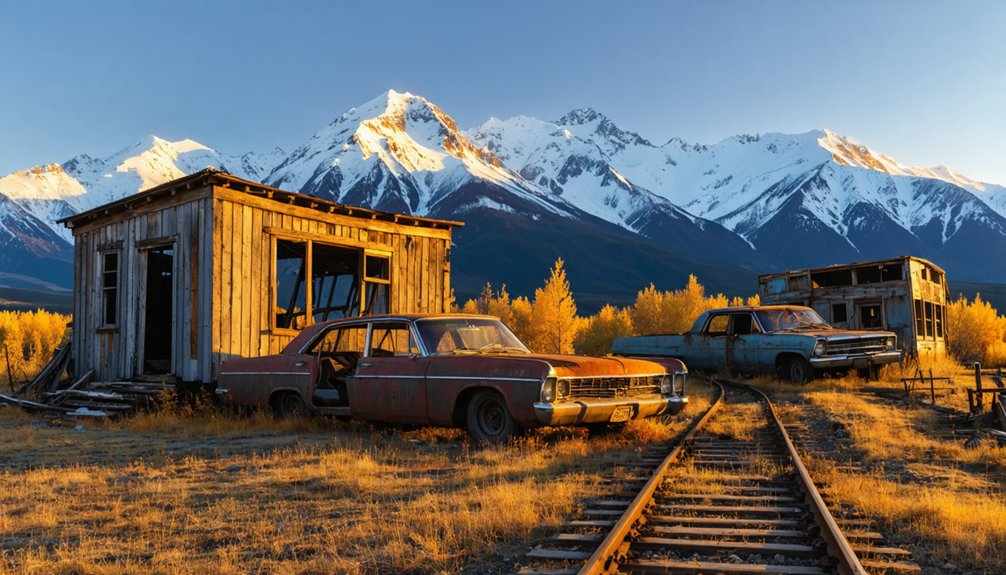
Today you’ll find a haunting ghost forest where spruce stands once thrived—gray skeletal trunks marking the earthquake impact across tidal mudflats.
The subsidence that destroyed Portage reshaped Turnagain Arm’s entire shoreline, creating one of Alaska’s most visible earthquake legacies.
You can explore this transformed landscape from the highway, witnessing how a single seismic event permanently erased a community.
Coastal Gold Rush Ghost Towns: Dyea and Treadwell
While seismic forces obliterated Portage in seconds, Alaska’s coastal gold rush settlements met their end through the slower grind of economic obsolescence.
Where earthquakes claimed one town in moments, the relentless tide of commerce slowly erased entire settlements from Alaska’s map.
Dyea history reveals a boomtown that surged to 3,500 residents by 1898, only to dwindle to six souls by 1903 when Skagway’s railroad diverted stampeders elsewhere.
What remains of Dyea’s dreams:
- Privy holes and root cellars marking where 3,500 fortune-seekers once lived
- A cemetery filled mostly from one catastrophic April 1898 snowslide
- Tree stumps from saplings planted during brief prosperity
- Silence where five blocks of commerce once thrived
You’ll find these ruins within Klondike Gold Rush National Historic Park, where self-guided exploration reveals Treadwell significance alongside Dyea’s vanished streets—freedom to witness ambition’s archaeological footprint.
Planning Your Ghost Town Adventure: Access, Safety, and Seasonal Considerations
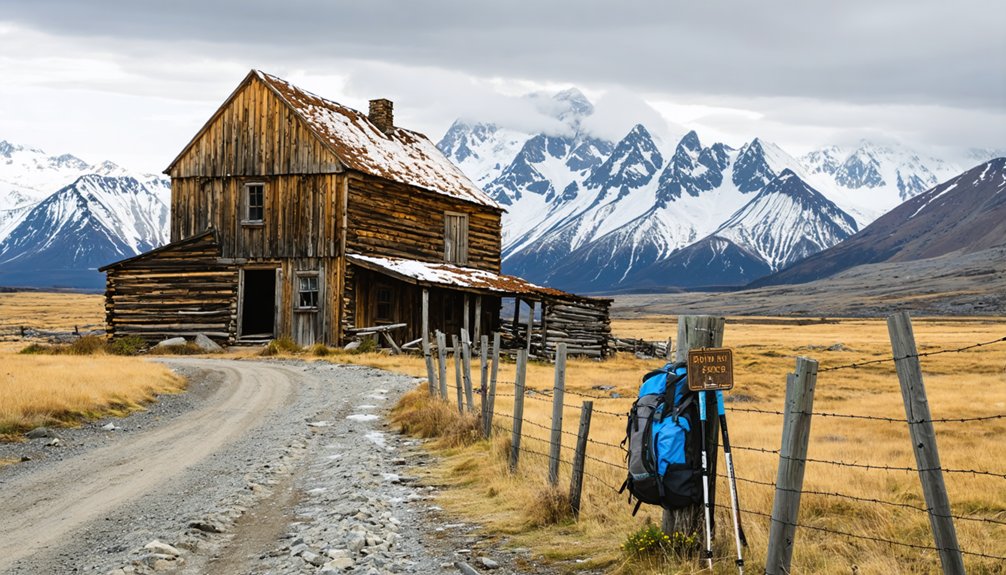
Before you turn the ignition toward Alaska’s interior ghost towns, understand that the Denali Highway—your primary corridor to abandoned mining camps—demands preparation uncommon to mainland road trips.
This 135-mile gravel artery closes October through mid-May, concentrating ghost town access into a narrow summer window. Sharp rocks and washboards threaten tires; fuel stations vanish for fifty-mile stretches.
Valdez Creek Road at mile 79 leads to the abandoned “Denali” mining camp, often requiring 4WD. Cell coverage disappears across most routes, so carry paper maps and satellite devices.
Safety tips for remote ruin exploration: pack bear spray, spare tire, extra fuel, and waterproof boots for boggy tundra. Wildlife encounters multiply near overgrown sites.
Your self-reliance isn’t romantic—it’s mandatory.
Connecting Ghost Town Exploration to Your Denali Itinerary
Most travelers treat Denali as an endpoint—wildlife, tundra, maybe a summit flight—then retreat to Anchorage.
You can push beyond that well-worn loop. Thread ghost towns into a 7–14 day interior route: Anchorage → Talkeetna’s mining-era storefronts → Denali → Richardson/Edgerton Highways → Kennicott’s copper ruins inside Wrangell–St. Elias.
This progression builds narrative momentum from nature to human story, from living historic towns to true abandonment.
Four reasons to extend your route:
- Kennicott’s National Historic Landmark status underscores cultural significance and ongoing preservation efforts.
- 14-story mill ruins deliver visceral proof of boom-and-bust cycles.
- No backtracking—the Glenn Highway loop returns you efficiently.
- Freedom to explore at your own pace, beyond managed park experiences.
Frequently Asked Questions
Are There Any Guided Ghost Town Tours Departing Directly From Denali National Park?
No guided tours departing directly from Denali focus on ghost town history. You’ll find wildlife, natural history, and gold-rush interpretation instead. For authentic ghost town experiences, you’ll need to travel independently to Kennecott in Wrangell–St. Elias.
Can You Camp Overnight at Independence Mine or Kennecott Ghost Towns?
You can’t camp overnight at Independence Mine, but coincidentally, both sites restrict camping due to historic significance and preservation needs. Kennecott’s camping regulations permit nearby camping at established areas, giving you overnight freedom near both preserved mining communities.
Which Ghost Towns Near Denali Are Accessible During Winter Months?
No documented ghost towns exist immediately near Denali accessible in winter. You’ll find winter accessibility severely limited throughout the region due to local conditions—extreme cold, deep snow, and road closures make most historical sites unreachable without specialized equipment.
Are There Ghost Towns Between Fairbanks and Denali Along the Highway?
No true ghost towns sit directly on the Parks Highway between Fairbanks and Denali. You’ll find inhabited service towns like Nenana and Healy instead. For ghost towns with historical significance, you must detour onto mining roads near Fairbanks.
For those seeking a unique adventure, exploring ghost towns near Dry Tortugas can reveal fascinating stories of the past. These once-thriving settlements, now remnants of history, offer a glimpse into the challenges faced by early settlers in the Florida Keys. Visitors can wander through the dilapidated structures and dream of what life was like in these abandoned places.
Do Any Ghost Towns Near Denali Allow Metal Detecting or Artifact Collecting?
No—metal detecting regulations and artifact preservation laws protect all historic sites near Denali. Federal lands prohibit collecting under ARPA; private property requires owner consent. You’ll find preservation rules trump personal freedom throughout this region’s ghost-town remnants.
References
- https://www.experiencedenali.com/blog/alaskas-most-haunted-places/
- https://thealaskafrontier.com/ghost-towns-in-alaska/
- https://www.thealaskalife.com/blogs/news/portage-the-sunken-alaska-ghost-town-that-nature-is-reclaiming
- https://www.alaska.org/detail/kennicott-mine-ghost-town-walking-tour
- https://www.youtube.com/watch?v=P1ZqxD5x478
- https://www.youtube.com/watch?v=oKY3lsfv2PA
- https://takemytrip.com/2018/04/take-that-trip-to-alaska-11-alaska-ghost-towns/
- https://www.islands.com/1891808/abandoned-mine-town-kennicott-chitina-alaska-copper-camp-ghost-town-tours-hikes-icy-views/
- https://getlostinamerica.com/alaska-ghost-towns/
- https://www.atlasobscura.com/things-to-do/alaska/ghost-towns