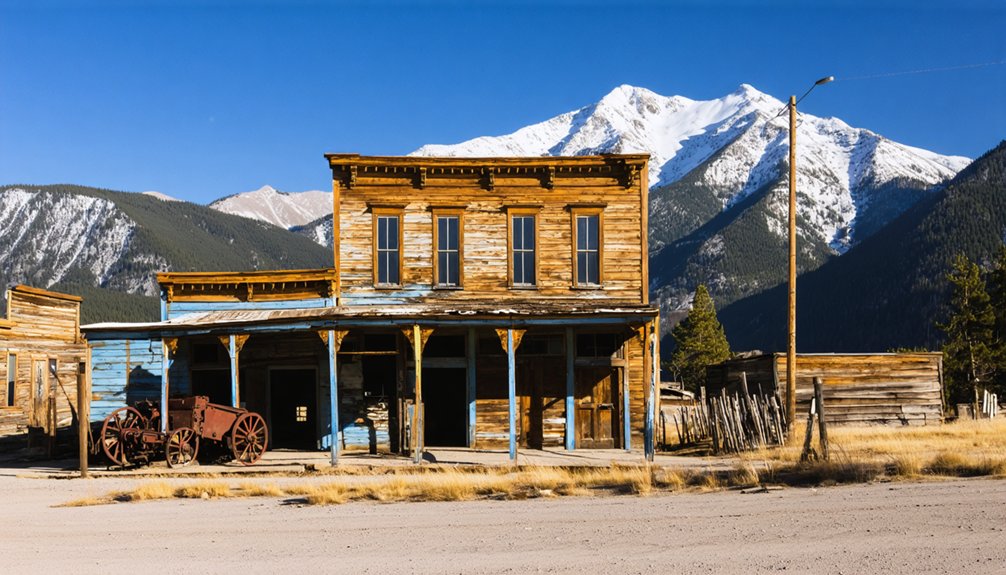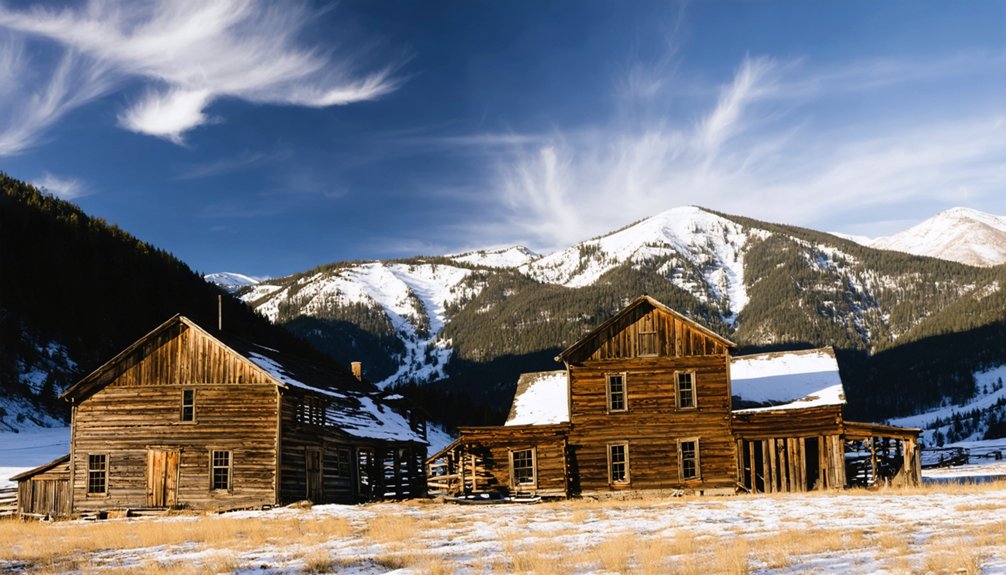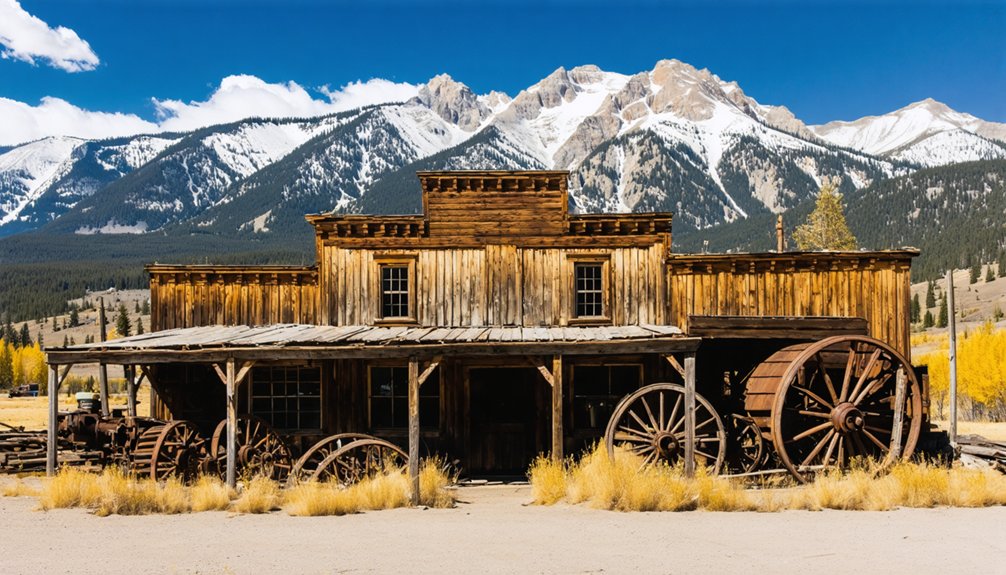
You’ll find several ghost towns within 90 minutes of Denver, including Nevadaville (40 miles west), which held 2,705 residents in 1860 before mines exhausted by 1900. St. Elmo preserves over 40 original 1880s structures with a post office that operated until 1952. Mount Vernon sits along I-70 as a former stagecoach hub founded in 1859, while Teller City‘s remote Roosevelt National Forest location at 8,200 feet conceals remnants from its 1,500-resident peak in 1882. Each settlement offers distinct architectural features and elevation-specific mining histories worth exploring further.
Key Takeaways
- Nevadaville, 40 miles west of Denver, was Colorado’s richest gold mining town in 1861 before abandonment by 1900.
- St. Elmo preserves over 40 original 1880s buildings, making it one of Colorado’s best-preserved ghost towns with intact structures.
- Teller City sits at 8,200 feet in Roosevelt National Forest, abandoned after the 1884 silver crash devastated its economy.
- Mount Vernon, accessible in Matthews/Winters Park along I-70, served as a major stagecoach stop and Wells Fargo Express hub.
- Vicksburg and Winfield, located above 9,600 feet, feature preserved museums including a furnished schoolhouse and miner’s cabin.
Nevadaville & Central City Area: Gold Rush Remnants 40 Miles West
Just 40 miles west of Denver along today’s Peak to Peak Highway, Nevadaville emerged within three weeks of John Gregory’s May 1859 gold discovery, developing alongside Black Hawk and Central City in the Gregory Gulch mining district.
Nevadaville history reveals a working-class Irish mining town that surpassed Denver’s population by 1860, reaching 2,705 residents who worked the Burroughs and Kansas Lodes. The district’s mining legacy earned it recognition as “the richest square mile on earth” in 1861, with 30 mills processing ore.
Though a catastrophic 1861 fire destroyed 50+ buildings, residents dynamited firebreaks and rebuilt. By 1880, 4,000 people called Nevadaville home. As near-surface gold veins depleted by the early 1860s, miners faced increasingly difficult processing challenges with deeper ores. The town was abandoned by the early 20th century as gold mines ran dry.
Today, you’ll find original structures—including Colorado’s only active ghost town Masonic Lodge—preserved on private property along accessible Main Street.
St. Elmo: Colorado’s Best-Preserved Mining Town Near Buena Vista
- Original false-front buildings along the main street
- Town hall and general store from the 1880s
- Alpine Tunnel access route above town
The post office operated until 1952, making abandonment relatively recent. Over 40 historical structures still exist in St. Elmo, making it one of Colorado’s most intact ghost towns. The town’s population peaked at 2,000 residents during the mining boom before declining after 1910.
Teller City: Remote Silver Camp in Roosevelt National Forest
Deep in Roosevelt National Forest southwest of Gould, Teller City stands as one of North Park’s most compelling ghost towns, its scattered cabin ruins and foundations gradually disappearing beneath encroaching pine forest at 8,200 feet elevation.
Founded in 1879 following silver mining discoveries, the camp exploded to 1,500 residents by 1882, boasting 27 saloons, the 40-room Yates Hotel, and rowdy frontier conditions that defined Colorado’s silver rush era.
Within three years of the silver boom, Teller City transformed from wilderness to a raucous settlement of 1,500 souls and 27 saloons.
Named for Senator Henry M. Teller, champion of silver interests, the town thrived until the 1884 silver price collapse devastated its economy. Within three years, population plummeted from 1,500 to 300. By 1902, Teller City sat abandoned.
The Endomile Mine served as the area’s most profitable operation, featuring blacksmith and ore processing shops that supported the booming settlement.
Today you’ll need high-clearance 4×4 vehicles to traverse County Road 21’s final three miles, where interpretive plaques mark dozens of structural remnants reclaimed by wilderness. Access the road from Highway 14 near Gould, following County Road 21 approximately 10 miles to the ghost town site.
Mount Vernon: Historic Stagecoach Stop Along the I-70 Corridor
- Transportation hub: Up to 50 wagons daily traversed the privately operated toll road during its 1859–1861 peak.
- Wells Fargo Express stop: Handled gold shipments inbound and mining supplies outbound.
- Accessible remnants: Matthews/Winters Park preserves stone structures and cemetery sites near the I-70/C-470 interchange. Founded by Dr. Joseph Castro in fall 1859, the settlement served miners traveling to Black Hawk and Central City gold discoveries. The Mount Vernon House, visible from the Village Walk trail, is listed on the National Register of Historic Places.
Vicksburg & Winfield: High-Elevation Ghost Town Cluster Southwest of Denver
Perched between 9,600 and 10,000 feet in Chaffee County’s Clear Creek Canyon, Vicksburg and Winfield form a remarkably intact ghost-town pair that capitalized on the same 1867 gold discoveries and subsequent silver boom.
Vicksburg history began when prospectors from Leadville found gold while tracking lost burros, eventually supporting 600–700 residents along a main street lined with Balm of Gilead trees hauled in by pack animals.
Prospectors tracking lost burros stumbled upon gold in 1867, transforming an empty canyon into a 700-resident boomtown adorned with transplanted Balm of Gilead trees.
Four miles upcanyon, Winfield grew larger still—peaking at 1,500 residents by 1890 on 120 platted acres at the North and South Fork junction.
Both towns saw mining operations cease after the silver market crash in 1893 triggered a depression that ended Winfield’s ore extraction by 1918.
Today’s Winfield preservation efforts maintain a furnished schoolhouse and miner’s cabin as summer museums.
The place name Vicksburg itself appears in multiple contexts across American history, though this Colorado settlement represents one of the more remote mining-era examples.
You’ll access both via County Road 390 off Highway 24, where surviving cabins blend ghost-town exploration with trailheads leading to nearby fourteeners.
Frequently Asked Questions
Are Dogs Allowed at Colorado Ghost Town Sites Near Denver?
Dog regulations vary by ghost town site, so you’ll need to verify policies beforehand. Most public lands welcome leashed pets, but practice proper ghost town etiquette by respecting historical structures and packing out waste.
Which Ghost Towns Near Denver Offer Guided Tours or Visitor Centers?
Most ghost towns near Denver lack formal visitor centers, though you’ll find guided experiences highlighting historical significance at St. Elmo’s operating general store and Vicksburg’s audio tour system for self-directed exploration.
Exploring abandoned sites near Frisco Colorado can reveal remnants of mining operations and the stories of those who once lived there. Outdoor enthusiasts may also appreciate the stunning mountain views that accompany these historic explorations. Each visit not only uncovers pieces of the past but also enhances your connection to the rich history of the area.
Exploring ghost towns near Vail Colorado offers a unique chance to step back in time as you wander through abandoned structures and witness the fading remnants of a once-thriving community. As you traverse these historical sites, you can imagine the lives of the miners and their families, experiencing a shared connection with the past. The tranquility of the surrounding landscape further enhances the adventure, making it an ideal destination for both history buffs and nature lovers alike.
Do I Need a 4WD Vehicle to Visit Ghost Towns Near Denver?
Better safe than sorry—most ghost towns near Denver don’t require 4WD in summer, but high-elevation sites like Animas Forks demand it. Vehicle recommendations favor higher clearance for unpaved Forest Service roads and changing mountain weather.
Can I Camp Overnight at Ghost Town Locations Near Denver?
No, you can’t camp overnight at ghost town sites near Denver due to camping regulations protecting historic properties. However, you won’t need overnight permits for abundant nearby national forest campgrounds surrounding these locations.
Are Ghost Towns Near Denver Safe to Explore With Children?
Tread carefully—some ghost towns offer family-friendly activities with safety precautions like managed sites (St. Elmo), while others hide unmarked shafts and contaminated soil. You’ll need proper planning to protect children from high-altitude hazards and unstable structures.
Exploring ghost towns near Leadville Colorado can reveal fascinating glimpses into the past, but it’s essential to educate your family about the history and potential dangers of these locations. Some towns are steeped in rich mining heritage, making them intriguing stops for older children and history enthusiasts. Ensure to pack plenty of water and snacks, as facilities may be limited in these remote areas.
References
- https://www.uncovercolorado.com/ghost-towns-near-denver-co/
- https://en.wikipedia.org/wiki/List_of_ghost_towns_in_Colorado
- https://alissapeterson.com/blog/discover-the-spookiest-colorado-ghost-towns
- https://www.colorado.com/articles/colorado-ghost-towns
- https://coloradoinfo.com/blog_post/explore-ghost-towns-in-colorado/
- https://www.islands.com/2061852/colorado-abandoned-ghost-towns-once-thriving/
- https://www.uncovercolorado.com/ghost-towns/
- https://www.amli.com/blog/abandoned-mines-and-ghost-towns-near-denver
- https://www.adventurable.com/views/ghost-towns-ruins
- https://www.americansky.co.uk/colorado-holidays/exploring-colorados-ghost-towns