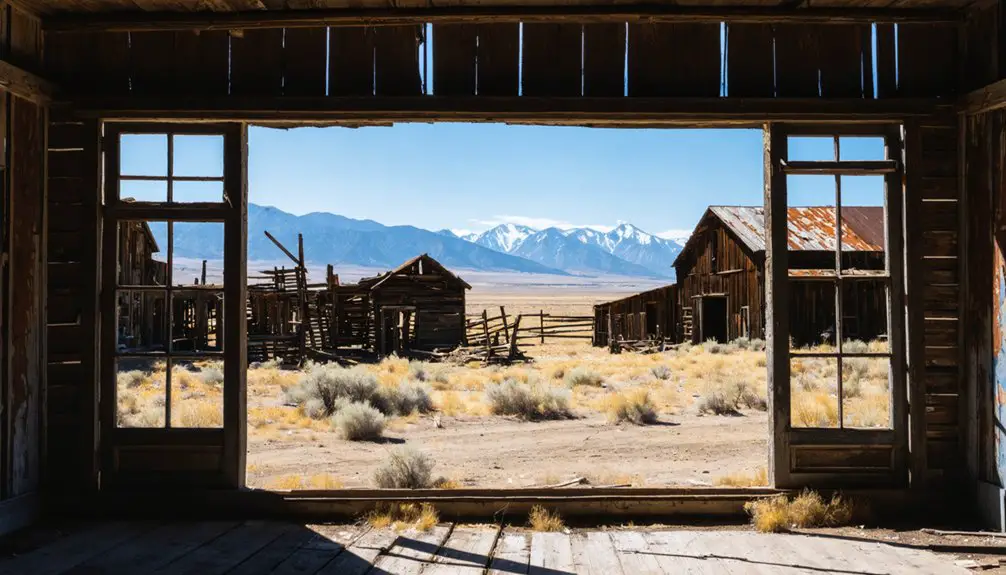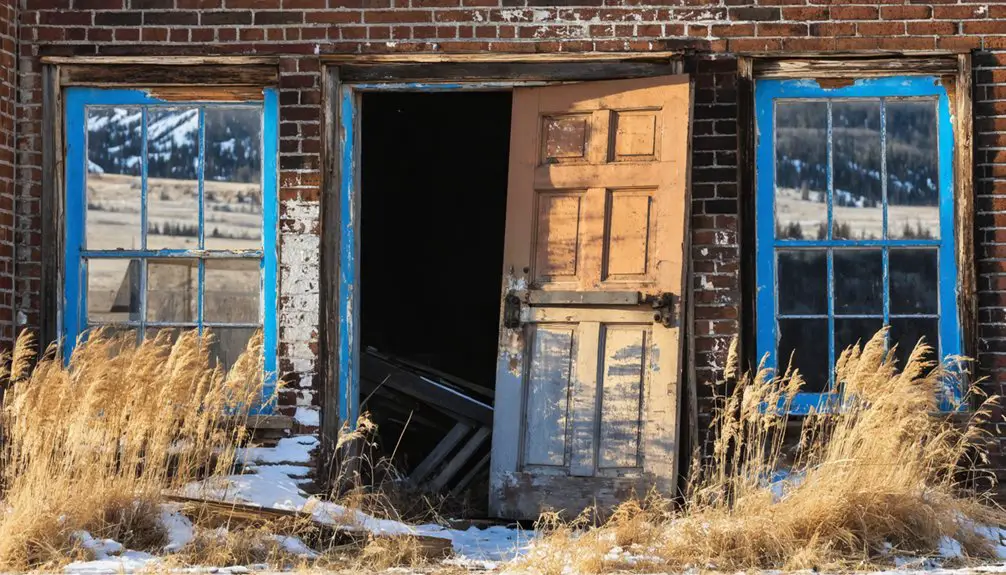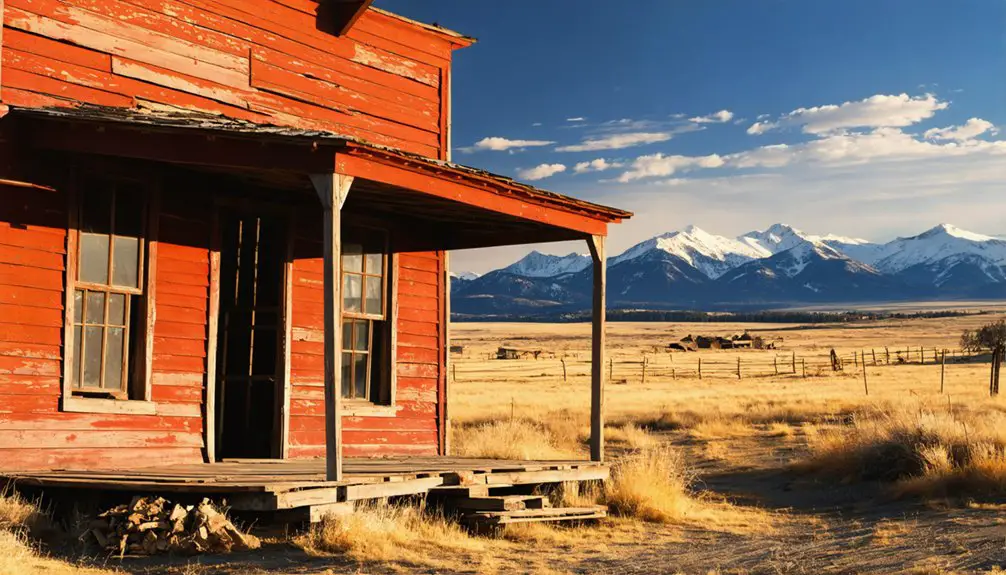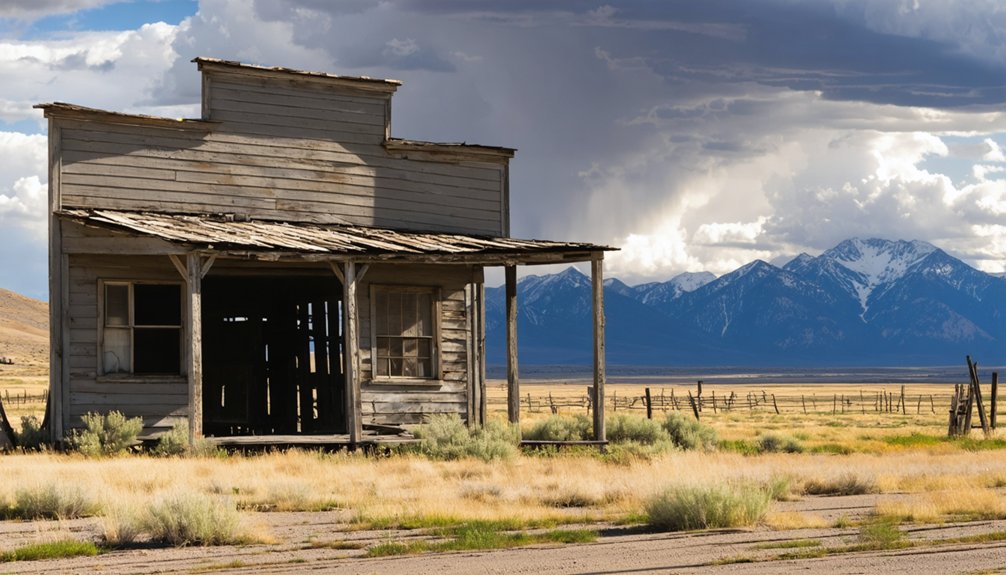
You’ll find Bannack State Park just twenty-five miles west of Dillon, Montana’s best-preserved ghost town where gold fever struck Grasshopper Creek in 1862. Over fifty original buildings from the mining boom still stand—false-front saloons, hand-hewn cabins, and a weathered church—all accessible without ropes or barriers separating you from authentic frontier history. The park welcomes visitors year-round, with extended summer hours until 9 p.m., and hosts atmospheric Ghost Walks each October that bring the town’s violent past to life through costumed performers and theatrical reenactments at historic sites throughout the abandoned streets.
Key Takeaways
- Bannack, Montana’s first territorial capital, is a preserved ghost town 25 miles west of Dillon with over 50 original structures.
- Gold discovery in 1862 at Grasshopper Creek sparked Bannack’s boom before miners left for richer strikes in 1863.
- Visitors can explore buildings year-round with self-guided tours; summer hours extend until 9 p.m., winter closes at 5 p.m.
- Annual October Ghost Walk features costumed reenactments of Bannack’s violent history with tickets at $15 adults, $10 children.
- Access requires $8 out-of-state vehicle fee; fuel available only in Dillon, not on Bannack Road leading to the park.
Bannack State Park: Montana’s Premier Ghost Town
When Montana Territory struck its first major gold discovery along Grasshopper Creek in 1862, thousands of fortune-seekers converged on what would become Bannack—a raw, violent boomtown that briefly served as the territory’s capital before the veins played out and the crowds moved on.
Today you’ll find over 50 original structures standing in carefully preserved dilapidation, a National Historic Landmark that’s earned its reputation as the West’s best-preserved ghost town.
The Bannack folklore centers on Sheriff Henry Plummer, who allegedly led the very road agents he was sworn to stop—lawless legends that ended when vigilantes hanged him in 1864.
Sheriff turned outlaw: Henry Plummer allegedly commanded the road agents he was meant to capture until vigilante justice caught up with him.
Walk the wooden boardwalks yourself, explore the courthouse and saloons, and decide whether those desperados murdered eight men or a hundred.
The Bannack Masonic Lodge built a schoolhouse in 1874 that educated local children for nearly seven decades, one of the few institutions that survived the town’s long decline.
Each October, annual ghost tours transform Bannack State Park into one of Montana’s liveliest attractions, drawing visitors eager to experience the town’s haunted history firsthand.
The 1862 Gold Discovery That Started It All
On July 28, 1862, prospector John White and his band of “Pikes Peakers” struck pay dirt along Grasshopper Creek while making their way toward Idaho’s gold fields—a discovery that would transform Montana Territory from empty wilderness into boomtown chaos within weeks.
You’d find it hard to overstate this strike’s historical significance. Within months, 500 fortune-seekers had staked claims along the creek, pulling $700,000 worth of gold from the gravel by winter.
The gold rush echoed through every Western mining camp, drawing thousands more to Montana’s wild country. White’s Bar, located three miles downstream from where Bannack would rise, became ground zero for Montana’s first major gold strike—the spark that ignited a territorial boom and changed the frontier forever. The prospectors named the creek after the grasshoppers they encountered along its banks, and this name would forever mark the site of Montana’s transformation. The mining boom drew thousands from various countries during the late 1860s as word of Montana’s riches spread across continents.
Exploring Over 50 Preserved Historic Buildings
You’ll walk the same weathered boardwalks that miners, merchants, and lawmen traveled in the 1860s, passing more than 50 original log and frame buildings that still stand along Bannack’s Main Street.
Each structure—from false-front saloons to hand-hewn cabins—preserves the architectural fingerprints of frontier Montana, maintained in a state of “carefully preserved dilapidation” that honors rather than erases 150 years of wind and weather.
Unlike rope-lined museum exhibits, you’re free to step inside many of these buildings year-round, running your fingers along squared timbers and peering into rooms where gold dust once changed hands. These structures witnessed the town’s turbulent early days, when notorious outlaws like Henry Plummer and his gang operated during Bannack’s lawless prime. The town was abandoned after gold depletion, leaving behind this remarkable snapshot of 1860s mining life frozen in time.
Main Street Walking Tour
Hotel Meade anchors your route, its former courthouse walls echoing with territorial politics.
The Masonic Lodge draws photographers, while multiple saloons illustrate Bannack’s service economy.
You’ll walk through cabins, peer into jails, and explore the church—all preserved in carefully maintained dilapidation.
The “preserved, not restored” philosophy keeps interiors authentically aged, maintaining that arrested-in-time atmosphere freedom-seekers crave.
The continuous walking tour flows without breaks through the historic district, emphasizing the concentration of structures.
Dillon’s Dinkley Building, constructed in 1888, showcases the ornate architectural style common to Montana’s mining boom era.
Original Mining Era Architecture
When you step beyond Main Street’s most photographed facades, the full scope of Bannack’s architectural preservation reveals itself—over 60 original structures stretching along Grasshopper Creek in weathered testimony to frontier enterprise.
You’ll discover hand-hewn log construction throughout the townsite, from crude single-room cabins to the two-story Masonic Lodge, each building preserved rather than restored to maintain authentic aging.
The architectural integrity here means creaking plank floors, leaning walls, and patched roofs that document 150 years of exposure—no sanitized reconstructions.
False-front commercial buildings, the original jail with barred cells, and a simple wooden church illustrate the town’s evolution from violent mining camp to settled community.
The town’s Assay Office once evaluated miners’ gold findings, with samples regularly testing at 99% purity.
This weathered landscape grants you unfiltered access to frontier reality, where builders prioritized function over form. Bannack’s founding in 1862 followed the gold discovery in Grasshopper Creek, transforming the area into a bustling settlement that once housed thousands of hopeful prospectors.
Year-Round Building Access
Unlike most historical sites that lock their gates come autumn, Bannack State Park maintains access to its 50+ original structures throughout Montana’s full seasonal cycle—meaning you can press your face against the same frost-rimmed windowpanes in January that prospectors peered through during the brutal winter of 1863.
Building accessibility shifts with seasonal variations: summer extends your exploration until 9 p.m., while winter shortens visits to 5 p.m. closings.
You’ll wander through staged hotels with period furnishings, peer into abandoned bakeries, and duck through blacksmith shops where anvils still rest silent.
The remarkable preservation lets you trace merchants’ footsteps across weathered floorboards, imagining when three hotels competed for miners’ silver and four saloons echoed with rough laughter—all without velvet ropes blocking your path.
Mining Camps Along Grasshopper Creek

On July 28, 1862, prospector John White and his band of “Pikes Peakers” struck color along Grasshopper Creek, and within months a raw camp called Bannack—named for the Bannock Indians—sprawled beside the diggings where White’s Bar first yielded pay dirt.
Within months of John White’s 1862 strike, Bannack sprawled beside Grasshopper Creek where fortune seekers first found color.
You’ll find this Montana gold rush unfolded with frontier intensity:
- 500 miners worked placer mining claims by year’s end, pulling $700,000 from creek gravels.
- Population exploded to 5,000 by 1863—merchants, gamblers, outlaws, and dreamers.
- Sheriff Henry Plummer’s gang murdered 102 victims before vigilante justice ended their reign in 1864.
- Civil War divisions split camps into “Yankee Flats” and Confederate enclaves across the water.
Bannack briefly became territorial capital in 1864, though lawlessness nearly eclipsed governance in these wild creek-side camps.
Planning Your Visit: Hours and Directions
Twenty-five miles of open ranchland separate Dillon from Bannack’s weathered storefronts, a straightforward drive along State Highway 278 that’s carried visitors to this 1862 gold camp since Montana paved the route decades ago.
You’ll find the park open year-round, though seasonal changes dictate dramatically different hours—summer stretches from 8 a.m. to 9 p.m., while winter shortens to 5 p.m. closures.
Among essential travel tips: fuel up in Dillon, as services vanish once you turn south onto Bannack Road. The $8 out-of-state vehicle fee grants access to fifty preserved buildings awaiting self-guided exploration.
Winter visitors should note December 24–25 closures and plan for unlit rural roads. Standard passenger cars handle the route easily in fair weather, delivering you to Montana’s finest ghost town.
Walking Tours Through Abandoned Streets
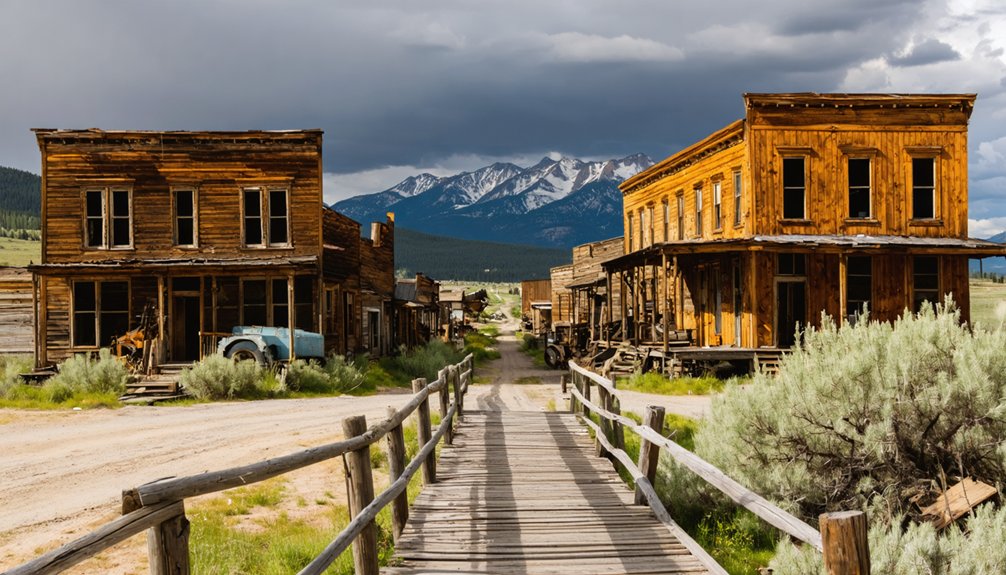
When you step onto Bannack’s packed-earth Main Street, over fifty weathered buildings stretch before you in a layout that hasn’t changed since 3,000 prospectors crowded these same storefronts in 1863.
Your self guided exploration unfolds through opened saloons, hotels, and homes where original wooden floors creak beneath your boots and faded wallpaper whispers forgotten stories.
What makes walking Bannack uniquely immersive:
- Direct building access – enter any structure whose door opens, no ropes or barriers
- Twenty-page guidebook – connects each stop to vigilante hangings and gold-rush economics through historical storytelling
- One-to-two-hour routes – wander at your own pace, photographing unobstructed facades
- Authentic surfaces – dirt streets and wooden boardwalks recreate the 1860s walking experience
Bring sturdy shoes for gravel paths and layers for mountain weather shifts.
October Ghost Walks and Special Events
Each October, Bannack’s weathered storefronts transform into something darker when the annual Ghost Walk turns Montana’s oldest gold-rush town into an after-dark theater of the macabre.
You’ll reserve your spot weeks ahead—tickets sell fast at $15 for adults, $10 for kids—then join one of two nightly shows at 7:00 or 9:00 p.m.
Your 1.5-hour journey follows a narrator through ten stations where costumed performers resurrect Bannack’s violent past: outlaws, shootouts, and tragedies from the 1862 gold rush.
The haunted history comes alive through spooky storytelling amplified by blank gunfire echoing between fifty historic buildings.
Dress for mountain weather and uneven ground.
Fair warning: the loud shots make this unsuitable for young children or noise-sensitive folks.
It’s raw, historically grounded theater beneath Montana’s October stars.
From Boom to Bust: The Story of Decline
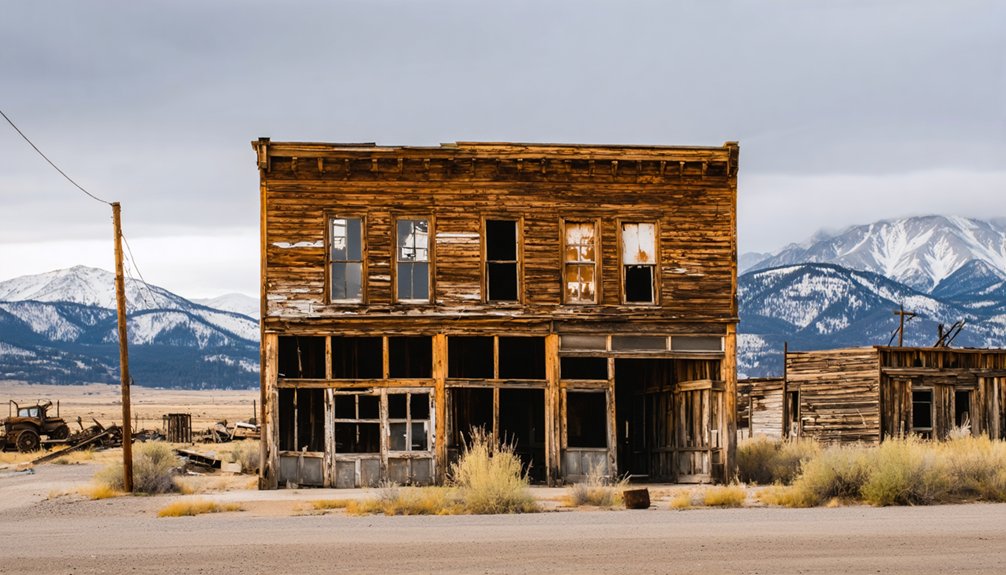
- Alder Gulch’s richer placers siphoned population to Virginia City in 1863.
- The territorial capital followed miners east in 1865.
- Last Chance Gulch (Helena) drew capital and labor away.
- The 1880s railroad to Dillon bypassed Bannack entirely.
A devastating 1895 fire torched what commerce remained, leaving weathered timber frames and silence where ten thousand fortune-hunters once roared.
Authentic Old West Architecture and Preservation
Bannack’s skeletal streetscape survives as one of the American West’s most authentic ghost town preserves.
You’ll walk dirt streets flanked by over 50 original log and frame buildings—their weathered wood stabilized “as found” rather than sanitized.
Architectural authenticity radiates from hewn-log saloons crowned with false fronts, from the schoolhouse where Masons still meet upstairs, from chipped paint exposing frontier-era construction shortcuts.
Historic preservation here means embracing decay’s honest testimony: sagging rooflines, drafty wall joints, exposed framing that reveals how miners built shelter with local timber and minimal tools.
Remote rangeland still surrounds this National Historic Landmark, reinforcing the isolation your predecessors endured.
Inside the old church, original floorboards creak beneath your boots—freedom’s architecture, unvarnished and enduring.
Frequently Asked Questions
Are Pets Allowed at Bannack State Park Ghost Town?
Yes, you can bring your pet to Bannack’s ghost town under Montana’s pet regulations. Keep your companion leashed within 8 feet while exploring ghost town activities, preserving the authentic historic atmosphere for everyone.
Is There an Entrance Fee to Visit Bannack State Park?
Yes, you’ll pay an $8 vehicle fee or $4 walk-in charge to explore Bannack’s history, though Montana residents with registration passes enter free. There aren’t entrance restrictions limiting your access to this preserved ghost town.
Can Visitors Enter the Historic Buildings or Only View Exteriors?
Step back in time—you’ll enter most accessible buildings freely. Building preservation guides which doors open, but visitor guidelines encourage wandering through interiors where safe. If it’s accessible, explore the weathered rooms yourself.
Are Restroom Facilities Available at the Ghost Town Site?
Yes, you’ll find modern flush restrooms near the main parking area at Bannack State Park. The restroom locations stay well-maintained year-round, offering clean facilities while you’re exploring the weathered buildings that time forgot.
Is Bannack State Park Accessible for Visitors With Mobility Limitations?
Remarkably, you’ll find wheelchair access throughout Bannack’s boardwalks and visitor center. The park amenities include ADA campsites, accessible restrooms, and designated parking—though historic preservation means some eastern boardwalk sections remain challenging to navigate independently.
References
- https://intrigue.ink/blogs/locals-only/our-5-favorite-montana-ghost-towns
- https://athomeonhudson.com/bannack-state-park-ghost-town-montana/
- https://visitmt.com/things-to-do/ghost-towns
- https://en.wikipedia.org/wiki/Bannack
- https://fwp.mt.gov/stateparks/bannack-state-park
- https://www.legendsofamerica.com/mt-bannack/
- https://southwestmt.com/blog/bannack-haunting-montana/
- https://www.mountain-home.com/blog/vacation-planning/step-back-time-bannack-state-park-montana
- https://www.youtube.com/watch?v=2wd4DVyZmkY
- https://montanastateparksfoundation.org/parks/bannack-state-park/