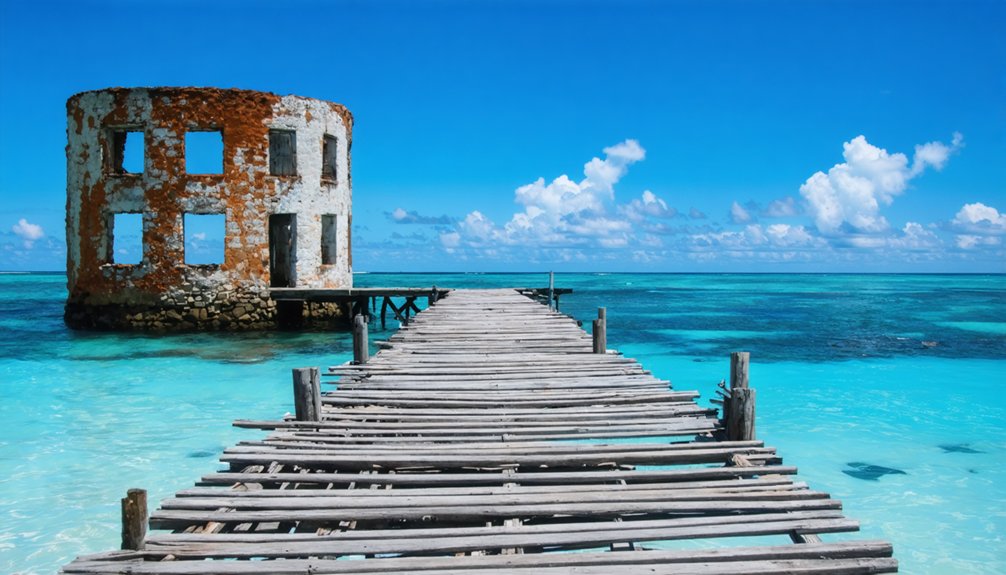
You won’t find traditional ghost towns near Dry Tortugas National Park—Fort Jefferson itself constitutes the region’s sole abandoned settlement. This sixteen-million-brick fortress, constructed between 1846 and 1875 on Garden Key seventy miles west of Key West, once housed over 1,000 soldiers, prisoners, and civilians before military obsolescence and yellow fever outbreaks forced its abandonment in 1874. The fort’s crumbling infrastructure, paranormal reports, and isolated maritime position create a unique ghost town experience accessible only by boat or seaplane, where careful exploration reveals layers of architectural decay and forgotten history.
Key Takeaways
- Fort Jefferson on Garden Key is the primary ghost town structure within Dry Tortugas National Park, 70 miles west of Key West.
- The massive brick fort was abandoned in 1874 and exhibits characteristics of a ghost town with structural decay and isolation.
- No traditional ghost towns exist near the park due to its remote offshore location in the Gulf of Mexico.
- The fort housed over 1,000 people during the Civil War but now stands empty with reported paranormal activity and shadowy figures.
- Visitors can explore designated walking areas of this abandoned military fortress accessible only by ferry or seaplane from Key West.
Fort Jefferson: Florida’s Largest Abandoned Coastal Fortress
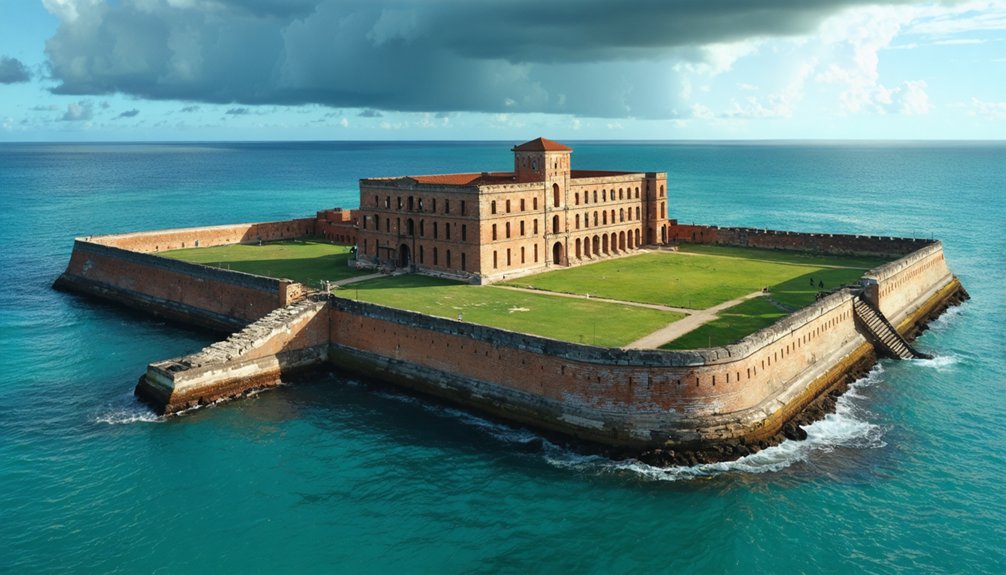
Rising from Garden Key seventy miles west of Key West, Fort Jefferson commands the Dry Tortugas anchorage as the Western Hemisphere’s largest brick masonry structure—a half-mile perimeter of casemates and gun platforms built from more than sixteen million bricks between 1846 and 1875.
You’ll find military architecture designed to mount hundreds of heavy guns controlling Gulf of Mexico and Caribbean shipping lanes, part of America’s coastal defense chain stretching from Maine to California.
Yet rifled artillery rendered these thick brick walls obsolete before completion. The Army abandoned construction in 1874, never having fired a shot in battle.
Fort Jefferson became obsolete before completion—its massive brick walls no defense against advancing military technology.
Shifting foundations only two feet deep caused persistent settling and cracking. Hurricanes battered the fort throughout the twentieth century, leaving casemates exposed to salt spray and decay—a monument to strategic ambition undone by technological change.
The fort’s construction relied on slaves and Irish immigrants who endured harsh conditions including yellow fever outbreaks and severe food shortages.
The fort later served as a quarantine station after the Marine Hospital Service took control in 1889, though it remained largely unoccupied until the Spanish-American War.
The Rise and Fall of Garden Key’s Military Community
Long before Fort Jefferson‘s brick walls began rising from the Gulf waters, Garden Key operated as a strategic federal outpost where the 1825 lighthouse tower marked America’s claim to these isolated coral reefs.
By 1846, you’d witness enslaved workers and Irish immigrants transforming the 16-acre key into a massive coastal stronghold, creating a self-contained military community designed for 1,500 troops.
During the Civil War, the population peaked at 1,013—soldiers, prisoners, and civilians forming a small town seventy miles from mainland Florida.
Yet obsolescence arrived swiftly: rifled artillery rendered masonry fortifications useless by the 1860s, while yellow fever epidemics devastated the garrison.
The fort’s strategic value came from its position overlooking Havana, Pensacola, Mobile, and the mouths of the Mississippi River, allowing it to prevent enemy blockades of critical Gulf ports.
Construction continued for thirty years but never finished, and the military community that once controlled Gulf shipping lanes gradually abandoned this remote fortress.
Among the fort’s most notable inmates was Dr. Samuel Mudd, imprisoned here for his involvement in the Lincoln assassination conspiracy.
Ghost Town Characteristics of the Dry Tortugas Fort Complex
When you approach Fort Jefferson’s hexagonal perimeter today, you’ll encounter 16 million handmade bricks arranged across 47 acres in a configuration that embodies traditional ghost town criteria—massive infrastructure abandoned mid-purpose, structural decay accelerating beyond repair, and architectural spaces emptied of their intended populations.
The fort’s six bastions stand as eroding monuments to obsolescence, their cannon rooms deteriorating from sea spray and weather beyond recovery. Unlike landlocked ghost towns, this maritime fortress merges traditional abandonment with nautical isolation, creating unique conditions for both structural collapse and paranormal narratives.
Maritime folklore intertwines with documented prisoner suffering, while ghostly encounters reported in empty corridors reinforce the location’s dual identity as both historical ruin and supernatural site, attracting freedom-seekers who value remote exploration. The fort’s construction began in the 1800s as a coastal fortress, serving strategic military purposes before its eventual abandonment left behind the decaying structure visible today. The construction required over 30 years to build, though it was never fully completed before military technology rendered it obsolete.
Historic Prison Population and the Isolated Island Settlement
The fort’s brick walls contained more than military equipment—between 1861 and the 1870s, they enclosed a shifting population that transformed Garden Key from construction site to wartime prison.
You’ll discover that 882 Confederate prisoners occupied cells by November 1864, while Union deserters and Lincoln assassination conspirators like Dr. Samuel Mudd endured the isolation impact of captivity 70 miles from Key West.
The prison legacy reveals a brutal reality: 2,000 inhabitants crowded onto 16 acres without fresh water, where tropical disease and overcrowding created conditions resembling Devil’s Island.
Fort Jefferson’s 16 acres imprisoned 2,000 souls without fresh water, where disease and overcrowding rivaled the horrors of Devil’s Island.
The 1867 yellow fever outbreak devastated this isolated community, killing prisoners and soldiers alike. Dr. Mudd took charge of medical responsibilities during the epidemic, treating over 300 cases and achieving a low mortality rate of 38 deaths. Construction of this massive masonry structure began in 1846 and continued for 30 years, though the fort remained unfinished despite the decades of labor.
Fort Dade on Egmont Key: A Comparable Florida Island Ghost Town
Across Florida’s Gulf Coast, 75 miles north of Fort Jefferson, another island fortress followed a parallel trajectory from strategic outpost to windswept ruins.
Fort Dade rose on Egmont Key between 1898–1899 as part of the Endicott coastal defense program, its batteries protecting Tampa Bay’s shipping channels. Named for Major Francis L. Dade, killed in the 1835 Dade Massacre, this military architecture housed 600 soldiers at its World War I peak—a self-sufficient community with brick roads, electric lights, and a bowling alley.
The garrison trained National Guard artillery units while managing submarine minefields alongside sister installation Fort De Soto.
After a devastating 1921 hurricane battered the barracks, the Army abandoned this coastal defense post in 1922–1923, leaving concrete batteries and paved streets to erosion and time.
Before the fort’s construction, the island served a darker purpose as a prison camp for captured Seminoles during the 1850s, a traumatic chapter the Seminole people remember as “The Dark Place.” Today, visitors can reach the island only by boat from Fort De Soto State Park, where ferry services transport explorers to the preserved ruins and wildlife refuge.
Paranormal Reports and Haunted Legends of Fort Jefferson
Fort Jefferson’s massive brick casemates—arched chambers designed for cannon emplacements—now function as corridors where visitors report shadowy figures and unexplained cold spots concentrated in former prison cells.
The spirit of Dr. Samuel Mudd, imprisoned here after the Lincoln assassination, allegedly manifests along the ramparts where he served his sentence from 1865 to 1869, with multiple accounts documenting his spectral presence in archival records and ranger testimonies.
After sunset, campers stationed on Garden Key consistently describe disembodied footsteps echoing through empty corridors, strange lights moving across bastions, and the sensation of unseen observers watching from the fort’s upper galleries.
Apparitions in Fort Casemates
Within the vaulted brick casemates and inner corridors of Fort Jefferson, paranormal investigators and overnight visitors have documented persistent reports of apparitions, disembodied voices, and what they describe as “residual hauntings” tied to the structure’s history of imprisonment, execution, and epidemic disease.
The southwestern turret zone, where Private Winters was fatally shot, generates concentrated ghostly encounters—rangers report whispering voices and shadow figures near casemate access points after dark.
Yellow fever victims, numbering over thirty documented deaths, allegedly manifest through moans and fleeting shadows in former hospital quarters.
You’ll find spectral sightings cluster where trauma intersected with enclosed architecture: execution sites, disease wards, and powder magazine approaches.
Contemporary photographs capture unexplained luminous anomalies within these brick corridors, suggesting ongoing electromagnetic irregularities in spaces once saturated with suffering.
Dr. Samuel Mudd’s Spirit
Among Fort Jefferson’s documented paranormal phenomena, Dr. Samuel Mudd’s restless presence dominates the haunted history. The physician imprisoned for aiding Lincoln’s assassin reportedly never left his confinement site, creating the legend of “the prisoner who never left.” His unresolved conviction fuels interpretations of supernatural regret anchoring him to these isolated walls.
Reported manifestation zones include:
- Hospital wing where Mudd treated yellow fever victims during the 1867-1869 epidemic
- Cell above the sally port documented as his primary confinement location
- Ramparts where solitary figures appear pacing in twilight hours
- Storm-triggered activity aligning with severe weather patterns
- Anniversary dates of his 1865 arrival intensifying atmospheric disturbances
You’ll encounter Mudd’s regret most intensely near the old hospital corridors—where shadowy figures watch from corners and oppressive atmospheres manifest without warning.
Nighttime Sounds and Sightings
Beyond Mudd’s confined footprint, Fort Jefferson’s nocturnal landscape pulses with broader acoustic and visual disturbances that span the entire hexagonal perimeter.
You’ll encounter reports of nighttime whispers echoing through casemate corridors—low, overlapping murmurs with no identifiable origin. Phantom footsteps resonate across upper walkways and the parade ground long after personnel have departed. Rangers document unexplained metallic clangs from gun rooms, while campers describe chains moving in darkness.
Shadow figures dart through archways, evading direct observation. Rampart sentries materialize and dissolve under scrutiny.
The southwest turret draws particular attention: Private Winters, shot near the powder magazine, anchors a concentrated zone of apparitions and vocal phenomena. Archeology teams report humanoid shadows in peripheral vision.
Paranormal investigators catalog spiral light streams and thermal anomalies, mapping Fort Jefferson as terrain where historical trauma refuses closure.
Remnants of Infrastructure: Lighthouse Ruins and Support Buildings
As you navigate Fort Jefferson’s perimeter, you’ll encounter the layered timeline of its infrastructure evolution—from the original 1820s brick lighthouse tower that stood 70 feet tall to the 1876 metal replacement, and the keeper’s cottage embedded within the fort walls themselves.
The cistern system‘s sand-filled columns still trace vertical paths from roof to foundation, their underground storage chambers representing critical 19th-century engineering solutions to the island’s freshwater scarcity.
Beyond these foundations, the 1902 coal rigs and water distilling plants vanished after the catastrophic 1906 hurricanes, leaving only archaeological traces of the naval installations that briefly transformed this military outpost into a strategic maritime facility.
Historic Lighthouse Keeper Quarters
Fire destroyed the original two-story dwelling in 1945, leaving only archaeological traces and a yellow-brick replacement bungalow.
At Garden Key, Fort Jefferson’s walls absorbed the 1826 keeper’s cottage, while hurricanes forced reconstruction with raised floors and wrap-around porches by 1876.
Today you’ll find:
- Foundation remnants marking original dwelling footprints
- Surviving brick cisterns and oil house ruins
- Modified keeper quarters within fort walls
- Ghost station landscapes documented archaeologically
- National Register recognition preserving fragmentary remains
Abandoned Cistern and Foundations
Beneath Fort Jefferson’s hexagonal footprint lie sophisticated water storage chambers that once sustained nearly 2,000 garrison members through innovative 19th-century engineering.
You’ll find abandoned cisterns connected to sand-filled columns that filtered rainwater from roof to foundation, addressing freshwater scarcity in this isolated location.
Modern radar surveys reveal foundation remnants of vanished structures—the 1877-removed lighthouse tower, barracks, hospitals, and support buildings that dotted the sandy landscape throughout construction decades.
These subsurface features tell stories of self-sufficiency and survival, where every drop mattered.
Archaeological investigations expose relict footpaths, utility networks, and buried refuse dumps, mapping a ghost infrastructure beneath shifting sands.
The fort’s inadequate two-foot foundations on unstable ground eventually surrendered to tropical storms and neglect after 1874 abandonment.
Disease, Death, and Departure: Why the Fort Was Abandoned
From the moment workers laid the first courses of brick on unstable coral rubble in 1846, Fort Jefferson’s foundations began a slow descent into the sand and shifting sediment beneath.
The cracked cisterns allowed seawater infiltration, destroying fresh water supplies while disease outbreaks turned the garrison into a tropical graveyard.
You’ll find the fort’s abandonment wasn’t sudden—it was inevitable:
- Yellow fever epidemics killed dozens repeatedly, decimating both garrison and prisoners
- Rifled cannon rendered thick brick walls obsolete by 1866, ending construction
- Labor hardships—brutal heat, brackish water, scurvy—created chronic worker shortages
- Hurricane damage accelerated structural deterioration the Army couldn’t justify repairing
- Strategic irrelevance after the Civil War made the remote outpost expendable
Visiting the Abandoned Fort: Access and Preservation Today
Despite Fort Jefferson’s remote position seventy miles west of Key West, you’ll find the journey to this crumbling fortress more accessible than its isolation suggests. The Yankee Freedom catamaran departs daily at 7:30 AM, delivering you to deteriorating ramparts by 10:30 AM. Seaplanes offer faster access methods for those prioritizing time over cost.
The preservation status reveals ongoing decay—moat walls closed through 2026, masonry crumbling across structural zones. You’re restricted to designated walking areas; mid-level and upper sections remain off-limits due to instability. Restoration crews battle decades of weathering, yet damage accumulates faster than repairs advance.
Book months ahead—ferry tickets ($190-$220) and camping permits vanish quickly. Pack sturdy footwear for traversing uneven brick surfaces, and bring all supplies. No roads connect this wilderness outpost to civilization.
Frequently Asked Questions
Are There Any Other Ghost Towns or Abandoned Settlements Near Dry Tortugas?
No ghost towns exist near Dry Tortugas, but you’ll find abandoned settlements farther northeast: Indian Key’s 1840s ruins lie off Key Largo, where archival records document its evolution from bustling trade post to hurricane-destroyed landscape.
Similarly, ghost towns near Pinnacles National Park tell stories of past lives, with remnants of former mining camps and abandoned homes scattered throughout the region. These ghostly remnants offer a glimpse into California’s rugged history, where the search for gold once lured many to the remote landscape. Exploring these sites can evoke a sense of nostalgia for a bygone era, drawing visitors into the tales of those who once called these places home.
Can Visitors Camp Overnight Inside Fort Jefferson’s Abandoned Casemates?
No, you can’t camp inside Fort Jefferson’s casemates. Current camping regulations restrict overnight stays to Garden Key’s designated campground only. Fort history preservation requires protecting these 19th-century structures from unauthorized interior access and potential damage.
What Artifacts or Relics Remain Inside the Abandoned Fort Today?
Time’s footprints fade within Fort Jefferson’s walls—you’ll find preserved artifacts like greywacke construction materials and structural elements protected by Federal law, though most relics of historical significance remain submerged underwater or archived elsewhere.
How Many People Died at Fort Jefferson During Its Operational Years?
Fort history reveals approximately 170 people died during operational years, though mortality rates remain incompletely documented. You’ll find archival documentation scattered across repositories, complicating efforts to trace how disease, violence, and environmental conditions claimed lives across this isolated landscape.
Are Guided Ghost Tours or Paranormal Investigations Offered at the Fort?
You’ll be shocked to learn no official ghost tours or paranormal investigations operate at Fort Jefferson. The National Park Service doesn’t permit commercial paranormal activities, though independent teams have documented unexplained phenomena throughout the fort’s historic corridors.
References
- https://en.wikipedia.org/wiki/List_of_ghost_towns_in_Florida
- https://southernmostghosts.com/fort-jefferson-in-the-dry-tortugas-ghost-goblins-and-assassins-in-paradise/
- https://www.onlyinyourstate.com/experiences/florida/historic-ghost-town-fl
- https://www.ghostsandgravestones.com/key-west/haunted-places
- https://miamihaunts.com/the-ten-most-haunted-spots-in-florida/
- https://www.youtube.com/watch?v=Oxtg_Ak70HE
- https://floridatrailblazer.com/2015/06/26/the-ghost-town-of-sturkey-in-the-green-swamp/
- https://freepages.history.rootsweb.com/~gtusa/usa/fl.htm
- https://www.youtube.com/watch?v=ybskzWdVzxs
- https://en.wikipedia.org/wiki/Fort_Jefferson