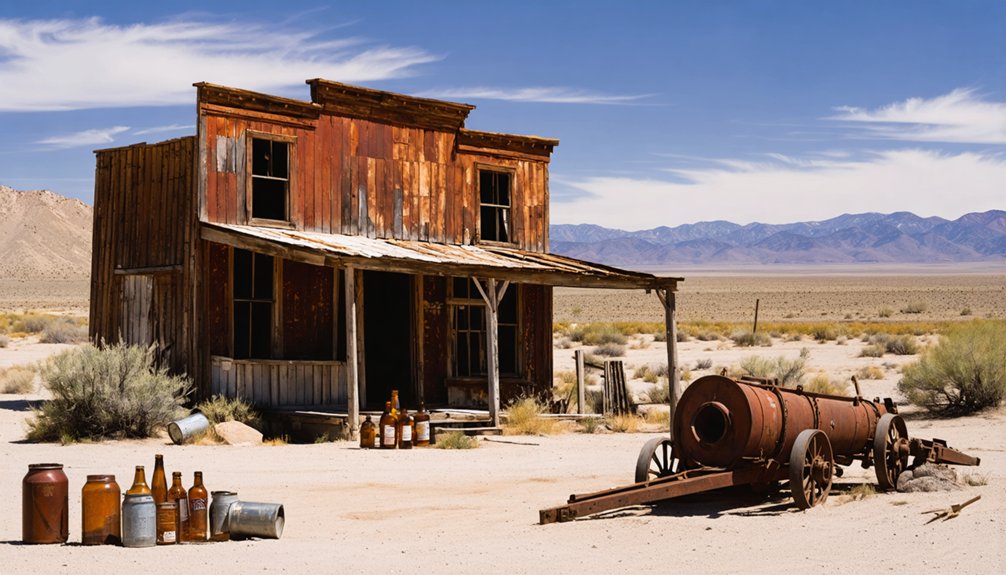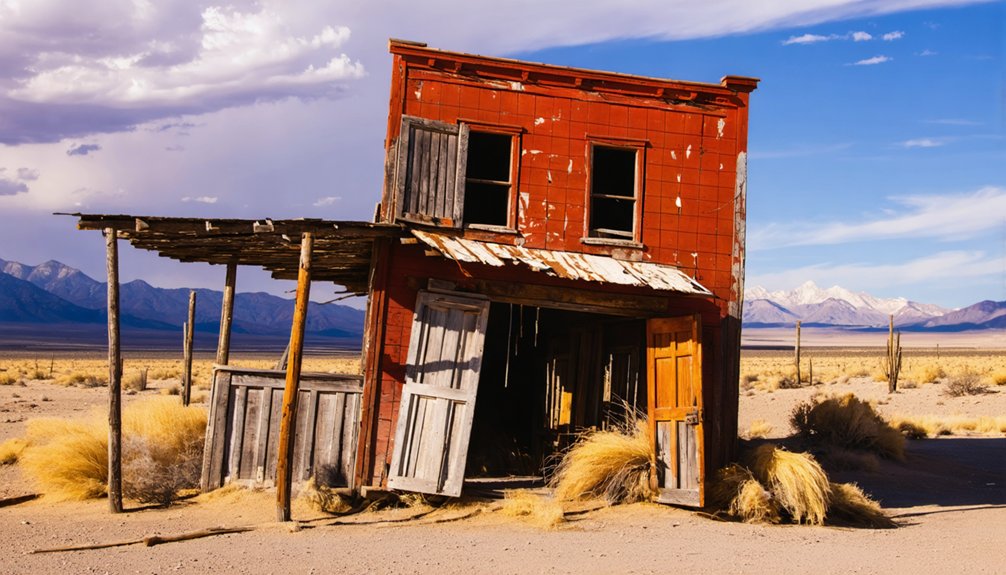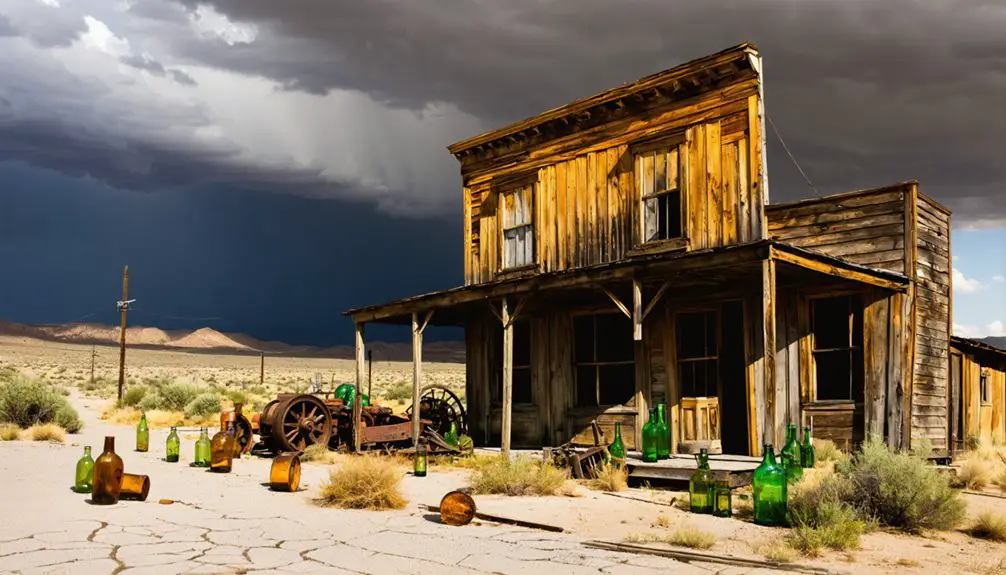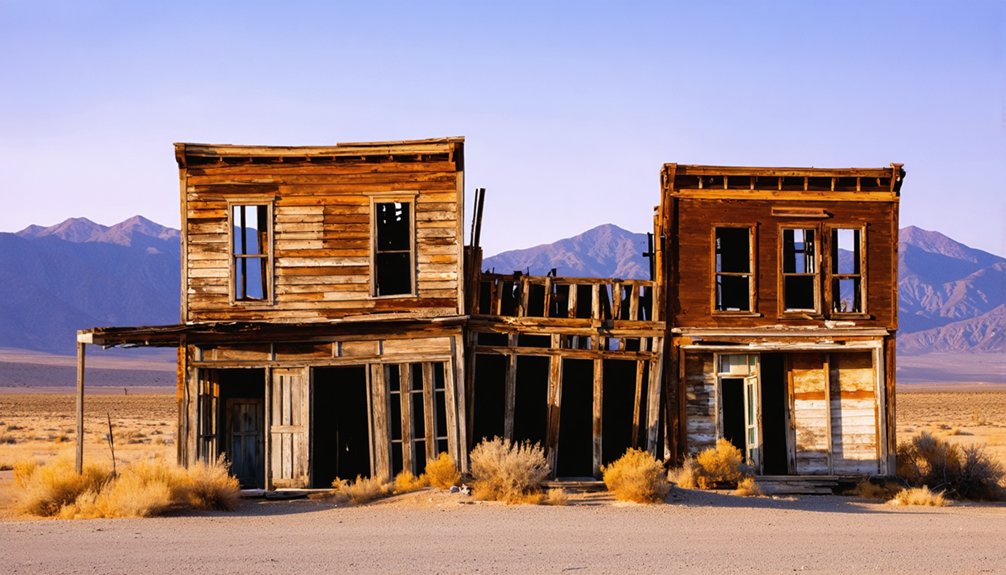
You’ll discover exceptional ghost towns within two hours of Elko, each telling distinct stories of Nevada’s boom-bust cycles. Tuscarora produced over $40 million in silver and gold before fading into abandonment, while Metropolis’ ambitious 1910 agricultural colony collapsed within five years, leaving only cement sidewalks and scattered ruins. Mountain City preserves remnants of Chinese miners’ homes, and Old Town Wells showcases railroad-era commerce along the California Trail. The surrounding valleys hide lesser-known camps like Bull Run and Charleston, where collapsed adits and rusting equipment slowly surrender to sagebrush, awaiting your exploration of their layered histories.
Key Takeaways
- Tuscarora, Elko County’s premier silver camp, produced over $10 million during peak years and operated until 1990.
- Metropolis, a failed 1910 agricultural colony, features ruins including graded streets, sidewalks, and the Lincoln School building.
- Mountain City, established in 1869, still operates today and includes remains of Chinese immigrant homes and mining structures.
- Downtown Elko serves as a central hub with ghost towns accessible within two hours’ drive via gravel roads.
- High-clearance vehicles or 4x4s are necessary for exploration, with late spring through early fall being optimal visiting times.
Metropolis: The Failed Agricultural Dream North of Wells
When New York’s Pacific Reclamation Company purchased 40,000 acres of sagebrush rangeland fifteen miles northwest of Wells in 1910, its promoters envisioned nothing less than a thriving agricultural metropolis of 7,500 souls rising from the high desert.
The Metropolis infrastructure materialized rapidly—graded streets, cement sidewalks, a 50-room brick hotel with running water and electric lights, an ornate rail depot, and the substantial Lincoln School. Land sales for dry farm land attracted settlers at prices ranging from $10 to $15 per acre.
Within months, the desert sprouted graded boulevards, cement walks, a grand hotel, ornate depot, and schoolhouse—all awaiting colonists who would never stay.
By late 1912, roughly 700 colonists had arrived. Yet agricultural challenges doomed the venture almost immediately. Downstream water-rights lawsuits strangled the irrigation scheme, forcing settlers onto marginal dry-farming.
Rabbit plagues devoured crops after overzealous coyote eradication, then drought and Mormon cricket infestations finished the job. Within five years, Metropolis stood abandoned. Today, visitors will find only ruins of the school and hotel amid the sagebrush that has reclaimed the townsite.
Tuscarora: Elko County’s Premier Silver Camp
After a Shoshone Indian shared the location of gold on McCann Creek in 1867, prospectors established a small placer camp that would eventually bear the name of the Civil War gunboat USS Tuscarora.
The real wealth arrived in 1871 when W. O. Weed discovered rich silver ore on Mount Blitzen’s east slope, transforming Tuscarora history from scattered tents into Nevada’s premier silver district.
You’ll find this camp produced over $10 million during its peak years, with a dozen steam hoists pulling ore from deep shafts by 1877.
The town swelled to 1,400 residents, including a vibrant Chinese community that built an ornate joss house while working abandoned placers.
Tuscarora culture thrived through the blend of hard-rock miners and Independence Valley ranchers, all connected by freight wagons hauling bullion fifty-two miles to Elko’s railroad.
Mining continued through various periods until 1990, with total production reaching 500,000 oz gold and 7.63 million oz silver from the district’s long history.
The original townsite on McCann Creek was protected by an adobe fort built to defend against Indian attacks after miners flooded the area.
Mountain City and the Gold Creek Mining District
If you venture sixty miles north of Elko into the rugged mountains near Idaho, you’ll find Mountain City, established in 1869 when prospectors traced silver and gold float along the East Fork Owyhee River back to rich lodes in the surrounding canyons.
The nearby Gold Creek District, centered on Island Mountain townsite, added another layer to the region’s mining story with strikes that ranged from early placer gold to substantial copper veins worked well into the twentieth century.
Reaching these scattered claims at elevations above six thousand feet meant traversing primitive pack trails and enduring brutal winters that isolated miners for months at a stretch. Like many Nevada mining camps, Mountain City attracted Chinese miners who established their own communities and contributed to the development of local commerce and milling operations. At Gold Creek near Jarbidge, over 200 Chinese immigrants made their home in the late 1800s, leaving behind foundations of about 11 homes and a store that remain buried beneath soil and gravel.
Early Gold-Silver Discoveries
Though trappers and prospectors had crossed the rugged terrain north of present-day Elko for years, it was M. L. Henry who reportedly struck placer gold on the upper Owyhee River in 1868.
The real rush came when Jesse Cope and his party discovered rich gold-silver deposits in April–May 1869 while traveling from Silver City, Idaho, to White Pine.
You’d have witnessed the camp of Cope spring up almost overnight—300 residents by June, drawn by promises of easy placer mining and lode prospects.
The district formally organized on May 22, 1869, establishing local mining regulations.
Within months, the settlement renamed itself Mountain City, though old-timers still called it the Cope district, honoring the man whose discovery transformed this remote canyon into Nevada’s newest ghost town.
By summer’s end 1869, the population had swelled to 700 residents, supported by 20 saloons, a dozen hotels, and 4 stores.
By 1870, Mountain City had established its post office, which remarkably continues operating to the present day.
Copper Mining Expansion
When geologist S. Frank Hunt struck copper in 1932, three miles southwest of Mountain City, he launched a copper boom that briefly reversed the region’s decline. His prediction proved accurate—at 227 feet, ore assayed at 40–47% copper content.
International Smelting & Refining formed Mountain City Copper Company, building a complete company town with schools, hospital, and theater. Hunt had named his original claim Rio Tinto, drawing inspiration from the ancient mines along the Spanish-Portuguese border.
The copper boom’s mining legacy shaped the district until 1947:
- Total copper production reached $21,339,300 before shutdown
- Rio Tinto became Elko County’s leading copper producer
- A planned community signaled long-term investment
- Mining wages supported ranching and regional services
- Post-1947 closure contributed to ghost-town character
The mine’s shutdown reflected broader trends in Nevada, where base metal production had peaked during World War II and would soon give way to a renewed focus on precious metals extraction.
Accessing Remote Mine Sites
Because Mountain City sits roughly 60–70 miles north of Elko on U.S. Highway 93, it serves as your paved-road gateway to the Gold Creek Mining District.
Beyond this point, remote navigation demands high-clearance 4×4 vehicles and careful planning. Secondary routes like Coleman–Hammond Canyon Road lead through archaeological sites where Chinese miners once built eleven homes and a store.
You’ll encounter seasonal closures, protective berms, and access challenges stemming from Forest Service efforts to preserve cultural resources. Winter snows forced historic residents to relocate seasonally to Tuscarora, and today’s unpaved mine roads become impassable during snowmelt.
Before heading into these lightly maintained networks, fuel up in Mountain City and pack extra water—services vanish quickly in this high-desert canyon country.
Old Town Wells and the California Trail Heritage
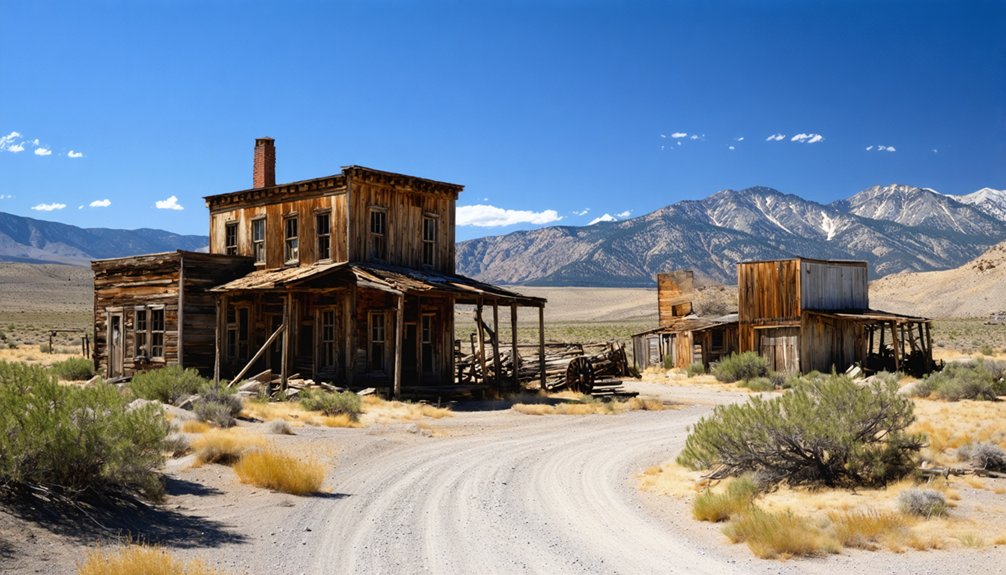
You’ll find Wells positioned at one of the most critical junctures along the California Trail, where from 1845 to 1869 tens of thousands of gold-seeking emigrants stopped at Humboldt Wells’ natural springs to water their livestock before facing a brutal forty-mile desert crossing.
The Central Pacific Railroad established a station here in 1869, transforming this historic rest stop into a freight hub that served the surrounding mining districts and ranches.
Today’s visitors can trace both the iron rails and wagon wheel ruts that still mark the landscape west of town, connecting railroad heritage with emigrant trail history in a single afternoon’s exploration.
Wells Railroad & Freight Heritage
Though Humboldt Wells began as little more than a spotted boxcar beside fresh-laid Central Pacific Railroad track in 1868, it evolved into one of northeastern Nevada’s most strategic freight and helper-engine stations within just a few years.
You’ll discover Wells freight operations once served mines at Sprucemont, Cherry Creek, and Dolly Varden while supporting ranches across Ruby and Clover valleys.
The railroad heritage here reveals impressive complexity:
- Helper locomotives staged at Wells assisted trains climbing Pequop Mountains
- Water towers supplied steam engines crossing the arid Great Basin
- Chinese railroad workers built thriving Chinatown with cafes and laundries
- Nevada Northern Railway (1906) diverted major freight flows north
- Western Pacific (1908) and Oregon Short Line (1926) added competing routes
Multiple rail carriers transformed Wells into a genuine transcontinental crossroads.
California Trail Emigrant Routes
When the Bidwell-Bartleson Party abandoned their wagons somewhere in northeastern Nevada’s parched basins during 1841, they couldn’t have imagined that within a decade, tens of thousands of emigrants would be grinding ruts into this same corridor along the Humboldt River.
By 1849, you’d have encountered trail landmarks like Carlin Canyon—a bottleneck that forced you to wait days during high water—and the dreaded Fortymile Desert beyond present-day Reno.
The emigrant challenges intensified at the Sierra crossings, where multiple variants developed as travelers sought viable passages. The Stephens-Townsend-Murphy party pioneered the Truckee River route in 1844, though you’d ford that river twenty-seven times.
Two years later, the Donner-Reed Party‘s catastrophic winter entrapment proved these weren’t mere inconveniences—they were life-or-death gambles for California-bound fortune seekers.
Combining Wells Ghost Town Tours
If you park along Wells’s quiet brick-lined commercial blocks—where false-front storefronts stand shoulder to shoulder with grain elevators and vacant lots—you’re standing at the junction of two ghost-town narratives: the slow fade of a railroad division point into semi-abandonment and the dramatic collapse of nearby Metropolis, that utopian farm colony twelve miles northwest that promised 7,500 residents but delivered barely three hundred before its 1920 bankruptcy.
Wells tours combine both sites into half-day itineraries that illustrate boom-bust cycles across Nevada’s high desert:
- Start at Old Town’s early-1900s railroad grid for context on division-point commerce
- Drive Lake Avenue/Metropolis Road’s twelve graded miles to the brick schoolhouse ruins
- Examine Pacific Reclamation Company’s failed irrigation infrastructure
- Trace Southern Pacific’s abandoned eighteen-mile spur alignment
- Return via California Trail Center exhibits linking emigrant routes to later settlement failures
Ghost town exploration here rewards archival preparation and desert self-reliance.
Lesser-Known Mining Camps: Bull Run, Jack Creek, and Charleston
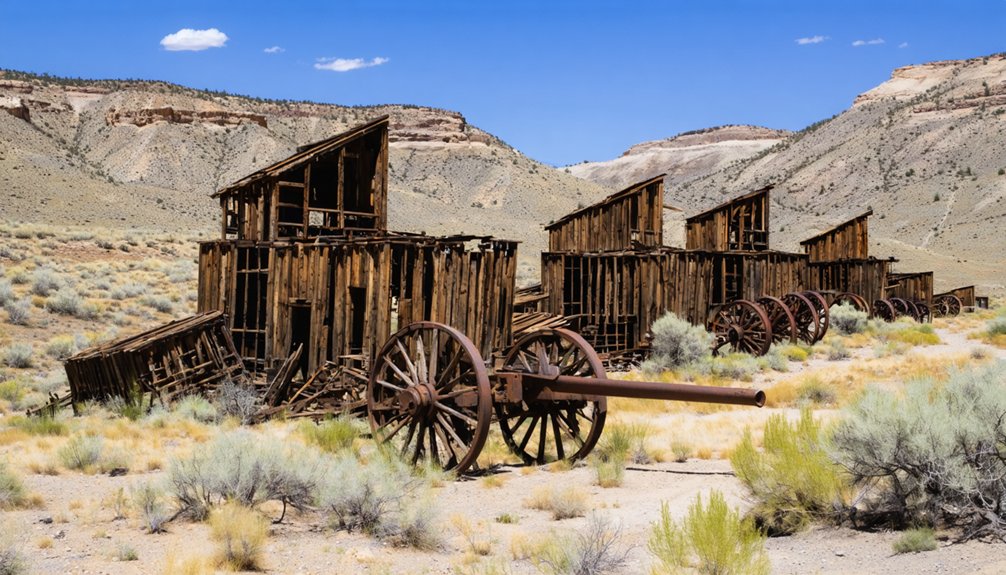
Beyond the well-documented camps of Tuscarora and Midas, a trio of lesser-known mining districts scattered across Elko County’s backcountry tells a quieter story of boom, brief prosperity, and inevitable decline.
Bull Run, established in 1868 at 8,000 feet in the Bull Run Mountains, worked gold-silver veins through miles of underground workings. When renewed interest sparked revival in 1905, promoters platted the townsite of Aura with streets and commercial lots. Operators upgraded mining techniques, installing new mills and drilling rigs, yet production remained intermittent.
Along Jack Creek, another ghost town emerged around 1869 where prospectors balanced lode work with ranching in the watered canyon.
Today collapsed adits, rusting equipment, and faint townsite traces mark these high-country camps—freedom seekers’ relics slowly reclaimed by sagebrush and snow.
Planning Your Ghost Town Adventure From Elko
How do you transform scattered historical fragments across Elko County’s vast backcountry into a coherent exploration?
Base yourself in downtown Elko, where national-brand hotels and outfitters support route planning from a central I-80 hub. Most ghost towns lie within two hours’ drive, perfect for themed day circuits combining railroad corridors, mining camps, and ranching settlements.
Elko’s central location transforms backcountry ghost town exploration into manageable day trips radiating from comfortable base accommodations.
Your vehicle preparation determines which sites you’ll access:
- High-clearance vehicles handle graded gravel to Tuscarora and Palisade
- 4×4 capability opens up rougher Spruce Mountain Road camps
- Late spring through early fall offers passable conditions
- Clay roads become impassable mud after precipitation
- Fuel up in Elko—stations vanish beyond town limits
The visitor bureau provides current road conditions and historical maps, while organized tours offer guided alternatives to solo exploration.
Safety Tips and Access Information for Remote Sites
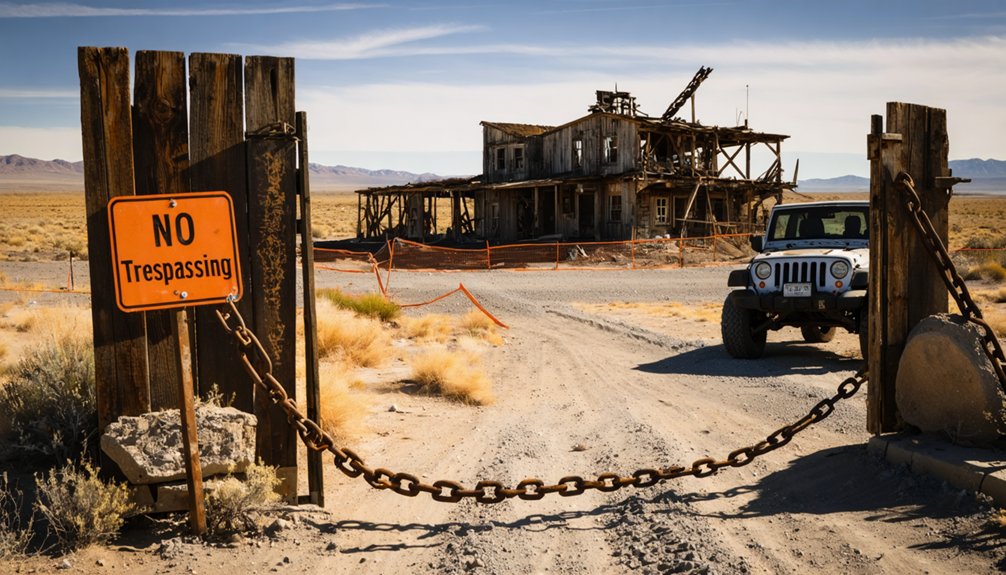
When your GPS signal drops to zero fifteen miles down a washboard road and the last gate you closed vanishes in your rearview mirror, you’re operating on the self-reliance that Nevada’s ghost town corridors demand.
Vehicle preparation starts before you leave pavement—high-clearance capability, recovery boards, spare fuel, and multiple water sources aren’t suggestions here.
Safety equipment matters when abandoned mine shafts open without warning and century-old floors hide voids large enough to swallow an adult. Pack first aid supplies, satellite communication devices, and tools for self-recovery.
Download offline maps before you lose signal. Respect every gate, every artifact, every no-trespassing sign—federal citations follow volunteers and trail cameras into these backcountry corridors.
Know your limits, provision thoroughly, and remember that rescue response times stretch into hours, not minutes.
Frequently Asked Questions
Are Camping Facilities Available Near Elko County Ghost Town Sites?
You’ll find multiple camping options throughout Elko County near ghost town exploration areas, including dispersed sites managed by BLM and Forest Service, plus private RV parks offering nearby amenities like full hookups and shower facilities.
Which Ghost Towns Allow Metal Detecting or Artifact Collecting?
The treasure-hunting dream hits a brick wall: no Elko ghost towns on public land allow metal detecting or artifact collecting. Metal detecting regulations and artifact preservation laws protect historic sites. You’ll need private property with written landowner permission.
Do Any Elko Ghost Towns Have Guided Tour Services Available?
Downtown Elko offers guided ghost tours through its haunted historical district, but outlying ghost towns like Metropolis, Tuscarora, and Jarbidge don’t have permanent guided tour services—you’ll explore their historical significance independently or through regional outfitters.
What Is the Best Season to Visit Ghost Towns Near Elko?
Spring and fall offer the best time for exploring, when crisp mornings give way to mild afternoons and seasonal weather keeps roads passable—you’ll dodge summer’s scorching heat and winter’s snowbound trails while wandering freely through Nevada’s desert ruins.
Are There Entrance Fees for Visiting Ghost Towns in Elko County?
You’ll find most ghost towns offer free access without entrance regulations—Metropolis, Tuscarora, and California Trail sites welcome independent exploration. Museums provide fee waivers for military personnel and residents, while commercial tours like Techatticup Mine charge admission.
References
- https://cowboycountry.com/ghost-towns/
- https://exploreelko.com/things-to-do/uncommon-activities/ghost-towns/
- https://nvtami.com/elko-county-ghost-towns/
- https://nvtami.com/2025/01/16/exploring-elko-county-ghost-towns/
- https://www.ghosttowns.com/states/nv/nvelko.html
- https://travelnevada.com/ghost-town/the-metropolis-that-wasnt/
- https://en.wikipedia.org/wiki/Category:Ghost_towns_in_Elko_County
- https://modernjeeper.com/4-ghost-towns-1-road-1-day-mission-explore-elko-nv-by-jeep/
- https://forgottennevada.org/sites/newlist.html
- https://travelnevada.com/ghost-town/metropolis-ghost-town/