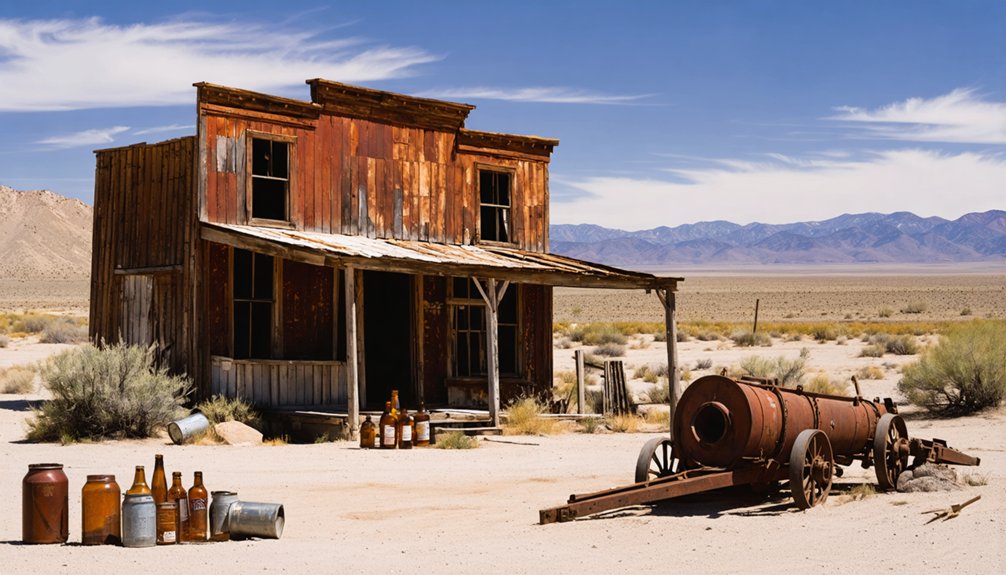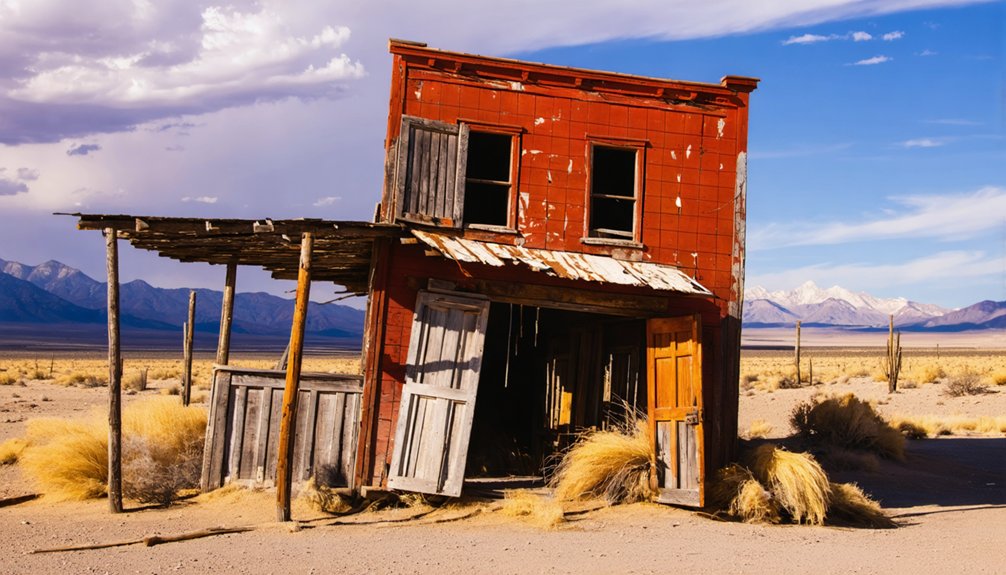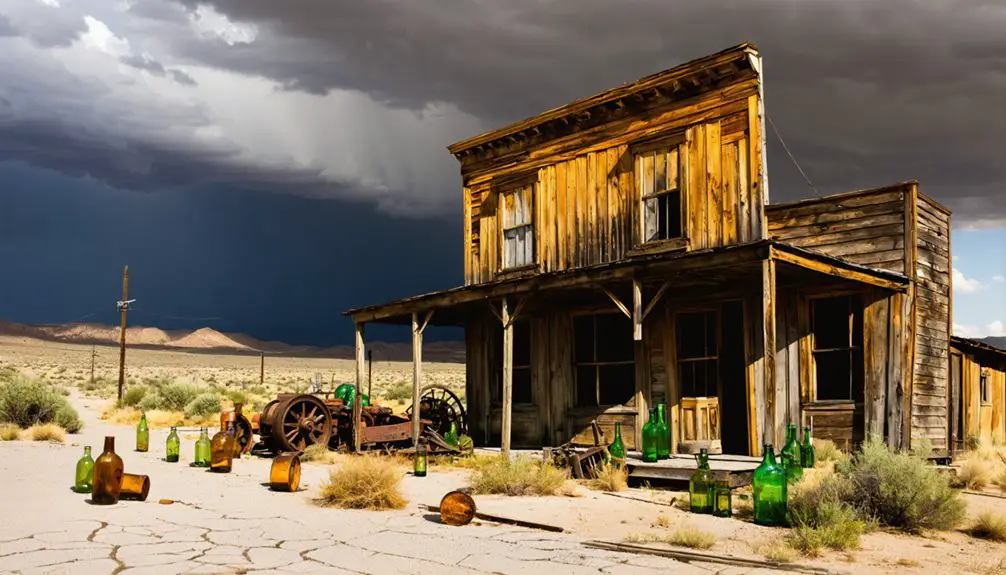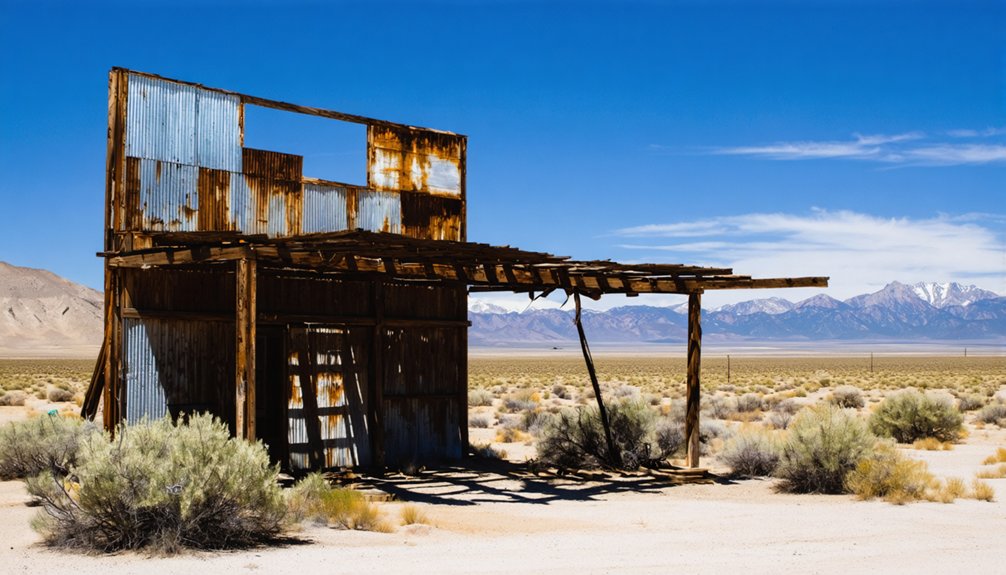
You’ll discover exceptional ghost towns within easy reach of Ely, Nevada. Cherry Creek, 50 miles north, preserves relics from its 1872 silver boom that produced over $6 million. The Ward Charcoal Ovens, built in 1876, stand as 30-foot stone monuments to industrial-scale mining. Osceola showcases Nevada’s first hydraulic gold mining operation from 1884. Hamilton once housed 10,000 residents and shipped $22 million in bullion before fires devastated it. Each site reveals unique engineering feats, economic boom-and-bust cycles, and architectural remnants that tell compelling stories of Nevada’s mining frontier.
Key Takeaways
- Cherry Creek, 50 miles north of Ely, boomed after 1872 silver discovery and produced over $6 million in precious metals.
- Ward Charcoal Ovens State Park features six 30-foot stone ovens built in 1876, now preserved with hiking trails.
- Hamilton was Nevada’s largest silver boomtown with 10,000 residents in 1869, generating $22 million before declining by 1887.
- Osceola in the Snake Range pioneered Nevada’s hydraulic mining in 1884, extracting nearly $5 million in gold.
- McGill’s satellite “sin towns” including Steptoe City, Smelterville, and Ragdump served vice industries until 1914-1948.
Cherry Creek: Eastern Nevada’s Silver Boom Legacy
Long before Cherry Creek’s silver veins drew thousands of fortune-seekers to eastern Nevada, prospectors had already begun working the gravels of nearby Egan Canyon in 1859, searching for gold deposits that would prove far less lucrative than what lay waiting in the hills to the north.
Cherry Creek’s history exploded in September 1872 when Peter Corning and John Carpenter struck the Tea Cup mine‘s rich silver chloride deposits.
The September 1872 discovery of the Tea Cup mine’s silver chloride deposits by Peter Corning and John Carpenter sparked Cherry Creek’s explosive transformation.
You’ll find this discovery transformed empty sagebrush into a town of 6,000 residents within months.
Mining techniques evolved rapidly—early prospectors simply smelted surface ore, but deeper sulphide deposits demanded sophisticated mills.
The town’s prosperity peaked between 1872 and 1883, generating over $6 million in precious metals before financial collapse and mismanagement shuttered operations.
The district encompasses over 20 past producing mines, including notable operations like Blue Bird and Ticup scattered across the mineralized landscape.
By spring 1873, the town was officially platted with a population of 400, marking its transformation from mining camp to organized settlement.
Ward Charcoal Ovens: Industrial Relics of White Pine County
Six massive beehive-shaped charcoal ovens rise from the sagebrush thirty feet into the Nevada sky, their dark stone walls testifying to the industrial fury that once consumed these hillsides.
Built by Swiss-Italian stonemasons in 1876, these structures powered Ward’s silver boom through relentless charcoal production.
Each oven’s specifications reveal the operation’s scale:
- 30 feet high, 27 feet diameter with 2-foot-thick tuff stone walls
- 35 cords of wood per burn cycle, producing 1,750 bushels of charcoal
- 10–12 day carbonization cycles using pinyon pine and juniper
- 16,000 bushels daily output at peak smelter demand
The historical significance extends beyond mere fuel production—these ovens consumed entire forests, sheltered outlaws and stockmen, and ultimately exemplified resource exhaustion’s role in mining district collapse by 1879. The site remained privately owned by ranchers until 1956, when a special use permit transferred protection of the ovens to the Nevada State Park Commission. Located 20 miles south of Ely along the Great Basin Highway, the ovens now anchor a state park offering hiking trails with commanding views of Steptoe Valley and access to Willow Creek fishing.
Osceola: Gold Rush Engineering in the Snake Range
High-pressure water jets carved through Nevada mountainsides in 1884, transforming Osceola into the state’s first hydraulic mining operation and launching an engineering feat that would ultimately extract nearly $5 million in gold.
Nevada’s pioneering hydraulic mining operation blasted mountainsides with water jets, engineering an ambitious gold extraction that would yield nearly $5 million.
You’ll find Osceola’s story begins in 1872 when Joseph Watson and Frank Hicks discovered a 12-mile gold-bearing vein. The game-changer came with ambitious water engineering—two 18-mile pipelines and extensive ditch systems channeling mountain water through canyons to power hydraulic gold mining operations.
The town swelled to 1,500 residents during the 1880s boom, sustained by innovations including Nevada’s first hydraulic techniques. An 1886 discovery of a 25-pound gold nugget worth $6,000 revitalized operations.
After an 1890 fire destroyed infrastructure, the Osceola Placer Mining Company closed in 1900, though brief revivals continued until final abandonment in the 1950s. The mining town shares its name with Osceola National Forest in Florida, both honoring the influential Seminole leader who resisted U.S. expansion in the 1830s. Today, visitors can explore the cemetery and remains of old buildings scattered along the dirt road just off Highway 50.
The Sin Towns: McGill’s Rowdy Satellite Settlements
- Steptoe City (¾ mile northeast) – housed 150 residents and earned Dr. Hovenden’s title of “toughest little camp in the state”
- Smelterville (2 miles southwest) – focused purely on vice economy operations
- Ragdump (2 miles north) – operated as a red-light district
- The Copper Club – McGill’s single authorized saloon
Public disapproval shut down Smelterville and Ragdump in 1914.
Steptoe City, which included families and a church, lasted longer before fading away. By 1948, only fifty houses remained, most abandoned or in disrepair.
These satellite settlements emerged because McGill operated as a regulated company town that prohibited saloons and gambling within its borders.
Exploring Hamilton, Treasure City, and Beyond
The remote landscape west of Ely holds the ruins of Hamilton, once Nevada’s most promising silver boomtown and a reflection of frontier aspiration.
You’ll find it 285 miles from Las Vegas off U.S. Route 50, where silver mining fever drew 10,000 souls in 1869. Hamilton history reveals staggering wealth—$22,000,000 in bullion shipped by 1868—supporting 100 saloons and twice-daily stage service to Elko.
The town’s brick courthouse cost $55,000 in 1870, serving as county seat until fires in 1873 and 1885 destroyed everything.
Standing at 8,000 feet, shallow ore deposits doomed this settlement. Production ceased in 1887 when miners found no viable veins below the surface. Today you’ll discover Wells Fargo’s arched brick building among scattered foundations, remnants of dreams carved into unforgiving terrain. Several buildings feature roofs constructed from flattened tin cans, a testament to the resourcefulness of early settlers.
Frequently Asked Questions
What Is the Best Time of Year to Visit Ghost Towns Near Ely?
Visit in spring (April–May) or fall (September–October) for ideal seasonal weather—mild days, accessible roads, and stunning light for photography tips. You’ll avoid summer’s scorching heat and winter’s snow-blocked routes while exploring freely.
Are Ghost Town Sites Near Ely Accessible by Standard Vehicle?
Yes, you’ll find many ghost towns accessible by standard vehicle via maintained roads off US-50 and US-93. However, road conditions vary seasonally, so vehicle recommendations include checking with Ely Visitor Center before departing.
Is Camping Permitted Near Ghost Town Locations in White Pine County?
Yes, you can camp near most ghost towns on BLM land following camping regulations—14-day limits apply. Practice ghost town etiquette: use existing sites, avoid structures and artifacts, pack out trash, respect cultural resources.
Which Ghost Towns Near Ely Charge Entrance or Admission Fees?
You won’t pay entrance fees at ghost towns near Ely—they’re all free to explore. There aren’t any admission costs since these abandoned mining sites sit on public land, letting you roam freely without tickets or gates.
Are Guided Ghost Town Tours Available From Ely Nevada?
Guided tours from Ely focus on railroad and mining Ely history rather than remote ghost towns. You’ll find the Nevada Northern Railway’s Haunted Ghost Train and yard tours, but backcountry sites require self-guided exploration.
in addition to exploring Ely, visitors can delve into the history of Blair, Nevada town, which offers a glimpse into the region’s mining past and the lives of its early settlers. This small community, once a flourishing hub, showcases remnants of its rich heritage through various historical sites. Outdoor enthusiasts can also enjoy scenic trails nearby, which provide a perfect backdrop for learning about the area’s unique culture and history.
References
- https://nvtami.com/white-pine-county-nevada-ghost-towns/
- https://www.thetravel.com/ghost-towns-near-ely/
- https://nvtami.com/2024/07/23/ely-explorations/
- https://travelnevada.com/ghost-town/cherry-creek-ghost-town/
- https://www.roadtripryan.com/go/t/nevada/northern-nevada/osceola-ghost-town
- https://www.youtube.com/watch?v=mCJqKWW8-W0
- https://travelnevada.com/ghost-town/
- https://www.youtube.com/watch?v=qHcwdkjc_io
- https://elynevada.net/project/ghost-towns/
- https://viscountmining.com/projects/cherry-creek/