You’ll find several remarkable ghost towns within an hour’s drive of Fernley, Nevada. Fort Churchill State Historic Park, established in 1860, preserves nearly two dozen original adobe structures from its military past. The Seven Troughs Mining District, 30 miles northwest of Lovelock, features Mazuma—devastated by a catastrophic 1912 flood—and Tunnel Camp, Northern Nevada’s best-preserved ghost town with intact cabins and a massive cyanide mill foundation. Further exploration reveals Candelaria’s silver mining ruins and Berlin-Ichthyosaur State Park, where mining history meets fossil discoveries.
Key Takeaways
- Fort Churchill State Historic Park, established in 1860, preserves nearly two dozen original adobe structures and became a National Historic Landmark in 1961.
- Seven Troughs Mining District, 30 miles northwest of Lovelock, boomed from 1905-1920 with towns reaching 5,000 residents during peak gold mining.
- Mazuma was devastated by a catastrophic 1912 flood that killed 9-20 people and left only hillside structures standing.
- Tunnel Camp remains Northern Nevada’s best-preserved ghost town, featuring intact cabins, a brick mill office, and the Freidman Mill foundation from 1930.
- Berlin-Ichthyosaur State Park combines mining history with fossil deposits, featuring an intact stamp mill and worker housing from Nevada’s mining era.
Fort Churchill State Historic Park: A Military Outpost Frozen in Time
Fort Churchill rose from the desert floor in July 1860 as a direct military response to the Pyramid Lake War, establishing Federal authority along a critical stretch of the Carson River where emigrant routes, Pony Express riders, and telegraph lines converged in western Nevada’s volatile frontier.
Named for Inspector General Sylvester Churchill, this permanent adobe architecture installation housed 200–600 soldiers and functioned as the Union Army’s primary supply depot throughout the Civil War.
You’ll find nearly two dozen original adobe structures still standing around the 13-acre parade ground, deliberately preserved in “arrested decay” rather than rebuilt. This approach to military history preservation showcases authentic 1860s fort design adapted to desert conditions.
Abandoned in 1869 and designated a National Historic Landmark in 1961, Fort Churchill remains frozen in time. The soldier remains from the fort were relocated to Lone Mountain Cemetery in Carson City in 1884, nearly two decades after the military outpost closed its doors. The National Park Service guided stabilization efforts of the adobe ruins to ensure their preservation for future generations.
Seven Troughs Mining District: Gold Rush Ruins in the Desert
About 30 miles northwest of Lovelock in Pershing County, you’ll find the Seven Troughs Mining District, where gold and silver discoveries in 1905 triggered a desert rush that swelled the canyon’s population to as many as 5,000 people by 1907.
The boomtowns of Seven Troughs, Mazuma, Vernon, and Farrell sprouted virtually overnight with stores, saloons, hotels, and at least two 10-stamp mills processing exceptionally rich ore—some Kindergarten-vein leases yielded values up to $100,000 per ton.
The boom collapsed after a catastrophic July 1912 flash flood killed approximately 20 people, washed Mazuma off the map, and destroyed critical milling infrastructure, leaving behind scattered ruins and tailings piles that mark one of Nevada’s most dramatic mining disasters. In the 1920s, the Seven Troughs Reorganized Mines Company launched an ambitious revival effort with the Long Tunnel project, designed to drain water from the flooded mines and restore economic viability to the district. Today, visitors can spot an old bank vault that was swept down the canyon during the 1912 flood, now resting at the mouth of the canyon among other weathered remnants of the bustling mining camp.
Early 1900s Boom Years
In 1905, prospectors working out of Lovelock and Goldfield identified gold-bearing quartz in Seven Troughs Canyon, setting the stage for one of Nevada’s most dramatic early-century rushes.
By spring 1907, reports of ore assaying into six figures per ton triggered a stampede—up to 800 people arrived daily by automobile stage. The district’s population swelled to roughly 5,000, spawning four camps: Seven Troughs, Vernon, Mazuma, and Farrell.
The Kindergarten vein became legendary, with select shipments reaching $100,000 per ton in gold and silver. Two 10-stamp mills processed ore averaging $600 per ton during peak years. The Coalition Cyanide Plant was erected in 1911, positioned 300 feet below the Kindergarten Mill to enhance ore processing capabilities.
Between 1908 and 1918, mines produced an estimated $2 million in gold, cementing Seven Troughs’ mining legacy before inevitable decline set in. Mule teams hauled ore along mining trails connecting the scattered camps and processing facilities.
Mazuma’s Devastating 1912 Flood
A violent cloudburst over the Seven Troughs Range on July 12, 1912, transformed the mining camp of Mazuma from a thriving settlement into a debris field in just eight minutes.
The storm system released a ten-foot wall of water down Seven Troughs Canyon, ripping buildings from their foundations and overturning the town hotel. The flood impact was catastrophic—sources report between 9 and 20 deaths, with children among the casualties.
You’ll find evidence of Mazuma history scattered throughout the canyon today, including a general store safe that settled downstream. Only hillside structures survived. The cemetery near Tunnel Camp holds flood victims, their graves marked by lanterns that once guided miners through the dark.
The disaster compounded existing water seepage issues plaguing the mines, accelerating the district’s decline. By 1918, the post office closed, and mining operations ceased by 1920. The entire mining district sat abandoned by the early 1920s, left to the desert winds.
Stamp Mills and Ruins
When winter snows receded in early 1908, the Kindergarten Mill—the district’s first stamp mill—began crushing high-grade ore from the Kindergarten vein, processing material that assayed up to six figures per ton in gold and silver.
By year’s end, two 10-stamp mills operated in Seven Troughs Canyon, their thunderous pounding echoing off canyon walls as stamp mill technology extracted $600-per-ton yields from surrounding mines.
Mining infrastructure you’ll discover today:
- Stone foundations and concrete footings marking where Coalition Cyanide Plant once stood 300 feet below Kindergarten Mill
- Tunnel Camp’s five-stamp mill, Nevada’s most complete surviving example
- Rusted safe from an early general store near canyon mouth
- Upper processing plant ruins and leach pond remnants scattered through canyon
The 1917 flooding ended operations, abandoning these monuments to industrial ambition.
The surrounding boomtowns of Seven Troughs, Vernon, and Mazuma supported the mining district’s growth, providing essential services and housing for workers during the productive years.
Mazuma and the Deadly Flood of 1912
Nestled at the mouth of Seven Troughs Canyon in northwestern Nevada’s Pershing County, Mazuma sprang to life between 1906 and 1907 as a deliberate commercial center for the booming Seven Troughs mining district.
Twenty-five miles northwest of Lovelock, the camp housed 100–250 residents who supported nearby stamp mills and mines. Its Yiddish-derived name meant “money”—a fitting symbol of gold-rush ambition.
That optimism ended abruptly on July 11, 1912. A violent cloudburst released a 20-foot wall of water down the canyon, destroying Mazuma in eight terrifying minutes.
The flood’s impact killed eight people, obliterated buildings, and scattered equipment across the desert. Survivors fled to Tunnel Camp, abandoning the ruined townsite.
Today, scattered foundations and Mazuma Cemetery preserve this Mazuma history, standing as stark reminders of nature’s devastating flood impact on Nevada’s mining frontier. Debris from the flood still litters the canyon floor, a haunting testament to the disaster’s violent force.
Tunnel Camp: a Company Town From the Roaring Twenties
The Nevada State Mining Company established Tunnel Camp in late 1926 to house workers operating a cyanide mill and boring a drainage tunnel into the Seven Troughs mountain range.
By 1930, the settlement had grown to approximately 30 structures, including the massive $3 million Freidman Mill capable of processing 100 tons of ore.
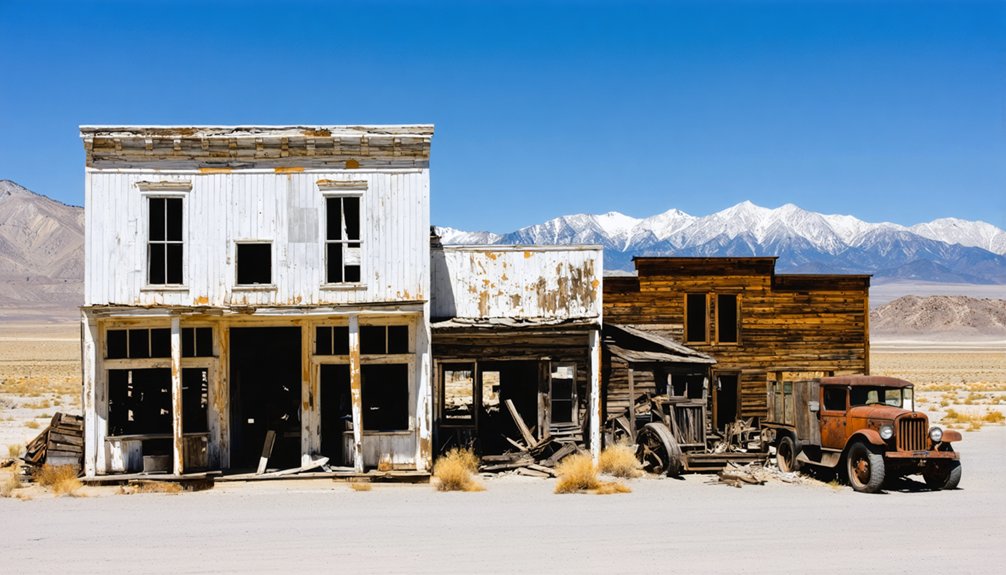
Today, you’ll find Tunnel Camp stands as Northern Nevada’s best-preserved ghost town from the district, with intact cabin structures, a large brick mill office, and the distinctive mill foundation with its loading chute still visible.
Cyanide Mill Operations
After the Nevada State Mining Company established Tunnel Camp in late 1926, the settlement’s primary focus remained on solving the Seven Troughs Mining District’s chronic flooding problems through an ambitious drainage tunnel.
However, the camp’s fortunes shifted when the 100-ton Freidman cyanide mill was completed in summer 1930, representing a $3 million investment in mill technology.
The operation’s scope included:
- First ore processing in 1932, bringing hope to struggling miners
- Two additional mills grinding alongside Freidman’s operation—a five-stamp mill and the Causten Mill processing one ton hourly
- Total district production reaching $807,495 during operations
- Operations continuing after Freidman’s 1934 death under Lithicum, Munk, and Mann’s lease
Despite primitive cyanide safety standards, you’ll find these remote operations pushed technological boundaries.
Structures Standing Today
Unlike Seven Troughs’ vanished structures, Tunnel Camp‘s 1927 founding as a company town left remarkably intact ruins that showcase Nevada’s late mining-era architecture.
You’ll find several well-preserved cabins showing evidence of occupation until around 2000, demonstrating the site’s historical significance beyond its mining operations. The partially intact brick office building stands as the camp’s centerpiece, while the Friedman Mill’s foundation, complete with loading chute and stamp mill components, dominates the landscape.
Stone and concrete foundations scattered throughout reveal the original layout of approximately 30 structures, including stores, bunkhouses, and bathhouses. A downstream graveyard, though poorly preserved, marks the human cost of frontier mining.
Limited preservation efforts and the camp’s isolation have protected these ruins from vandalism and development pressures.
Candelaria: Silver Boom Legacy Along the Free-Range Art Highway
Deep in the remote hills southeast of Hawthorne, Candelaria stands as proof of Nevada’s richest silver mining district, where Mexican and Spanish prospectors discovered extraordinary ore deposits in 1863–1864.
By 1880, this ghost town dominated Esmeralda County with 1,500 residents and $20 million in silver production. The Northern Belle mine’s exceptionally high-grade ores—averaging 50–60 ounces per ton—attracted heavy investment and railroad service by 1882.
Candelaria mining operations came at devastating human cost:
- Chronic water scarcity forced dry stamp mills that filled the air with toxic silica dust
- “Miners’ consumption” killed workers through relentless lung disease
- Fire, strikes, and the 1890s silver crash triggered rapid abandonment
Today’s weathered ruins whisper stories of fortunes won and lives lost.
You’ll find authentic frontier remnants along this isolated stretch of mining history.
Berlin-Ichthyosaur State Park: Mining History Meets Prehistoric Fossils
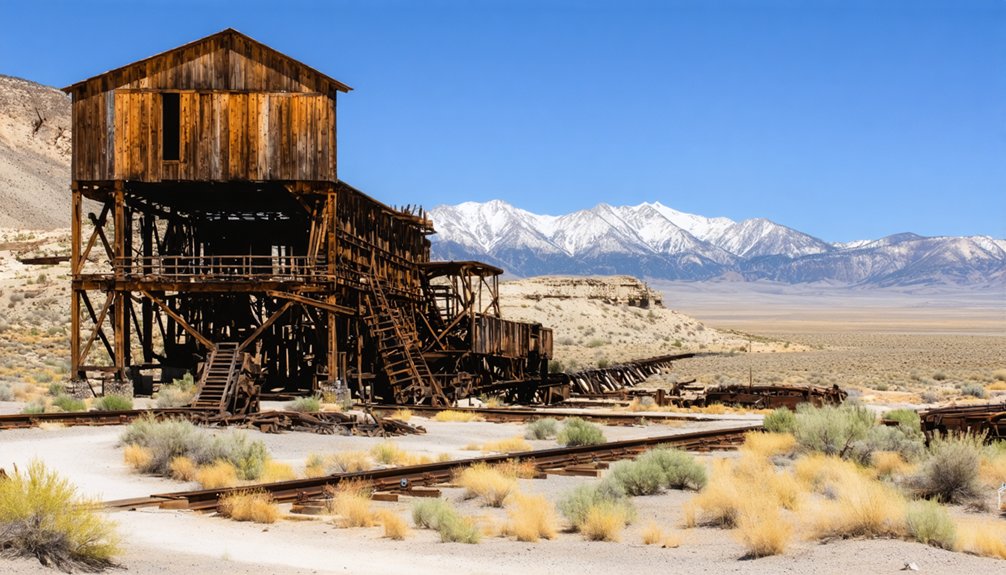
While most Nevada ghost towns preserve only mining heritage, Berlin-Ichthyosaur State Park combines two extraordinary narratives: a 1890s silver-and-gold camp frozen in arrested decay and North America’s richest deposit of giant marine reptile fossils.
You’ll explore a company town that housed 200–250 residents before abandonment after thirteen years, with its stamp mill, assay office, and worker housing remarkably intact. The Diana Mine offers underground tours showcasing period mining technology.
But the park’s paleontological treasure—Shonisaurus popularis, Nevada’s state fossil—draws equal attention. The enclosed Fossil House displays articulated skeletons of 37–40 ichthyosaurs discovered in systematic 1950s–60s excavations.
At 7,000 feet elevation in northwestern Nye County, this dual-purpose park earned National Natural Landmark designation in 1973.
Planning Your Ghost Town Adventure From Fernley
Successful ghost town exploration from Fernley demands strategic planning that accounts for Nevada’s unforgiving desert conditions and remote access challenges.
in addition, adventurers can enhance their experience by visiting historic sites near Laughlin Nevada, where remnants of the region’s vibrant past come to life. these sites offer unique insights into the area’s rich history and are often accompanied by breathtaking desert scenery. with careful planning, visitors can combine exploration of ghost towns with a deeper appreciation for the local heritage.
You’ll need an off-road vehicle for Seven Troughs District sites, located two to three hours northwest via Highway 95.
Pack extra fuel, water, emergency supplies, and ghost town photography equipment before departing—no services exist at abandoned settlements.
Essential preparations for your independent exploration:
- Witness authentic stamp mills and miner cabins frozen in time since the 1930s
- Discover Mazuma’s cemetery where flood victims found their final rest
- Photograph deteriorating structures before historical preservation efforts begin
- Experience genuine isolation where spring floods once destroyed entire communities
Avoid spring and early summer when flash flooding risks remain highest.
Careful navigation around unstable ruins protects both you and these fragile remnants of Nevada’s mining heritage.
Frequently Asked Questions
Are Pets Allowed at Ghost Town Sites Near Fernley?
Pet policies vary by location—you’ll find pets allowed at BLM ghost towns like Seven Troughs with control requirements, while state historic parks near Fernley permit leashed dogs outdoors. Always verify ghost town regulations and land ownership before visiting.
Do I Need a Four-Wheel-Drive Vehicle to Visit These Ghost Towns?
You won’t need a horseless carriage with 4WD for every ghost town, but off-road capabilities dramatically improve access to remote sites. Vehicle recommendations: high-clearance SUVs or pickups handle Fernley’s rough, washboarded mining roads best.
Can I Camp Overnight at Any Ghost Towns Near Fernley?
Most ghost towns near Fernley lack camping facilities due to camping regulations protecting historical sites. Fort Churchill and Berlin operate as day-use areas. You’ll find ghost town amenities minimal, requiring overnight stays in Fernley or nearby corridor towns instead.
Are Ghost Town Sites Near Fernley Safe for Young Children?
Ruins hold whispers of risk alongside adventure. You’ll find child safety varies dramatically—developed sites like Fort Churchill offer supervised ghost town activities, while remote locations demand extreme caution due to open shafts, toxins, and wildlife hazards.
What Cell Phone Coverage Should I Expect at These Locations?
Expect minimal to no cell service at most ghost town sites near Fernley. Network availability drops rapidly outside town despite strong coverage there. You’ll encounter frequent dead zones on access roads and in remote canyons.
References
- https://en.wikipedia.org/wiki/List_of_ghost_towns_in_Nevada
- https://nvtami.com/top-10-ghost-towns-nevada-northwest/
- https://travelnevada.com/ghost-town/ghost-towns-near-reno/
- https://nvtami.com/2023/11/16/ghost-towns-highway-395-reno-to-lakeview/
- https://www.dicksonrealty.com/2019/10/08/ghost-towns/
- https://visitusaparks.com/surviving-the-loneliest-road-in-america/
- https://knpr.org/desert-companion/2024-02-29/outdoor-nevada-see-a-ghost
- https://parks.nv.gov/learn/park-histories/fort-churchill-history
- https://www.nvexpeditions.com/lyon/ftchurchill.php
- https://en.wikipedia.org/wiki/Fort_Churchill_State_Historic_Park