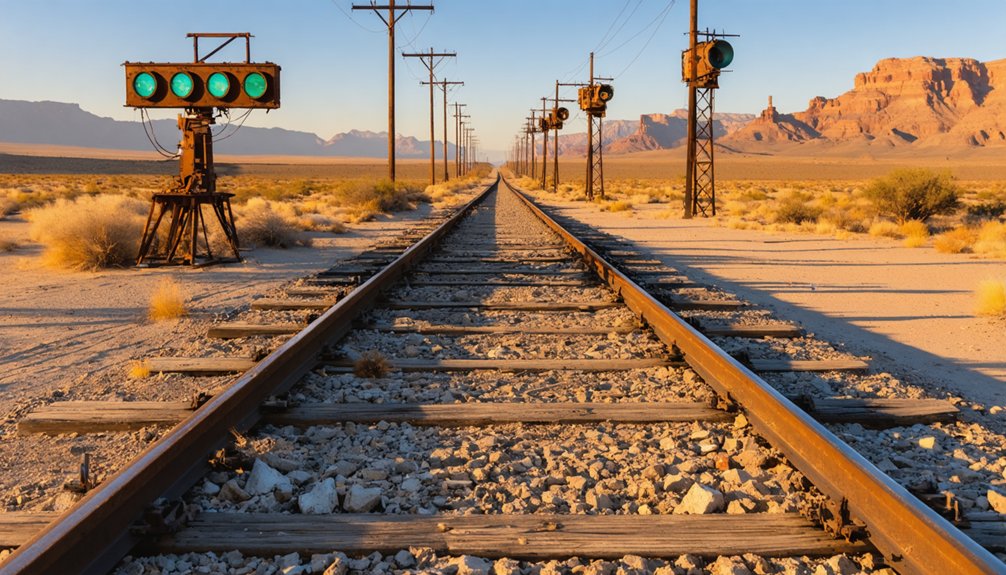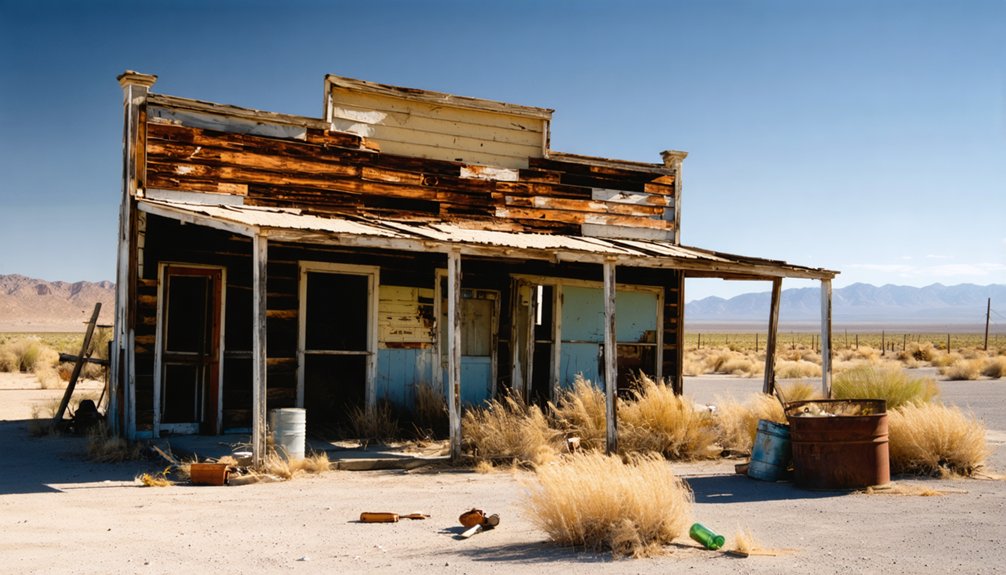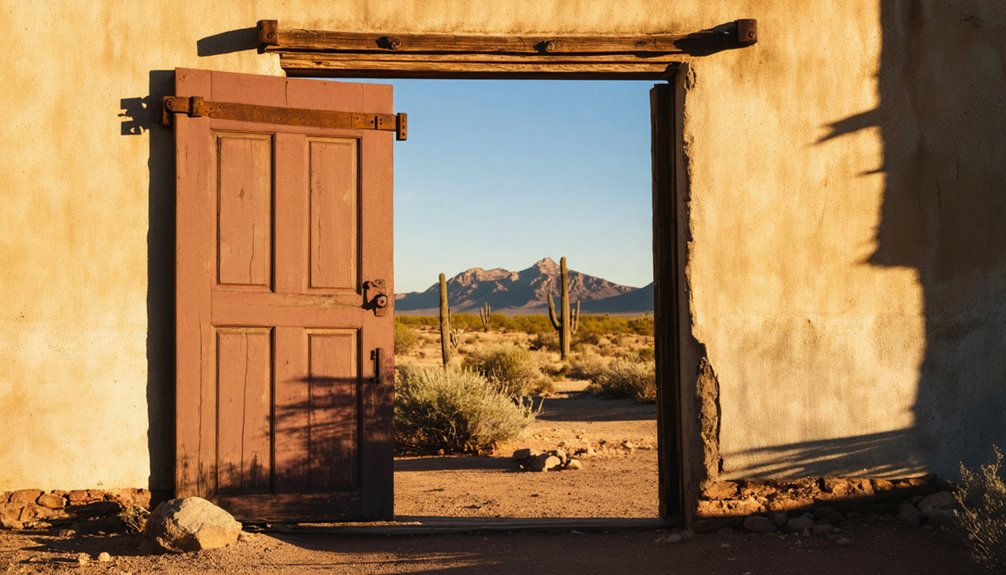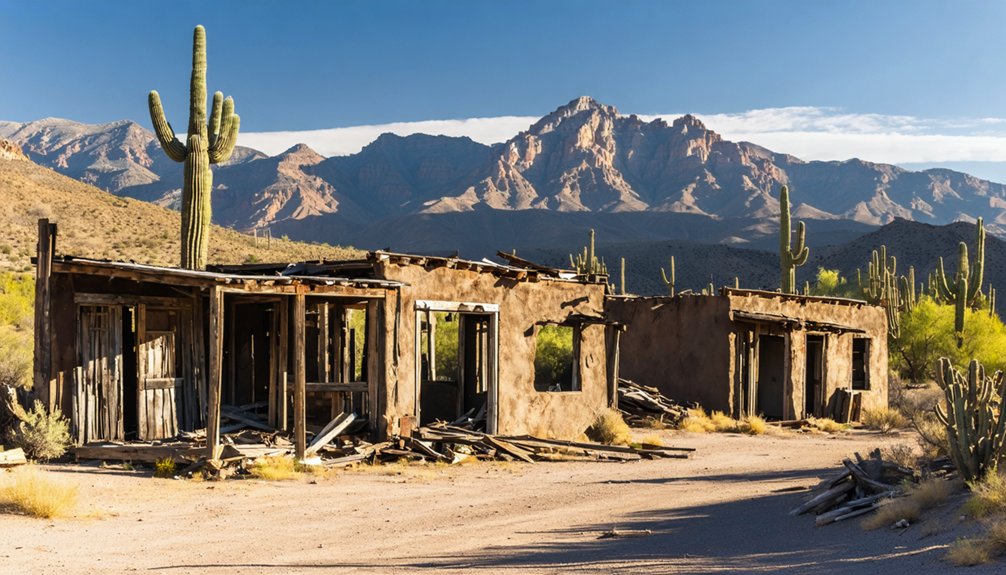
You’ll find several ghost towns within thirty miles of Florence, each marking different eras of Arizona’s territorial past. Adamsville, established in 1866 on the Gila River, was destroyed by a catastrophic 1900 flood and now exists only as a cemetery. Pinal City peaked at 2,000 residents during the 1880s silver boom before collapsing. Ray, a Kennecott copper town, was entirely consumed by open-pit mining in 1962, displacing 2,700 residents to nearby Kearny. The following sections explore each site’s distinct historical trajectory and what remains visible today.
Key Takeaways
- Adamsville, established in 1866, was destroyed by a 1900 flood and now only its cemetery remains visible.
- Pinal City boomed with silver mining in the 1870s-1880s but crashed by 1890, leaving only cemetery headstones today.
- Ray was a company mining town consumed by open-pit operations in 1962, displacing 2,700 residents to Kearny.
- Historic Goldfield offers tourist-friendly experiences including underground mine tours, gunfights, and family entertainment near Florence.
- Visit responsibly by avoiding unstable structures and mine openings while respecting posted boundaries at remote ruins.
Adamsville: Florence’s Flood-Ravaged Farming Neighbor
In 1866, when Charles (Fred) Adams chose farmland on the south bank of the Gila River west of Florence, he set in motion the creation of one of Pinal County’s earliest settlements—though Pinal County itself wouldn’t exist for another nine years.
Adamsville history unfolded rapidly: by 1870, four hundred residents worked irrigated fields, operated a flour mill, and traded in several stores. The agricultural legacy sustained the community through the 1870s and 1880s, even as violence earned the town a notorious reputation.
But the 1900 Gila River flood delivered catastrophic flood impact, washing away adobe buildings and infrastructure. Survivors fled to Florence, triggering swift community decline. By 1920, Adamsville had dwindled to ghost town status, its once-thriving farms and businesses reduced to mere memories along the riverbank. Today, the Adamsville Cemetery, deeded to the Ancient Order of United Workmen in 1894, stands as one of the few tangible remnants of the original settlement.
Pinal City and Copper Creek: Silver Camps in the Mountains
When prospectors and ranchers discovered silver in 1870 in the mountains northeast of Florence, they triggered the creation of Pinal City—a settlement that would briefly rival Florence itself in size and commercial importance.
By the mid-1880s, over 2,000 residents called this silver boom town home, drawn by the Silver King Mine‘s rich ore bodies five miles away.
You’ll find impressive mining infrastructure developed here, including one of Arizona’s largest stamp mills processing ore from the mountains.
The town boasted hotels, banks, newspapers, and full municipal services. Water from Queen Creek powered the operations that made Pinal City essential to Arizona’s mineral economy.
Main Street served as the central hub of activity, where residents conducted business and gathered at the town’s numerous establishments.
Then the silver market crashed in the late 1880s. By 1890, only ten people remained.
Celia Ann Mattie Blaylock, Wyatt Earp’s common law wife, died in Pinal in 1888.
Today, nothing visible survives except cemetery headstones and deep wagon ruts scarring the landscape.
Ray: The Copper Town That Moved to Kearny
While silver sparked Pinal City’s brief glory, copper built Ray into something more enduring—until the mine itself consumed the town.
You’ll find Ray’s story in Kennecott’s corporate archives: a company town born in the late 19th century, housing Anglo, Mexican, and Spanish workers in segregated communities—Ray, Sonora, and Barcelona.
Ray’s Demise** began when underground operations shifted to open-pit mining in the 1950s. The expanding pit swallowed landmarks like the “Old Man of the Mountain.” By 1962, Kennecott issued eviction notices** to 2,700 residents. The business district fell in 1963. Open-pit mining replaced underground workings in the late 1940s.
Kearny’s Development followed as a planned replacement town, receiving displaced families from 1958 through 1965. As one of the first planned integrated communities in the United States, Kearny brought together the ethnic groups that had previously lived separately. Ray vanished into the pit that created it.
Forgotten Farm Settlements of the Gila River Valley
Mormon colonists and Anglo homesteaders repeated the pattern in the 1870s, building Safford, Thatcher, and Pima on the same bottomlands.
Their cooperative ditches echoed prehistoric farming layouts—until upstream diversions, soil salinization, and mechanization rendered small irrigated farms obsolete.
The water diversions upstream in the 1870s and 1880s that starved the Gila River communities downstream ultimately doomed these Anglo settlements as well.
Like the Pima farms that had once provided food for newcomers, these Anglo settlements fed travelers and military operations before their decline.
Today linear berms, dry headgates, and mounded house sites mark where both ancient and historic irrigation systems once sustained communities now vanished.
Visiting Ghost Towns and Historic Mining Attractions Today
For visitors drawn to Arizona’s mining heritage, the Florence area offers ghost towns ranging from polished tourist attractions to windswept ruins accessible only by dirt track.
Historic Goldfield, 35 miles northwest, transforms ghost town tourism into family entertainment—you’ll find underground Mammoth Mine tours, gold panning, and staged gunfights along wooden boardwalks.
Adamsville Cemetery, west of Florence, presents a starker experience: gravestones and adobe remnants mark the 1866 farm settlement destroyed by Gila River floods.
County road trips reach DeNoon, Cochran, and Copper Creek, where mining history survives in smelter ruins and slag piles.
Exercise caution around unstable structures and mine openings. Some sites require high-clearance vehicles, and private mining claims restrict access—respect posted boundaries while exploring Pinal County’s abandoned landscapes.
Frequently Asked Questions
Are Ghost Town Artifacts Near Florence Protected by Law?
Yes, you’ll face serious penalties—ARPA prosecutions jumped 300% in Arizona’s 2010s. Legal regulations and artifact preservation rules protect ghost town sites on federal and state lands near Florence, requiring permits before you disturb any historic materials.
What Safety Precautions Should Visitors Take When Exploring Ghost Towns?
You’ll need sturdy boots for terrain challenges like eroded foundations and loose rock, carry plenty of water for desert heat, watch for wildlife encounters including rattlesnakes in ruins, and inform someone of your route before heading out.
Can You Camp Overnight at Ghost Town Sites Near Florence?
You’ll face a mountain of red tape—overnight camping at ghost town sites themselves is nearly impossible due to camping regulations on private mining claims and State Trust Land, where you’ll need overnight permits and face strict 14-day limits.
Which Ghost Towns Near Florence Are Best for Photography?
Reymert and Adamsville offer the best locations for authentic ghost-town photography near Florence. You’ll capture stone ruins and desert textures at Reymert; Adamsville delivers minimalist flood-history compositions. Follow basic photography tips: shoot during golden hour, pack water.
Do Any Ghost Towns Near Florence Offer Guided Tours?
You won’t find formal tours availability at Florence-area ghost towns like Adamsville. However, Florence Museum staff can direct you to local guides who’ll share archived details about nearby historical sites and cemetery locations dating back to 1894.
References
- https://kids.kiddle.co/List_of_ghost_towns_in_Arizona
- https://www.arizonahighways.com/article/arizona-ghost-towns
- https://southernarizonaguide.com/ghost-towns-southern-arizona/
- https://azgw.org/pinal/ghosttowns.html
- https://www.tripadvisor.com/Attraction_Review-g29033-d116634-Reviews-Goldfield_Ghost_Town-Apache_Junction_Arizona.html
- https://goldfieldghosttown.com
- https://en.wikipedia.org/wiki/Adamsville
- https://www.florenceaz.gov/historical-presentation-ghost-towns-of-the-second-world-war/
- https://www.youtube.com/watch?v=0zhxVC9HLw4
- https://www.ghosttowns.com/states/az/adamsville.html