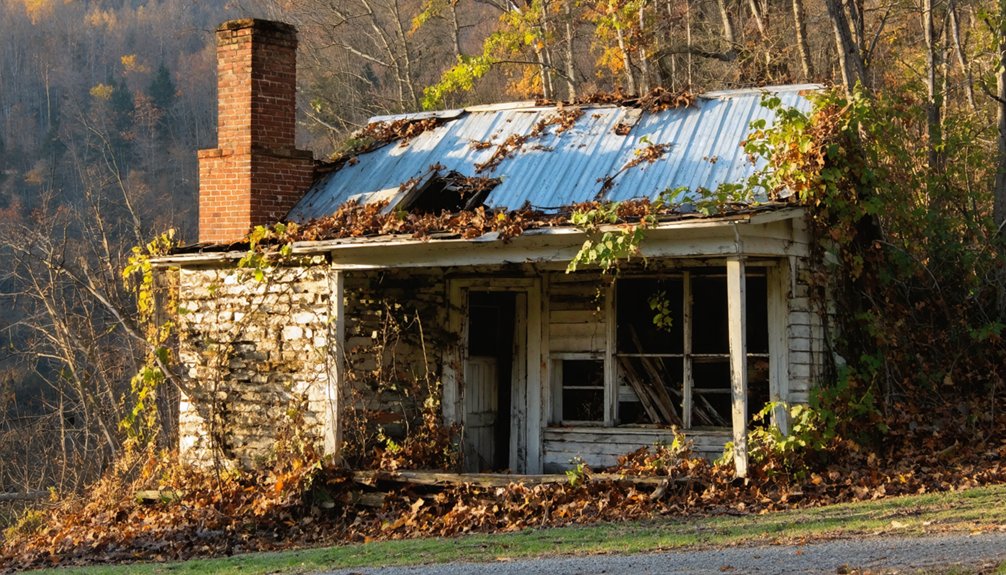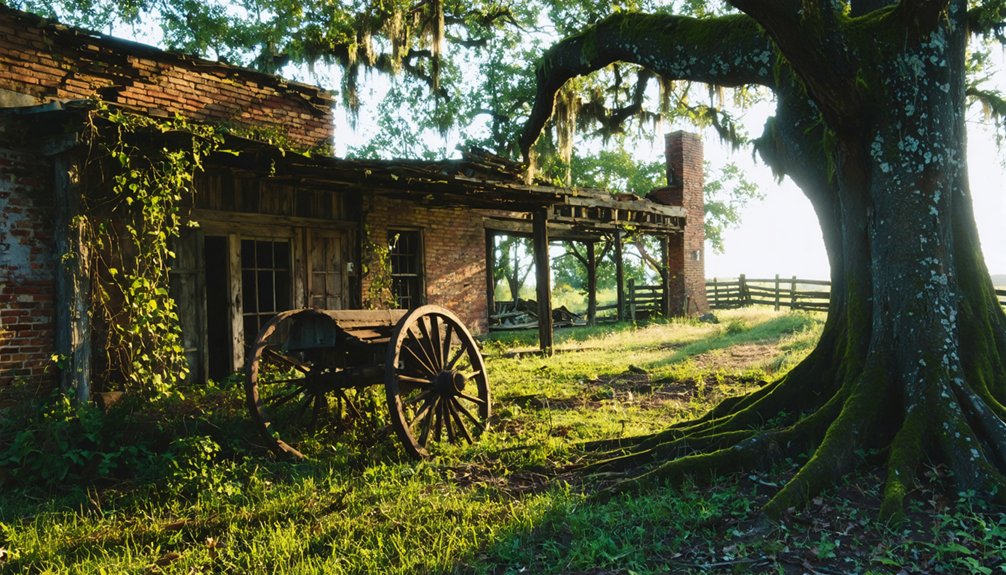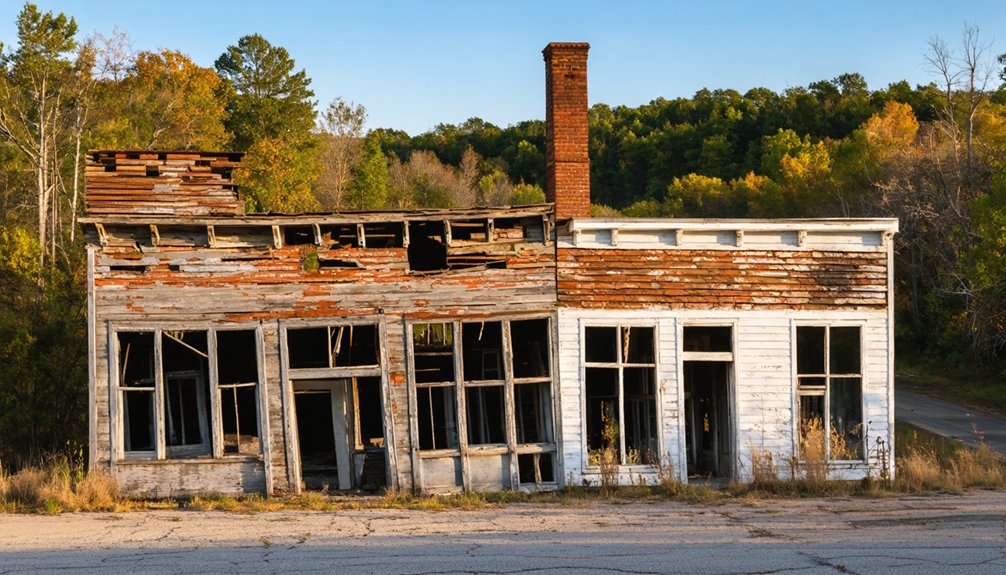
Within 50 miles of Fort Smith, you’ll find 15 documented ghost towns—representing three-quarters of all mapped abandoned settlements in Arkansas—clustered along historic transportation corridors that once funneled commerce between the Arkansas River and Indian Territory. These weathered remnants include zinc-mining boomtowns like Rush, which supplied 40% of Arkansas’s zinc production before WWI’s end collapsed the market, railroad sidings, river landings, and mill communities scattered across Sebastian, Crawford, Franklin, and Logan counties. The stories behind their abandonment reveal how resource depletion, economic shifts, and changing transportation patterns shaped the region’s forgotten landscape.
Key Takeaways
- Fort Smith has 15 documented ghost towns within 50 miles, representing 75% of Arkansas’s 20 mapped abandoned settlements.
- Ghost towns cluster in Sebastian and Crawford counties, with sites extending into Franklin, Logan counties, and Oklahoma.
- Rush ghost town flourished 1911-1918 as a zinc mining hub, peaking at 5,000 residents before post-WWI market collapse.
- Peppersauce, now within Calico Rock, was a steamboat-era trading hub that declined after railroad arrival transformed the area.
- Most ghost towns resulted from resource depletion in timber, mining, and agriculture, plus economic shifts ending boom periods.
The High Concentration of Abandoned Settlements in the Fort Smith Region
When you trace a 50-mile circle around Fort Smith on a map, you’ll discover 15 documented ghost towns—an extraordinary concentration that accounts for 75% of Arkansas’s 20 mapped abandoned settlements.
This clustering isn’t random. You’re standing at the convergence of major historical corridors: the Arkansas River and routes into Indian Territory. These pathways fostered countless small, transient settlements—rail sidings, river landings, mill communities—that vanished as infrastructure modernized.
What remains today are weathered foundations and ghost town architecture scattered across western Arkansas and eastern Oklahoma borderlands.
These ruins tell stories embedded in local folklore: of zinc mines that played out, railroads that changed routes, and river commerce that dried up. The cross-border economic systems that once thrived here left behind tangible reminders of freedom-seeking pioneers and their fleeting dreams. Some settlements declined after devastating floods in the 1920s, mirroring the fate of mining towns like Zinc, which experienced its major decline after 1927. The lumber and river trade industries shaped many of these communities before their eventual abandonment.
Fort Chaffee: From Military Post to Haunted Semi-Ghost Town
Just sixteen months of furious construction transformed 15,163 acres of Arkansas farmland into Camp Chaffee, a sprawling military installation that received its first soldiers on December 7, 1941—the same day Pearl Harbor thrust America into World War II.
Named after tank warfare advocate Major General Adna R. Chaffee Jr., the base trained three armored divisions while housing 3,000 German POWs who worked surrounding fields.
Fort Chaffee history spans decades of service—from Korean War training operations to housing Southeast Asian refugees in 1975 and Cuban Mariel Boatlift arrivals in 1980.
After the 1995 BRAC process, portions deactivated, leaving abandoned barracks and empty streets. The U.S. government had paid $1.35 million to acquire the land from 712 property owners before construction began.
Today’s visitors report haunted experiences throughout decaying buildings where soldiers once prepared for combat and refugees awaited uncertain futures.
The National Guard maintains training operations, but vast sections remain frozen in time. Over 50,809 Indochinese refugees passed through Fort Chaffee during Operation New Life, leaving behind memories embedded in the abandoned structures.
Peppersauce Ghost Town: A Deserted District Within Calico Rock
Tucked within the modern city limits of Calico Rock lies a six-block district frozen in early 20th-century decay—a collection of 20-23 weathered structures that locals proudly call “the only authentic ghost town within the city limits of a town in America.”
East Calico’s origins trace to the steamboat era, when French traders and trappers made the White River landing a frontier trading hub, but the district’s true infamy came from Peppersauce Alley, the vice-ridden shantytown behind Main Street where strong homebrew liquor fueled a lawless riverside economy of taverns, gambling, and violence.
Railroad construction in 1902 sparked a citizen clean-up that drove out the bootleggers, transforming East Calico into a legitimate boomtown for zinc, timber, and cotton. The arrival of the railway in 1903 made the town a central hub for rail and river trade that brought unprecedented prosperity to the region.
Yet fires, floods, and economic shifts eventually emptied the district, leaving the old jail, cotton gin, blacksmith shop, and feed stores standing as monuments to Moonshine History and frontier commerce. Today, visitors can explore twenty-two descriptive signs that provide historical context for the original structures throughout the ghost town.
Rush and the Zinc-Mining Boom That Built and Broke Arkansas Towns
You’ll find Rush’s story etched in the boom-and-bust cycle that defined Marion County’s mining frontier.
Between 1911 and 1918, wartime demand for brass ammunition transformed Rush Creek into a thriving community of 2,000–5,000 souls, supported by fourteen zinc mines extracting high-grade smithsonite from Rush Mountain’s depths.
When the armistice ended World War I’s industrial appetite, the zinc market collapsed overnight, leaving Rush and neighboring mining camps to fade into the wooded hollows where tramways once clattered and mill wheels turned.
The district’s most productive operations included the Monte Cristo Mine, the Climax Mine, and the Morning Star Mining Company, which helped establish Rush as one of Arkansas’s largest zinc producers.
Miners employed the room-and-pillar method, excavating minerals horizontally and leaving behind waste rock piles that today are often mistaken for natural hills scattered throughout the valley.
Rush’s World War I Prosperity
When global demand for brass skyrocketed during World War I, Rush Mountain’s zinc mines became the beating heart of Arkansas’s contribution to the war effort.
You’d have witnessed ten mining companies operating fourteen mines across these hills, their elevated tramways hauling ore down steep slopes to concentrating mills that processed lower-grade deposits with mechanical precision.
The Morning Star Mine—founded in 1885—grew into the district’s largest producer, its room-and-pillar workings extracting zinc that fueled munitions factories overseas.
Rush supplied forty percent of Arkansas’s zinc production during these years, while advanced mining technology transformed this valley from speculative camp into a boomtown of 2,000–5,000 souls.
Hotels, offices, and stores lined the streets, serving miners and speculators chasing wartime prosperity.
By 1916, Rush was incorporated and recognized as the most prosperous town per capita in Arkansas, a testament to the wealth generated by its zinc deposits.
Yet the post-war zinc price collapse would soon transform this thriving community into a ghost town, as the very market forces that built Rush ultimately dismantled it.
Zinc Market Collapse Aftermath
The prosperity that had drawn thousands to Rush Mountain vanished almost overnight when post-war zinc prices plummeted below profitable levels. Global zinc production peaked during 1914–1917, then declined sharply, leaving small, high-cost operations like Rush unable to compete.
By the early 1920s, most of the area’s ten companies operating thirteen mines had shuttered their workings. The economic decline accelerated as investors redirected capital to larger, rail-served districts in the Tri-State region, where economies of scale kept operations viable.
Rush’s reliance on hand-sorted carbonate ore and shallow workings became fatal disadvantages. Local merchants, freighters, and service businesses dependent on mine payrolls failed or relocated. Schools and boarding houses closed.
Marion County Ghost Town Density
Few Arkansas counties can match Marion County’s concentration of abandoned settlements, where zinc fever created—and then destroyed—entire communities across the rugged Ozark hills.
Rush stands as the crown jewel of this mining heritage, preserving what vanished elsewhere.
Marion County’s ghost-town landscape includes:
- Rush – The only Arkansas zinc camp retaining substantial mining architecture, supporting 2,000–5,000 residents at WWI peak
- Zinc – Named for the mineral itself, now nearly erased from the landscape
- Anderson Flat, Bruno, and Eros – Smaller resource-driven settlements that followed boom-to-bust trajectories
Rush Heritage survives because the National Park Service absorbed the historic district in 1972.
You’ll find 13 developed mines, company buildings, and tailings piles stacked vertically along Buffalo River slopes—a complete mining ecosystem frozen in abandonment.
Transportation Corridors and the Rise and Fall of Regional Settlements
Long before asphalt and rail steel reshaped the Arkansas River Valley, natural corridors dictated where towns would rise and whether they’d endure.
You’ll find that transportation evolution turned Fort Smith into a regional powerhouse precisely because the Arkansas River, military roads, and later the Frisco Railroad all converged there.
Steamboat landings spawned ferry crossings; Gold Rush travelers demanded outfitting posts; and the St. Louis–San Francisco line cemented rail supremacy after 1881.
Settlement dynamics shifted ruthlessly—once the Frisco tunneled through Winslow and bypassed older wagon stops, those communities withered.
When Interstate 40 later carved a high-speed spine toward Oklahoma City, it starved two-lane highway towns of through traffic, leaving ghosted storefronts wherever the pavement didn’t follow.
Resource Depletion: How Timber, Mining, and Agriculture Shaped Ghost Town Patterns
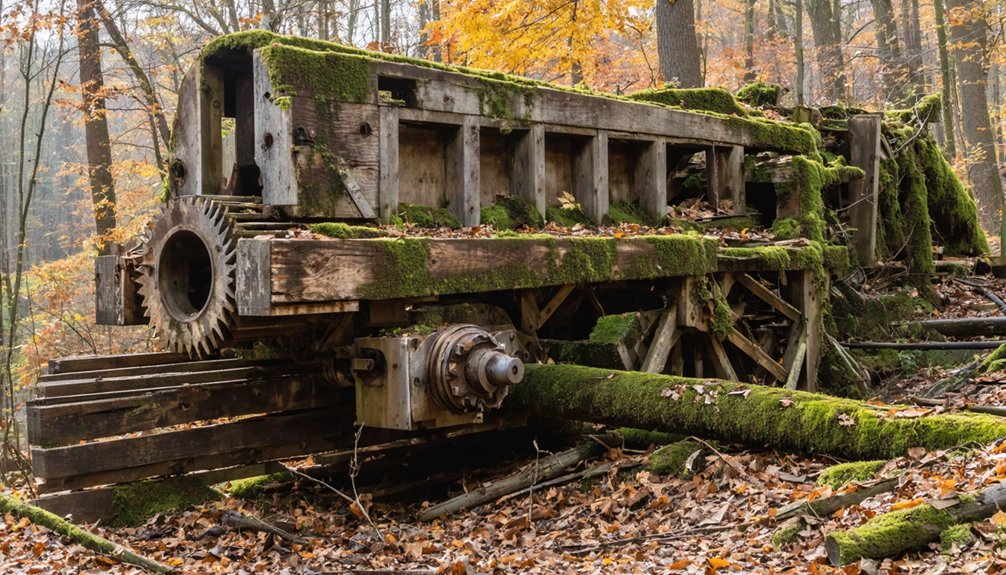
When sawmills moved into the Ouachita and Ozark foothills around Fort Smith, they ignited timber boomtowns that burned bright and fast.
Sawmills sparked timber boomtowns that blazed briefly before vanishing into the Ouachita and Ozark foothills.
Railroad demand for crossties and lumber drove intensive cutting that exhausted merchantable stands within 10–20 years. Once timber depletion made operations unprofitable, cut-and-move companies relocated their portable mills, leaving abandoned settlements behind.
Mining impacts followed similar patterns across western Arkansas coal, zinc, and lead districts:
- Resource exhaustion forced mines deeper into uneconomic seams, closing marginal shafts and their company towns.
- Price collapses from cheaper competitors made local operations unsustainable.
- Environmental damage—subsidence, spoil piles, contaminated water—discouraged alternative land uses.
Meanwhile, cotton monoculture depleted bottomland soils near Fort Smith, pushing farmers off exhausted fields and emptying rural hamlets across the region.
Mapping and Cataloging Ghost Towns Within 50 Miles of Fort Smith
Geotab’s national dataset pinpoints 15 ghost towns within a 50-mile radius of Fort Smith, giving you a concrete starting point for exploration in the Arkansas River valley and surrounding mountain margins.
The highest concentrations sit in Sebastian and Crawford counties—the two counties flanking Fort Smith itself—where old rail lines and wagon roads once fed the regional hub.
You’ll find the remaining sites scattered eastward into Franklin and Logan counties, with a few more bleeding across the state line into Oklahoma’s wooded eastern fringe.
Geotab’s 15 Documented Sites
Within a 50-mile radius of Fort Smith, 15 documented ghost towns form a distinctive cluster that tells the story of Arkansas’s bygone settlements and their connections to eastern Oklahoma’s frontier history.
The history of Fort Douglas, Arkansas reveals the rich tapestry of life in a once-thriving community that has since faded into obscurity. This area played a crucial role in the region’s development, serving as a hub for trade and interaction among settlers and Native American tribes. Today, remnants of this past can still be found in the landscape, offering a glimpse into the challenges and triumphs of those who once called it home.
You’ll discover these sites through Geotab’s extensive mapping technology, which cataloged over 3,000 abandoned communities nationwide.
Key Documentation Features:
- County-level precision identifies exact locations using resources like ghosttowns.com and roadsidethoughts.com.
- Interactive radius parameters let you explore sites within 25 to 50-mile ranges from Fort Smith.
- Selection criteria prioritize abandonment narratives, structural quality, and photographic evidence.
The ghost town history preserved here reveals Industrial Revolution settlement patterns, while tourism impact grows as adventurers seek these accessible remnants of frontier life, offering you unregulated exploration opportunities across western Arkansas’s landscape.
County-Level Concentration Patterns
Marion County dominates the ghost town landscape with three documented sites, revealing how historical forces concentrated abandonment in specific regions rather than spreading it uniformly across western Arkansas.
You’ll find ghost town demographics clustered where frontier industries—mining, timber, agriculture—once flourished before Post-Civil War economic shifts triggered widespread desertion. Rush stands as Marion County’s most significant example, where standing structures preserve the historical significance of resource-driven settlement patterns that shaped the region.
Other counties within the 50-mile radius show sparse distributions, typically containing single sites or badly faded communities.
Transportation corridors determined which settlements survived and which vanished into obscurity. Resource depletion accelerated abandonment in concentrated pockets, creating the uneven distribution you’ll discover when exploring county-level records.
This clustering reflects migration patterns that defined settlement viability across western Arkansas’s evolving landscape.
Visiting Ghost Towns Responsibly: Access, Permissions, and Preservation Ethics
Before you set out to explore the abandoned settlements scattered through the hills near Fort Smith, you need to understand that stepping onto a ghost town site carries real legal and ethical responsibilities.
Many former townsites like Shawber and Armada sit on private property—entering without explicit landowner permission constitutes trespassing.
Others, such as Rush on the Buffalo National River, fall within federal park units where you’ll follow National Park Service rules.
Ghost town etiquette for respectful exploration:
- Never enter structures or mines—viewing from a distance protects both you and fragile historic fabric.
- Leave all artifacts in place—removing objects violates ARPA and erases archaeological context.
- Obtain permits before filming, metal detecting, or organized tours—agencies and landowners control these activities.
Your freedom to roam depends on honoring these boundaries.
Frequently Asked Questions
Are Any Ghost Towns Near Fort Smith Safe for Overnight Camping?
No, they’re not safe—like chasing a mirage, you’ll find ghost towns near Fort Smith sit on private land where camping regulations forbid trespass, and crumbling structures plus hidden hazards make essential safety tips non-negotiable.
Can Metal Detectors Be Used Legally at Ghost Town Sites?
Metal detecting regulations ban you from using detectors at most ghost-town sites on public land due to ARPA’s 100-year rule. You’ll need landowner permission on private property, respecting treasure hunting ethics always.
Which Ghost Towns Near Fort Smith Are Wheelchair Accessible?
Like finding treasure in your own backyard, you’ll discover Fort Smith National Historic Site offers wheelchair ramps and accessible trails through its haunted frontier history—true ghost towns nearby lack verified accessibility infrastructure.
Do Any Ghost Towns Offer Guided Tours or Interpretive Programs?
Rush Ghost Town at Buffalo National River offers self-guided interpretive programs with marked trails and historical signage explaining the site’s mining heritage. You’ll find no formal guided tours, but you can explore its historical significance independently through established pathways.
What Wildlife Hazards Should Visitors Expect at Abandoned Settlement Sites?
You’ll encounter venomous snakes, aggressive feral hogs, rabies-carrying bats, and disease-transmitting ticks lurking in overgrown ruins. Take safety precautions: wear boots, avoid dark spaces, use repellent, and respect these untamed wildlife encounters reclaiming forgotten homesteads.
References
- https://arkansasfrontier.com/ghost-towns-in-arkansas/303766/
- http://freepages.rootsweb.com/~gtusa/history/usa/ar.htm
- https://www.letsroam.com/explorer/haunted-places-in-arkansas/
- https://metaldetectingforum.com/index.php?threads/arkansas-ghost-towns.80591/
- https://onlyinark.com/featured/10-most-haunted-places-in-arkansas/
- https://www.vintagebentonville.com/village-of-cross-hollows-remains-only-in-memories.html
- https://www.geotab.com/ghost-towns/
- https://en.wikipedia.org/wiki/List_of_ghost_towns_in_Arkansas
- https://encyclopediaofarkansas.net/entries/fort-chaffee-2263/
- https://theclio.com/entry/170893