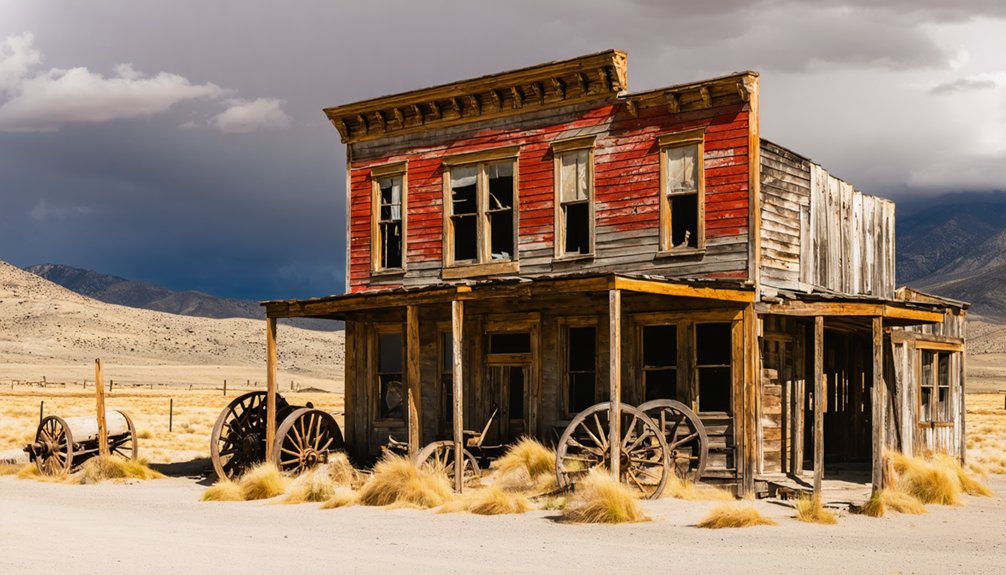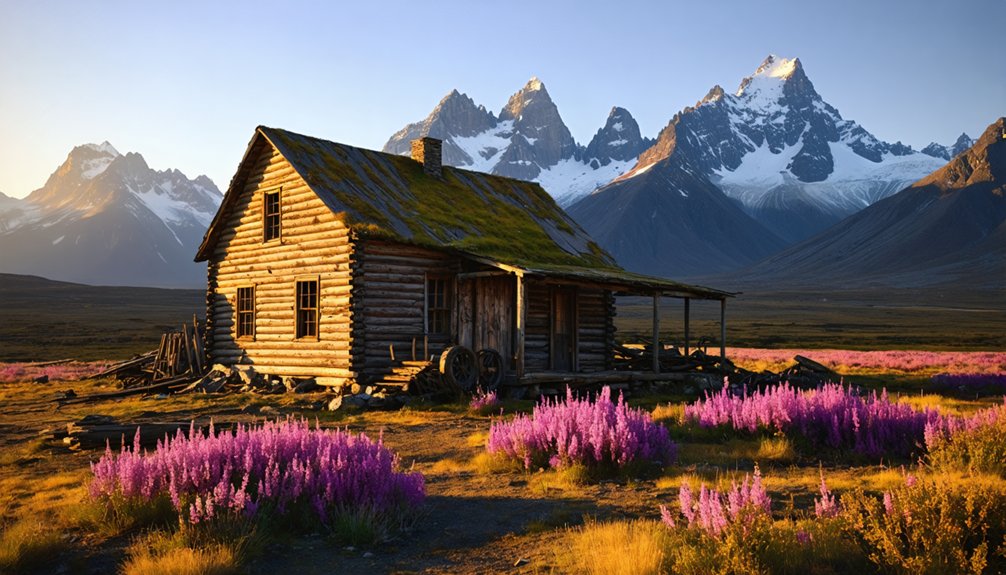
You’ll find two remarkably preserved settlements from Alaska’s gold rush era near Gates of the Arctic National Park. Coldfoot, initially a mining camp from 1899, transformed into a pipeline service station and now serves as the last fuel stop on the Dalton Highway. Wiseman, just 13 miles north, remains a living museum where year-round residents still inhabit original log cabins dating to 1908. Both settlements embody Alaska’s frontier spirit, with Wiseman’s historical structures and Coldfoot’s Arctic Interagency Visitor Center offering gateways to understanding the region’s layered past and enduring wilderness character.
Key Takeaways
- Coldfoot, originally Slate Creek (1898), declined to a ghost town before revitalization as a Trans-Alaska Pipeline service station in 1975-1977.
- Wiseman, 63 miles north of the Arctic Circle, retains only one-quarter of its original 29 gold-rush structures from 1911-1915.
- The 1899 Coldfoot Gold Rush saw 90% of 1,200 miners abandon the settlement after one harsh winter, creating abandoned cabins.
- Both settlements are accessible via the Dalton Highway, 200 miles from the nearest town, serving as Gates of the Arctic gateways.
- Wiseman functions as a living ghost town with 13 residents inhabiting historic log cabins and offering heritage tours of 1908-era structures.
The Coldfoot Gold Rush of 1899
When prospectors pushed up the Koyukuk River from the Yukon in 1898, they carried the momentum of the Klondike rush into the remote valleys beneath the Brooks Range. About 1,200 miners followed discoveries along the Middle Fork, converging on Slate Creek tributaries where you’d find shallow placer deposits in frozen ground.
By March 1899, prospectors sank 24 test holes to bedrock at the Slate-Myrtle confluence, striking pay dirt that anchored Coldfoot’s economy.
Yet patchy returns and brutal mining challenges—severe cold, supply shortages, and expensive freight—drove 90% away by spring breakup. They faced the same permafrost barrier that plagued Klondike miners, where frozen ground below 6 feet forced them to burn wood fires just to soften soil enough for digging. Many who left Coldfoot joined over 8,000 people abandoning Dawson that summer for the Cape Nome bonanza.
Harsh conditions and disappointing yields forced nine out of ten miners to abandon their claims within a single season.
Only 100 remained after 1899, working creeks around what became the upper Koyukuk’s primary camp. The rush you’d hoped for died before it truly lived.
How Coldfoot Got Its Name
You’ll find the origin of Coldfoot’s name in the pattern of prospectors who reached Slate Creek in 1899-1900, only to lose their nerve and turn back south before winter set in.
These gold seekers literally got “cold feet” about pushing deeper into Arctic territory, creating a settlement marker for ambition’s limits. The idiom stuck permanently as cabin after cabin was abandoned by miners who reconsidered their prospects in the failing light of autumn.
The settlement was originally founded in 1898 as Slate Creek during the initial wave of the gold rush. Original cabins still remain from the early days, standing as weathered monuments to those who stayed and those who fled. By 1902, the growing community supported two roadhouses, two stores, seven saloons, and a gambling house that served the prospectors and miners.
The 1899 Gold Discovery
While half a dozen prospectors had made minor discoveries on gravel bars at Hughes, Florence, and Tramway Bars between 1885 and 1890, the region’s fate changed dramatically in March 1899.
The Dorothy Party from Boston struck pay dirt at the confluence of Slate and Myrtle creeks after sinking 24 holes into bedrock at Slate Creek, each averaging six to seven feet deep.
This gold prospecting breakthrough represented the first “real money” from the Koyukuk.
The discovery rekindled interest in the area after the initial wave of prospectors had dwindled to only 100-200 remaining by 1899.
This renewed mining activity came years after the 1882 Treadwell Mine began transforming Alaska’s gold industry into a major commercial enterprise.
Winter Abandonment Pattern
The Dorothy Party’s 1899 strike brought over 1,200 miners rushing into the upper Koyukuk region, but the subarctic continental climate quickly tested their resolve.
Temperatures plunged to –70°F, averaging around –15°F from October through April. Winter survival demanded serious preparation—hauling supplies over the final 65 miles from Bettles cost as much as shipping from Seattle, and dog teams represented your only freight option once rivers froze.
After enduring one brutal winter with disappointing returns, roughly 90% fled at spring breakup in 1899. This seasonal migration pattern gave Coldfoot its name: prospectors literally got “cold feet” and retreated south before freeze-up.
Only 100–200 hardier souls remained to work the tributaries, cementing the camp’s reputation as a place few could endure year-round. The settlement’s early infrastructure included two roadhouses that provided shelter and supplies for those who stayed through the harsh winters. When gold was discovered in nearby Wiseman in 1908, Coldfoot was quickly abandoned as miners rushed to the new boomtown.
The Great Migration to Wiseman
Around 1907, something remarkable began to unfold along the Middle Fork of the Koyukuk River when prospectors working Slate Creek discovered richer placer deposits downstream and started relocating en masse.
What emerged was Wiseman—a frontier hub born from gold mining ambition and relentless community development.
You’ll find evidence of this migration wave in the twenty-nine log structures built between 1905 and 1950, though only a quarter remain standing today.
The settlement drew Euro-American, Scandinavian, and other immigrants north, including African American miner Roshier H. Creecy, who died there in 1948.
Peak population far exceeded today’s thirteen residents.
This pattern reflected the broader Klondike gold rush that had attracted White Americans to Alaska’s remote regions beginning in 1896.
Creecy chose to remain in Wiseman instead of returning to the Lower 48, earning income from placer claims, gemstones, and gold findings.
Arctic isolation forced year-round settlement patterns, transforming a transient rush-camp into a permanent supply center anchored by the Wiseman Trading Company and sustained through placer claims, trapping, and subsistence hunting.
Coldfoot’s Transformation Into a Pipeline Camp
You’ll find Coldfoot’s modern identity forged between 1975 and 1977, when tens of thousands of pipeline workers transformed Dick Mackey’s repurposed school bus burger stand into a permanent service station along the newly constructed Haul Road.
The camp’s organic growth from donated building materials and leftover modular construction units created the improvised architecture that still defines this remote outpost.
Today’s truckers rely on the same strategic location pipeline workers once did—Coldfoot remains the last fuel, food, and lodging stop before the 250-mile stretch to Deadhorse at Prudhoe Bay.
Trans-Alaska Pipeline Construction Era
When the Trans-Alaska Pipeline project ignited Alaska’s black gold rush in the early 1970s, Coldfoot emerged from decades of abandonment to serve an entirely new purpose.
The temporary highway camp housed up to 260 Coldfoot workers in prefabricated trailers and modular units, transforming the ghost town into a bustling industrial outpost.
During pipeline construction, you’d have witnessed:
- Long shifts under extreme conditions – workers operating heavy machinery in sub-zero temperatures
- Critical logistics operations – material flow for pipeline segments between Fairbanks and Prudhoe Bay
- High wages attracting skilled labor – mechanics, electricians, and equipment operators accepting isolation
- Rapid infrastructure assembly – dormitories, dining halls, and maintenance shops springing from wilderness
These facilities supported the massive undertaking of building America’s longest pipeline through unforgiving Arctic terrain.
Modern Trucking Hub Services
After the 1977 pipeline completion, Alyeska’s modular camp didn’t vanish—it stayed put and found new life.
You’ll find Coldfoot transformed into a critical midway hub on the Dalton Highway, where trucker culture shaped every expansion. Drivers themselves hauled surplus pipeline crates and pounded nails between runs, building the truck stop that serves them today.
The service evolution reflects pure function: 24/7 fuel access, café meals, basic lodging in repurposed ATCO trailers, and vehicle repair bays for remote breakdowns.
Inside, a message pole serves as the communication hub for truckers, miners, and workers traversing 250 miles between fuel stops.
It’s the last full-service point north of the Arctic Circle—a frontier logistics node built by those who depend on it most.
Wiseman: A Living Historic Settlement
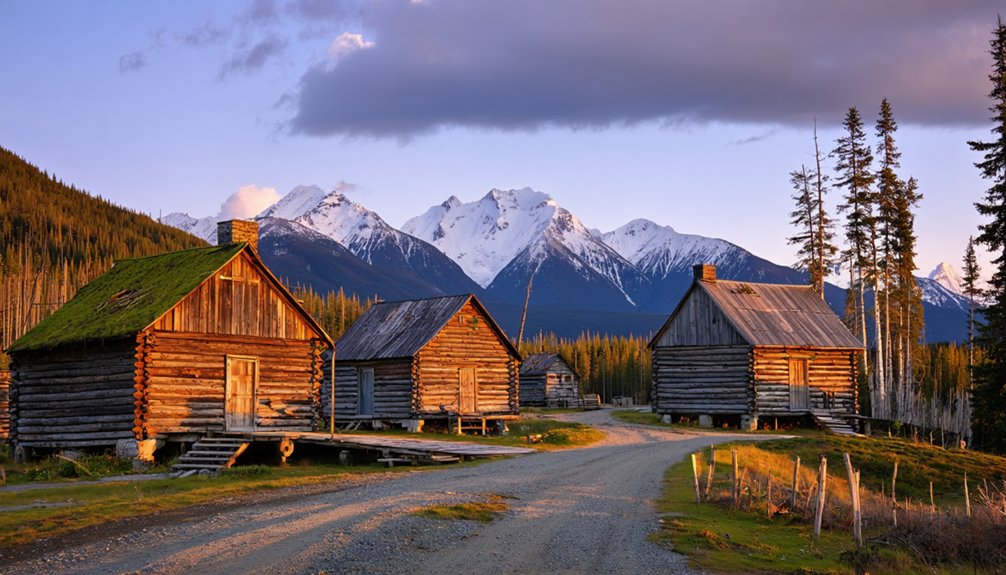
Sixty-three miles north of the Arctic Circle, Wiseman clings to the Middle Fork of the Koyukuk River as one of Alaska’s most authentic frontier remnants—a place where approximately 13 year-round residents still inhabit log cabins built during the gold-rush era.
This settlement’s historical significance spans from its 1911–1915 heyday, when $1 million in Hammond River placer gold flowed through town, to its current role as a living museum of Arctic community resilience.
You’ll discover:
- Log cabin church (1915) — featured in Robert Marshall’s *Arctic Village*
- Wiseman Trading Company — original trading post open for exploration
- Scattered historic cabins — only one-quarter of 29 original structures survive
- Dalton Highway access — turnoff at milepost 189 leads to gravel road
Gates of the Arctic National Park borders this remarkable settlement where frontier life continues unchanged.
Bob Marshall’s Legacy in the Brooks Range
Between 1929 and 1939, forester and explorer Bob Marshall transformed the central Brooks Range from unmapped wilderness into a documented landscape whose preservation would become a national cause.
His Brooks Range Exploration covered over 30,000 km, producing foundational maps and naming the iconic “Gates of the Arctic”—Boreal Mountain and Frigid Crags—that frame today’s national park.
Marshall’s explorations mapped 30,000 km of wild terrain and named the legendary Gates of the Arctic that define the park today.
You’ll find Marshall’s influence everywhere here. He spent 15 months in Wiseman, writing “Arctic Village” and studying timberline ecology.
His vivid accounts proved these roadless expanses held irreplaceable value. By 1938, he urged Congress to protect this wilderness permanently.
Marshall co-founded The Wilderness Society using Brooks Range experiences as proof that America needed large, intact landscapes.
His Wilderness Preservation advocacy directly shaped Gates of the Arctic National Park’s 1980 establishment.
Visiting These Remote Northern Communities
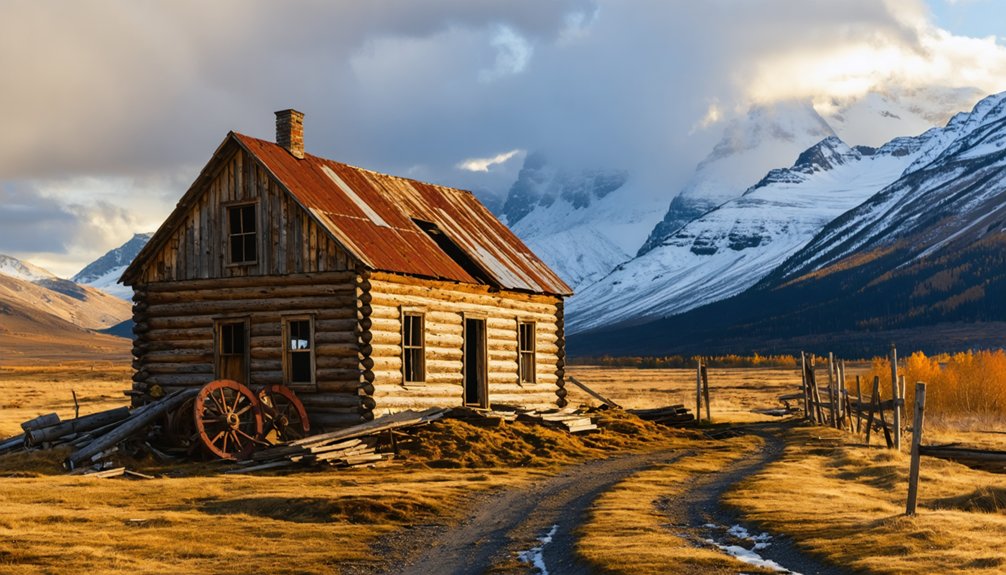
Reaching Coldfoot and Wiseman requires commitment—these communities sit 200 miles from the nearest town along the Dalton Highway, a 500-mile gravel artery connecting Fairbanks to Prudhoe Bay.
Remote access demands preparation, but visitor experiences reward those who venture north.
What You’ll Find:
- Arctic Interagency Visitor Center in Coldfoot, your gateway to Gates of the Arctic National Park with staff from multiple federal agencies
- Vital services—fuel, lodging, dining—supporting travelers on this isolated stretch
- Wiseman’s preserved log cabins from the 1908 gold rush, with resident-conducted heritage tours
- Air service alternatives for those avoiding the challenging drive
These settlements maintain Alaska’s frontier spirit while providing essential infrastructure for independent travelers exploring America’s northernmost wilderness.
Frequently Asked Questions
Are There Other Ghost Towns Near Gates of the Arctic National Park?
Yes, you’ll find abandoned settlements beyond Coldfoot and Wiseman throughout the Yukon-Koyukuk region. White Eye and numerous unmapped mining camps hold historical significance, though their remote Arctic locations mean they’re largely inaccessible and incompletely documented today.
What Wildlife Can Be Encountered Around Coldfoot and Wiseman?
This wild crossroads teems with wildlife species—you’ll encounter moose, caribou, grizzlies, Dall sheep, wolves, and golden eagles across local ecosystems spanning boreal forest, alpine tundra, and river corridors untamed by human boundaries.
Can You Stay Overnight in Wiseman’s Historic Cabins?
Yes, you’ll find cabin accommodations at restored properties like Arctic Getaway and Boreal Lodging. Historic preservation efforts transformed Wiseman’s original log structures into comfortable overnight stays, blending frontier authenticity with modern amenities for independent travelers.
How Much Gold Is Still Mined in the Region Today?
Wondering where the gold rush went? Today’s gold mining near Gates of the Arctic remains minimal—scattered small-scale placer claims and exploratory work, not modern operations. Most Alaska production happens far south of this preserved frontier.
What’s the Best Season to Visit These Remote Communities?
You’ll find the best months are June through August, when weather conditions allow road access and the Arctic Interagency Visitor Center opens. Winter’s harsh temperatures severely restrict travel freedom along the remote Dalton Highway.
References
- https://glaciermt.com/ghost-towns
- https://thealaskafrontier.com/ghost-towns-in-alaska/
- https://www.nps.gov/gaar/planyourvisit/coldfoot.htm
- https://www.atlasobscura.com/things-to-do/alaska/ghost-towns
- https://www.alaska.org/detail/kennicott-mine-ghost-town-walking-tour
- https://motorcyclemojo.com/2015/09/alaska-ghost-towns/
- https://www.youtube.com/watch?v=Cz0IGc2Uy0E
- https://en.wikipedia.org/wiki/List_of_ghost_towns_in_Alaska
- https://en.wikipedia.org/wiki/Klondike_Gold_Rush
- https://postalmuseum.si.edu/exhibition/as-precious-as-gold-stories-from-the-gold-rush/the-great-nome-gold-rush