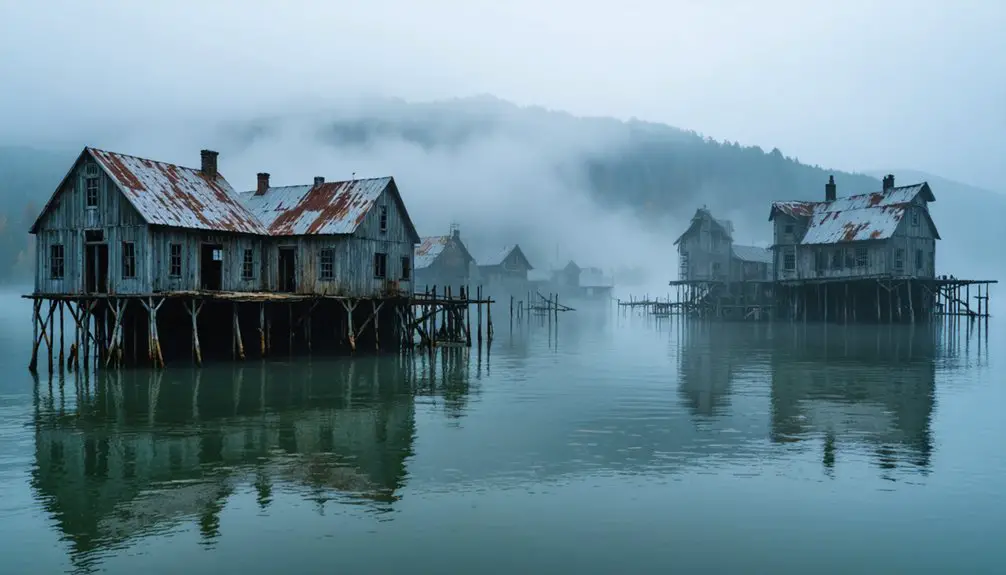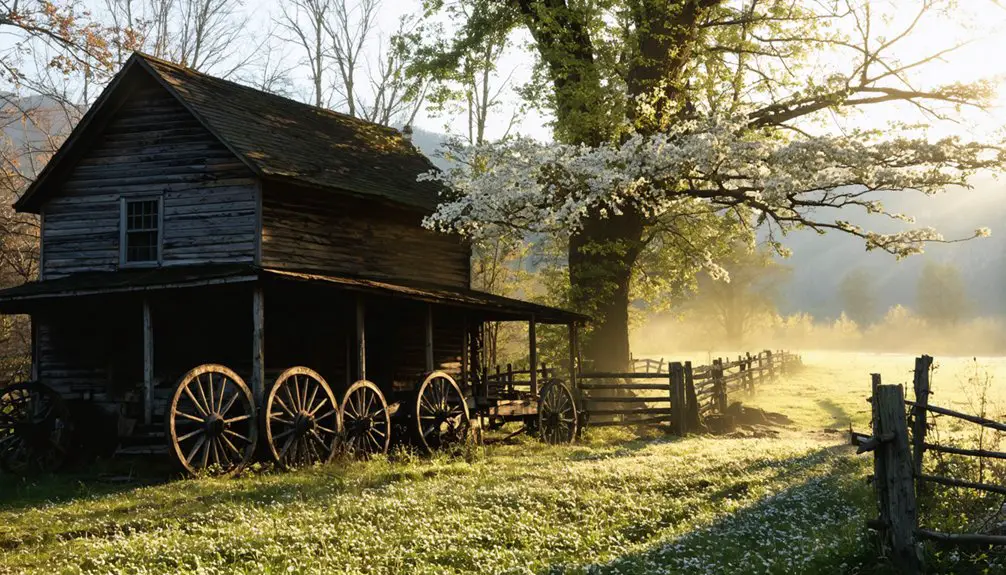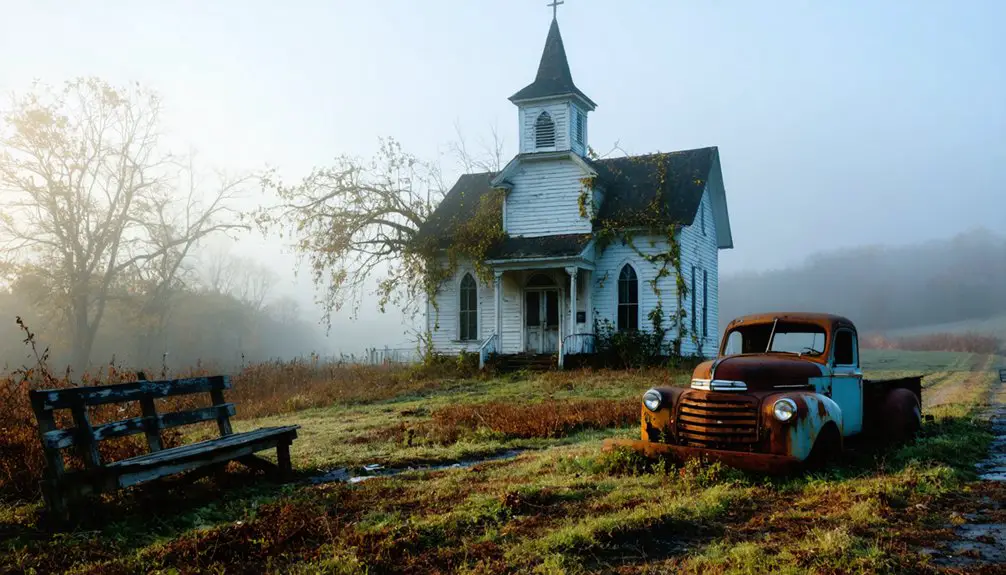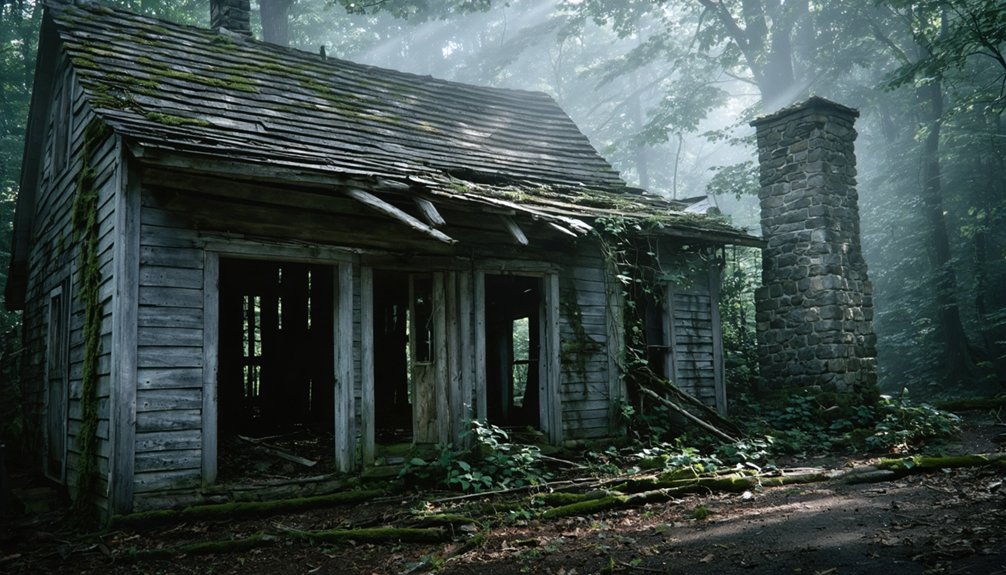
You’ll find Elkmont ghost town just eight miles west of Gatlinburg inside Great Smoky Mountains National Park—a haunting collection of 70-80 abandoned vacation cabins that once served Knoxville’s elite before federal buyouts in the 1930s. The National Park Service has preserved 15-20 structures, including the restored 1917 Levi Trentham cabin, alongside dozens of stone chimneys and foundations along Little River trails. Other displaced communities like Little Greenbrier and Cades Cove offer deeper glimpses into the mountain families who lost their homesteads when the park was established.
Key Takeaways
- Elkmont ghost town sits eight miles from Gatlinburg within Great Smoky Mountains National Park, featuring seventy to eighty abandoned vacation cabins.
- Originally a logging town in 1901, Elkmont transformed into an elite vacation resort by 1910 before federal acquisition in 1934.
- The National Park Service preserves fifteen to twenty structures, including the restored 1917 Levi Trentham cabin and interpretive walk-through buildings.
- Access Elkmont in twenty to twenty-five minutes from Gatlinburg; parking requires a five-dollar day tag from Sugarlands Visitor Center.
- Little Greenbrier and Cades Cove offer additional ghost community sites where mountain families lived until federal buyouts in the 1930s.
Elkmont: The Crown Jewel of Smoky Mountain Ghost Towns
Elkmont stands as the most haunting and accessible ghost town within eight miles of Gatlinburg, where roughly seventy to eighty abandoned vacation cabins and resort buildings line a forested valley deep inside Great Smoky Mountains National Park.
Seventy to eighty abandoned structures create an eerie forest settlement just eight miles from Gatlinburg’s bustling tourist center.
You’ll discover early twentieth-century wood-frame cottages along the old railroad grade, with stone chimneys and collapsed porches marking Daisy Town’s linear streetscape.
The Elkmont architecture reflects vernacular Appalachian resort design from the 1910s–1930s, including structures from the Wonderland Hotel site and Appalachian Club area.
While “ghost town” refers primarily to abandonment rather than hauntings, visitors report an Elkmont folklore atmosphere of eerie stillness among overgrown yards and silent forest paths.
Nineteen significant buildings earned National Register protection and restoration, preserving this crown jewel for exploration.
The town’s transformation began when Levi Trentham sold land to W.B. Townsend, who founded the Little River Lumber Company that would shape Elkmont’s destiny as a logging community.
The community once thrived with essential infrastructure, including a railroad line, school, church, and homes that supported logging families throughout the early twentieth century.
From Logging Camp to Vacation Resort: The Story of Elkmont
You’ll find Elkmont’s transformation began in 1901 when Colonel Wilson B. Townsend’s Little River Lumber Company carved 86,000 acres of virgin timber from these mountains, establishing a thriving logging town by 1908.
Within just two years, wealthy Knoxville sportsmen discovered the same rushing waters that powered the timber industry made for exceptional fishing, founding the exclusive Appalachian Club alongside the working camp in 1910.
This dual identity—sawmill town and mountain retreat—ended abruptly in 1934 when Great Smoky Mountains National Park forced residents to choose between immediate buyouts or discounted lifetime leases that would eventually expire decades later. The railroad that once transported timber through the mountains also began carrying tourists from Knoxville, transforming the lumber company’s infrastructure into a gateway for recreation. Today, the name Elkmont refers to multiple geographical locations in Tennessee, though this particular site remains the most historically significant as a ghost town within the national park.
Little River Lumber Operations
The transformation of Elkmont from industrial logging camp to exclusive mountain retreat began with a calculated business venture in 1901, when W.B. Townsend chartered the Little River Lumber Company to exploit virgin timber across 80,000–100,000 acres in the Smokies.
His logging techniques were ruthlessly efficient—clear-cutting entire watersheds and hauling logs via 150 miles of railroad track to Townsend’s mill.
The scale of extraction was staggering:
- 560 million to 2 billion board feet harvested from Little River watershed
- Severe erosion from complete removal of merchantable timber
- String towns of portable houses sheltering workers along the tracks
- Resale of stripped land as the ultimate profit strategy
The logging operations employed traditional frontier methods, including skidding logs with horses and steam-powered log loaders to transport timber from remote mountain slopes to the railroad lines below.
By 1925, after extracting the region’s most valuable timber, Tennessee purchased 76,507 acres from Townsend to establish what would become Great Smoky Mountains National Park.
Elite Knoxville Social Clubs
As logging operations carved deeper into the Smokies’ virgin forests, Knoxville’s elite saw opportunity in the industrial wreckage.
Around 1910, prominent businessmen and professionals founded the Appalachian Club, purchasing former lumber company land for exclusive gatherings in mountain retreats. You’ll find their legacy in dozens of rustic cottages surrounding a central clubhouse, where elite networking flourished through hunting trips, dances, and extended summer stays.
The 1912 Wonderland Hotel expanded access slightly before becoming the members-only Wonderland Club in 1919. Special excursion trains delivered Knoxville society directly to this semi-gated playground via Little River Railroad observation cars.
What began as industrial exploitation transformed into prestigious cottage ownership—a social status symbol among Tennessee’s upper class seeking escape from urban constraints. The area’s transformation was made possible by Colonel Wilson B. Townsend, who established the Little River Lumber Company in 1901 and built the railroad infrastructure that would later transport vacationers instead of timber. These wealthy vacationers continued their visits until leases were denied in 1992, ending nearly eight decades of exclusive mountain recreation.
National Park Displacement Era
When Wilson B. Townsend purchased 86,000 acres in 1901, he couldn’t have predicted Elkmont’s transformation from logging camp to ghost town.
The 1934 park establishment triggered unprecedented displacement patterns across the Smokies. You’ll find the historical context reveals stark inequalities: federal acquisition forced difficult choices on property owners.
The buyout mechanisms created two Americas:
- Year-round mountain families took immediate cash settlements, losing generational homesteads
- Wealthy seasonal cottage owners negotiated lifetime leases, delaying relocation decades
- Poorer residents faced immediate displacement while elites retained occupancy rights through 2001
- Economic privilege determined who stayed and who left
This wasn’t just land acquisition—it was selective removal.
Lifetime leases expired between 1992-2001, finally transferring 70 deteriorating structures to federal control, completing Elkmont’s conversion to authenticated Appalachian ruin. The site’s historical significance earned recognition when Elkmont was listed on the National Register of Historic Places in 1994. The legislature had exempted Elkmont from National Park status, allowing cottage owners to maintain their seasonal retreats while the surrounding communities were displaced.
What You’ll See at Elkmont Today: Preserved Buildings and Ruins
When you visit Elkmont today, you’ll encounter a haunting mix of carefully restored Daisy Town cottages standing beside weathered, abandoned shells with broken windows and sagging roofs.
The National Park Service has preserved 15–20 of the original 70 structures, including the fully restored 1917 Levi Trentham cabin, while leaving many others to illustrate the community’s slow decay.
Stone chimneys, foundation outlines, and crumbled walls mark where buildings once stood along Jakes Creek and Little River, creating a tangible record of the district’s logging-camp-to-resort history.
Restored Vacation Cottages
A handful of early-1900s frame vacation cottages stand preserved in Daisy Town today, their wood siding and front porches offering tangible connections to Knoxville’s prosperous families who once escaped summer heat in these Smoky Mountain retreats.
The National Park Service has stabilized several structures under National Register of Historic Places guidelines, protecting their architectural significance through careful historic preservation work.
You’ll find simple Craftsman-era details intact on restored exteriors, though many cabins show weathered wood and peeling paint from decades of abandonment.
What you’ll encounter at preserved cottages:
- Walk-through access to select stabilized buildings with visible original floor plans
- Interpretive signs identifying former owners and construction dates
- Boarded or restored multi-pane windows depending on structural condition
- Cleared paths allowing close viewing of cottage rows
Forest growth now crowds these structures, reclaiming former yards.
Remaining Foundations and Chimneys
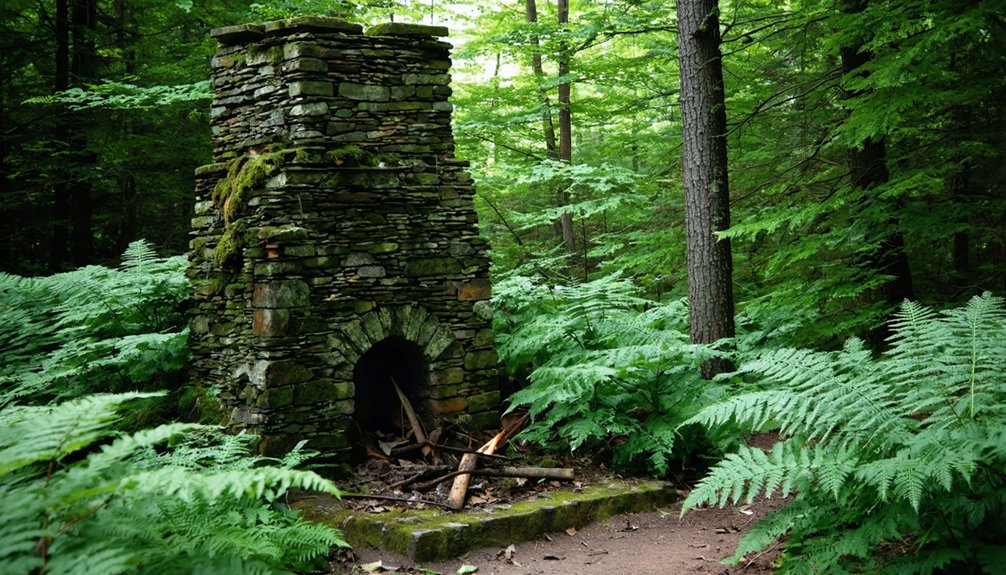
Dozens of stone chimneys rise like sentinels through the forest canopy along Little River and Jakes Creek trails, marking where vacation cabins stood before demolition crews arrived in 2018.
You’ll find rock foundations outlining former room layouts, concrete porch pads, and scattered stone walls reclaimed by undergrowth.
The Wonderland Hotel site preserves massive chimneys and foundation stones—all that survived the 2005 collapse and 2016 fire.
This remnants analysis reveals former street grids and cabin clusters that housed Knoxville’s elite each summer.
The architectural significance lies in these masonry elements: fieldstone chimneys and hand-laid foundations demonstrate early-1900s mountain construction methods.
Walking among bare foundation pads where 70-plus buildings once stood creates an eerie, abandoned-camp atmosphere—a landscape frozen between preservation and wilderness reclamation.
How to Get to Elkmont Ghost Town From Gatlinburg

Getting to Elkmont Ghost Town from downtown Gatlinburg takes about 20–25 minutes along well-marked roads through Great Smoky Mountains National Park.
You’ll drive US-441 through Sugarlands Visitor Center, then turn onto Little River Road for approximately 7 miles. Watch for the Elkmont Campground sign on your left.
Essential driving tips and park regulations:
- Purchase your $5 day parking tag at Sugarlands Visitor Center before reaching Elkmont
- Download offline maps—cell coverage vanishes inside the park
- Turn left just before the campground entrance to access the historic district
- Park near the Elkmont Nature Trail sign for easy cabin access
The final approach winds through narrow roads where you’ll spot abandoned structures.
You’re free to explore the preserved cabins on foot once parked.
Cades Cove and Little Greenbrier: Other Abandoned Communities in the Smokies
Beyond Elkmont’s weathered vacation cabins, the Smokies harbor deeper stories of mountain families who built entire lives in these valleys—communities like Little Greenbrier and Cades Cove where generations farmed, raised children, and buried their dead long before tourists ever arrived.
Little Greenbrier History reveals a mid-1800s settlement in the northeastern park section where families carved out self-sufficient existences until federal buyouts in the 1930s.
The Walker Sisters became famous holdouts, refusing to sell their 166-acre homestead until 1941. These five women maintained traditional mountain life into the 1950s—hunting, farming, and preserving meat in smokehouses—capturing national attention through a 1946 Saturday Evening Post feature.
You’ll find their original cabin, springhouse, and moss-covered stone walls standing today, reflection of Appalachian resilience against outside pressure.
Why These Communities Were Abandoned: The Creation of Great Smoky Mountains National Park
While mountain families had occupied these valleys since the early 1800s, their displacement began with a 1923 proposal to establish a national park in the Smokies.
Unlike western parks carved from federal land, creating this park required purchasing private property from hundreds of individual farmers and timber corporations.
The federal government’s 1926 authorization demanded systematic removal of established communities despite their historical significance and community resilience:
- Tennessee and North Carolina transferred 300,000 acres by 1934
- Champion company’s $3 million settlement secured nearly 100,000 acres in 1931
- Hundreds of families were forced from ancestral homesteads between 1925-1939
- President Roosevelt allocated additional federal funds to complete acquisitions
Your freedom to explore these mountains today came at the expense of generations who called them home.
Planning Your Ghost Town Adventure: What to Know Before You Go
Before you navigate the winding mountain roads to Elkmont’s forgotten settlement, you’ll need to understand how these ghost town remains fit within the broader Great Smoky Mountains National Park infrastructure.
You won’t encounter entrance fees or reservations—just drive seven miles from Sugarlands Visitor Center and park at the Elkmont Nature Trail lot.
The National Park Service’s ghost town preservation efforts mean 16 restored cabins remain accessible for self-guided exploration, while stone foundations and chimneys mark demolished structures along Jakes Creek and Little River trails.
Visitor safety requires staying on established paths, as deteriorating structures beyond the restored core present hazards.
You’re free to wander overgrown routes discovering the Levi Trentham cabin and Elkmont Troll Bridge, experiencing Appalachian history without restrictions or guided tours.
Frequently Asked Questions
Are the Ghost Town Buildings at Elkmont Actually Haunted or Paranormal?
No verified paranormal activity exists at Elkmont—you’ll find Elkmont history rooted in logging accidents and folklore, but reported hauntings stem from natural drafts, decaying structures, suggestibility, and atmospheric conditions rather than genuine supernatural phenomena.
Can You Camp Overnight Near the Elkmont Ghost Town Cabins?
You’ll camp at Elkmont Campground, which sits right alongside the historic ghost town cabins. Camping regulations require reservations during peak season, letting you explore Elkmont history while staying steps from these preserved Appalachian structures.
Is There an Admission Fee to Visit Elkmont Ghost Town?
No admission costs exist to explore Elkmont’s history—you’ll visit free year-round. However, you’ll need a parking tag: $5 daily, $15 weekly, or $40 annually to access Great Smoky Mountains National Park’s lots.
What’s the Best Time of Year to Photograph Elkmont Ruins?
Late fall through early spring offers the best photography tips for Elkmont ruins, with bare trees revealing hidden structures and seasonal lighting effects creating dramatic textures. You’ll capture the ghost town’s atmosphere without summer crowds blocking your shots.
Are Guided Ghost Town Tours Available From Gatlinburg to Elkmont?
While Elkmont doesn’t have traditional ghost town tours, you’ll find Pink Jeep’s Historic Elkmont Tours departing Gatlinburg, plus ranger-led interpretive programs at the site itself. Self-guided audio tours offer maximum flexibility for exploring independently.
References
- https://www.tnvacation.com/trip-inspiration/articles/ghost-towns-tennessee
- https://gatlinburghaunts.com/elkmont-tennessees-ghost-town/
- https://www.pigeonforge.com/elkmont-ghost-town/
- https://www.visitmysmokies.com/blog/smoky-mountains/about-elkmont-ghost-town/
- https://www.tripadvisor.com/Attraction_Review-g143031-d8426768-Reviews-Elkmont_Ghost_Town-Great_Smoky_Mountains_National_Park_Tennessee.html
- https://smokymountainnationalpark.com/popular-places-smoky-mountains/elkmont/
- https://www.thesmokies.com/abandoned-places-in-the-smoky-mountains/
- https://www.youtube.com/watch?v=P-Ui5yB31hs
- https://thedailyself.me/2017/01/27/gatlinburg-and-ghost-towns/
- https://smokymountainnationalpark.com/blog/fun-facts-about-elkmont-ghost-town/