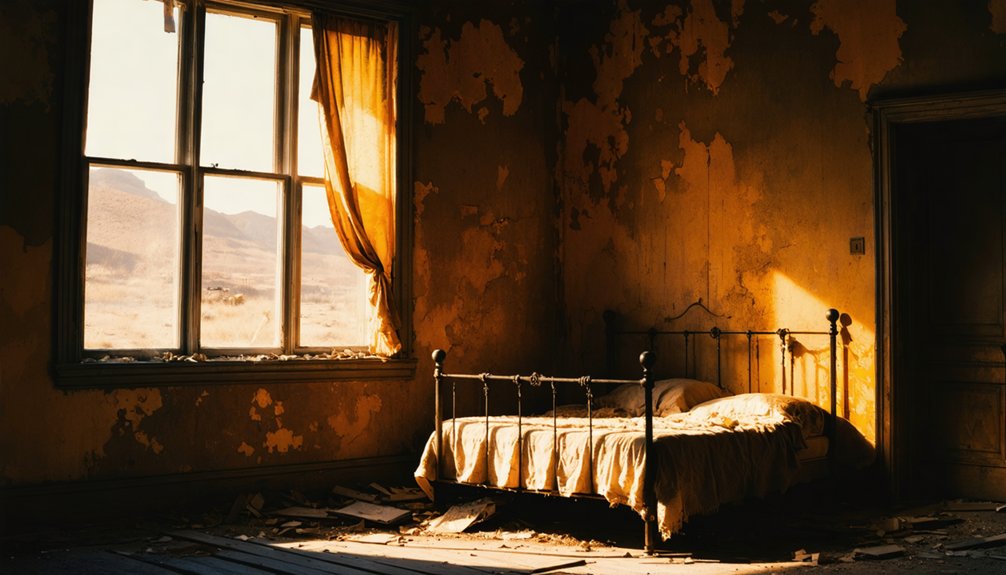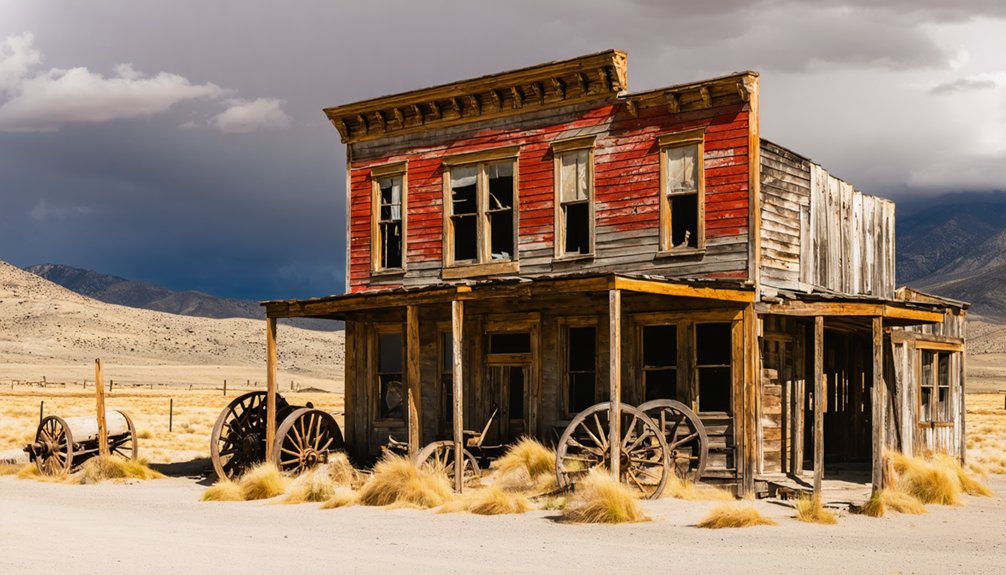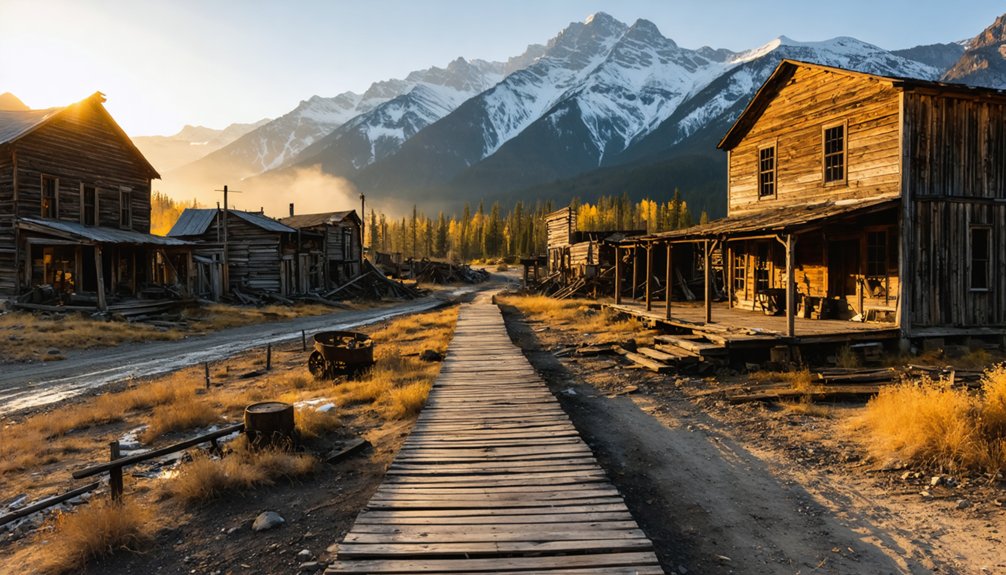
From Glacier National Park, you’ll find Montana’s best-preserved ghost towns by heading south on MT-83 through Seeley-Swan Valley toward the Garnet Range. Garnet Ghost Town, with approximately 20 original buildings from the 1898 gold rush, stands as the state’s most intact mining camp. The 12-mile Garnet Range Road loop connects five historic sites including Coloma, Reynolds City, and Beartown. Further south, Bannack State Park preserves Montana’s first major gold strike site from 1862. The route continues to Granite’s silver mining remnants and Virginia City’s living streetscapes, where your exploration of 1860s territorial Montana unfolds.
Key Takeaways
- Garnet Ghost Town, Montana’s best-preserved ghost town, features approximately 20 original buildings from its 1898 boom with 1,000 residents.
- Access Garnet year-round via Garnet Range Road; winter requires snowmobile or ski approach from designated parking areas.
- Plan a ghost town road trip starting at West Glacier, heading south on MT-83 through Seeley-Swan Valley to multiple sites.
- Explore the 12-mile Garnet Range Road loop connecting five historic mining camps: Reynolds City, Springtown, Beartown, Garnet, and Coloma.
- Summer and early fall offer ideal conditions for self-guided walking tours through Kelly’s Saloon, Wells Hotel, and historic miner cabins.
Planning Your Ghost Town Road Trip From Glacier
How do you transform a simple park visit into an adventure through Montana’s mining past?
Begin your five-day journey at West Glacier, heading south on MT-83 through the Seeley-Swan Valley. This corridor, carved between the Mission and Swan Mountains, opens access to numerous ghost towns scattered across Montana’s backcountry.
Your route flexibility allows reversal between Glacier and Yellowstone, depending on your starting point. The scenic routes shift from maintained blacktop to dirt forest service roads as you approach historical sites, with elevations climbing toward 7,000 feet.
You’ll navigate through Bigfork alongside Flathead Lake before pursuing destinations like Coolidge via Pioneer Mountain Scenic Byway, Bannack’s sixty preserved structures, and Elkhorn’s mountain trails. Located south of Missoula in the Big Hole Valley, Bannack was founded in 1862 after gold discovery on Grasshopper Creek. Consider adding Rimini to your itinerary, positioned 25 minutes southwest of Helena, where you can explore log cabins over a hundred years old.
This itinerary demands adequate time for thorough exploration of Montana’s mining heritage.
Garnet Ghost Town: Montana’s Best-Preserved Mining Camp
You’ll find Montana’s best-preserved ghost town at Garnet, where approximately 20 original buildings stand as they did when the last residents departed in the 1940s.
The town’s remote location in the Garnet Range, 50 miles east of Missoula, protected these structures from vandalism and salvage that destroyed other mining camps.
Your visit offers year-round access to explore the 1898 peak-era commercial district and 1930s revival-era cabins, though winter requires snowmobile or ski approach along the snow-covered road. At its height, Garnet supported 13 saloons along with multiple hotels and stores, reflecting the bustling commercial activity of a thriving gold mining community.
The Nancy Hanks mine alone produced approximately $300,000 worth of gold during the boom period, demonstrating the substantial mineral wealth that drew nearly 1,000 residents to this remote mountain settlement.
History and Peak Era
When prospectors first discovered gold at Bear Creek in the early 1860s, they set in motion a migration that would eventually create one of Montana’s most enduring mining camps.
Garnet’s origins trace to an 1865 strike at Bear Gulch, where Bear Town emerged as a primitive predecessor. By 1870, depleted placer deposits forced miners to pursue gold-bearing quartz veins using hard-rock mining techniques.
The camp exploded after Dr. Armistead Mitchell built a stamp mill in 1895, initially naming the settlement after himself.
When Samuel Ritchey’s Nancy Hanks mine struck rich ore, the rush began. Renamed Garnet in 1897 for local semi-precious stones, the town peaked around 1898 with 1,000 residents and twenty active mines—supporting thirteen saloons, four stores, seven hotels, and a school educating forty-one students in Montana’s rugged Garnet Range. Miners employed panning, rockers, and sluice boxes to extract gold from the surrounding deposits. Situated in the heart of the Garnet Mountains, the community thrived as gold miners and their families built homes and established businesses throughout the isolated valley.
Buildings and Walking Tour
Garnet’s legacy lives on through approximately 80 historic buildings and 46 other structures that still stand within the townsite district, making it Montana’s most intact frontier mining camp.
The BLM and Garnet Preservation Association maintain a “preserved, not restored” philosophy, stabilizing weathered structures rather than rebuilding them. This historic preservation approach honors the town’s architectural significance while allowing you to experience its authentic abandonment.
Your self-guided walking tour reveals:
- Kelly’s Saloon – one of 13 saloons that once served miners seeking entertainment and escape
- Wells Hotel – three-story lodging with creaky stairs and period furnishings intact
- Davey Store – mercantile with original shelving illustrating remote supply lines
- Dahl House – the town’s finest 1938 residence, later a Prohibition-era speakeasy
- Miner cabins – abandoned with furniture, stoves, and domestic items still inside
An overlook above the town provides a panoramic view where you can see the entire layout and understand how the community was organized during its prosperous years. The visitor center provides information and showcases old artifacts from the mining era.
Seasonal Access and Activities
Because Garnet operates year-round with dramatically different conditions across seasons, your visit experience depends heavily on timing and preparation.
From Memorial Day through October, you’ll find interpretive interiors open daily (9:30 a.m.–4:30 p.m.), guided tours available, and a visitor center with educational exhibits. Summer and early fall offer prime conditions for self-guided exploration, gold panning with purchased pay dirt, and fall foliage photography.
Winter access transforms completely—once snowpack closes the road (mid-December through April), you’ll reach Garnet only by snowmobile, cross-country skis, or snowshoes from designated parking areas.
Two rustic cabins offer overnight rentals during this period. Shoulder seasons bring variable Montana snowfall affecting road passability. Winter visitors can navigate the route via cross-country skiing or snowmobiling when vehicular access becomes impossible.
Entrance fees ($10 per adult) apply during staffed months; winter visits mean complete solitude but zero services. Federal passes are accepted for those who hold them, providing an alternative to the standard entrance fee.
Exploring Coloma and the Garnet Range Loop
A few miles north of Garnet, the remnants of Coloma sprawl across a high-elevation clearing where mine shafts, ventilation systems, and narrow-gauge rail traces mark one of the Garnet Range’s most enigmatic camps.
Established around 1893 and nicknamed the “Mystery Camp” for its sparse archival footprint, Coloma offers you a less-interpreted landscape—collapsed cabins insulated with 1920s newspapers, rusting pumps, and overgrown adits that signal ongoing University of Montana field research.
The rough gravel loop connecting Garnet and Coloma forms a compact circuit through turn-of-the-century hard-rock mining infrastructure, typically requiring high-clearance vehicles and yielding a half-day to full-day backcountry exploration.
Coloma Mining Infrastructure Remains
The scattered remnants of Coloma’s mining infrastructure tell a story of industrial ambition that once transformed this remote mountainside into a complex operation.
You’ll discover Coloma ruins spanning decades of extraction efforts, where the Mammoth Mine‘s 350-foot incline shaft once drove production that yielded $200,000 in gold over twenty years.
Today’s mining artifacts include:
- Massive gallows frame constructed from 14 X 18 inch timbers
- Visible narrow-gauge railroad tracks threading through the site
- Abandoned shaft openings descending into mountain depths
- Remnant ventilation systems and pumping machinery
- Weathered cabins and scattered mechanical equipment
The 2000 cultural evaluation documented eighty-seven structures and features across this ghost town, preserving evidence of the 60-horsepower boiler systems, cage hoists, and ten-stamp mill that powered this isolated enterprise.
Garnet Range Road Loop
Winding through the Garnet Mountains approximately 40 miles east of Missoula, the 12-mile Garnet Range Road forms a backcountry loop that connects five historic mining camps within a single drive.
You’ll navigate between Highway 200 and I-90, linking Reynolds City, Springtown, Beartown, Garnet, and Coloma across BLM-administered lands at elevations near 6,000 feet. The primary entrance from Highway 200 offers the most reliable route—11 miles to Garnet Ghost Town—while the steep Bear Gulch approach from Drummond discourages RVs and trailers.
May through mid-December permits wheeled access; winter transforms the corridor into snowmobile and ski territory. Among the finest scenic drives in western Montana’s mining districts, the loop delivers forested ridgelines, wildlife viewing opportunities, and visible remnants of 1860s gold operations across terrain named for ruby-colored garnet minerals embedded in surrounding rock.
Bannack State Park: Where Montana’s Gold Rush Began
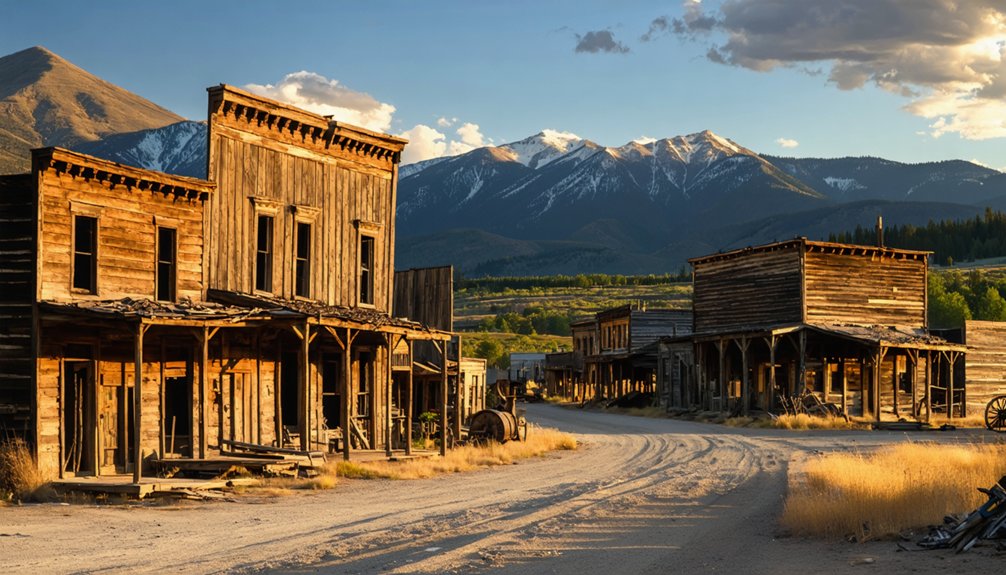
When prospector John White and his fellow “Pikes Peakers” from Colorado discovered gold at Grasshopper Creek on July 28, 1862, they triggered Montana’s first major gold strike and set off what would be called the greatest rush to the West since the 1848 California Gold Rush.
What You’ll Find at Bannack:
- Over 50 preserved buildings along Main Street, including Montana’s first Governor’s residence
- The 1875 brick courthouse and original jail from the vigilante era
- Mine remnants and wooden boardwalks from the boomtown that housed 3,000 residents by 1863
- Gold purity records of 99–99.5%, exceptional for placer deposits
- Sheriff Henry Plummer’s controversial law enforcement legacy with the alleged “Innocents” gang
Today’s National Historic Landmark preserves this territorial capital through “arrested decay,” stabilizing structures without full restoration.
Granite Ghost Town State Park and the Silver Boom Legacy
Perched at 7,200 feet in the Flint Creek Range, Granite Ghost Town State Park preserves Montana’s silver boom legacy through the remnants of what became the world’s richest silver mine.
You’ll discover Granite history dating to 1872, when prospector Holland found deposits that would yield the legendary Bonanza Chute—assaying 1,700 ounces per ton and ultimately producing $40 million in silver.
Virginia City and Nevada City: Living History on the Route South
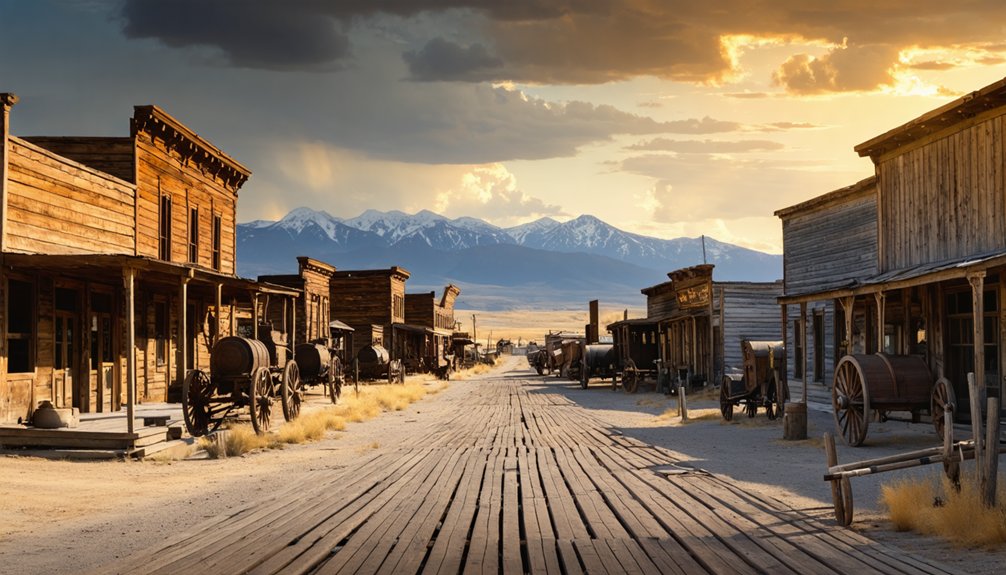
South from Granite, the route drops into the broad valleys where Virginia City and Nevada City preserve Montana’s first great gold rush along Alder Gulch.
South from Granite, the landscape opens to reveal Montana’s first great gold rush preserved in two authentic frontier towns.
The 1863 strike drew 10,000–30,000 fortune-seekers within months, spawning camps that stretched fourteen miles. Virginia City became territorial capital in 1865, while Nevada City anchored the satellite settlements.
What sets these communities apart:
- Over 115 preserved 19th-century structures still line original streets and mining claims
- Charles and Sue Bovey’s mid-century restoration saved entire streetscapes from collapse
- Vigilante history sparked extralegal hangings that remain controversial among historians
- Chinese residents comprised one-third of Virginia City’s 1870 population
- “Living ghost town” status maintains year-round inhabitants alongside authentic Victorian architecture
You’ll find operational saloons, boardwalks, and freight wagons—functional relics documenting territorial Montana’s lawless beginnings.
What to Expect When Visiting Remote Mining Sites
Beyond the living museums of Virginia City and Nevada City, Montana’s backcountry mining sites demand different expectations.
You’ll find no remote accommodations at places like Cracker Lake Mine below Mt. Siyeh or Van Pelt Mine within Glacier’s recommended wilderness—these require backcountry permits and self-sufficiency.
Road conditions dictate access; call ahead after rain or snow, especially when approaching Granite’s dramatic mountain ruins where all-wheel-drive becomes essential.
Historical artifacts remain where miners left them, protected by federal and state preservation laws. You’re free to photograph and explore, but touching or removing items violates these protections.
Seasonal access varies dramatically at 6,000-foot elevations like Garnet’s, where winter snows close roads until spring.
Pack water, navigation tools, and emergency supplies—cell service rarely reaches these sites.
Seasonal Access, Winter Adventures, and Annual Events
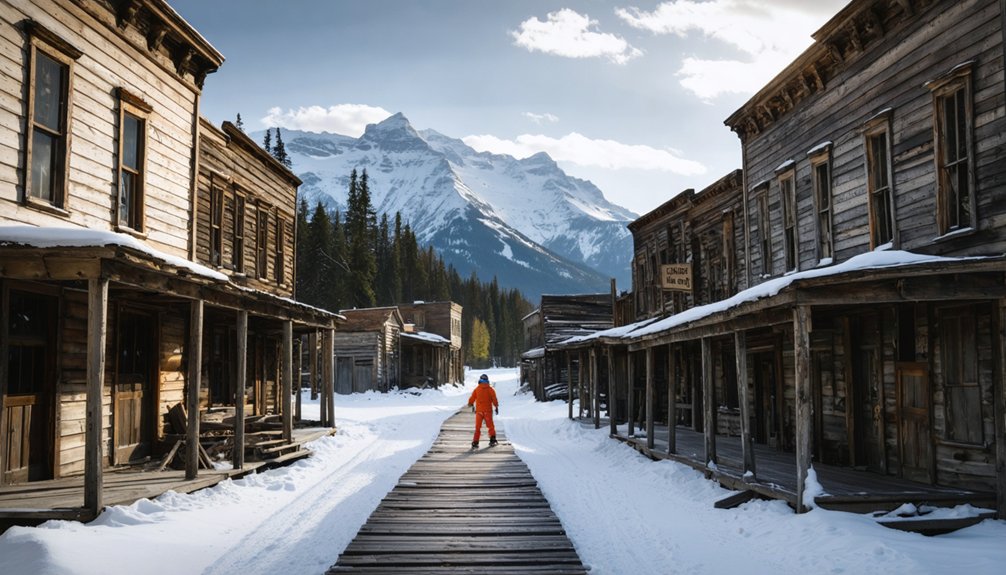
When elevation and snowpack determine access more than distance, Montana’s ghost towns split into two distinct calendars.
Garnet at 6,000 feet transforms entirely—its upper road closes December through April, becoming snowmobile and ski terrain. You’ll find primitive winter cabin rentals accessible only by over-snow travel, creating low-density backcountry experiences among frozen structures. Seasonal challenges reward those seeking winter exploration beyond conventional routes.
Garnet’s winter transformation restricts vehicle access for five months, turning ghost town exploration into a backcountry ski and snowmobile adventure.
June–September access highlights:
- Bannack’s 60+ preserved structures with full facilities and interpretation
- Nevada City and Virginia City heritage performances and summer events
- Coolidge via Pioneer Mountain Scenic Byway’s autumn drives
- Garnet with staffed interpretation and open buildings
- Glacier-to-Yellowstone five-day route combining multiple sites
Spring mud and fall ice bookend these windows.
High-elevation sites like Granite Ghost Town depend on local plowing and vehicle capability year-round.
Frequently Asked Questions
Are Ghost Towns Near Glacier National Park Safe for Children to Explore?
Several ghost towns offer safe exploring with proper child supervision. Bannack and Elkhorn State Parks maintain preserved structures with established trails. Garnet provides managed access year-round. You’ll find Rimini and Marysville require closer monitoring due to deteriorating buildings and minimal oversight.
For families looking to expand their adventures, there are numerous historic sites near Denali National Park that provide a glimpse into the region’s rich history. These locations often feature guided tours and informative displays, making it easier to engage children in learning about the past. Additionally, many of these sites have amenities for families, ensuring a comfortable and enriching experience during your visit.
Can I Bring My Dog to Montana Ghost Town Sites?
Want to explore with your four-legged companion? You can bring dogs to most Montana ghost town sites under dog friendly policies requiring leashes outdoors, though pet safety concerns exclude them from historic buildings and hazardous mine areas.
Do Any Ghost Towns Near Glacier Have Cell Phone Service?
Cell service availability at Montana ghost towns near Glacier remains undocumented in official records. You’ll find ghost town connectivity unpredictable in these remote mountain locations, so you’d better prepare for off-grid exploration and pack accordingly.
Are There Entrance Fees for Visiting Montana’s Ghost Town Sites?
Most Montana ghost towns don’t charge entrance fees—you’ll find free access at BLM-managed Garnet and open sites like Rimini. State parks may require fees, though specific costs aren’t standardized. Each site’s historical significance shapes its administration and accessibility.
What Hazards Should I Watch for in Abandoned Mining Buildings?
Rotting floorboards conceal deadly shaft openings; test structural integrity before entering. Watch for hazardous materials like asbestos insulation, chemical residues, and contaminated dust. Unstable timbers, hidden pits, and wildlife nests demand constant vigilance when you’re exploring independently.
References
- https://glaciermt.com/ghost-towns
- https://destinationmissoula.org/ghost-towns
- https://www.islands.com/2064601/rimini-montana-open-air-ghost-town-abandoned-old-west-once-thriving/
- https://visitmt.com/trip-ideas/ghost-town-route
- https://garnetghosttown.org
- https://www.tripadvisor.com/ShowTopic-g143026-i1168-k5573061-Ghost_Towns-Glacier_National_Park_Montana.html
- https://fwp.mt.gov/stateparks/granite-ghost-town
- https://www.youtube.com/watch?v=Ab5PUYYyLhk
- https://southwestmt.com/specialfeatures/this-is-montana/special-places/garnet-ghost-town/
- https://www.seeleylakelife.com/garnet-ghost-town.htm