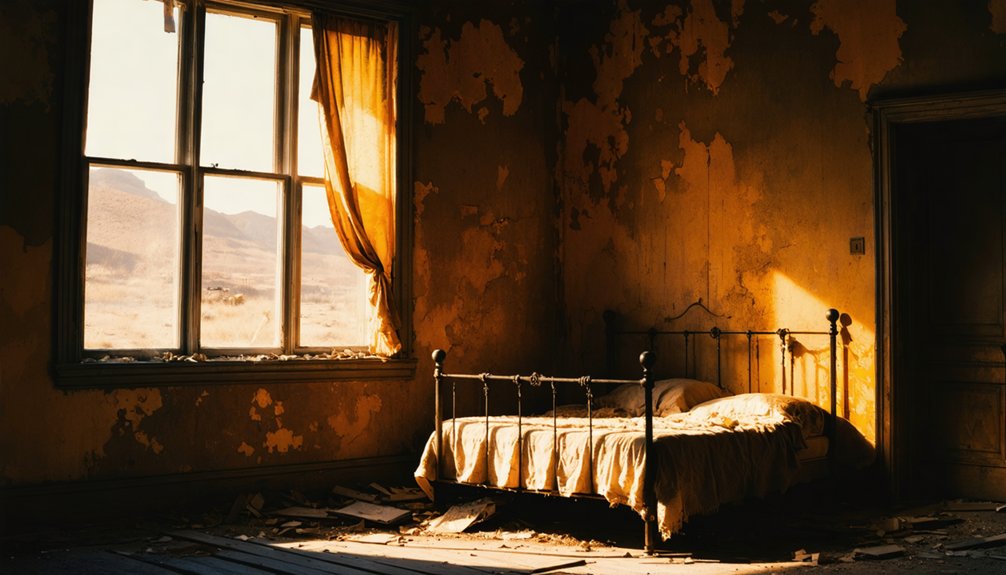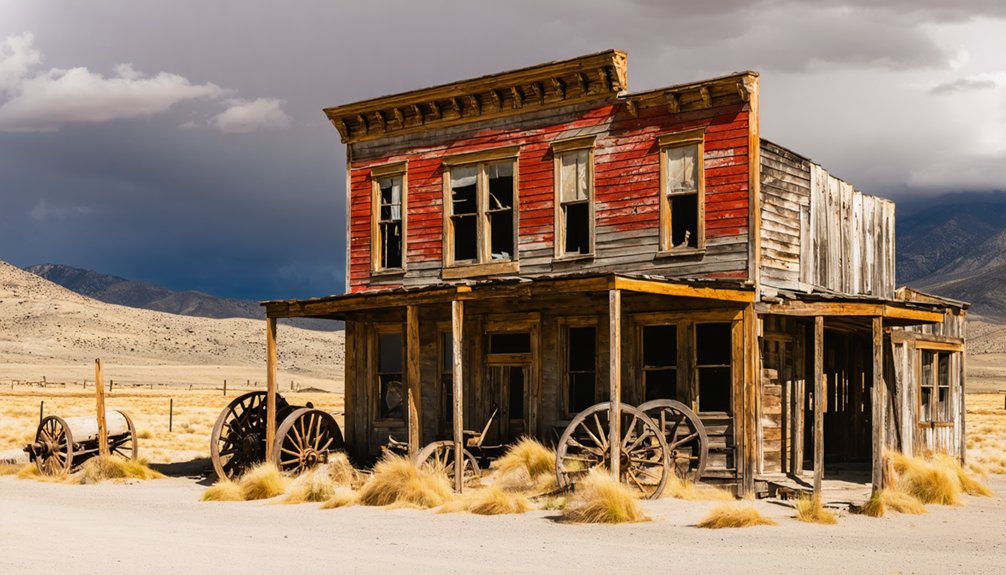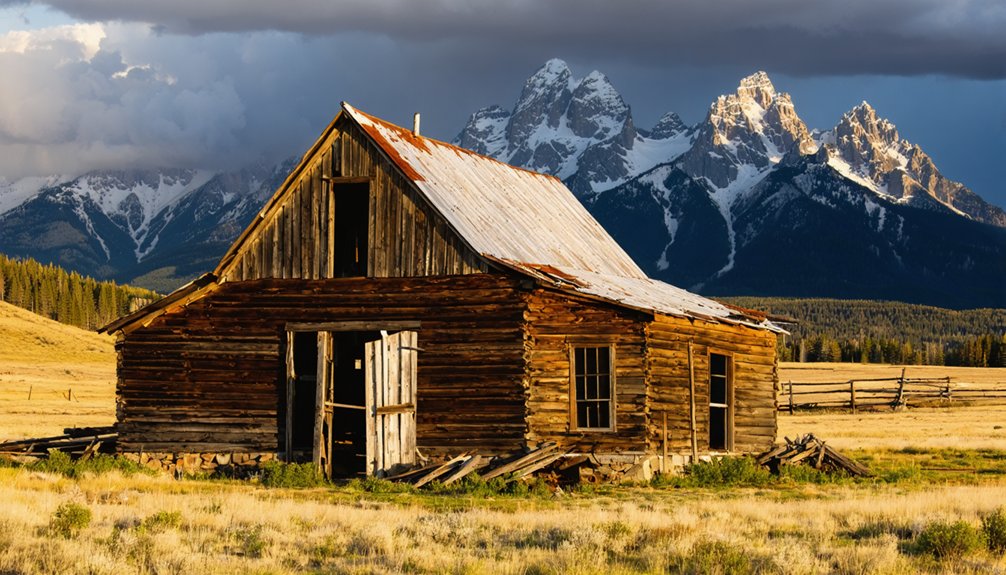
You’ll discover several authentic ghost towns within a two-hour drive of Grand Teton National Park, starting with Mormon Row Historic District inside the park itself—a 1890s homesteading settlement with six preserved building clusters. South Pass City, 90 miles southeast, preserves over 20 structures from its 1867 gold rush boom, including the Carissa stamp mill. Hidden remnants like Eadsville and Kirwin mining camps dot the surrounding mountains at elevations reaching 9,500 feet. Your exploration options extend from Jackson Hole’s forgotten homesteads to reconstructed frontier villages near Cody.
Key Takeaways
- Mormon Row Historic District preserves six homestead clusters from the 1890s within Grand Teton National Park’s boundaries.
- Eadsville mining camp remnants at 7,800 feet elevation mark an 1891 settlement hidden in Jackson Hole Valley.
- Deadman’s Bar, now a river launch site, has a dark 1886 history of multiple murders.
- South Pass City historic site preserves over 20 structures from an 1867 gold rush boom town.
- Kirwin mining camp at 9,500 feet features dramatic ruins accessible via rough Forest Service roads near the park.
Mormon Row Historic District: Grand Teton’s Iconic Homestead Settlement
In the 1890s, Mormon homesteaders from Idaho and the Salt Lake region crossed into Jackson Hole valley and established what they called Grovont—a farming settlement named after the Gros Ventre River that would grow into one of the region’s distinctive agricultural communities.
Under the Homestead Act of 1862, these settlers claimed 160-acre parcels and built 27 clustered homesteads along what’s now the Jackson–Moran Road, creating a compact village rather than scattered ranches.
This Grovont history shaped Teton agriculture through dryland farming and livestock operations supported by hand-dug irrigation systems. Families like the Moultons, Chambers, and Egglestons raised barns and log houses against the Teton Range, operating until the 1950s when Grand Teton National Park expanded and transformed their working landscape into today’s photogenic Mormon Row Historic District.
The settlement’s cultural significance earned Mormon Row a place on the National Register of Historic Places in 1997, recognizing nearly a century of homesteading legacy and the role these pioneers played in western irrigation and agricultural development. Today, six building clusters remain in the district, extending from the Gros Ventre River to north of Blacktail Butte.
Hidden Ghost Town Remnants in the Jackson Hole Valley
Beyond Mormon Row’s photographed barns, Jackson Hole Valley conceals lesser-known settlements where ambitious miners and homesteaders left behind structural remnants that document the region’s boom-and-bust cycles.
Hidden among Jackson Hole’s celebrated barns lie forgotten mining camps and homesteads—silent witnesses to the valley’s dramatic economic rise and fall.
You’ll find Eadsville remnants at 7,800 feet elevation, where Charles W. Eads founded a mining camp in 1891 that housed nearly 50 prospectors seeking gold, silver, lead, and copper. Cabin foundations mark where a dozen structures once stood before abandonment in the early 1900s. A small grave marks the site alongside the remaining foundations.
Deadman’s Bar along the Snake River carries darker history—multiple murders occurred here in 1886, including the discovery of a human skull on the riverbank. Today it serves as a popular float launch, though its name preserves frontier violence.
Pioneer cemeteries like Aspen Hill and Elliot Cemetery document early settler deaths, while John Sargent’s grave remains accessible near Jackson Lake. Montana’s first major gold discovery occurred at Bannack on July 28, 1862, sparking the rush that would eventually bring prospectors into surrounding territories including Jackson Hole.
South Pass City: Gold Rush Legacy in the Wind River Mountains
Gold fever transformed a windswept mountain pass into Wyoming Territory’s second incorporated city within months of the 1867 Willow Creek strike.
You’ll find South Pass City‘s preserved remnants within a 30-square-mile historic mining district where 2,000 fortune-seekers once crowded saloons, breweries, and mercantile halls during the 1869 peak.
The Carissa Mine anchored this boomtown culture, discovered by H.S. Reedall in June 1867 and producing thousands in placer gold before becoming the district’s longest-running operation.
Yet promotional exaggeration of reserves and a failed $115,000 London investment deal triggered rapid decline by 1869.
By 1872, populations in South Pass towns fell below 100 each, marking the end of the initial mining boom.
Among South Pass City’s pioneers, William H. Bright introduced the landmark women’s suffrage bill in 1869, forever changing Wyoming’s political landscape.
Today’s state historic site preserves over 20 structures, including the 1903 Carissa stamp mill, offering you authentic glimpses into Wyoming’s frontier gold-mining legacy beyond Grand Teton’s shadows.
Kirwin and Remote Mining Camps Within Driving Distance
While South Pass City drew crowds to accessible prairie foothills, prospectors seeking fortune pushed far deeper into Wyoming’s mountain wilderness.
Kirwin exploration reveals one of the state’s most dramatic mining heritage sites—a hard-rock camp perched at 9,500 feet in the Absaroka Mountains. You’ll find this remote settlement roughly 40 miles southwest of Meeteetse, where William Kirwin’s 1880s gold and silver discoveries sparked intensive development.
By 1905, 200 residents occupied a surprisingly modern town featuring electricity, telephones, and regular stagecoach service. The community maintained strict moral codes—no saloons or brothels operated within town limits, forcing miners to seek entertainment in nearby Meeteetse. The February 1907 avalanche changed everything. Three deaths and massive destruction drove families out permanently. Charles Tewksbury remained behind with his wife Sarah, operating a hotel and store while continuing to pursue mining opportunities seasonally.
Today’s ruins—cabins, stores, mining structures—stand frozen in time within Shoshone National Forest. Reaching Kirwin requires serious four-wheel-drive commitment on rough Forest Service roads, but you’ll encounter authentic frontier remnants few tourists ever witness.
Old Trail Town and Cody’s Reconstructed Frontier Village
Unlike Kirwin’s windswept ruins accessible only to determined backcountry explorers, Old Trail Town presents frontier Wyoming through carefully curated structures you’ll find steps from modern Cody’s western edge.
Archaeologist Bob Edgar relocated 26–28 authentic buildings from remote Wyoming and Montana sites to this reconstructed village on Buffalo Bill’s original 1895 Cody City townsite.
You’ll walk through cabins where Butch Cassidy’s Hole-in-the-Wall Gang once sheltered, examine Crow scout Curley’s dwelling, and stand at Jeremiah Johnston’s reinterred grave.
The complex operates seasonally May through September, displaying 100 horse-drawn vehicles and thousands of artifacts inside period saloons, stores, and homes. Among the preserved structures, you’ll discover the Coffin School, a one-room schoolhouse dating to 1884. Admission costs $9 for adults, $8 for seniors, and $5 for children ages 6-12.
True West Magazine recognized it as the region’s premier historical attraction—frontier preservation without requiring pack mules or topographic maps.
Montana and Idaho Ghost Towns on Extended Teton Loop Trips
When you’re willing to extend your Grand Teton itinerary by an extra day or two, a constellation of Montana and Idaho ghost towns opens up along loop routes threading through the northern Rockies.
Montana’s Virginia City and Nevada City preserve hundreds of 1860s gold-rush buildings along boardwalks where territorial governance once thrived. Bannack State Park, Montana’s first territorial capital, stands frozen since its 1862 gold strike, offering fifty structures including a weathered jail and schoolhouse.
Elkhorn Ghost town sits higher in the Elkhorn Mountains, where Fraternity Hall and Gillian Hall mark an 1880s silver camp that extracted 8.9 million pounds of ore before collapse. Idaho’s Silver City requires rough Owyhee Mountain roads but rewards adventurous travelers with intact high-desert ruins far beyond conventional park loops.
Frequently Asked Questions
What Is the Best Time of Year to Visit Ghost Towns Near Grand Teton?
Late June through September offers you the best access to remote sites and dependable weather. You’ll find ideal photography opportunities with clearer roads, longer daylight, and fewer seasonal attractions competing for attention at historic homesteads.
Are Pets Allowed at Mormon Row and Other Historic Ghost Town Sites?
Planning to bring your four-legged companion? Pet regulations at Mormon Row prohibit dogs beyond parking areas. You’ll find few dog friendly areas at Grand Teton’s historic sites—pets stay within thirty feet of roads only.
Can I Enter the Buildings at These Abandoned Ghost Town Locations?
Most buildings are locked or posted against entry due to building safety hazards and historical preservation rules. You’ll find exterior viewing permitted, but interiors remain restricted without guided tours or special permission at designated sites.
Do I Need a High-Clearance Vehicle to Reach Most Ghost Towns?
No—Mormon Row welcomes rental sedans like modern wagon trains. Road conditions to major ghost-town sites near Grand Teton favor passenger vehicles in summer. Vehicle recommendations shift to high-clearance only for backcountry mining camps like Kirwin’s rugged mountain approach.
Are There Guided Tours Available for Ghost Towns Near the Park?
You’ll find limited guided tour options specifically for ghost towns near Grand Teton. Local tour companies in Jackson, Lander, and Meeteetse occasionally offer backcountry history excursions, though most visitors explore independently.
For those interested in exploring ghost towns near Badlands National Park, several independent operators provide maps and resources to help guide you through these fascinating remnants of history. The stark landscapes and abandoned structures tell stories of a bygone era, making it a compelling adventure for history enthusiasts. Additionally, visitors can enjoy the dramatic scenery of the Badlands while seeking out these hidden gems away from the more crowded tourist spots.
References
- https://travelwyoming.com/blog/stories/post/5-wyoming-ghost-towns-you-need-to-explore/
- https://www.yellowstonepark.com/things-to-do/attractions/ghost-town/
- https://www.youtube.com/watch?v=sue3X3MzlUQ
- https://www.youtube.com/watch?v=43FALCp70hE
- http://www.fathomaway.com/focus-forgotten-life-teton-national-park/
- https://www.youtube.com/watch?v=4MqMcuV4V_0
- https://www.tripadvisor.com/ShowUserReviews-g60838-d2329299-r503219408-Mormon_Row_Historic_District-Moose_Grand_Teton_National_Park_Wyoming.html
- https://www.gtnpf.org/initiatives/renewing-life-on-mormon-row/
- https://wyoshpo.wyo.gov/index.php/programs/national-register/wyoming-listings/view-full-list/874-mormon-row-historic-district
- https://jacksonholewildlifesafaris.com/history-of-mormon-row/