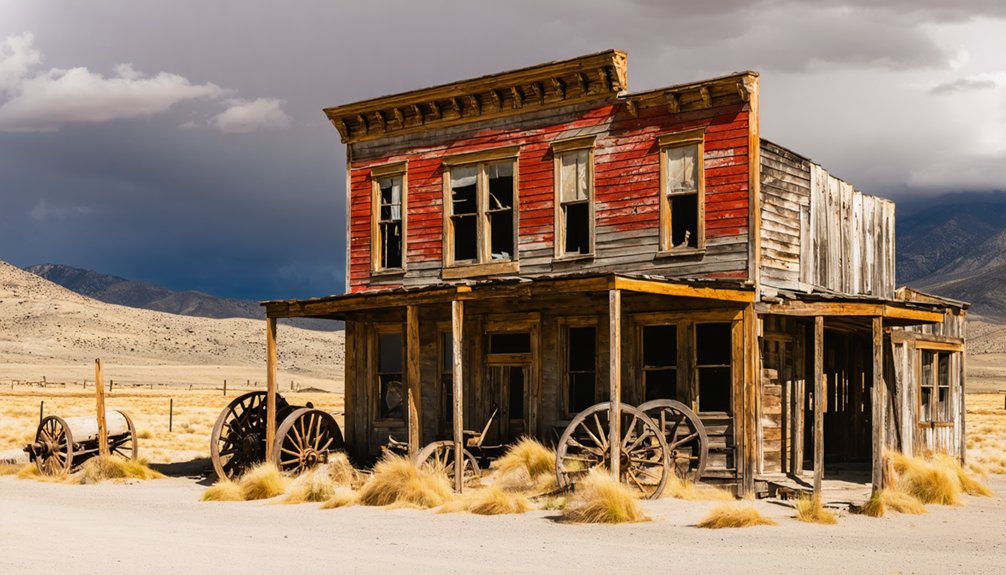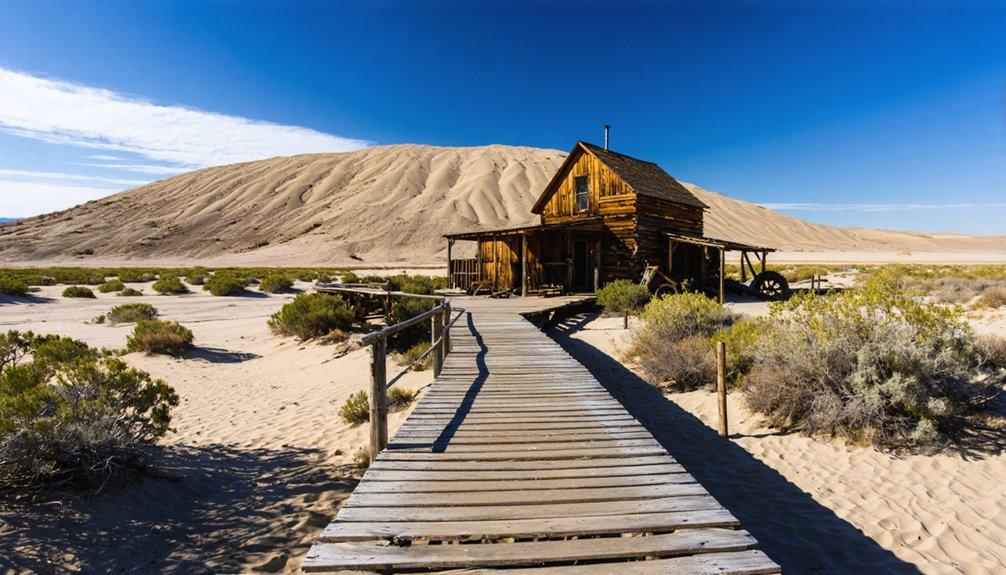
You’ll find three significant ghost towns—Duncan, Liberty, and Denton Spring—in the western foothills of the Sangre de Cristo Range bordering Great Sand Dunes National Park. Duncan, established in 1874, housed 3,000 residents before U.S. Marshals evicted settlers from the Baca Grant in 1900. Displaced miners founded Liberty one mile south on public land, operating until 1921. These sites feature weathered cabins, foundation remnants, and mining infrastructure, though access varies between National Forest and private property. The settlements’ rise and fall illuminate how Spanish land-grant law shaped Colorado’s mining frontier beyond the familiar narratives.
Key Takeaways
- Duncan, established in 1874 as a gold mining boomtown, peaked at 3,000 residents before eviction in 1900.
- Liberty was founded in 1900 by displaced Duncan residents, operating until 1921 with infrastructure including post office and school.
- Both ghost towns emerged from mining operations in Colorado’s Sangre de Cristo range near the former Baca Grant.
- Duncan features John Duncan’s preserved log cabin within Rio Grande National Forest; Liberty contains scattered collapsed wood structures.
- Access requires permission due to private property and federal regulations protecting archaeological resources and public safety.
Duncan: A Mining Boomtown Born and Lost Within a Land Grant
When John Duncan crossed Medano Pass into the San Luis Valley in 1874, he followed routes already traced by explorers Zebulon Pike and John C. Fremont.
Discovering “float” gold-bearing ore at Pole Creek’s mouth, he platted a town and sold lots for $25–$75 each.
But here’s the catch: Duncan thought he’d purchased land from Colorado’s state government, yet the town site actually sat within the Luis Maria Baca No. 4 Grant—private property whose land ownership would seal Duncan’s fate.
By 1892, up to 3,000 residents supported stamp mills using mercury amalgamation mining technology to extract gold from “not especially rich” ore.
This boomtown offered hotels, saloons, and even telephone service, yet its foundation rested on contested ground.
The legal battles over land ownership culminated in 1900 when the entire town faced eviction, ending Duncan’s 26-year existence.
Like Animas Forks, which gained its post office in February 1875, Duncan’s establishment marked the rapid development of Colorado’s mining frontier during the 1870s.
The Rise and Fall of Liberty: Freedom From Disputed Ownership
When Duncan’s residents faced eviction from the Baca Grant in 1900, they established Liberty at Short Creek‘s mouth—approximately one mile south—where gold float discoveries promised legally secure mining opportunities.
You’ll find that this refuge community quickly developed processing infrastructure, including a stamp mill and post office that operated until 1921, serving miners who’d relocated entire log cabins to escape ownership disputes.
The settlement’s brief two-decade existence ultimately succumbed to the same economic reality that claimed countless San Luis Valley mining camps: low-grade ore deposits that rendered operations financially unsustainable, similar to Independence Ghost Town where gold deposits were exhausted by the early 1880s after producing over $190,000 in just two years.
Liberty’s fate mirrored other agricultural ghost towns like Green City, which failed when water issues prevented the colony from fulfilling its promises of irrigated farmland to settlers.
Founding After Duncan’s Eviction
After George Adams purchased the Luis Maria Baca No. 4 Grant in 1899 and the courts confirmed his ownership rights, Duncan’s residents faced a stark choice: abandon their claims or relocate beyond the grant’s southern boundary.
They chose freedom. Around 1900, you’d have witnessed displaced settlers dismantling their hand-hewn log cabins and hauling timbers one mile south to the mouth of Short Creek—public domain land outside disputed ownership.
This spatial shift preserved community continuity while eliminating legal vulnerability. The new townsite, aptly named Liberty, symbolized autonomy from large land-grant holders who’d dominated the San Luis Valley’s settlement patterns.
Relocated structures formed Liberty’s architectural heritage, allowing rapid establishment of housing and commerce without new materials.
You’d have recognized Duncan’s layout reborn across the fence, where mineral prospects and surface rights belonged to those who worked them.
Mining Economy and Amenities
Economic sustainability proved elusive when ore values failed to match speculative hopes.
Still, Liberty developed stagecoach service, a hotel, school, and post office****—amenities signaling families and permanence, not just transient fortune-seekers. These infrastructures thrived on land you could actually own, free from eviction threats.
The post office operated until 1921, though declining ore profits had already sealed the town’s fate. Two teachers staffed the school, serving children of families who had settled in the area.
The broader valley had attracted settlers for ranching and farming since the late 19th century, activities that outlasted most mining ventures.
Decline Into Ghost Town
Yet symbolic liberty didn’t guarantee economic sustainability.
Despite establishing a post office, stagecoach service, hotel, and school, Liberty remained dependent on speculative, low-grade ore deposits.
The post office operated until 1921, marking the community’s shift from civic optimism to abandonment.
Without strong mineral wealth, even secure land tenure couldn’t prevent Liberty’s decline into another ghost town haunting the Great Sand Dunes.
Settlers faced challenges from both the harsh climate and the region’s remote location, compounding Liberty’s economic struggles.
Denton Spring: The Least Documented Ghost Town in the Dunes Region
Tucked into the montane foothills southeast of the Great Sand Dunes, where the shift zone between grassland and forested slopes begins its rise into the Sangre de Cristo Range, Denton Spring represents the most enigmatic settlement in the region’s mining-era landscape.
You’ll find virtually no archival documentation about this “little boomtown,” only scattered bricks, foundation stones, and weathered planks marking where structures once stood.
What makes Denton Spring historically layered is its Water Source—a perennial spring used by Indigenous Heritage communities for millennia before Mining Activity drew fortune-seekers in the late 1800s.
Today, elk and deer still visit the spring, drinking where ancient travelers and gold-rush prospectors once did.
At Denton Spring, wildlife now drinks from waters that once sustained Indigenous peoples and nineteenth-century miners alike.
Like similar springs throughout Colorado’s mining territories, this water source was likely shaped by tectonic forces that created natural seeps across the region’s geological formations.
The National Park Service acknowledges knowing little about this community, leaving its story largely unwritten.
How Land Grants and Legal Disputes Shaped Mining Communities
You’ll find that Duncan’s lot buyers paid $25 each for parcels that sat squarely on the Baca Grant, where title belonged not to the townsite promoter but to the grant’s heirs—a legal defect that ultimately enabled wholesale evictions.
When consolidating ranchers asserted their superior patent rights, residents who’d built homes and financed stamp mills were reclassified as trespassers and forced out.
Meanwhile, Liberty’s founders deliberately platted their camp just south of the grant boundary on public domain, securing post-office continuity until 1921 precisely because settlers there faced no challenge from private patent holders.
Baca Grant Evictions
When Luis Maria Cabeza de Baca petitioned Spanish authorities in 1821 for a land grant near present-day Las Vegas, New Mexico, he couldn’t have anticipated the decades of legal turmoil that would follow.
The conflict between his Las Vegas Grandes grant and the Town of Las Vegas Land Grant ultimately led Congress to offer compensation through floating land claims elsewhere.
George Adams’ 1886 purchase transformed property rights into weaponized eviction narratives. U.S. Marshals executed brutal nighttime removals in 1900 and 1917, expelling over 150 settlers who’d built lives on what became Baca Float No. 3.
Despite offers of $125 per structure, families lost generational homesteads. While mining communities like Cottonwood and Duncan vanished, their community resilience echoes through the ghost towns dotting the Sangre de Cristo range today.
Liberty’s Freedom Strategy
The forced removals on Baca Float No. 3 exemplify one axis of land-grant power—physical expulsion—but a parallel system governed mining districts through contract rather than eviction.
You’ll find liberty’s legacy ironically embedded in company towns like Latuda, where freedom-of-contract ideology masked structural coercion. Firms purchased former grant lands, then leased townsites, housing, and store lots back to workers under “voluntary” agreements that legally framed occupancy as revocable privilege.
This architecture preserved mining autonomy for capital while eliminating it for labor. When courts resolved overlapping claims and water-rights disputes in corporate favor, the same open-access mineral laws that fostered boomtowns allowed consolidation into single-owner blocks.
Contract law became the lever: companies could dismantle entire settlements—salvaging structures, revoking leases—transforming thriving camps into ghost towns without ever issuing an eviction notice.
What Remains Today: Cabins, Ruins, and Historical Markers
Weathered cabins and foundation scars mark the shift from bustling mining settlements to nearly vanished landscapes across the ghost towns near Great Sand Dunes National Park.
In particular, ghost towns along Route 50 reveal the stories of those who once thrived in these remote areas. As nature reclaims the land, remnants of old railways and faded storefronts serve as poignant reminders of a vibrant past. Exploring these sites offers a glimpse into the challenges and aspirations that defined the lives of early settlers.
At Duncan, you’ll find John Duncan’s hand-hewn log cabin standing as the sole intact structure, its tight corner notches preserving community memories while ranch operations obscure the original street grid.
Liberty offers scattered wood cabins in various states of collapse, with foundation depressions tracing where hotels and mills once anchored commerce.
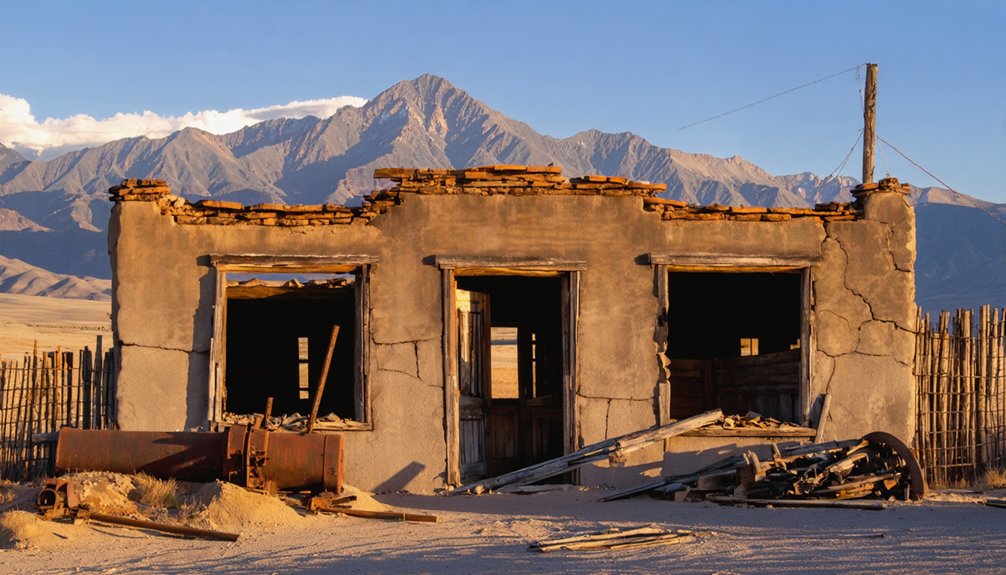
Denton Spring reveals only brick fragments and stone alignments near its still-flowing spring, cultural features easily missed without archival maps.
Tailings piles and disturbed creek banks hold historical significance as industrial archaeology, though most machinery and residential housing vanished after Baca Grant court actions displaced these unpatented settlements.
Visiting Ghost Town Sites: Access Rules and Land Ownership
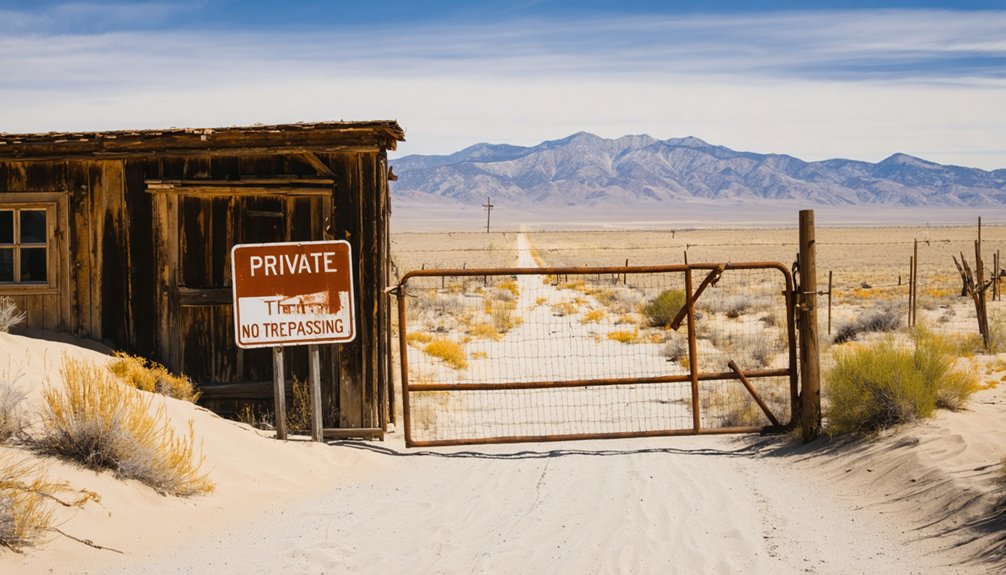
Before planning any visit to these historic mining sites, you’ll need to understand that complex land ownership patterns create a patchwork of access permissions across the former Baca Grant.
Liberty’s townsite remains private property—entering without landowner permission violates Colorado trespass statutes.
Duncan’s cabin and townsite now fall within Rio Grande National Forest, where ghost town access follows standard USFS protocols, though NPS explicitly states many features aren’t open for exploration.
Federal regulations protecting archaeological resources apply strictly here. The Archaeological Resources Protection Act prohibits removing artifacts, metal detecting, or disturbing structural remnants on public lands.
You can’t legally pocket bottles, tools, or building materials from Duncan or Denton Spring sites.
Advanced structural decay and concealed mine shafts compound legal restrictions with genuine hazards, prompting agencies to close areas protecting both cultural integrity and visitor safety.
From Gold Rush to Ghost Town: Why These Communities Failed
- U.S. Marshals stationed in temporary quarters executing eviction orders
- Homeowners dismantling buildings for $10 buybacks after $125 compensation
- Abandoned stamp mills rusting beside ore too marginal to process
- Mountain freight routes that made every supply shipment a financial burden
Geography and law conspired where economics had already sentenced these camps to abandonment.
The Role of Ghost Towns in Great Sand Dunes Cultural Heritage
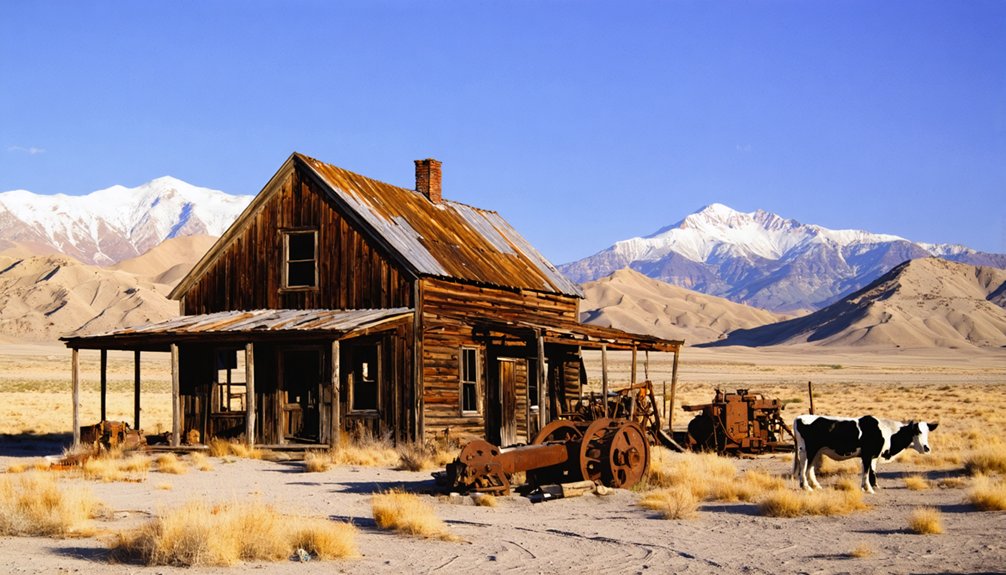
Scattered across the approaches to Great Sand Dunes, the ruins of Liberty and Duncan anchor a settlement narrative that transformed the valley floor from Indigenous homeland to Anglo mining frontier in less than two decades.
You’ll find these ghost towns preserve cultural significance through layered occupancy—Duncan’s 3,000-resident peak in the 1890s overlaid spring sites used “since ancient times,” while Liberty’s standing structures mark where displaced Duncan families reclaimed land closer to the dunes.
Each foundation stone and brick fragment at Denton Spring provides historical context linking mobile Indigenous patterns to fixed extractive settlements, then to today’s protected landscape.
The material record teaches you how boom economies erased earlier lifeways before vanishing themselves, leaving vertical timelines readable in ruins.
Frequently Asked Questions
Were There Any Other Ghost Towns Near Great Sand Dunes Besides These Three?
Based on archival records and spatial analysis, you’ll find no other ghost towns documented as nearby attractions directly around Great Sand Dunes—only Duncan, Liberty, and Denton Spring cluster at the monument’s immediate edges.
What Kind of Gold Mining Methods Did Duncan and Liberty Miners Use?
Duncan and Liberty miners employed hard-rock methods—underground workings, stamp milling, and mercury amalgamation—to extract low-grade gold from veins, not placer mining, despite dune sand proximity suggesting alluvial potential.
Can You Camp Near Any of the Ghost Town Sites Today?
You can’t camp at Liberty, Duncan, or Denton Spring due to camping regulations and ghost town accessibility restrictions on private property and refuge land. Instead, use Piñon Flats Campground or Alamosa’s facilities as your base.
Did Any Famous Historical Figures Visit Duncan, Liberty, or Denton Spring?
No famous visitors reached Duncan, Liberty, or Denton Spring. You’ll find these remote camps held no historical significance beyond local mining—their isolation, brief existence, and sparse records reveal settlements too obscure for documented national figures.
Are There Guided Tours Available to Visit These Ghost Town Locations?
No official guided exploration exists for Liberty, Duncan, or Denton Spring due to private-property restrictions and sensitive archaeological status. You’ll find commercial historical tours concentrated in distant San Juan Mountains districts instead.
References
- https://www.coloradocentralmagazine.com/duncan-colorado-the-story-of-a-short-lived-town-on-the-edge-of-the-great-sand-dunes/
- https://www.visitouray.com/ghost-towns
- https://www.colorado.com/articles/colorado-ghost-towns
- https://www.nps.gov/grsa/learn/historyculture/liberty-duncan-and-denton-spring.htm
- https://www.rmpbs.org/shows/colorado-experience/episodes/ghost-towns-b96fft
- https://seelincolncounty.com/cowans-colorado-ghost-town/
- https://www.tripadvisor.com/Attraction_Review-g33386-d6960972-Reviews-Summitville_Ghost_Town-Del_Norte_Colorado.html
- https://www.legendsofamerica.com/animas-forks-colorado/
- https://www.cpr.org/2023/08/24/san-luis-valley-duncan-cabin-public-rental/
- https://www.youtube.com/watch?v=J8dR9D3pJrs