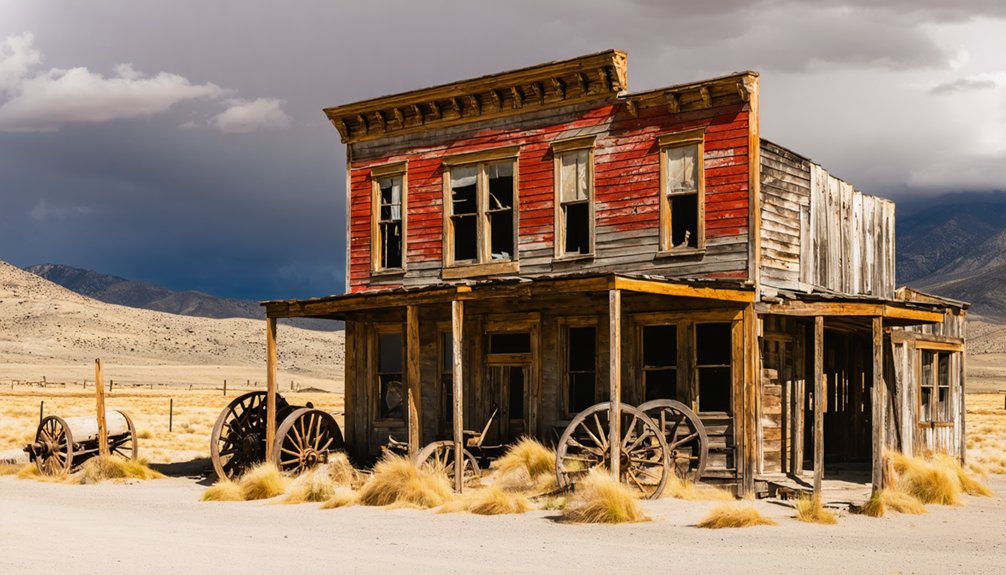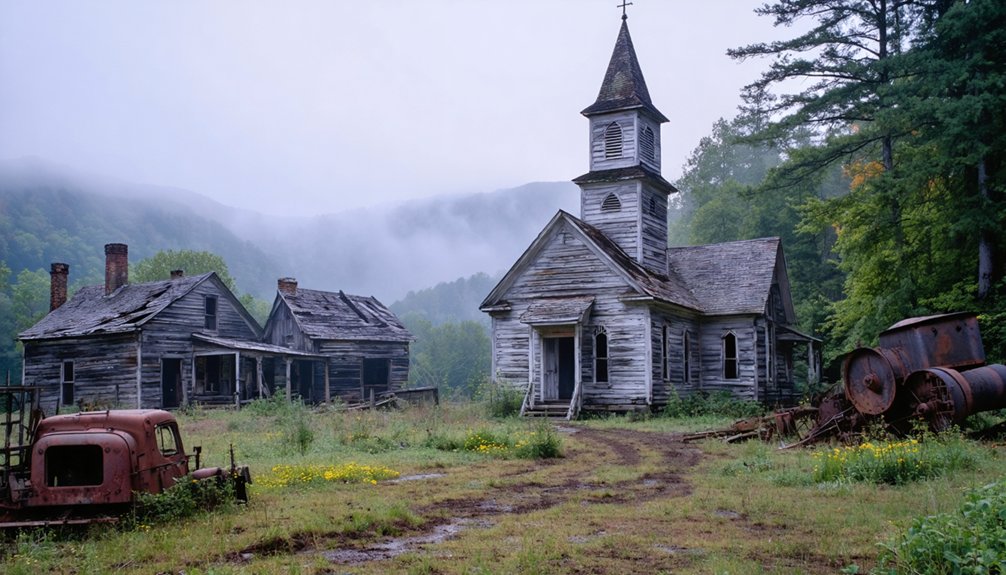
You’ll find Elkmont, the park’s most accessible ghost town, just six miles from Gatlinburg along Little River Road. This abandoned resort community evolved from a 1910s logging camp to an exclusive vacation enclave before becoming federal land in 1934. When lifetime leases finally expired in 1992, over 70 buildings stood empty. Today, 19 restored structures and countless stone chimneys remain scattered throughout the historic district, with trails leading to foundations that trace the settlement’s transformation from frontier homesteads to Appalachian Club retreats—each remnant revealing deeper layers of this mountain community’s contested history.
Key Takeaways
- Elkmont evolved from a 1910s logging camp to an exclusive resort community before becoming a preserved ghost town within the national park.
- Over 70 historic buildings remain at Elkmont, with 19 restored structures including the Appalachian Club lodge and pioneer cabins open to visitors.
- Stone chimneys and foundations mark abandoned homesteads dating to the 1830s, serving as archaeological signatures throughout the Elkmont Historic District.
- The 0.8-mile Elkmont Nature Trail and 3.7-mile Jakes Creek Trail provide accessible routes to explore cabin ruins and cultural heritage sites.
- Elkmont is located six miles from Gatlinburg via Little River Road, with parking and amenities available near the campground year-round.
Elkmont: From Logging Camp to Abandoned Resort Community
Tucked into a mountain hollow along the Little River’s west prong, Elkmont evolved from a rough-hewn logging camp into one of the Southern Appalachians’ most exclusive resort communities before abandonment transformed it into the region’s most visited ghost town.
Elkmont history began in earnest around 1910 when the Little River Lumber Company sold parcels to Knoxville’s elite, who established the Appalachian Club and Daisy Town’s vacation cottages. The Wonderland Hotel opened in 1912 with fifty rooms overlooking Meigs Mountain.
Elkmont architecture reflects this resort era—wood-frame structures designed for seasonal leisure rather than permanence.
When the park absorbed the community in 1934, lifetime leases allowed residents to remain temporarily. Those leases expired in 1992, leaving seventy-plus buildings to weather and decay without stewards. The National Park Service ultimately chose to preserve 19 buildings while demolishing the deteriorating remainder, with demolition work completing in 2018. Restoration efforts launched in 2009 to save the remaining structures from further decay.
The Transformation From Timber Industry to Tourist Destination
Elkmont’s resort-era cottages represent just one chapter in the broader economic upheaval that reshaped these mountains between 1900 and 1940.
Timber industry infrastructure laid the groundwork for modern tourism throughout the Smokies region, as the same railroads that hauled virgin hardwoods to mills in Townsend and Walland later brought excursionists into high-elevation valleys.
When timber depletion made logging unprofitable by the 1920s, companies pivoted toward land sales.
You’ll find that today’s scenic highways follow alignments first cut for log transport, while former depot towns evolved into gateway communities supplying lodging and provisions.
This economic shift from extractive industry to timber tourism wasn’t gradual—it was forced by cutover slopes and declining stumpage values, fundamentally altering employment patterns and tax revenues across boundary counties.
The Wonderland Hotel, which opened in 1912, served as one of the premier accommodations during Elkmont’s transformation into an exclusive resort destination.
The establishment of the national park required residents to leave, with communities like Elkmont preserving only a fraction of their original structures as the land transitioned to federal protection.
How National Park Establishment Created a Ghost Town
When Congress authorized Great Smoky Mountains National Park in 1934, federal and state governments launched a land-acquisition campaign that dismantled Elkmont’s resort economy within a decade.
You’d witness the displacement impact as bureaucrats purchased tracts from timber companies and club owners, converting private holdings into restricted federal territory.
Park Service philosophy demanded “natural” wilderness—no permanent residents, no independent businesses within boundaries. Former property owners received time-limited leases that expired by 1992, severing multi-generational ties to the land.
Without municipal authority to maintain structures or renew economic function, Elkmont’s 60–70 cabins stood empty.
The community loss was absolute: no civic institutions, no services, no stewards. Gateway towns outside park borders captured tourism revenue while Elkmont decayed into administrative silence.
The Legal Battles and Lifetime Leases of Former Residents
- 1952 conversion — Lifetime leases became 20-year terms when residents sought electrical service, sacrificing perpetual rights for modern infrastructure.
- 1972 renewal — Second renewal reinforced expectations of indefinite occupation.
- 1992 non-renewal — NPS refused further extensions, stranding 70+ buildings without legal occupants. The Wonderland Club closed this same year, marking the end of an era that began in 1912.
- 1994–2009 preservation fight — Historic district listing triggered 15 years of legal implications and advocacy, forcing compromise restoration plans. Many cottages were placed on the National Register of Historic Places, which prevented their demolition.
You’re witnessing how administrative convenience eroded individually-negotiated freedoms into standardized expiration dates.
Preservation Efforts and the Fight to Save Historic Structures
The legal expulsions of longtime residents paradoxically galvanized the preservation movement that would save Elkmont’s built heritage. When 1994’s National Register designation halted demolition plans, you witnessed a dramatic policy reversal—from systematic removal to documented preservation.
Friends of the Smokies established a $9 million endowment, enabling specialized restoration techniques that matched original materials and period-appropriate paint shades across 19 surviving structures.
The preservation challenges proved formidable. Of 70+ buildings assessed, only 19 met restoration standards. Teams spent three years on individual cabins, balancing structural integrity with historical authenticity. Among the preserved structures, the Levi Trentham Cabin stands as the oldest, originally constructed by Robert Trentham in the 1830s.
What Remains: Exploring the 19 Restored Buildings
- Appalachian Club lodge – the social center of the early resort community
- Levi Trentham cabin – pre-resort settler homestead linking frontier and tourism eras
- Chapman-Byers cabin – final restoration symbolizing the project’s completion in Society Hill
- Fulton-Sneed “Wild Rose” cabin – exemplary Daisy Town cottage with vibrant exterior and period details
Walk Daisy Town’s narrow lanes to experience closely-spaced vacation homes painted in bright period colors. Their porches and decorative trim reflect middle-class leisure architecture rather than wilderness isolation. The restoration process involved craftsmen who matched original paint colors to preserve historical authenticity. The restoration project included 60 structures total, though only 19 were ultimately restored while 41 were demolished.
Hiking Trails and Hidden Remnants Throughout Elkmont
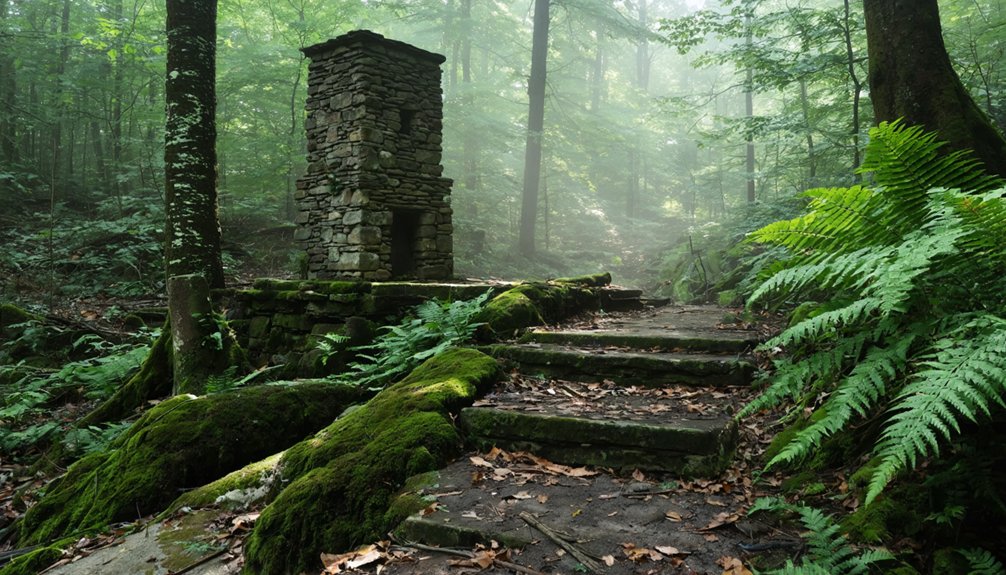
You’ll find Elkmont’s most evocative remnants not in the restored buildings but along the trail corridors that once carried loggers, vacationers, and supplies through the settlement.
The Jakes Creek Trail begins on an old gravel road threading past tall stone chimneys and crumbling foundations—silent markers of homes that lined this historic approach for nearly half a mile before the path climbs toward Jakes Gap.
Meanwhile, the Elkmont Nature Trail‘s 0.8-mile loop follows a former logging road, offering an interpretive framework for understanding how timber extraction gave way to the resort colony whose streets and cabins you can still walk today.
Jakes Creek Trail Exploration
Setting out from the Elkmont Historic District‘s parking area near the Daisy Town cottages, you’ll follow Jakes Creek Trail as it begins along an old gravel road that once served the summer colony’s uppermost reaches.
This 3.7-mile route climbs 1,700 feet to Jakes Gap, shifting from broad, level roadbed into steep, rocky single-track that hugs the cascading creek.
Trail History highlights include:
- Avent Cabin access via unmarked spur—an 1845 Humphrey Ownby log house acquired by artist Mayna Treanor Avent in 1918
- Backcountry campsites #27 and #26 for overnight exploration beyond the ghost town corridor
- Waterfall-studded creekside sections beneath mixed hardwood canopy and seasonal wildflower displays
- Junction at Jakes Gap connecting Panther Creek and Miry Ridge Trails for extended backcountry loops
You’re walking paths once trodden by vacationers and subsistence farmers alike.
Stone Chimneys and Foundations
Where wooden cabins have vanished into memory, stone chimneys and foundations remain as Elkmont’s most enduring ghost-town signatures—weathered monuments to four generations of mountain settlement and leisure.
As visitors traverse the rugged terrain, they uncover stories of resilience often associated with exploring ghost towns near Guadalupe Mountains. These remnants offer a glimpse into the past, where echoes of laughter and labor blend with the whispering winds. Each abandoned structure serves as a canvas, inviting curious souls to imagine the lives once lived amidst the stark beauty of the landscape.
You’ll find these hand-stacked fieldstone remnants throughout Little River Trail, marking sites from 1830s homesteads through Appalachian Club resort cabins. The National Park Service intentionally preserved these masonry structures during restoration—their stone craftsmanship proved both stable and historically significant enough to warrant retention as open-air archaeological features.
Wide fireboxes reveal combined heating and cooking functions, while dry-laid foundation lines trace multi-room footprints now reclaimed by forest. Each chimney standing alone documents the shift from pioneer necessity to elite recreation, offering tangible connection to Elkmont’s layered past without interpretive barriers or managed access.
Elkmont Nature Trail Access
Winding through forest just beyond Elkmont Campground, the 0.8-mile Nature Trail loop delivers both ecological education and scattered material traces of the community’s multi-layered past within an easy 20-minute walk.
You’ll access the trailhead by turning onto Elkmont Road from Little River Road, parking 0.3 miles past the campground. Trail accessibility remains high year-round thanks to minimal elevation gain and a nearly flat 2% grade.
Nature interpretation unfolds through wooden signage highlighting native flora, fungi-covered logs, and spring wildflowers alongside subtle reminders of older human presence:
- Old logging route forms the trail’s original corridor
- Creeks and branches follow historic drainage patterns
- Mixed laurel-pine canopy reclaims former clearings
- Footbridges cross streams once essential to settlement life
Planning Your Visit: Directions and Accessibility Information
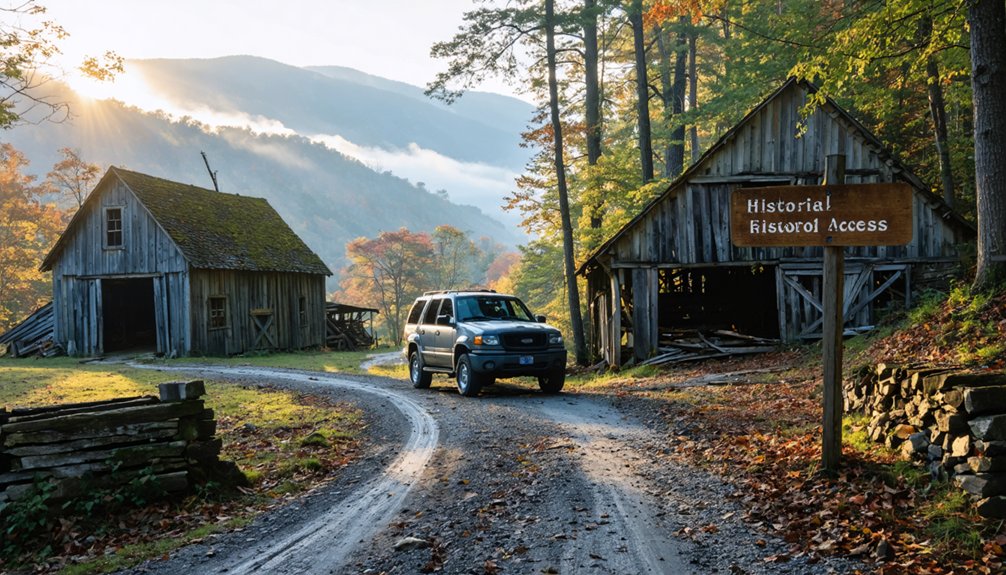
Reaching Elkmont requires traversing the well-maintained interior roads of Great Smoky Mountains National Park, where this remarkably intact ghost town sits approximately six miles from Gatlinburg within Sevier County’s protected boundaries.
From Sugarlands Visitor Center, you’ll drive Little River Road west for 4–7 miles before turning onto Elkmont Road toward the campground. The paved route accommodates standard vehicles, though RVs face tighter maneuvering near cabin clusters.
The paved six-mile route from Sugarlands accommodates most vehicles, though larger RVs should expect challenging turns near historic cabins.
Parking Options include designated spaces near Daisy Town and along the Elkmont corridor, allowing direct pedestrian access to preserved structures.
Visitor Safety protocols restrict entry to unstable buildings—16 cabins remain publicly accessible following NPS restoration efforts.
Winter weather occasionally closes park roads; check current conditions through official alerts. The adjacent campground provides restrooms and potable water, essential amenities absent within the ghost town itself.
The Cultural Legacy of Elkmont’s Settlers and Vacationers
When you walk Elkmont’s cottage rows and logging trails, you’re tracing two overlapping efforts to shape the Smokies: wealthy Knoxvillians who vacationed here didn’t just escape the city—they lobbied in parlors and state houses to create the national park itself.
Figures like Willis P. Davis and fellow Appalachian Club members converted their seasonal retreat into a platform for conservation advocacy, ensuring the valley they loved would gain federal protection.
Yet that same protection displaced the descendants of Trentham, Hauser, and Ownby homesteaders, whose farmsteads, churches, and cemeteries form a deeper, quieter layer of Elkmont’s cultural record.
Advocacy for Park Establishment
Though Elkmont began as a logging boomtown and evolved into an exclusive mountain resort, its greatest historical significance lies in the role its seasonal community played in championing the creation of Great Smoky Mountains National Park.
Elkmont advocacy emerged from the Appalachian Club‘s elite membership, who transformed their 40,000-acre hunting preserve into a platform for Smokies conservation discussions.
You’ll find the movement’s origins traced to cottage owner Willis P. Davis, whose 1920 Yellowstone visit sparked his national park vision—one he shared with David C. Chapman, who became the campaign’s driving force.
Key contributions included:
- Social networks connecting Knoxville business leaders at Wonderland Park Hotel
- Legal expertise facilitating interstate coordination and fundraising
- Half-price property sales in exchange for lifetime leases
- Legislative exemptions allowing cottage owners to remain temporarily
Their sacrifice enabled Tennessee’s wilderness protection.
Preserving Early Settlement Heritage
Beyond its advocacy legacy, Elkmont’s cultural significance resides in the layered built environment left by three successive communities—frontier settlers, logging families, and resort vacationers.
You’ll find settler traditions embedded in homestead sites dating to the 1830s, where families like the Trenthams established multigenerational land tenure.
The Little River Lumber Company‘s 1908 arrival transformed agrarian lifeways into industrial camp culture, leaving commissaries and worker housing.
By 1910, the Appalachian Club and Wonderland Hotel anchored a resort era that drew Knoxville’s elite via the “Elkmont Special” rail excursion.
Roughly seventy surviving structures document this cultural continuity—from frontier cabins to rustic vacation cottages—preserving Appalachian architectural heritage and social patterns within the national park’s protected landscape.
Frequently Asked Questions
Can You Camp Overnight at Elkmont Campground Near the Ghost Town?
Yes, you’ll find designated campsites welcoming tents and RVs at Elkmont Campground near the historic district. Camping regulations restrict overnight stays to reserved sites only—campsite reservations through Recreation.gov secure your frontcountry freedom.
Are the Restored Buildings at Elkmont Wheelchair Accessible for Visitors?
Available documentation doesn’t specify wheelchair accessibility for Elkmont’s building restorations. While the National Register-listed structures underwent preservation following lease expiration between 1992-2001, you’ll find interior access details aren’t publicly documented in current park records.
Is There an Admission Fee to Visit Elkmont Ghost Town?
Like stepping through time’s open door, you’ll find no admission fee at Elkmont Ghost Town. Admission policies honor the park’s free-access legacy, though you’ll need a parking tag ($5 daily) to explore Elkmont history’s preserved chapters.
What Are the Best Times of Year to Photograph Elkmont?
You’ll capture the best seasonal colors during mid‑October for autumn foliage or late May for fireflies. Winter’s leaf‑off months reveal architecture clearly, while spring streamflow enhances photography techniques using long exposures along Little River.
Are Pets Allowed on the Trails Through Elkmont Ghost Town?
No, you’ll find Elkmont’s pet policies strictly forbid dogs on trails—only roadways permit leashed pets. Trail etiquette here honors decades-old wildlife protection rules, so you’re free to explore campgrounds and scenic drives instead.
References
- https://www.pigeonforge.com/elkmont-ghost-town/
- https://www.visitmysmokies.com/blog/smoky-mountains/about-elkmont-ghost-town/
- https://smokymountainnationalpark.com/popular-places-smoky-mountains/elkmont/
- https://www.tripadvisor.com/Attraction_Review-g143031-d8426768-Reviews-Elkmont_Ghost_Town-Great_Smoky_Mountains_National_Park_Tennessee.html
- https://hikinginthesmokymountains.com/blog/elkmont-ghost-town-restoration/
- https://www.youtube.com/watch?v=P-Ui5yB31hs
- https://www.thesmokies.com/abandoned-places-in-the-smoky-mountains/
- https://gatlinburghaunts.com/elkmont-tennessees-ghost-town/
- https://smokymountainnationalpark.com/blog/fun-facts-about-elkmont-ghost-town/
- https://en.wikipedia.org/wiki/Elkmont