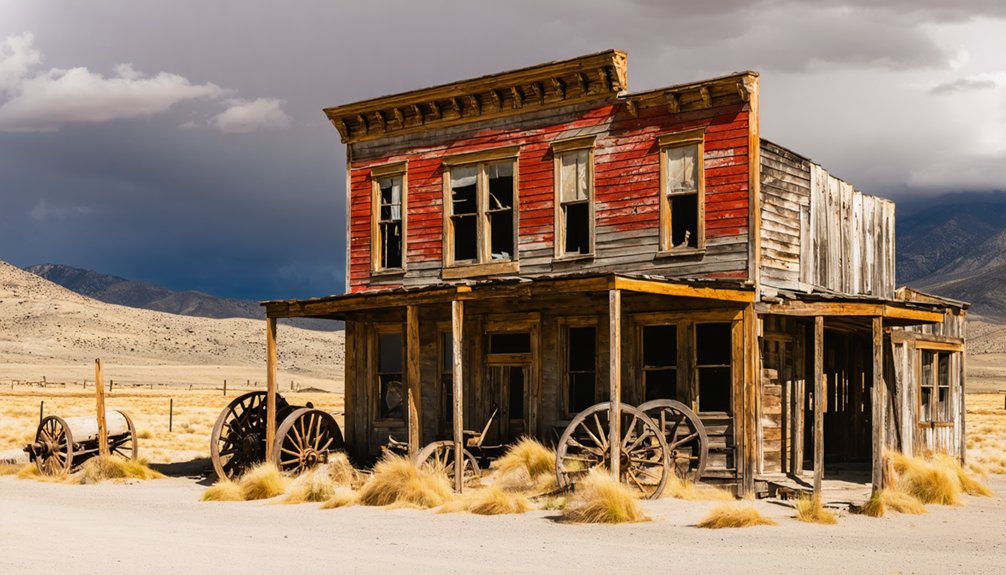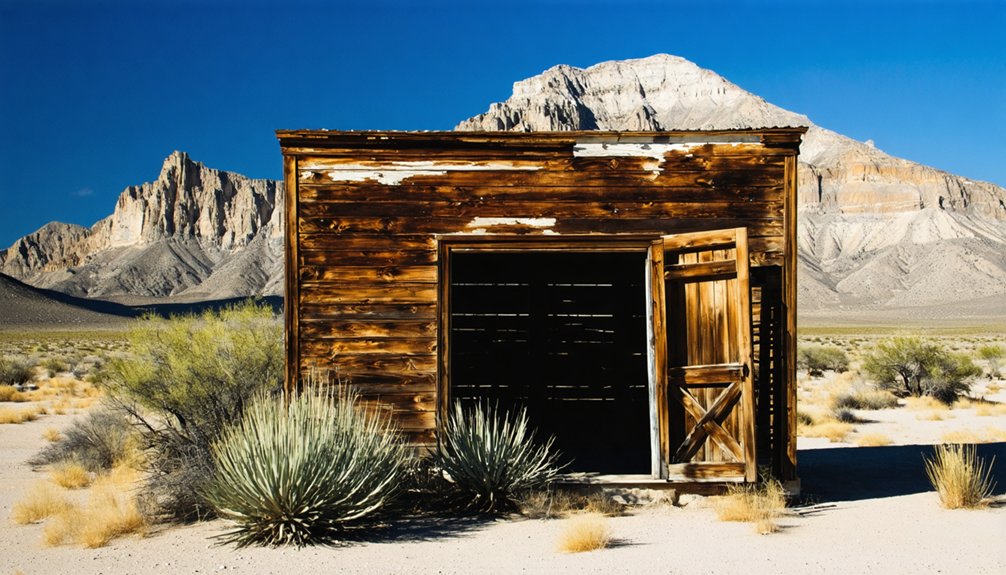
You’ll find Salt Flat approximately 90 miles east of El Paso, the closest ghost town to Guadalupe Mountains National Park, where abandoned buildings and a historic café still serve as a Greyhound stop. Lobo sits 40 miles south of Van Horn along Highway 54, offering restored structures on private property. Before visiting these remote sites, you’ll need to download offline maps, carry emergency water and supplies, respect private property boundaries, and avoid structurally unstable buildings. The article below covers essential preparation steps and photography recommendations for safely exploring these desert remnants.
Key Takeaways
- Salt Flat, a ghost town 90 miles east of El Paso, features abandoned buildings and a historic café still serving Greyhound passengers.
- Lobo sits 40 miles south of Van Horn along Highway 54, restored by Alexander Bardorff since 2001 with accessible motel and gas station structures.
- An emergency airstrip east of Guadalupe range operated continuously until early 1960s, created after a 1932 mountain plane crash.
- Visitors should download offline maps, carry emergency supplies, and respect private property boundaries when exploring remote ghost town locations.
- Schedule visits during golden hour for photography while avoiding midday heat and unstable structures for safety.
Salt Flat: The Closest Ghost Town to Guadalupe Mountains National Park
Located in northeastern Hudspeth County along U.S. Routes 62 and 180, you’ll find Salt Flat approximately 90 miles east of El Paso at 3,730 feet elevation.
Salt Flat’s history began in 1928 when entrepreneur Edwin W. Hammack capitalized on the new highway connecting El Paso to Carlsbad Caverns. He built the first store and gas station in 1929, establishing Salt Flat’s economy around serving highway travelers.
Born from highway convenience in 1928, Salt Flat emerged as entrepreneur Edwin Hammack’s vision to serve travelers journeying between El Paso and Carlsbad Caverns.
The town’s name comes from the natural salt pan beneath it—deposits Native Americans and Mexicans had harvested for centuries. The area’s salt deposits sparked the El Paso Salt War in the 1860s, resulting in multiple casualties and the reestablishment of Fort Bliss in 1860.
Population peaked at 125 residents in the early 1960s before declining sharply. By 1970, the population had significantly declined to 35. Today, it’s a ghost town with abandoned buildings, though Greyhound buses still stop at Hammack’s old café.
You’ll observe minimal habitation despite internet records suggesting 56 residents.
The Rise and Fall of Salt Flat’s Emergency Airstrip
The facility operated continuously:
- 24-hour staffing by federal aviation personnel handled emergency diversions and communications when mountain weather turned deadly.
- Strategic positioning east of the Guadalupe range provided pilots a critical alternate when fog obscured passes.
- Basic infrastructure—graded runway, lighting, highway access—kept the field perpetually ready without scheduled commercial service.
- Technological obsolescence arrived by the early 1960s as improved navigational equipment eliminated the need for ground-based emergency fields.
The airstrip’s creation followed a 1932 plane crash in the Guadalupe Mountains that prompted local government to take action.
Similar emergency fields, like Matagorda Peninsula Army Airfield in Texas, featured curved roads and dozens of buildings to support training operations before their eventual abandonment.
You’ll find minimal traces today where pilots once sought refuge from unforgiving mountain weather.
Exploring the Salt Pans and Desert Landscape Around Salt Flat
Stretching west from the ghost town, the salt pans represent one of the Chihuahuan Desert‘s most unforgiving landscapes—a broad basin where ancient Pleistocene lakes left thick evaporite deposits that still gleam white under the relentless sun.
You’ll encounter polygon-cracked crusts that transform into deep, adhesive mud after rains, capable of trapping vehicles for days.
Desert ecology shifts dramatically from barren halophyte patches at the basin center to creosote and mesquite on higher ground, then to montane forests in the nearby Guadalupe Mountains.
Seasonal runoff creates temporary pools that attract migratory birds, but don’t let that beauty fool you—extreme heat, minimal shade, and deceptive terrain make these flats genuinely dangerous.
These salt flats formed from shallow lakes created by rainwater runoff flowing down from the Guadalupe Mountains over centuries.
The evaporation of water from these ancient lakes left behind the minerals and salt that now form the distinctive white, crusty surface.
Stay on established routes, carry extra water, and respect both your limits and this fragile environment.
Lobo: A Privately Owned Ghost Town South of Van Horn
Forty miles south of Van Horn along Highway 54, Lobo stands as one of West Texas’s most accessible yet genuinely eerie ghost towns—a privately owned settlement where you can wander among weathered buildings that witnessed boom, bust, and an unlikely German revival.
Lobo history began with Van Horn Wells supplying westbound travelers, then evolved through railroad development and cotton farming before complete abandonment in 1991.
The Lobo revival attempt by German bartender Alexander Bardorff since 2001 brought new wells and restored structures. The town once hosted the Desert Dust Cinema Festival for several years, bringing cultural events to this remote location.
Key Guidelines for Visiting:
- Respect private property—Lobo remains privately owned
- Don’t disturb buildings or remove artifacts
- Watch for unstable structures damaged by 1929-1931 earthquakes
- Bring adequate water; wells serve owner’s needs only
The town’s structures include a motel and gas station that once served travelers along this remote highway corridor. You’ll experience authentic Western desolation while supporting preservation through responsible exploration.
Other Ghost Towns and Semi-Ghost Communities in the Trans-Pecos Region
Beyond the well-known abandoned settlements, you’ll find ghost towns throughout the Trans-Pecos region that exist in various states of preservation and decline.
One intriguing area to explore is the ghost towns near Congaree National Park, where history lingers in the quiet remnants of structures long forgotten. Visitors can wander through these spectral landscapes, each telling a unique story of resilience and abandonment. Wildlife thrives in these spaces, making them a captivating destination for both history enthusiasts and nature lovers alike.
Terlingua, located near Big Bend National Park, transformed from a defunct cinnabar mining operation into Texas’s most visited ghost town, where you can explore restored churches, historic cemeteries, and the old jail. The town thrived as a mining community in the early 1900s before its eventual abandonment.
The region also includes semi-ghost communities like Catarina and Toyah, where fewer than 100 residents remain among intact buildings that once served thriving populations. Toyah was established as a trading post in the early 1880s and became the oldest townsite in Reeves County.
Terlingua’s Mining Town Revival
While most ghost towns across the American West remain frozen in abandonment, Terlingua has charted a distinctive path from derelict mining camp to thriving cultural destination.
After the Chisos Mining Company’s 1942 bankruptcy triggered mass depopulation, the town’s extensive ruins—including the iconic St. Agnes Church, Perry Mansion, and cemetery—attracted heritage tourism.
In 1983, entrepreneur James Ivey purchased key structures and launched restoration efforts that transformed Terlingua history into economic opportunity.
You’ll discover how former company buildings now serve visitors as restaurants, lodging, and outfitters.
Terlingua Tourism Today:
- Starlight Theatre converted from cinema to restaurant and live music venue
- Perry Mansion restored as historic lodging overlooking town ruins
- Annual Chili Cook-off draws 10,000+ visitors each November
- Big Bend gateway positioning supports desert recreation outfitters
Marfa’s Artistic Desert Transformation
How does a declining railroad town reinvent itself as an international art destination without losing its soul?
When minimalist artist Donald Judd arrived in 1971, he transformed Marfa’s decommissioned Fort D.A. Russell into the Chinati Foundation, installing 100 aluminum boxes that harness desert light.
You’ll find this artistic transformation has reshaped the entire economy—tourism now surpasses ranching.
Yet cultural tensions simmer beneath the minimalist aesthetics. Rising property values displace multigenerational Hispanic families, while second-home ownership creates seasonal ghost-town dynamics.
Landmarks like Prada Marfa and Ballroom Marfa draw international crowds, but you’ll notice the strain: service workers face housing shortages, and vacant structures dot blocks off-season.
Marfa’s reinvention offers a cautionary tale about preserving authentic community identity amid outside investment.
Planning Your Ghost Town Visit: Access, Safety, and Photography Tips
Visiting ghost towns near Guadalupe Mountains National Park requires careful preparation, since these abandoned settlements sit in one of Texas’s most remote and unforgiving desert landscapes.
Proper ghost town access begins with understanding property boundaries—many sites rest on private land where entry without permission constitutes trespassing. Safety precautions demand respect for extreme heat, high winds, and structural instability in abandoned buildings.
Essential Planning Steps:
- Download offline maps before departure, as cell service remains unreliable across desert basins and remote highways.
- Carry emergency water, first-aid supplies, and navigation tools to counter isolation and long distances to medical facilities.
- Schedule visits during golden hour for ideal photography light while avoiding midday heat exposure.
- Respect “No Trespassing” signs and fence lines to preserve both historic sites and landowner relations.
Frequently Asked Questions
Are There Any Guided Tours Available for Ghost Towns Near Guadalupe Mountains?
Formal guided adventures focusing on nearby ghost towns aren’t readily available. You’ll find self-guided exploration at Salt Flat and roadside viewing at private Lobo, offering historical insights but requiring personal research and respectful, no-trespass practices.
Can You Camp Overnight in Salt Flat or Other Nearby Ghost Towns?
You can’t legally camp in Salt Flat or nearby ghost towns due to private property and trespassing laws. Instead, respect camping regulations by using Pine Springs Campground, which offers proper ghost town amenities and protects this fragile desert ecosystem.
What Is the Best Time of Year to Visit West Texas Ghost Towns?
Fall through early spring offers the best season for exploring West Texas ghost towns. You’ll enjoy mild weather conditions, avoid dangerous summer heat, and experience safer hiking among ruins while protecting these fragile historic sites.
Are There Any Restaurants or Gas Stations Still Operating in Salt Flat?
No, Salt Flat currently has no operating restaurants or gas stations. You’ll find the nearest local amenities in Van Horn, Whites City, or Carlsbad—plan ahead and fuel up before entering this remote region.
How Far Is the Nearest Lodging From Salt Flat Ghost Town?
The nearest lodging options are approximately 78-87 miles away in Carlsbad, New Mexico or El Paso, Texas. You’ll need to plan for 1.5-hour travel distance each way, so prepare accordingly with fuel and supplies.
References
- https://nuttyhiker.com/the-texas-ghost-town-of-lobo/
- https://en.wikipedia.org/wiki/List_of_ghost_towns_in_Texas
- https://nuttyhiker.com/ghost-town-salt-flat-texas/
- https://www.legendsofamerica.com/salt-flat-texas/
- https://klaq.com/adventurous-locals-venturing-to-salt-flats-to-see-water-wonderland/
- https://www.youtube.com/watch?v=g9kZH1UBmLM
- https://www.youtube.com/watch?v=0es4BPUPS68
- https://blog.txfb-ins.com/texas-travel/city-spotlight-salt-flat/
- https://en.wikipedia.org/wiki/Salt_Flat
- https://www.mrt.com/news/article/Danger-lurks-in-West-Texas-salt-flats-9285261.php