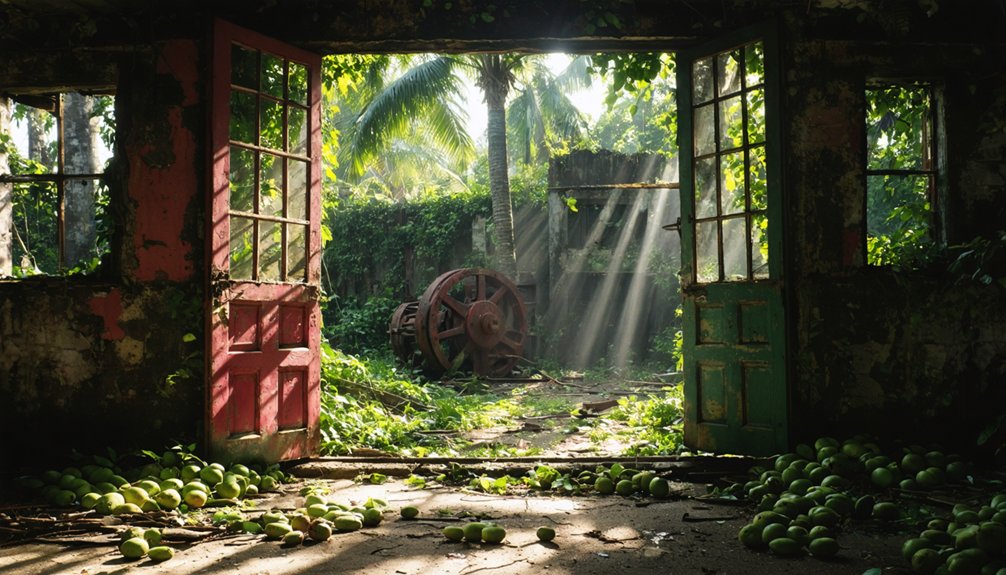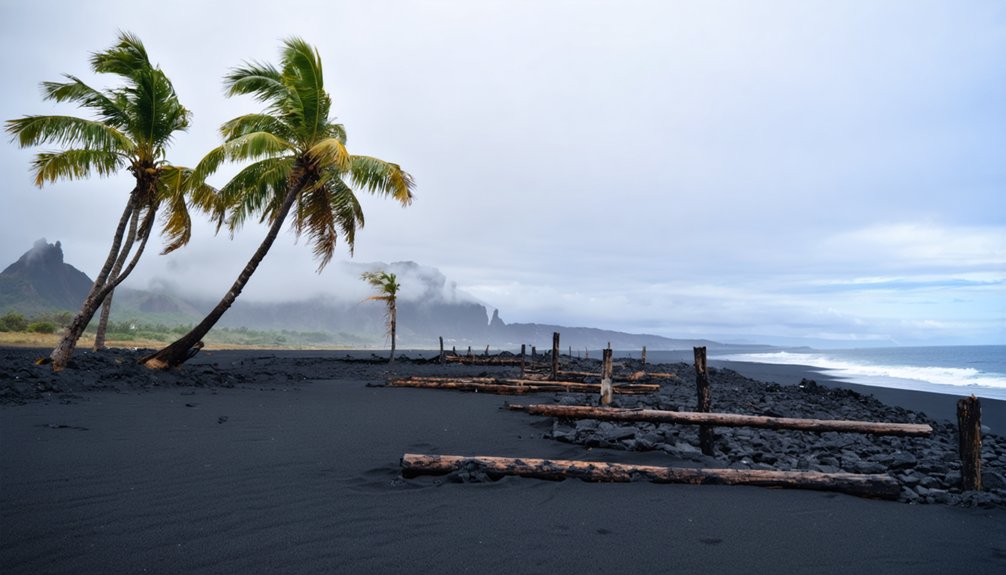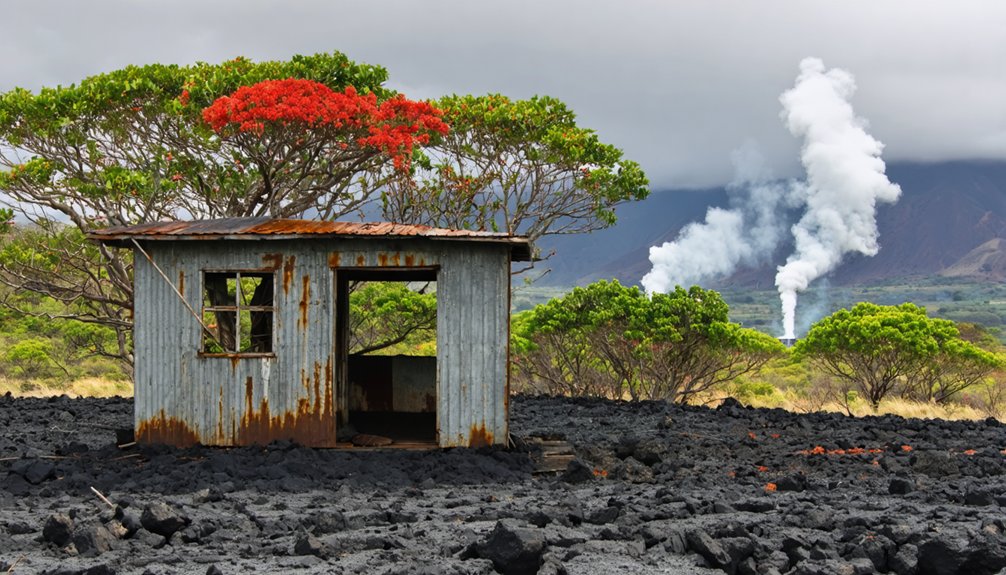
You’ll find Kalapana, Hawaii’s most haunting ghost town, just southeast of Hawaii Volcanoes National Park—a thriving community buried under 30 feet of lava during Kīlauea’s 1990 eruption. This former cultural hub lost hundreds of homes, sacred sites, and its famous black sand beach when flows advanced at 0.3 meters per second. Today, you can drive to the end of Highway 130 and walk across hardened lava fields, but stay within designated areas since new coastal benches remain dangerously unstable. The full story reveals why even a $4.6 million relocation effort couldn’t restore what nature claimed.
Key Takeaways
- Kalapana, buried by 1990 lava flows, remains the most notable ghost town near Hawaii Volcanoes National Park in Puna District.
- Access Kalapana via Highway 11 to Keaʻau, then Highway 130 south through Pāhoa to the lava flow front.
- Visitors find extensive hardened lava fields, a ghost-town atmosphere, and a new black-sand beach where lava met ocean.
- Cultural sites including Wahaula Heiau, Kaimū Beach, and Queen’s Bath were destroyed, leaving only lava-covered remnants and memories.
- Safety requires obeying posted restrictions, avoiding unstable lava benches, and staying within designated areas near flow fronts.
Kalapana: A Village Buried Under 30 Feet of Lava
Between 1990 and 1991, lava flows from Kīlauea’s Puʻu ʻŌʻō–Kupaianaha eruption systematically buried the coastal village of Kalapana under layers of molten rock that reached up to 30 feet thick in places.
The lava dynamics of this tube-fed pāhoehoe system created advance rates up to 0.3 meters per second during peak effusion, giving residents limited time to evacuate before their community disappeared.
The burial impacts were devastating: hundreds of homes, roads, and utilities vanished beneath overlapping lava lobes that built thick compound flows.
You can still witness where the shoreline extended seaward as molten rock created new coastal benches.
This transformation from residential area to rugged lava landscape serves as a stark reminder of volcanic hazards in active zones, demonstrating why understanding eruption patterns matters for your safety. Kīlauea has been active for at least 2,000 years, making it one of the most persistently active volcanoes in the world. Bruce Omori photographed molten lava crossing a road in Kalapana in 2010, documenting the area’s ongoing vulnerability to volcanic flows.
What Made Kalapana a Treasured Hawaiian Community
Kalapana wasn’t just another coastal village—it was a living repository of Native Hawaiian culture and natural wonders that had thrived for centuries.
You’d have found Kaimū’s black sand beach, considered one of Hawaii’s most stunning coastlines, alongside the sacred Queen’s Bath freshwater pool where generations of families gathered.
The community’s cultural heritage ran deep through ancient heiau sites, the Star of the Sea Painted Church, and traditional practices like distinctive lauhala mat arrangements that connected residents to their Polynesian ancestors.
Located in the Puna District on the Big Island of Hawaiʻi, this once-thriving fishing village sat at the end of Highway 130, where families built their lives around the ocean’s rhythms and the land’s volcanic energy.
Today, a determined local woman has inspired thousands of coconut trees and palms to be planted across the lava-covered landscape, breathing new life into the devastated area even as she faced a terminal illness.
Natural Beauty and Features
Before its tragic burial beneath volcanic flows, this coastal paradise drew visitors and residents alike to one of Hawaii’s most spectacular black sand beaches. Kaimu Beach combined fine volcanic sand with towering coconut palms, creating an unmatched recreational destination.
The natural landscapes included Queen’s Bath, a spring-fed pool carved into lava rock, and ancient ohia forests thriving in kipukas—isolated pockets surrounded by older lava flows.
You’ll find that ecological resilience defines this region. Former residents have planted hundreds of coconut trees along the emerging beach beyond the lava field, demonstrating nature’s remarkable recovery. The landscape encourages contemplation of the area’s history and future.
A new black-sand beach now forms where lava meets ocean, accessible via a path across the solidified flows. These natural features showcase both the destructive and creative forces that shape Hawaii’s volcanic coastline. Visitors should exercise caution and follow warning signs on the unstable terrain.
Cultural and Historical Significance
The landscape’s power to create and destroy becomes even more profound when you consider the generations of families who called this place home.
Kalapana’s cultural heritage stretched back centuries, anchored by sacred landmarks that defined Hawaiian identity.
The community’s spiritual significance included:
- Wahaula Heiau – Hawaii’s first 13th-century sacrificial temple, completely destroyed by lava
- Star of the Sea Painted Church – A resilient landmark preserving cultural memory
- Queen’s Bath – A freshwater gathering place where families shared stories
- Kaimu Bay – A stunning black sand beach recognized as wahi pana(sacred place)
Families like the Keli’iho’omalus maintained deep ancestral roots here, sustaining traditional fishing practices and Hawaiian sovereignty values.
Despite losing 180 homes, residents demonstrated remarkable resilience—no lives were lost, and the aloha spirit endured through collective support and cultural preservation efforts.
Life in Kalapana was marked by simplicity, with many homes featuring kerosene lamps and outhouses rather than modern electricity and running water.
The community maintained cultural place names even after lava flows erased previous landmarks, preserving their connection to the transformed landscape.
Life Among the Lava Fields: The Few Who Stayed Behind
While most residents accepted relocation after Kīlauea’s eruptions buried their community, a determined few chose to stay on the hardened lava fields where Kalapana once stood.
You’ll find these die-hard residents trucking in soil to fill volcanic cracks, planting coconut trees directly on lava rock, and maneuvering through rough roads chiseled over terrain sometimes buried 30 feet deep.
Their daily lives involve painful encounters with Pele’s hair—fine strands of volcanic glass that make barefoot walking impossible—and complete isolation along a rocky coastline with no safe ocean access.
The landscape preserves remnants of ancient fishponds and structures crafted from lava rock, echoing the area’s pre-historic significance.
Meanwhile, the government’s $4.6 million Kikala-Keokea development sits largely empty, with only 15 of 67 lots occupied decades after its creation for lava refugees.
Surviving on Hardened Lava
Although most residents fled when Kīlauea’s eruptions destroyed their communities, a handful of determined families chose to remain among the cooling lava fields that had consumed their former homes.
These Resilient Communities developed essential Lava Adaptation techniques for survival on newly formed volcanic terrain.
You’ll find these settlers employed creative strategies:
- Collecting rainwater from rooftops since groundwater systems were destroyed
- Building structures on elevated lava platforms to avoid toxic gas vents
- Cultivating hardy crops in pockets of ash-enriched soil between lava flows
- Establishing evacuation routes and monitoring equipment for safety
Their self-reliance demonstrates remarkable human tenacity, though modern safety experts don’t recommend inhabiting active volcanic zones.
Understanding their methods helps preserve this unique chapter of Hawaiian history while respecting nature’s unpredictable power.
Creating Homes From Nothing
When lava finally cooled after the 1990 Kalapana flows, a few determined homeowners returned to what had been their residential lots—now featureless expanses of black rock stretching from buried roads to vanished coastlines.
They navigated using old tax map keys, building custom foundations over fractured pāhoehoe and ʻaʻā lava where conventional concrete couldn’t work.
Environmental adaptation meant installing private catchment tanks, off-grid solar systems, and engineered septic solutions—no county utilities would risk infrastructure in Zone 1 hazard areas.
This community resilience wasn’t naïve optimism; builders accepted disclosure requirements and paid premium insurance rates.
For some, reconstructing atop fresh lava honors a cultural landscape that’s always renewed itself through Pele’s cycles.
You’re witnessing self-reliance tested against geological reality, where starting from nothing demands both technical ingenuity and spiritual acceptance of impermanence.
Isolation and Daily Challenges
Building a home on fresh lava represents only the first obstacle for the handful of residents who reclaimed their Kalapana lots.
Daily survival demands extraordinary community resilience amid transportation struggles and environmental hazards that test your self-reliance.
Highway 130 remains your lifeline—when earthquakes or subsidence don’t crack it.
You’ll navigate:
- Detours around 50-foot-thick lava flows that buried entire neighborhoods
- Vog exposure aggravating asthma and heart conditions downwind
- CO₂ pockets in lava depressions creating asphyxiation zones
- Heat-radiating basalt fields accelerating dehydration and material wear
Emergency services crawl through damaged roads.
Postal delivery becomes sporadic.
Your high-clearance 4×4 absorbs punishing costs crossing razor-sharp ʻaʻā flows.
Property values collapsed, mortgages vanished, insurance disappeared—yet you’ve chosen freedom over conventional security.
The Kikala-Keokea Relocation: A $4.6 Million Fresh Start
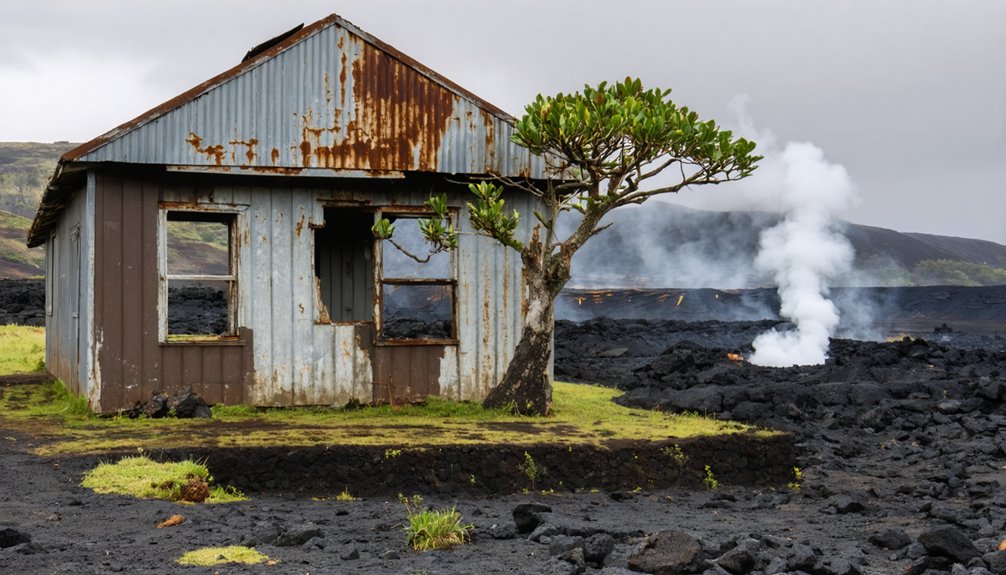
After eight years of slow-moving lava devastated Kalapana between 1983 and 1991, the Hawaii State Legislature recognized that displaced Native Hawaiian families needed more than temporary relief—they required a path to rebuild their community.
Act 314 established the Kikala-Keokea Community in 1991, creating a 67-lot subdivision adjacent to the original location. You’ll find this wasn’t just housing assistance—it preserved a unique Hawaiian lifestyle that existed for generations.
The state offered 65-year leases at $132 annually per one-acre lot, making the arrangement financially accessible.
Despite Relocation Challenges, including an 11-year gap before the first resident moved in, 48 families eventually secured leases through the Department of Land and Natural Resources.
Most settlement occurred after 2013, with younger generations now experiencing the traditional Kalapana way of life.
Why the Replacement Community Couldn’t Replace What Was Lost
The Kikala-Keokea subdivision provided land and shelter, but it couldn’t resurrect the spiritual, ecological, and social landscape that lava had consumed. You can’t rebuild ancestral connections when heiau, burial sites, and petroglyph fields lie buried under rock. The cultural disconnection ran deep:
Land can be replaced, but the sacred geography binding generations to place cannot be reconstructed from ash and memory.
- Traditional coastal fisheries and gathering grounds were obliterated
- Sacred sites linked to Pele and other deities became inaccessible
- Integrated ahupua’a resource systems—connecting mountains to sea—were severed
- Close-knit, intergenerational village networks scattered across the island
New lots couldn’t restore the place-based knowledge, daily gathering spaces, or communal rhythms that had sustained community resilience for generations.
While families showed remarkable strength in rebuilding, the replacement community represented survival—not restoration of a living cultural landscape rooted in specific, irreplaceable ground.
Visiting Kalapana Today: What to Expect and How to Get There
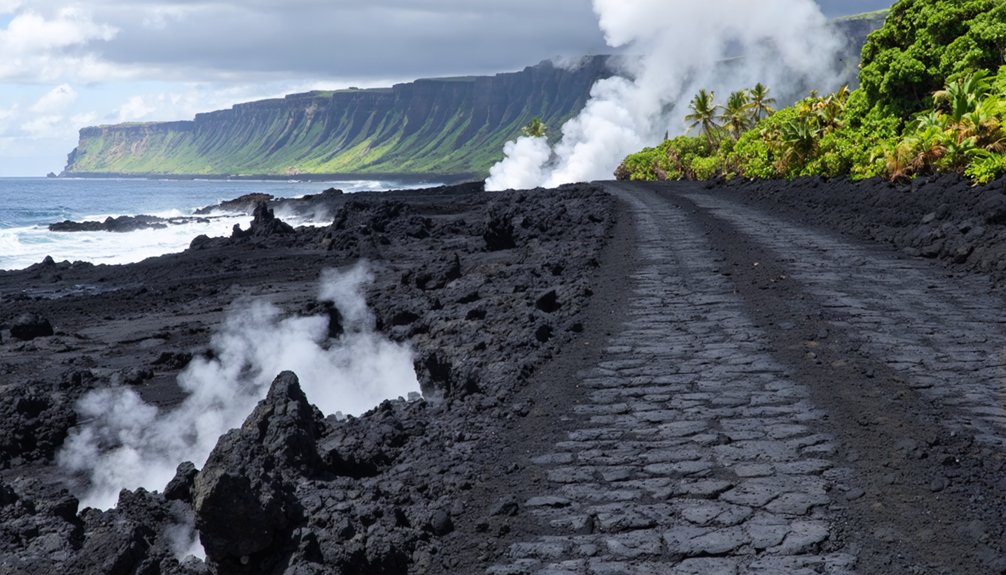
Reaching Kalapana today means driving to where the road literally ends—swallowed by the 1990 Kīlauea eruption that buried this fishing village under tens of meters of pāhoehoe lava.
From Hawaiʻi Volcanoes National Park, take Highway 11 to Keaʻau, then Highway 130 south through Pāhoa—expect 45–75 minutes depending on conditions.
Kalapana access terminates at parking near the flow front, where you’ll find a ghost-town atmosphere and extensive lava fields stretching to a reshaped coastline.
Many parts of the world hold similar eerie charm, like the underwater ghost towns in Connecticut, where remnants of abandoned communities lie submerged beneath tranquil waters. These sites tell stories of a bygone era, often revealing glimpses of structures that once held lively gatherings. Exploring these submerged towns can evoke a deep sense of history, as the water cradles both memories and mysteries waiting to be uncovered.
Laze safety demands your full attention: new lava benches remain unstable and can collapse without warning.
Obey all posted restrictions, stay within designated areas, and watch every step on uneven terrain.
Officials warn that the creative and destructive forces you’re witnessing still pose serious hazards at this evolving landscape.
Frequently Asked Questions
Are There Other Ghost Towns Near Hawaii Volcanoes National Park Besides Kalapana?
Wondering what else vanished? You’ll find Royal Gardens subdivision and Kaimū village are abandoned settlements near the park, both buried by lava flows. They hold historical significance as reminders of Kīlauea’s ongoing power and nature’s dominance.
Is It Safe to Visit Areas Affected by Active Lava Flows?
No, you shouldn’t visit active lava flow areas—they’re closed for critical reasons. Lava flow safety and volcanic hazard awareness protect your freedom to explore responsibly. Stay within designated viewing areas along the caldera rim instead.
Can You Still See Lava Flowing Into the Ocean at Kalapana?
No, you can’t see lava flowing into the ocean at Kalapana currently. Ocean entry lava viewing ended in 2018. Today’s lava activity remains confined to Kīlauea’s summit craters, far from coastal areas.
What Happened to Residents Who Lost Their Homes in the Eruption?
Displaced families faced difficult decisions after losing homes, with many receiving buyout offers or relocating permanently. You’ll find inspiring displacement stories showcasing community resilience as neighbors rebuilt lives together despite devastating losses.
How Often Does KīLauea Volcano Erupt and Threaten Nearby Communities?
Kīlauea’s eruption frequency has increased dramatically, with 39 episodes in 2025 alone. While you’ll find most activity confined to the summit, community safety requires vigilance since major eruptions have historically destroyed homes and displaced residents.
References
- https://nvtami.com/2023/04/26/big-island-hawaii-ghost-towns/
- https://volcanovillagelodge.com/halloween-in-hawaii
- https://www.civilbeat.org/2018/07/big-island-last-time-hawaii-had-lava-refugees-it-built-a-ghost-town/
- https://www.ghosttowns.com/states/hi/kalapana.html
- https://www.youtube.com/watch?v=znD_FEc60jw
- https://en.wikipedia.org/wiki/List_of_ghost_towns_in_Hawaii
- https://kids.kiddle.co/List_of_ghost_towns_in_Hawaii
- https://volcano.si.edu/volcano.cfm?vn=332010
- https://hilo.hawaii.edu/natural-hazards/offmain/2018KilaueaEruption.php
- https://wpg.forestry.oregonstate.edu/sites/default/files/seminars/pp1676_Kauahikauaetal.pdf