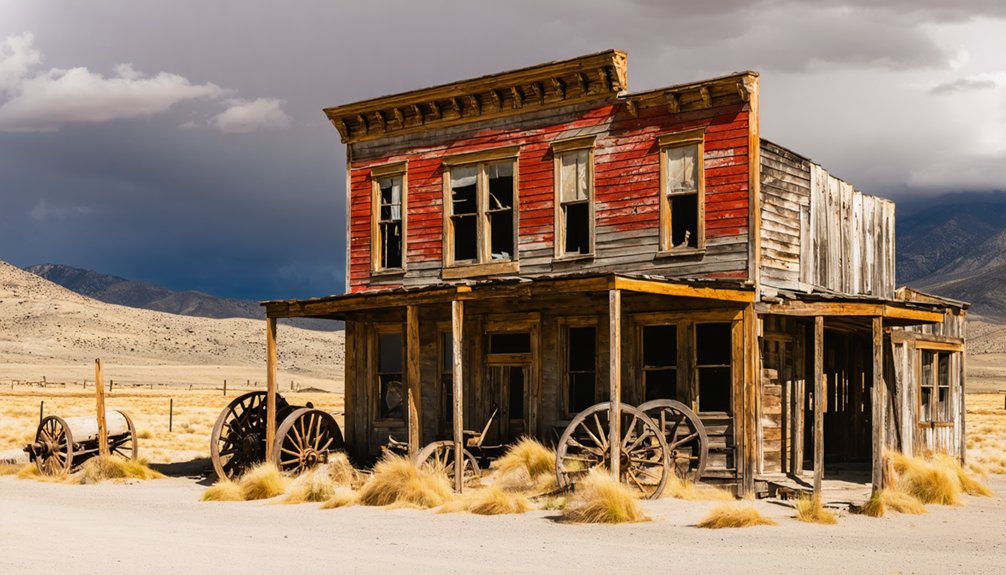
You’ll find remarkable ghost towns near hot springs throughout the Basin and Range Province, where fault lines created both mineral wealth and thermal waters. Hot Creek, Nevada—discovered by Indian Jim in 1865—once housed three hundred miners near natural springs before earthquakes and fires emptied it by 1870. Agua Caliente’s thermal resort thrived until postwar groundwater pumping collapsed the aquifer by the late 1940s. Warm Springs, Nevada still features concrete soaking pools among motel ruins. These sites reveal how geology, Indigenous heritage, and boom-bust cycles shaped abandoned landscapes that warrant careful exploration today.
Key Takeaways
- Hot Creek Range, Nevada became a ghost town after an 1865 silver boom, earthquake, and fires ended mining by 1870.
- Agua Caliente’s resort community collapsed when postwar groundwater pumping depleted aquifers, drying the hot spring by late 1940s.
- Warm Springs, Nevada features abandoned concrete soaking pools and motel ruins accessible to cautious explorers today.
- Basin and Range fault lines created both mineral-rich hydrothermal veins and hot springs that attracted miners and settlers.
- Jacumba Hot Springs and other sites blend Indigenous sacred thermal waters with commercial bathhouse ruins from railroad expansion.
Where Desert Springs and Mining Camps Meet: A Geological Foundation
Fault lines threading through the Basin and Range Province write a double narrative across the desert Southwest—one of heat rising from fractured crust, the other of metals dissolved and deposited in those same fissures.
You’ll find ghost towns clustered where these stories converge: normal faults that channeled ore-bearing hydrothermal veins to shallow depths also guide deep groundwater upward, creating hot springs a few miles away.
Crustal thinning during regional extension elevated geothermal gradients, shortening circulation loops and concentrating thermal discharge near fault intersections.
The same fracture permeability that sustained mines kept springs flowing long after the camps died.
Walk between a collapsed headframe and a travertine-rimmed pool, and you’re tracing a single plumbing system—different outputs, identical architecture. These geological processes unfolded across a landscape where erosion continues to reshape canyon walls and expose deeper mineral-bearing layers, just as it does at sites like the Grand Canyon today. Jerome’s story exemplifies this pattern, where submarine volcanic sequences from the early Proterozoic laid the foundation for one of Arizona’s most productive copper districts.
From Indigenous Healing Waters to Victorian Health Resorts
Long before Anglo developers hung “Health Resort” shingles above travertine terraces, Indigenous communities across the Desert Southwest treated hot springs as liturgical and therapeutic sites in equal measure.
At Pagosa Springs, Ute bands claimed waters they named for healing; at Agua Caliente, Cahuilla irrigators drew on thermal sources for both survival and ceremony.
Thermal waters served dual purpose for Indigenous peoples—practical resource for agriculture and survival, sacred space for ceremonial healing traditions.
Spanish missions redirected these landscapes through Cultural Syncretism—Chimayo’s Tewa earth-shrine became El Santuario by 1816, blending Indigenous Healing Practices with Catholic pilgrimage.
By the 1880s, railroads transformed sacred geographies into commercial bathhouses: Indian Hot Springs added sixty cottage-tents by 1899, marketing mineral cures for rheumatism while erasing tribal stewardship.
You’re witnessing sovereignty repackaged as wellness tourism, ancestral knowledge commodified into Victorian balneology.
Boom, Bust, and the Sound of Welsh Songs at Hot Creek
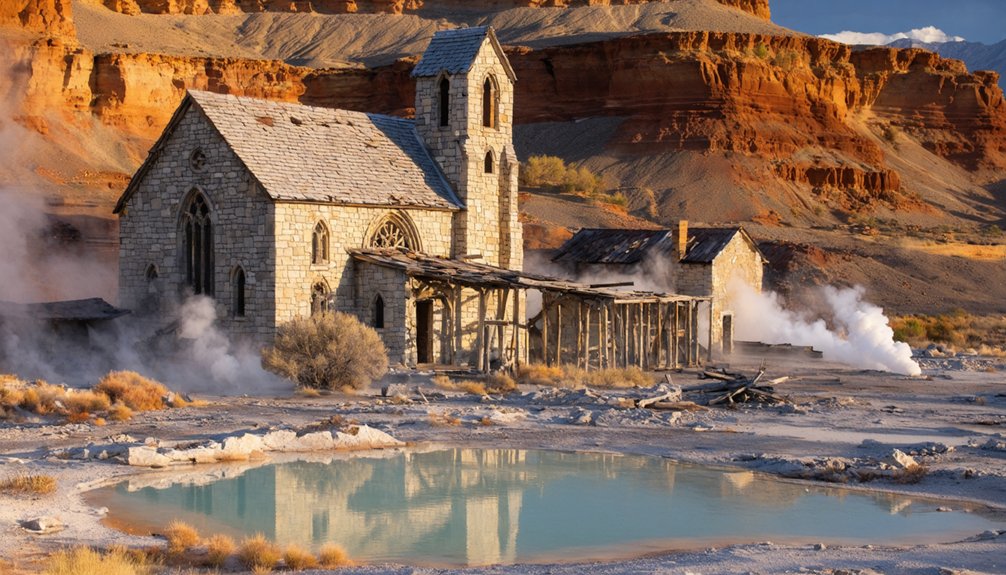
When Indian Jim struck silver in the Hot Creek Range in 1865, he set in motion a three-year frenzy that would populate a desert canyon, incinerate two mills, and leave behind a soundscape of Welsh hymns echoing against travertine.
By 1867, three hundred residents crowded Upper and Lower Hot Creek, served by stamp mills processing promising ore.
Then calamity struck: an 1868 earthquake rattled infrastructure, fire consumed the 20-stamp Dominion mill in February, and the lower mill burned that April.
The 1870 census counted just forty souls.
The pattern mirrored Bodie’s own decline, where devastating fire in 1912 accelerated the abandonment already underway from exhausted gold deposits.
Meanwhile, Welsh miners at Mountain View descended steep trails each Saturday to bathe in Hot Creek’s springs, their songs reverberating through the canyon—a remarkable blend of mining history and cultural heritage that defined this ghost town’s brief, vivid life.
The Hot Creek Range, a volcanic mountain range extending 43 miles, derives its name from these warm springs that had long been significant gathering places for Native American activities.
When the Water Ran Dry: Overuse and Abandonment in Agua Caliente
For centuries the hot mineral spring at Agua Caliente flowed dependably from a shallow aquifer beneath the Gila Bend Mountains, sustaining Indigenous communities, Spanish missionaries who visited in 1748 and 1750, and eventually a 22-room adobe health resort that operated from about 1897 into the 1950s.
Then postwar cotton and alfalfa farmers in neighboring Hyder and Sentinel valleys drilled deep wells, extracting groundwater faster than recharge could replenish it. Without effective aquifer management, cumulative pumping reversed the pressure gradient that had pushed hot water to the surface.
When wells pump faster than aquifers can refill, pressure gradients collapse and century-old springs vanish forever.
By the late 1940s the spring ran dry—bathing pools emptied, guests stopped coming, and the resort economy collapsed.
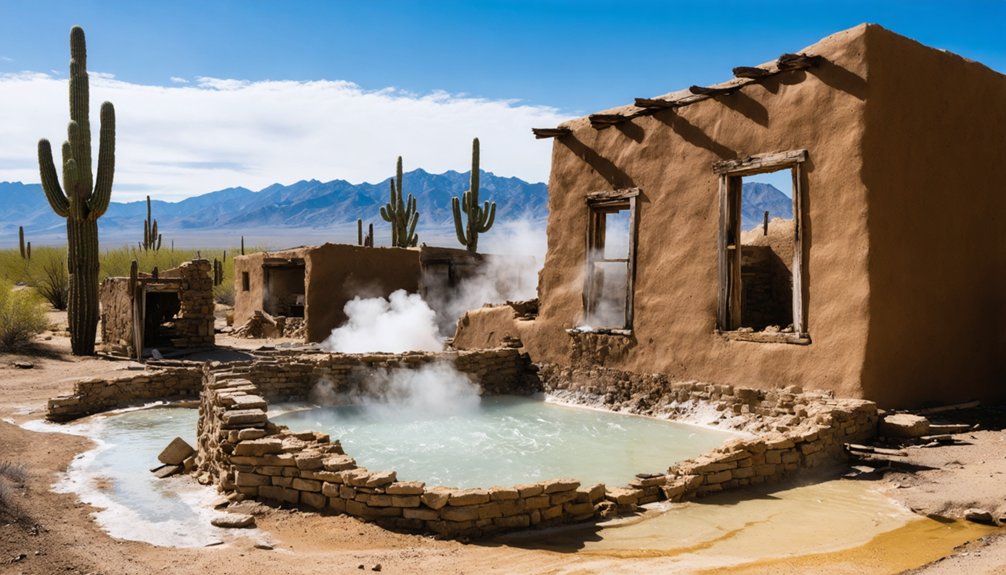
Today stone walls and adobe ruins mark a landscape where absence speaks louder than historical significance: groundwater once taken for granted, now gone. The pioneer cemetery nearby contains many unmarked graves, a silent testament to the forgotten souls who once sought healing in these therapeutic waters. The spa building itself still stands with no trespassing warnings posted, guarded by a large satellite antenna that marks its current occupation.
Exploring What Remains: Visiting Desert Ghost Towns and Thermal Springs Today
Across the arid Southwest, ghost towns that once thrived around hot springs now offer visitors a stark tableau of abandonment shaped by geology, economics, and time.
Warm Springs, Nevada—little more than a phone box and streetlight at the junction of US 6 and NV‑375—preserves concrete soaking pools and motel ruins built directly over geothermal vents that once sustained a stagecoach stop dating to 1866.
Ghost town exploration here demands caution: deteriorating structures, broken glass, and unstable foundations mark these remote sites.
Thermal spring safety remains paramount, as unmaintained pools present scalding, slip, and water‑quality hazards. You’ll find no services, no rescue infrastructure.
Desert conditions require route planning, communication gear, and ample water.
Jacumba Hot Springs near California’s Mexican border retains 104°F springs alongside aging hotel shells, while Colorado’s Dunton Hot Springs operates as a reservation‑only luxury resort within restored 1880s mining buildings. Arizona’s Agua Caliente, located about 120 miles southwest of Phoenix, was built around natural hot springs that attracted travelers since the 1860s and featured a 22-room resort constructed in 1897 with a swimming pool fed by the thermal waters. New Mexico’s Engle, situated 17 miles east of Truth or Consequences, was founded in 1879 as a railroad stop and crucial shipping point for miners.
Frequently Asked Questions
Are Any Desert Hot Springs Near Ghost Towns Still Safe to Bathe In?
Most desert hot springs near ghost towns carry safety concerns—water quality, pathogens, and heavy metals aren’t routinely tested. You’ll find no certified bathing at Agua Caliente, Arizona; check current land-management agencies before soaking anywhere unregulated.
What Wildlife Can Be Encountered When Visiting Remote Desert Ghost-Town Sites?
You’ll encounter mule deer, gray foxes, kit foxes, and coatis near ghost towns, offering exceptional wildlife photography opportunities. Understanding desert ecology helps you identify Gila monsters, desert tortoises, and scorpions while exploring these remote, unrestricted historical sites.
Do I Need Special Permits to Explore Ghost Towns on Federal Land?
Exploration regulations on federal land aren’t just red tape—they’re survival guides you’ll actually want. Casual sightseeing? You’re usually free. Metal detecting, digging, entering structures? You’ll need permits. BLM and Forest Service rules vary wildly by location.
Which Ghost Town Offers the Best-Preserved Victorian-Era Resort Architecture?
White Oaks, New Mexico offers you the best-preserved Victorian architecture among Desert Southwest ghost towns, featuring the 1893 Hoyle Mansion and Gumm House. Historic preservation efforts maintain authentic facades you’ll find nowhere else in the region.
Can I Camp Overnight Near Hot Springs at These Historic Sites?
Camping regulations typically prohibit overnight stays within 100–200 yards of hot springs and historic structures to protect water quality and historic preservation. You’ll find dispersed camping allowed on nearby BLM land, respecting posted setbacks and private boundaries.
References
- https://www.visitarizona.com/like-a-local/4-arizona-ghost-towns-you-may-have-never-heard-of
- https://www.desertusa.com/desert-nevada/nevada-ghost-towns1.html
- https://www.newmexico.org/places-to-visit/ghost-towns/
- https://www.visittheusa.com/experience/6-nevada-ghost-towns-explore-if-you-dare
- https://www.hipcamp.com/journal/camping/arizona-ghost-towns/
- https://www.youtube.com/watch?v=7Yvhng2y6Gs
- https://nvtami.com/2021/12/27/mountain-view-nevada-ghost-town/
- https://neon.reviewjournal.com/travel/exploring-ghost-towns-of-the-southwest/
- https://travelnevada.com/ghost-town/
- https://www.nathab.com/blog/geology-of-the-american-southwest