New England’s ghost towns cluster nowhere near the thermal springs that anchor wellness tourism in other regions, forcing you to pair ruined cellar holes and abandoned mill villages with modern hot tub resorts separated by 20 to 50 miles of forest roads and coastal highways. Sites like Dogtown’s 17th-century foundations sit three miles from Cape Ann’s oceanfront Jacuzzis, while Livermore’s logging ruins require an hour’s drive to North Conway spa hotels. The itinerary structure below connects these haunted landscapes with their nearest thermal-amenity lodging.
Key Takeaways
- New England lacks natural hot springs but marketed elevation, seaside air, and forest scenery as therapeutic alternatives in grand resort hotels.
- Dogtown, a 17th-century ghost town abandoned by 1830, pairs haunted trails with nearby Cape Ann oceanfront hot tubs for wellness.
- The Southern New England Sampler connects Gay City, Hanton City, and Dogtown ruins with Hartford and Providence spa facilities.
- White Mountains ghost resorts like Crawford House collapsed after 1910, creating a haunted wellness corridor amid forested settlements.
- Multi-day itineraries combine half-day ghost town exploration with evening hydrotherapy at thermal-amenity lodging, best accessed May through October.
Understanding New England’s Unique Ghost Town and Spa Landscape
When nineteenth-century Americans sought therapeutic waters and mountain air, New England’s resort developers faced a dilemma: the region lacked the dramatic hot springs that anchored spa towns across New York’s Saratoga and Virginia’s Allegheny valleys.
Instead, operators marketed elevation, “pure” seaside breezes, and forest scenery as restorative substitutes. Grand White Mountain hotels and Connecticut coastal retreats built wellness history around non-thermal amenities—walking paths, indoor pools, mineral springs without sulfur heat. Properties like Water’s Edge in Westbrook transformed from 1920s summer estates into full-service health resorts, capitalizing on Long Island Sound’s perceived therapeutic benefits.
New England’s therapeutic resorts transformed ordinary elevation and coastal air into marketable cure, bypassing the thermal springs that defined competitors southward.
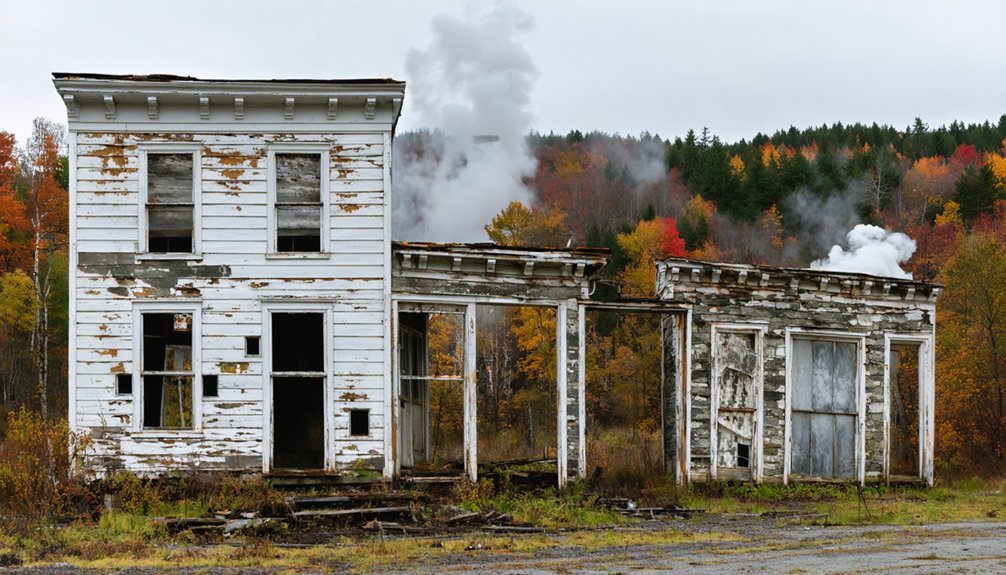
Between 1885 and 1910, the White Mountains hosted a greater concentration of grand resort hotels than anywhere else in America, with properties like Crawford House and Profile House accommodating up to 400 guests. As car tourism replaced rail-dependent long stays, many remote health resorts collapsed into abandonment. Today you’ll find forested ghost settlements like Dudleytown occupying the same terrain once promoted for healthful isolation.
This convergence of derelict villages and spa landscapes weaves ghost folklore directly into New England’s therapeutic geography, creating a uniquely haunted wellness corridor.
Perkins Township and Swan Island: Kennebec River Ruins Meet Mid-Coast Wellness Retreats
Though mid-coast Maine’s wellness seekers today gravitate toward Bath’s boutique spas and Boothbay Harbor’s seaside yoga retreats, the Kennebec River’s most complete ghost settlement lies just upstream in waters few tourists navigate.
Swan Island preserves Perkins Township, incorporated 1847 and abandoned by the 1940s after shad fishing, ice harvesting, and shipbuilding collapsed. You’ll find five historic houses—including a 1763 saltbox—plus twenty cellar holes documenting a vanished community of nearly 100 residents.
Maine disincorporated the township in 1918 when too few voters remained, then claimed tax-delinquent parcels and designated the island a game preserve in 1929. The island’s prominence traces back to the 17th century when the Kennebec tribe of the Abenaki and European-American settlers first recognized its strategic river position.
Today’s state-managed wildlife refuge offers kayakers and history seekers rare access to Federal-period architecture and riverside ruins upstream from commercial wellness destinations. The Steve Powell Wildlife Management Area, comprising Swan Island’s 1,755 acres of islands and tidal flats, operates without regular dedicated state funding despite $80,000 in annual costs.
Livermore’s Logging Legacy in New Hampshire’s White Mountains Resort Zone
Today’s White Mountains resort economy—ski lodges near North Conway, hiking outfitters along the Kancamagus, and wellness retreats throughout Waterville Valley—obscures the region’s industrial past, but Livermore’s ruins preserve New Hampshire’s most complete company logging town sixteen miles west of the resort hub.
Founded in 1876 as a Saunders family timber operation, the township housed 150–200 workers who harvested spruce and fir for Massachusetts mills. The Sawyer River Railroad (1874–1927) connected remote cutting zones to coastal markets, and its stone abutments still mark hiking trails through White Mountain National Forest.
Charter revocation in 1951 formalized Livermore’s shift from Logging Heritage site to outdoor recreation corridor.
Industrial Archaeology along Sawyer River Road—mill foundations, railroad grades, company housing ruins—reveals how extractive capital shaped terrain now marketed for wilderness escape. The Saunders brothers’ selective cutting method preserved the forest ecosystem and prevented major fires, distinguishing their operation from competitors who practiced destructive clear cutting. Between 1911 and 1919, the Livermore Tripoli Company operated a diatomaceous earth mine at East Pond, dredging silica deposits through 4-inch pipes to a processing mill that dried and separated sediment for use in silver polish and paper manufacturing.
Monson Center: Colonial Foundations Near Southern New Hampshire Spa Hotels
While contemporary spa seekers navigate Route 101’s corridor between Nashua wellness centers and Highland Lake resorts, few recognize that Monson Center—New Hampshire’s first inland colony—lies abandoned in the woodlands bisecting Hollis, Brookline, Amherst, and Milford.
Settled in the 1730s and incorporated in 1746, this Colonial Heritage site reveals how governance failures doom communities. Residents couldn’t agree on a meeting house location, ultimately requesting their charter’s repeal before the American Revolution.
By the 1770s, farmers relocated to neighboring Hollis and Milford, leaving only stone walls and cellar holes scattered through forests. A short 0.2-mile walk from Federal Hill Road brings visitors to stone-wall lined lanes and at least 6 cellar holes marked with historical signs detailing the families who once lived there. The Society for Protection of New Hampshire Forests now preserves this archaeological treasure.
You’ll find the restored 1756 Gould House—the settlement’s sole surviving structure—operating as a museum, with marked trails leading to homestead foundations where Monson Center’s brief colonial experiment ended. While Hollis prospered with 90 structures recognized by the National Register of Historic Places, Monson never built the meeting house or school that might have sustained it.
Dogtown’s Haunted Trails and Cape Ann’s Coastal Hot Tub Resorts
You’ll find Dogtown’s 5 square miles of abandoned cellar holes and glacial boulders about 30 miles north of Boston, where tales of “Queen of the Witches” Thomazine Younger and the settlement’s 1800s decline into poverty have shaped its ghost-town reputation.
Cape Ann’s coastal communities—Gloucester, Rockport, and Annisquam—now offer spa hotels and oceanfront resorts with hot tubs within a 15-minute drive of Dogtown’s numbered ruins and wooded trails.
This proximity lets you combine morning hikes through marked cellar sites and Babson Boulder inscriptions with afternoon hydrotherapy sessions overlooking the Atlantic.
The settlement was initially named Common Settlement before later becoming known as Dogtown.
Before English settlers arrived in the 1650s, Algonquian peoples used Dogtown as a hunting ground for deer, muskrat, and beaver while maintaining their main village in nearby Riverview.
Dogtown’s Folklore and Ruins
Nestled across approximately 5 square miles of interior Cape Ann, the former Common Settlement that became Dogtown stands as one of coastal Massachusetts’ most storied ghost towns. Founded in the 17th century and abandoned by 1830, you’ll find numbered cellar holes marking where 80 families once prospered.
Dogtown legends center on Thomasine “Tammy” Younger, the “Queen of the Witches,” who allegedly extorted travelers for safe passage. Widows, vagrants, and freedmen occupied decaying structures through the settlement’s final years, fueling tales of curses and apparitions.
Today’s Dogtown exploration reveals glacial boulders, overgrown road traces, and Depression-era “Babson boulders” carved with inspirational phrases. The forest-reclaimed ruins continue attracting hikers seeking both documented history and supernatural lore along trails threading through Massachusetts’ most atmospheric haunted landscape.
Cape Ann Spa Offerings
Though Dogtown’s abandoned cellar holes and witch-cursed pathways attract paranormal enthusiasts year-round, Cape Ann’s sole contemporary hot tub facility operates 25 miles southeast at the Hotel at Cape Ann Marina in Gloucester.
You’ll find the resort’s Jacuzzi and heated pool within a 6,000-square-foot enclosed atrium called the Aqua Room, accessible year-round through second-floor passages from guest lodging.
The facility doesn’t offer traditional spa amenities like massage treatments or wellness services—instead, you’re limited to basic hot tub access with food delivery from the adjacent Mile Marker One restaurant.
While the marina-view setting provides modern comfort, it’s significantly disconnected from Dogtown’s historic bathing culture, functioning primarily as a hotel amenity rather than a destination thermal springs experience.
Pairing Trails With Wellness
After traversing Dogtown’s haunted trails—where granite boulders inscribed with Depression-era aphorisms rise from overgrown cellar holes and fog-shrouded paths wind through 3,600 acres of abandoned settlement—you’ll find Cape Ann’s modern wellness infrastructure concentrated along the coastal perimeter, twenty-five miles removed from the inland commons’ eerie solitude.
This geographic pairing creates a deliberate contrast: Dogtown’s haunted history of witches, Revolutionary-era abandonment, and lonely dogs grounds you in mortality and reflection, while oceanfront hot tubs at Rockport and Gloucester properties offer immediate physical restoration.
The wellness philosophy emerges from juxtaposition—hiking ten miles through “Blair Witch” atmosphere, reading Babson’s carved admonitions (“Courage,” “Never Try Never Win”), then soaking in heated saltwater overlooks transforms dark introspection into embodied recovery, merging New England’s ghost-town past with contemporary thermal therapy.
Whitewash Village: Cape Cod’s Vanished Fishing Settlement and Beachside Spa Getaways
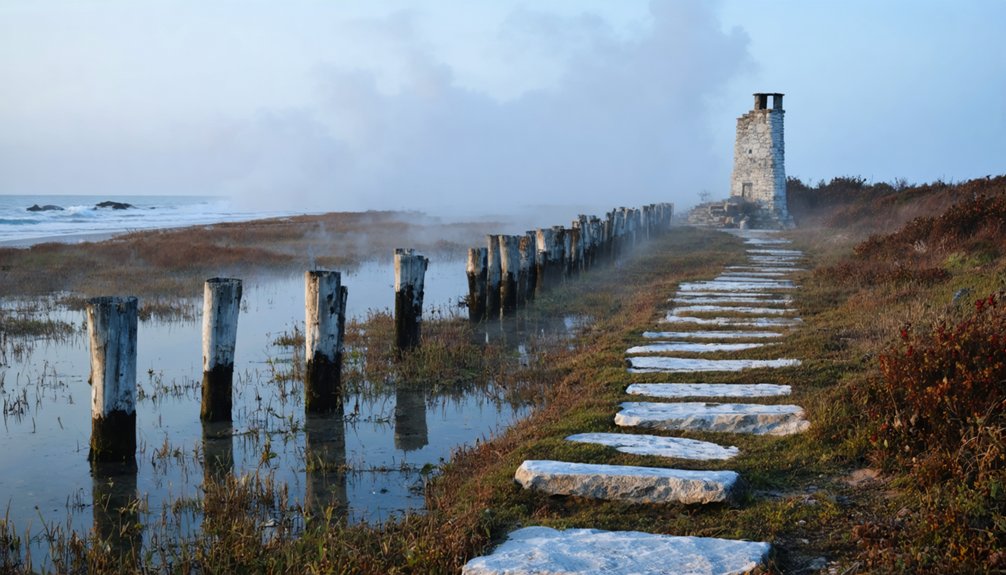
On the windswept shores of South Monomoy Island, Whitewash Village emerged as a thriving fishing settlement clustered around the natural deep-water harbor known as Powder Hole.
By the mid-1800s, 150–200 residents dried cod and mackerel for Boston markets while lobster sold for two cents apiece. The village’s distinctive whitewashed houses guided mariners past treacherous shoals, and Monomoy Point Light stood watch from 1823.
At its peak, Whitewash Village housed up to 200 fishermen who relied on Powder Hole’s protected waters and the guiding beacon of Monomoy Point Light.
Around 1860, a devastating storm reshaped the inlet and destroyed Powder Hole’s sheltered anchorage. Without harbor access, the fishing fleet collapsed and families abandoned their homes.
Today, you’ll find this fishing heritage preserved only in archives—the settlement itself erased by relentless sand and surf. Modern Cape Cod’s beachside spas now occupy the region where Whitewash Village once prospered.
Hanton City: Rhode Island’s “Lost City” and Providence-Area Hydrotherapy Options
Deep in the forests of Smithfield, Rhode Island, twelve miles northwest of Providence, stone foundations and cellar holes mark where Hanton City thrived as a modest colonial settlement before vanishing from official maps by the 1850s.
You’ll find tanners and bootmakers once populated this 1730s community, linked to English families like the Paines and Hantons who received land grants after King Philip’s War.
Economic decline and rerouted trade paths drove residents away, leaving behind stone walls and a small cemetery where Alice Herrington’s grave still stands.
The 1880s Providence Journal dubbed it “Haunted City,” spawning theories about Loyalist refugees and asylum escapees—though colonial history reveals ordinary poverty, not scandal, ended this isolated woodland enclave you can explore via Hanton City Trail today.
Planning Your New England Ghost Town and Hot Water Retreat Itinerary
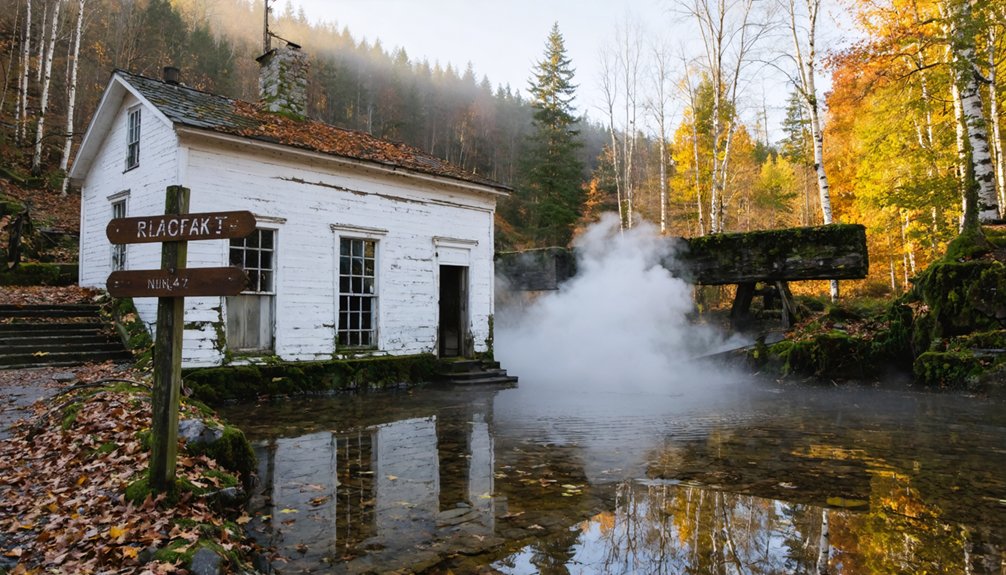
You’ll need to construct a hybrid itinerary that separates ghost town exploration from wellness destinations, as New England’s abandoned settlements don’t coincide with natural hot springs.
Plan visits to sites like Dogtown or Hanton City during spring or fall when forest access is ideal, then travel to established spa resorts in the Berkshires or coastal Maine for hydrotherapy experiences.
A multi-day route might anchor around a central resort—such as those near North Conway, New Hampshire, or the Litchfield Hills in Connecticut—with day trips radiating outward to documented ruins within a 60-90 minute drive.
Pairing Ruins With Resorts
Planning a combined ghost town and hot spring itinerary in New England presents an immediate challenge: the region’s abandoned settlements and thermal resort destinations developed along entirely separate trajectories and rarely share geographic proximity.
You’ll need to construct a two-track journey, visiting ghost town preservation sites like Dogtown’s accessible foundations or Norton Furnace’s industrial remnants, then traveling significant distances to thermal facilities.
The historical record shows these locations served different populations—mill workers versus wealthy vacationers—with distinct spa history emerging in established resort communities rather than declining industrial centers.
Your itinerary requires accepting this geographic reality: you’re exploring two separate chapters of New England’s past, not integrated destinations.
Plan multi-day circuits connecting clusters of ghost towns, then relocating to spa regions entirely.
Seasonal Timing and Access
Because New England’s ghost towns developed primarily in forested valleys and upland clearings, access windows follow the region’s pronounced seasonal rhythm rather than year-round availability.
You’ll find the most reliable access routes from late May through October, when dirt roads are graded and trails are snow-free. High-elevation sites like Livermore remain largely inaccessible November through April due to snowpack and seasonal road closures, while mud season (late March–late April) renders unpaved routes impassable.
Seasonal challenges include black fly swarms in May–June, thunderstorms causing rapid stream rises near mill ruins, and hunting season overlap during peak foliage.
State parks operating ghost town trailheads typically run full services Memorial Day through Columbus Day.
Winter visits demand backcountry skills, navigation gear, and awareness of hidden cellar holes beneath snow.
Multi-Day Route Suggestions
When you link multiple ghost-town sites with thermal-amenity lodging across New England, the resulting itinerary structure differs markedly from conventional historical tourism—instead of rushing through one ruin per day, you’ll adopt a rhythm of half-day exploration followed by evening hydrotherapy recovery.
Southern New England 3–4 day sampler:
- Day 1: Gay City State Park foundations (Hebron, CT), then Hartford-area spa relaxation
- Day 2: Hanton City stone ruins (Smithfield, RI), overnight Providence hydrotherapy
- Day 3: Dogtown cellar holes (Gloucester, MA), Cape Ann oceanview hot tub
Vermont–New Hampshire 4–5 day mountain circuit pairs Ricker Basin mill ruins and West Castleton quarry remnants with Waterbury lodge pools, then crosses to White Mountains logging ghost town exploration—Livermore, Johnson—anchored by resort-town jacuzzis.
Driving legs average 1.5–3 hours, balancing archival fieldwork with thermal recovery.
Frequently Asked Questions
Are Any New England Ghost Towns Actually Haunted by Documented Paranormal Activity?
You’ll find New England ghost towns rely on haunted legends and anecdotal reports rather than verifiable evidence. Paranormal investigations remain sparse at these sites, with documented activity concentrated instead at occupied historic buildings, not abandoned settlements.
What Permits or Permissions Are Required to Explore Ghost Town Sites?
You’ll need landowner permission before exploring most ghost towns, as they’re typically on private property. Follow exploration guidelines respecting historical preservation laws, and consult local historical societies for site-specific access requirements and archaeological protection regulations.
Can You Camp Overnight Near These Ghost Town Locations?
Overnight camping near most New England ghost towns is prohibited or restricted to designated sites only. You’ll face strict camping regulations on conservation land, and overnight safety concerns drive no-trespassing enforcement at popular ruins.
Which Ghost Towns Are Wheelchair Accessible or Family-Friendly for Young Children?
You’ll find wheelchair access and family activities at Feltville’s paved roads and accessible buildings. Flagstaff Lake’s shoreline viewpoints and Freeman Township’s driving tours also work well for children, though terrain varies considerably elsewhere.
What’s the Best Season to Visit Both Ghost Towns and Spas?
You’ll find ideal conditions in early fall when best weather—crisp 55–70°F temperatures—aligns with peak foliage and seasonal attractions. Late spring offers budget-friendly alternatives, though black flies may test your pioneer spirit near wetland ghost-town sites.
References
- https://newenglandhistoricalsociety.com/six-new-england-ghost-towns/
- https://wokq.com/ghost-town-of-livermore-new-hampshires-smallest-town/
- https://thefrogandpenguinn.blogspot.com/2021/07/a-nh-ghost-town.html
- https://stephentravels.com/top5/ghost-towns/
- https://www.youtube.com/watch?v=jPneYGJR4-o
- https://www.youtube.com/watch?v=T4yhm_S-dHc
- https://www.onlyinyourstate.com/experiences/maine/abandoned-swan-island-me
- https://www.cbsnews.com/boston/news/the-best-ghost-towns-in-the-western-us/
- https://www.historichotels.org/us/hotels-resorts/waters-edge-resort-and-spa/history.php
- https://enchantednewengland.com/stories-all/2018/10/the-stories-of-5-haunted-new-england.html