You’ll find ghost towns clustered along Pennsylvania’s mineral springs corridor from Bedford to Cambridge Springs, where railroad expansion transformed Native American healing grounds into fashionable nineteenth-century resorts. Sharon Springs and Lebanon Springs in New York exemplify this pattern—once-thriving chalybeate spas that declined after penicillin’s discovery and highway bypasses emptied grand hotels. Cold Spring and Rausch Gap became railroad depot ghosts when transportation routes shifted and mining resources depleted. The architecture, foundations, and interpretive markers that remain reveal how therapeutic landscapes rose and fell with America’s shifting medical beliefs and transportation networks.
Key Takeaways
- Sharon Springs, New York declined from a fashionable chalybeate spa to ghost-town status after penicillin’s discovery and highway bypass.
- Lebanon Springs and Cambridge Springs experienced population collapse when medical skepticism and Pure Food regulations undermined mineral water health claims.
- Railroad depot ghost clusters emerged where defunct rail lines once connected mineral springs to health-seekers throughout Pennsylvania and New York.
- Bedford Springs Resort, hosting seven presidents, exemplifies Pennsylvania’s mineral springs belt evolution from Native American healing grounds to abandoned settlements.
- Cold Spring and Rausch Gap became ghost towns after fires and resource depletion ended their railroad-dependent mineral tourism economies.
When Mineral Waters Built Communities: The Rise of Northeast Spring Resorts
Long before the wellness industry commodified self-care, mineral springs built entire economies across the Northeast.
You’ll find the earliest documented sites at Bristol, Pennsylvania in 1700 and Yellow Springs, Chester County by 1722. These weren’t just watering holes—they sparked genuine community growth.
When David Eldredge opened Sharon Springs’ first boarding house in 1825, he triggered a development boom. The Utica and Schenectady railroads’ 1836 completion changed everything, bringing spring healing seekers by the thousands. Visitors traveled by stagecoach from nearby stations, including Palatine Bridge, to reach the emerging resort town.
Between 1836 and 1860, grand hotels with marble porticos and fluted columns rose across New York, New Jersey, and Pennsylvania. By the 1920s, Sharon Springs alone drew peak crowds to its five distinct mineral waters, while Maine’s Summit Spring pulled New York and Boston’s elite northward. These wellness destinations thrived through the post-Civil War era, when Americans regularly visited mineral water sources seeking health remedies and social connection.
Defining Ghost and Semi-Ghost Settlements in Spring Country
Understanding the threshold helps you read the landscape:
The line between dormant and dead isn’t population—it’s whether the infrastructure still remembers its original purpose.
- Shuttered pump rooms and capped wells signal complete abandonment
- A minimal but functioning bathhouse marks the semi-ghost line
- Resort grids and spring pavilions remain legible even when vacant
- Civic continuity—one church, one post box—distinguishes survival from extinction
- Restored settlements sometimes operate as resorts while preserving their original ghost-town architecture
- Properties available for private rent can transform entire ghost-town sites into exclusive venues
You’re tracking institutional presence, not just vacancy rates.
Saratoga’s Satellites: Abandoned Hamlets Around New York’s Famous Springs
You’ll find Saratoga Springs’ ghost hamlets concentrated in two distinct rings: industrial satellites that processed limestone and served mill operations along the Kayaderosseras Creek watershed, and outer resort-service settlements clustered around defunct railroad depots that once channeled tourists toward the springs.
Rowland’s Hollow, fifteen miles from downtown Saratoga, exemplifies the first type—a once-thriving milling complex whose limestone buildings were dismantled and repurposed after the plaster industry collapsed in the early 1900s.
The second pattern appears in abandoned depot hamlets where hotel workers, laundresses, and supply vendors built temporary communities that evaporated when rail lines consolidated or closed between 1920 and 1960. Just fifteen miles away in Barkersville, the Saratoga County Homestead served as a tuberculosis hospital from 1914 until antibiotics rendered such facilities obsolete in 1960. These forgotten crossroads, like Rowland’s Hollow itself, represent nine generations of settlers whose farms, mills, and communities have largely vanished from Saratoga County’s landscape since its establishment in 1791.
Railroad Depot Ghost Clusters
Several defunct railroad hamlets scatter across the landscape north of Saratoga Springs, their skeletal remains marking where mineral springs and transportation infrastructure once converged to create temporary prosperity.
You’ll find the most compelling abandoned railroads evidence along the former Sackets Harbor and Saratoga Railroad, which struggled sixty miles northward to North Creek by 1870.
These industrial archaeology sites reveal how transportation failures doomed remote communities like Tahawus, where both nineteenth-century iron operations and twentieth-century titanium mining ultimately succumbed to logistical impossibilities.
The shift from coal to oil heating in the early 1950s devastated freight operations, forcing closure by 1956 when declining traffic levels made continued service unsustainable despite the line’s historical importance. The entire railroad line, including spurs to Corinth and Warrensburg, was abandoned in 1983 as mining operations ceased to provide adequate freight revenue.
Visible remnants along decommissioned routes include:
- Flat cars and wooden snow plows rusting beside abandoned Delaware and Hudson tracks
- The repurposed engine house in Saratoga, now functioning as a beverage store
- Trestle foundations crossing Fish Creek outlet at Saratoga Lake
- Railway ties harboring bee nests along Bog Meadow Nature Trail
Vanished Resort Service Villages
When Saratoga Springs consolidated its dominance as New York’s premier mineral-water resort in the 1840s, the region’s earlier spa hamlets saw their service economies collapse almost overnight.
Ballston Spa’s Sans Souci Hotel—opened in 1803—closed in 1849 after traffic shifted northward, stranding its entire support village. You’ll find empty lots where bakers, carriage operators, and bathhouse attendants once thrived on seasonal visitor income.
Owner Nicholas Low’s decision to monopolize spring access through private parcels backfired; Saratoga’s open-access model won. The dense service belts required by early mineral springs resorts vanished when flagship hotels shuttered. Modern Saratoga Springs evolved from residential to hotel use across multiple development phases, mirroring the area’s long tradition of hospitality transformations.
The Sans Souci itself was demolished in 1887, erasing the architectural anchor and leaving fragmented streetscapes where genteel health-seekers once strolled between treatments. The first United States Hotel had opened in Saratoga Springs in 1824, accelerating the competitive pressure on neighboring spa towns.
Sharon Springs and Lebanon Springs: Decline of the Chalybeate Corridor
Nestled in the Mohawk Valley‘s eastern reaches, Sharon Springs rose from David Eldredge’s modest 1825 boarding house to achieve international renown as a chalybeate spa destination by 1841.
Wealthy German-Jewish families flocked here after exclusion from Saratoga Springs, establishing vibrant Orthodox and Hasidic communities.
The chalybeate decline accelerated through multiple forces: penicillin’s discovery undermined water cure therapies, the New York State Thruway bypassed the village entirely, and second-generation families abandoned traditions by the 1960s.
Sharon Springs’ transformation reveals:
- Population collapsed from 459 residents in 1910 to ghost-town status by 1990
- The Adler Hotel closed in 2004, ending institutional Jewish heritage
- Arson destroyed abandoned grand hotels throughout deterioration
- 180 buildings earned National Historic Place designation despite ruins
Pennsylvania’s Mineral Springs Belt: From Bedford to Cambridge
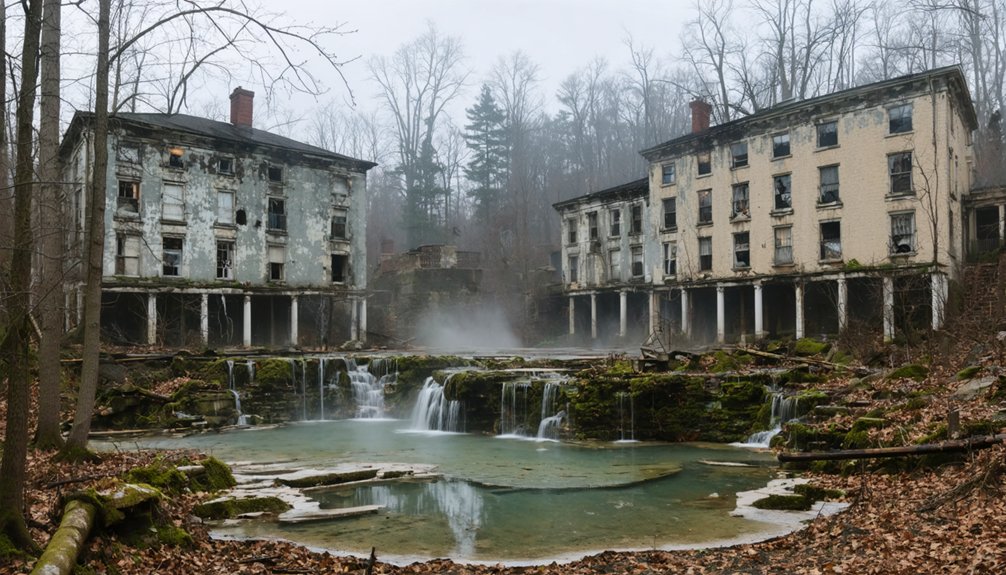
Pennsylvania’s mineral springs corridor stretched from Bedford in the south-central mountains to Cambridge Springs in the northwestern corner, anchored by two resorts that evolved from Native American healing grounds into fashionable nineteenth-century spa destinations.
You’ll trace Bedford’s transformation through railroad expansion—the 1872 Pennsylvania and B&O connections that spawned construction booms and short-lived service hamlets along the tracks—while Cambridge Springs rode its 1884–1915 health-resort wave before commercial bathhouses shuttered and resort inns emptied.
Both endpoints left behind architectural remnants and railroad ghost settlements that mark the belt’s rise as America’s therapeutic landscape and its subsequent abandonment.
Bedford Springs Resort History
Bedford Springs’ influence extended beyond mineral healing into political history:
- Seven sitting U.S. Presidents visited, with James Buchanan declaring it the summer White House from 1857-1861.
- The Supreme Court informally convened here in 1856 while deliberating the Dred Scott Decision.
- Resort architecture evolved from the original Stone Inn to an 1905 colonnade connecting dining facilities to spring pavilions.
- One of America’s first golf courses opened in 1895.
The Navy commandeered the property during World War II before its 1986 closure.
Railroad Ghost Hamlets
While Bedford Springs drew presidents and Supreme Court justices to its grand colonnade, smaller mineral spring communities across Pennsylvania’s central valleys relied on railroad spurs and branch lines to bring more modest crowds seeking similar healing waters.
Cold Spring hamlet in Stony Creek Valley thrived after 1851 rail service enabled health-seekers to reach its 48°F springs—until a September 1900 fire destroyed both hotels and triggered abandonment.
You’ll find foundation ruins today along the Stony Valley Railroad Grade in State Game Lands 211.
Nearby Rausch Gap developed as a railroad town servicing coal, timber, and mineral tourism passengers, maintaining several dozen homes before resource depletion emptied it around 1900.
These railroad heritage sites represent Pennsylvania’s decentralized spa economy, where branch-line access determined survival.
Cambridge Springs Decline Era
Stretching northwest from Bedford’s grand colonnaded pavilions to the bottling works of Cambridge Springs, Pennsylvania’s mineral-springs belt peaked in the 1890s as a connected therapeutic landscape where dozens of resort towns competed for health-seekers willing to trust their ailments to advertised water chemistries.
Cambridge Springs embodied the era’s mineral tourism ambitions—its population doubled as multi-story wooden hotels filled seasonally with regional and national guests.
Yet the 1906 Pure Food and Drug Act shattered exaggerated cure claims while physicians abandoned hydrotherapy referrals, triggering therapeutic decline across the belt.
- Concentrated economic dependence on seasonal springs revenue left Cambridge Springs vulnerable to shifting leisure preferences
- Medical skepticism eroded elite patronage and long-stay guests essential to sustaining grand hotels
- Coastal resorts and automobile-oriented destinations fractured the cure-town model
- Receiverships and financing disputes exposed financial fragility beneath resort-era ambitions
Railroad Ghosts: Vanished Depot Villages Along Spa Routes
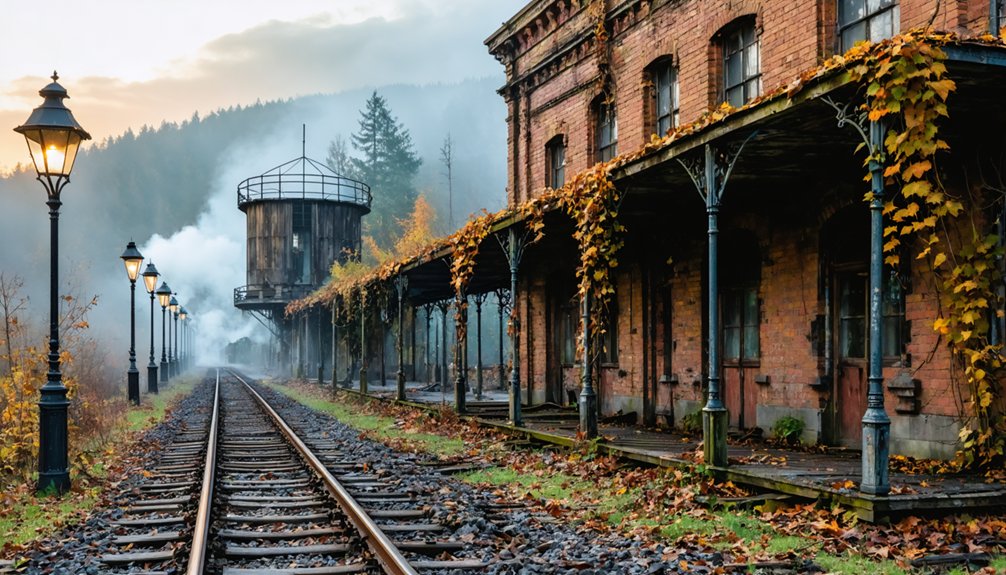
Seasonal tourism drove these linear settlements: populations of hundreds swelled to thousands each summer as through-cars unloaded daily.
Railroads platted streets, sold resort lots, and marketed “health excursions” with integrated bath packages.
When automobiles freed travelers from timetables, these depot-dependent economies collapsed, leaving foundations where livery stables and boarding houses once clustered around vanished platforms.
Why They Failed: Economic and Cultural Forces Behind Abandonment
Though railroads initially breathed life into these spa settlements, broader economic shifts proved fatal.
You’ll find that changing medical beliefs undermined the therapeutic spring industry—by 1920, modern pharmaceuticals had eclipsed water-cure treatments. Simultaneously, coastal resorts siphoned vacation dollars from inland hamlets, while automobile ownership let travelers bypass isolated valleys entirely.
Forces that sealed their fate:
- Highway construction rerouted traffic away from spa main streets, strangling passing trade
- Multi-week “taking the waters” stays collapsed into brief overnight stops
- Aging wooden hotels couldn’t meet new fire codes without prohibitive investment
- Industrial pollution upstream poisoned spring reputations for purity
Today these ruins evoke cultural nostalgia for an era when Americans sought freedom in nature’s healing waters, not prescriptions.
Exploring Responsibly: Access, Preservation, and What Remains Today
Before you load the car, understand that reaching these thermal ghost towns demands maneuvering a patchwork of ownership and regulation.
Private parcels require explicit permission; park-managed ruins limit you to marked trails and posted hours. National Register sites permit access but forbid artifact removal and structural disturbance—preservation ethics that protect archaeological context from your well-meaning souvenir hunting.
Respect boundaries: private land needs permission, park ruins have designated paths, and registered sites welcome visitors but protect artifacts from removal.
Responsible exploration means accepting exterior viewing when interiors show collapsed roofs or rotting floors. Old mine shafts and industrial debris create real hazards in terrain offering zero cell coverage and no rescue infrastructure.
Seasonal closures compound the challenge.
What remains today? Foundations, interpretive panels, and the skeletal frames of bathhouses that once channeled mineral water into a fleeting prosperity—visible only if you respect the boundaries that keep these fragments standing.
Frequently Asked Questions
Are Any Northeast Hot Springs Still Naturally Thermal or Geothermally Heated Today?
You’ll find only one true thermal spring in the Northeast: Sand Springs in Massachusetts, where geothermal activity warms water to 72–74°F. Natural hot springs remain virtually nonexistent here, unlike the West’s abundant geothermal resources.
Can I Legally Visit Ghost Town Sites on Private Property Near Springs?
No, you can’t legally visit without permission—roughly 70% of Northeast ghost towns sit on private land where property rights trump curiosity. Legal access requires explicit landowner consent, easements, or documented public rights-of-way before entry.
Which Ghost Towns Near Springs Have the Best-Preserved Standing Structures?
Dunton Hot Springs and St. Elmo in Colorado showcase the best-preserved towns near springs, offering intact log cabins and false-front storefronts with historical significance you can explore, though they’re outside the Northeast region.
Do Any Former Spring Resort Ghost Towns Offer Camping or Overnight Access?
Northeast spring resort ghost towns don’t offer camping—ruins remain private, posted, or unsafe. You’ll find overnight facilities only at nearby modern campgrounds. Camping regulations prohibit access to abandoned structures. Western sites like Faywood Hot Springs provide developed alternatives.
Explorers seeking unique experiences might be drawn to the abandoned mining towns near Hot Springs, where remnants of the past tell fascinating stories. The eerie atmosphere and historical significance attract photography enthusiasts and urban explorers alike. However, safety remains a priority, and visitors are advised to admire these ghost towns from a distance.
While discovering ghost towns around Hot Springs, it’s essential to remain vigilant about the surroundings, as some areas may be unstable or hazardous. Enthusiasts often report sightings of remnants from the mining era, creating an exciting atmosphere for those with a keen interest in history. Engaging with locals can also provide additional insights into the intriguing tales behind these forgotten places.
Are There Guided Tours of Abandoned Communities Near Saratoga or Sharon Springs?
No guided explorations of abandoned communities exist near Saratoga or Sharon Springs. You’ll find only paranormal walking tours through active downtown districts, emphasizing haunted buildings and Gilded Age historical narratives rather than depopulated settlements or true ghost towns.
However, for those drawn to the allure of history and the supernatural, exploring abandoned places in New England offers a rich tapestry of forgotten stories. From derelict factories to deserted towns, each site carries its own whispers of the past waiting to be uncovered. Adventurous individuals can experience the haunting beauty of these locations while reflecting on their historical significance and the lives once lived there.
References
- https://nvtami.com/2022/11/13/humboldt-pershing-county-ghost-towns/
- https://www.newmexico.org/places-to-visit/ghost-towns/
- https://www.youtube.com/watch?v=MynafCIrhkc
- https://onlyinark.com/places-and-travel/rush-arkansas-ghost-town/
- https://www.nationaldaycalendar.com/lists/12-oregon-ghost-towns
- https://kkyr.com/arkansas-top-5-ghost-towns/
- https://visitidaho.org/things-to-do/ghost-towns-mining-history/chesterfield-historic-town-site/
- https://www.cruiseamerica.com/trip-inspiration/hot-springs-in-the-us
- https://www.youtube.com/watch?v=6_a36_y9NuY
- https://archive.org/download/theytooktowaters00weis/theytooktowaters00weis.pdf