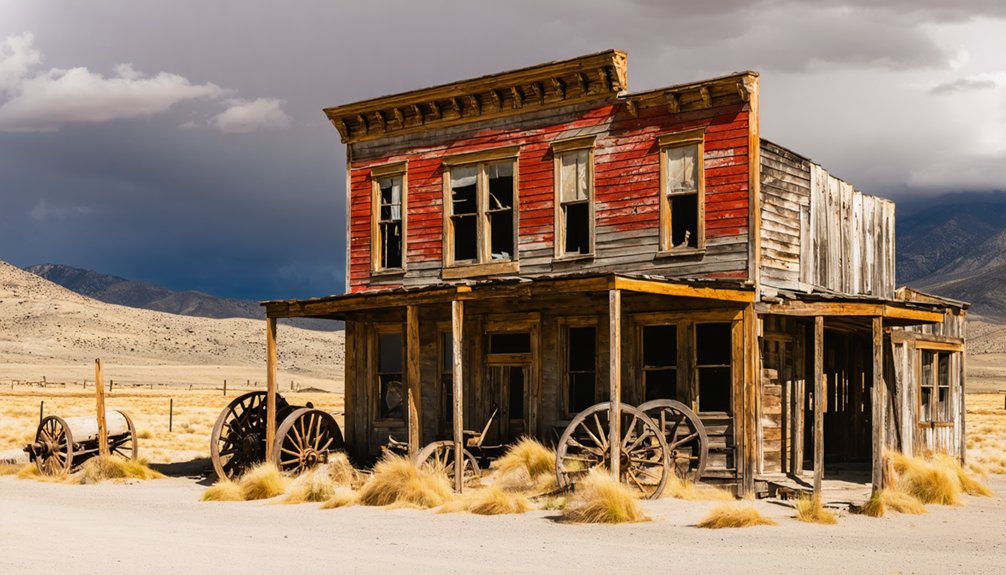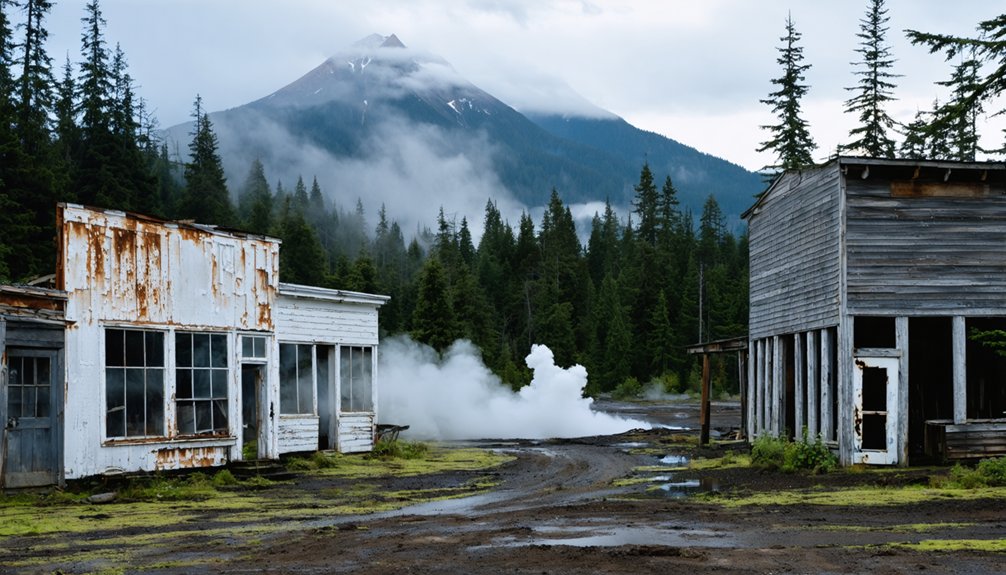
You’ll discover the Pacific Northwest’s most fascinating ghost towns like Burgdorf, Idaho, where Chinese miners found thermal springs in 1866, and Silver City, which extracted over one million ounces of gold while establishing Idaho Territory’s first telegraph office. Highway 395 connects abandoned settlements including Wendel—a depot town with nine name changes—and Oregon’s Fort Rock Homestead Village, where drought-stricken settlers relied on geothermal-fed springs. These sites reveal how Indigenous healing waters transformed into mining-era resorts before communities vanished, leaving architectural remnants that document territorial expansion.
Key Takeaways
- Burgdorf features three naturally heated pools (100–115°F) alongside log-cabin resort architecture from the 1870s along the Lewiston-to-Warren trail.
- Bayhorse preserves fourteen mining structures including a Wells Fargo building, saloon, and charcoal kilns near thermal features in Custer County.
- Hot Lake Springs combines 1906 resort buildings with 186°F mineral water, representing Pacific Northwest geothermal resort development.
- Silver City extracted over one million ounces of gold near thermal regions, establishing Idaho Territory’s first telegraph office and daily newspaper.
- Highway 395 connects multiple geothermal ghost towns including Wendel, Steamboat Springs District, and Carson Hot Springs across California and Nevada.
Burgdorf: From Mining Camp to Rustic Hot Springs Retreat
When a Chinese placer miner stumbled upon thermal springs in the remote Idaho mountains during summer 1866, he unknowingly set in motion the development of what would become central Idaho’s oldest resort.
Fred C. Burgdorf, a German shipwreck survivor, heard the tale and secured a 160-acre government deed by 1870. Burgdorf History began when he built a hotel along the historic Lewiston-to-Warren trail, serving pack horse travelers hauling supplies and gold dust.
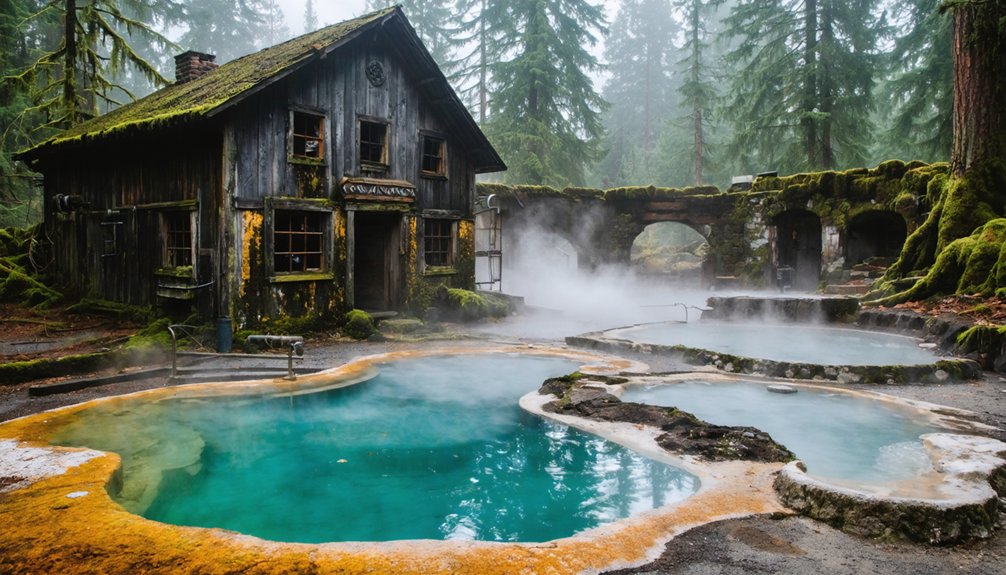
The Resort Architecture featured log-cabin dwellings and rustic native furniture that you’ll still find preserved today. Three naturally heated pools maintaining 100–115°F attracted mining camp personnel and day visitors seeking two-hour soaks.
Unlike typical boom-and-bust mining camps, this settlement survived through continuous private ownership, maintaining its frontier character 32 miles north of McCall. The hotel served as a way station for travelers journeying through the rugged Idaho backcountry. During the Thunder Mountain gold rush, prospectors used Burgdorf Hot Springs as a stopping point on their way to the mining camp of Roosevelt.
Historic Hot Springs Communities Along Highway 395
Along the eastern spine of California and Nevada, Highway 395 connected a chain of geothermal settlements where mineral-rich water shaped community identity as powerfully as gold or silver ever did.
At Wendel, California, the Nevada–California–Oregon Railway relied on hot springs for locomotive water, transforming a stage stop into a thriving depot town before automation rendered it nearly abandoned.
Further south, Steamboat Springs District evolved from sacred indigenous pools to an 1860s resort serving Comstock miners, then faded as geothermal power replaced tourism.
Carson Hot Springs capitalized on railroad history and highway traffic, building bathhouse economies that drew health-seekers to Eagle Valley’s steaming vents. Near Bridgeport, Travertine Hot Springs features natural pools where Victorian-era travelers once gathered before the town’s mining fortunes declined.
Amedee Ghost Town became known for its hot springs alongside saloons and outdoor recreation, serving as a terminal for the Nevada-California-Oregon Railway until the post office closed in 1924.
- Witness crumbling water towers where iron horses once drank from geothermal springs
- Stand in empty bathhouses that promised freedom from affliction to desperate miners
- Trace vanished rail beds linking thermal oases across high-desert silence
Silver City’s Legacy as Idaho’s Premier Mining Destination
When you explore Silver City’s rise after 1864, you’re examining Idaho Territory’s first major hard-rock mining district—a camp that extracted over one million ounces of gold and twenty million ounces of silver from the Owyhee Mountains.
The district’s exceptional ore grades, reportedly reaching $9,800 per ton in combined metals, drove enough capital investment to support Idaho’s first daily newspaper and telegraph office by the late 1860s.
These communications firsts weren’t mere conveniences; they positioned Silver City as the administrative and information hub that connected remote southwestern Idaho to national mining markets and territorial governance.
The town’s infrastructure development included the Owyhee County courthouse constructed in 1867, reflecting Silver City’s status as a center of both mining wealth and territorial authority.
The name Silver City refers to multiple locations across the American West, though Idaho’s version became the most significant mining camp in the territory during its peak production years.
Historic Mining Operations Overview
The discovery of gold in the Owyhee region on May 18, 1863, by the Jordan party transformed Idaho’s southwestern desert into one of the West’s most profitable mining districts.
Initial assays revealed $2,800 in gold and $7,000 in silver per ton—surpassing Nevada’s famed Comstock Lode. This triggered an unprecedented rush as prospectors employed evolving mining techniques to extract wealth from War Eagle and Florida mountains.
The economic impact reshaped the entire territory:
- Annual production exceeded one million dollars by the late 1860s
- Total regional output reached approximately $40,000,000 from combined operations
- Over one million ounces of gold and twenty million ounces of silver flowed from early workings
Mines sustained commercial-scale operations for nearly fifty years, with twelve ore-processing mills supporting the district’s independence from outside control. A massive 500-pound silver crystal from the Poorman Mine earned a gold medal at the Paris Exposition in 1867, showcasing the extraordinary quality of the region’s ore deposits. The Coeur d’Alene district in Idaho would later become the state’s most prolific silver producer, yielding over 37,000 metric tons through 2006.
Telegraph and Newspaper Firsts
By 1874, Silver City‘s emergence as Idaho Territory’s communication nexus was complete: Western Union had established the territory’s first telegraph office in the mountain camp, and local publishers launched what territorial records cite as Idaho’s first daily newspaper.
These telegraph advancements transmitted real‑time ore prices and freight rates across national networks, reducing the isolation that plagued remote Owyhee mines.
You’ll find that newspaper influence extended beyond daily reporting—editors documented mining litigation, advertised stage lines, and incorporated wire reports into local editions.
By 1869, the town supported two competing papers, an extraordinary density for any frontier settlement.
This media cluster reinforced Silver City’s role as Owyhee County’s administrative seat and commercial hub, attracting investors who valued rapid access to claim values and mill output data.
The Silver City Nugget, founded in 1866, became one of the region’s earliest and most enduring publications, initially documenting local mining activities before expanding its coverage to community events and civic matters.
The town’s diverse business establishments included saloons, brothels, and various eateries, reflecting the vibrant social culture characteristic of successful mining communities.
Bayhorse and the Gold Rush Era Hot Springs Circuit
Although prospectors first struck mineral deposits near Bayhorse in 1864 during central Idaho’s early mining explorations, the settlement didn’t materialize until the discovery of a significant lead-silver vein at Ramshorn Mine in 1877 transformed the isolated canyon into a regional magnet.
By 1878, roughly 300 independent miners had staked claims in this Custer County frontier camp, building an industrial operation that produced over $10 million in combined metals.
Bayhorse heritage lives through tangible remains:
- Fourteen standing structures including the brick Wells Fargo building and restored saloon
- Charcoal kilns from 1882 that produced 80,000 bushels annually
- Three-story gravity mill where ore descended through crushing stages
This mining legacy connects you to the Land of the Yankee Fork’s historic circuit linking ghost towns Bonanza and Custer along today’s Salmon River Scenic Byway.
Wendel’s Many Names and Therapeutic Waters
You’ll find Wendel’s identity cycling through at least nine official names—from Upper Hot Springs and Schaeffer Hot Springs to Smithon, Boyd, Hot Springs Station, Purser, Antola, and Caloreta—before settling on Wendel in 1914 when the Nevada–California–Oregon Railway established its junction station.
This final designation honored a friend of railway president Thomas Moran, reflecting how corporate patronage replaced the earlier geographic labels tied to the site’s thermal waters.
The town’s location at the March 1913 crossing with the Fernley & Lassen Railway transformed it from a remote bathing resort into a crew-change hub with engine house, water tower, and powerhouse infrastructure serving travelers bound for the hot springs.
Evolution of Town Names
Consider what you’d lose without archival records preserving this sequence:
- The therapeutic promise of thermal waters advertised to health-seekers
- The corporate ambitions of the Nevada–California–Oregon Railway reshaping geography
- The personal networks of rail barons immortalized in place names
Freedom to document these layers keeps vanished junctions alive.
Hot Springs Development History
Place names tell only part of the story—the physical landscape itself shaped settlement patterns through features like hot springs, which drew both Indigenous peoples and later colonizers to specific sites.
You’ll find that Native American tribes traveled hundreds of miles to access these healing waters for centuries before Hudson Bay fur trappers arrived in the 1840s.
Early explorers like John Minto documented their expeditions in the 1870s, paving the way for resort development. By 1891, entrepreneurs constructed facilities like the Great Northern Hot Springs Hotel, capitalizing on therapeutic water flowing at rates of 500 gallons per minute.
Mining crews and railroad surveyors discovered additional springs near Stevens Pass, transforming remote wilderness into destination resorts that promised health and rejuvenation.
Geographic Location and Accessibility
Straddling Highway 395‘s northeastern California corridor between Reno and Lakeview, Wendel occupies a geographic position that explains both its settlement viability and eventual decline. This ghost town geography initially thrived on N.C.O. railroad connections, with thermal springs attracting travelers along what became modern accessibility routes.
The settlement’s evolution reveals freedom-seeking patterns:
- Nine name changes (Upper Hot Springs, Schaeffer Hot Springs, Smithon, Boyd, Hot Springs Station, Purser, Antola, Caloreta, Wendel) document fluid community reinvention
- Railroad water tower remains mark infrastructure dreams that outlasted the people
- Honey Lake clustering shows how multiple settlements competed for identical thermal resources
You’ll find Wendel among several abandoned railroad towns—Termo, Milford, Amedee—where transportation shifts determined survival.
Highway 395 now enables day-trip exploration of what rails once promised permanence.
Exploring Oregon’s Abandoned Settlements Near Geothermal Sites
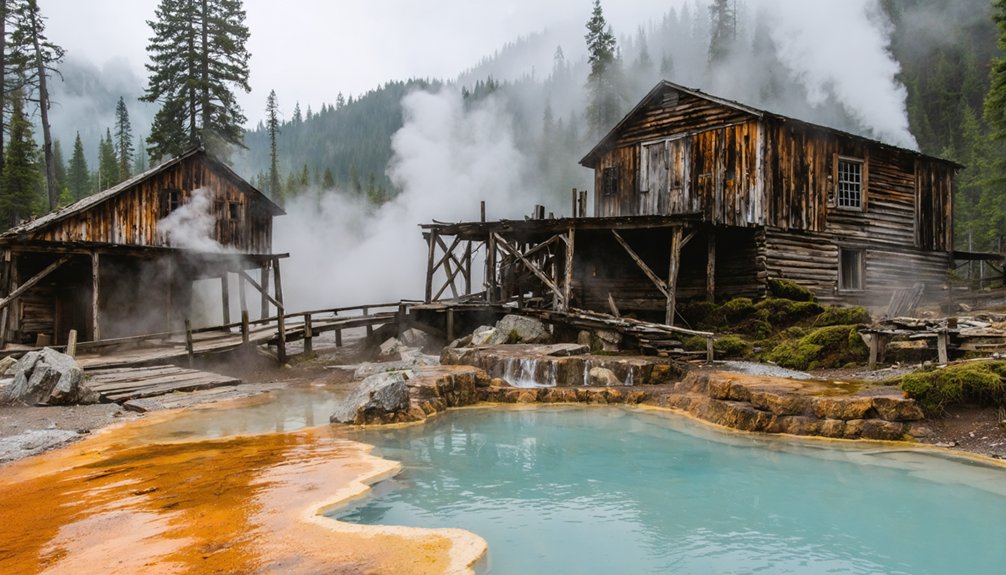
Oregon’s High Lava Plains and Basin-and-Range provinces interweave volcanic landforms with human abandonment, creating a distinct class of ghost settlements shaped as much by geology as by economic boom-and-bust cycles.
You’ll find Fort Rock Homestead Village Museum 67 miles southeast of Bend, where thirteen relocated structures preserve early-1900s abandoned architecture once scattered across the Fort Rock Basin’s maar craters and cinder cones.
Drought ended homesteading attempts at 4,400 feet elevation, forcing reliance on geothermal-fed springs.
Eastern Oregon’s Hot Lake Springs offers a different narrative—1906 resort buildings channeling 186°F mineral water survived near-abandonment before restoration.
Southwest Oregon’s Illinois River gold camps and scattered sanatoriums complete this geothermal history, linking thermal features to communities that flared briefly then faded when markets, water, or ore disappeared.
Frequently Asked Questions
Are Any Hot Springs Ghost Towns Accessible During Winter Months?
Yes, Burgdorf Hot Springs remains winter-accessible via snowmobile when roads close—ironic that Idaho’s harshest season delivers the best ghost-town soaking. You’ll find authentic hot springs history where winter accessibility actually enhances the experience.
Which Ghost Towns Near Hot Springs Allow Overnight Camping or Lodging?
Burgdorf Hot Springs offers rustic cabins directly on-site, while Silver City’s Idaho Hotel provides historic lodging within town. You’ll find dispersed camping opportunities near Metropolis following BLM regulations. Check seasonal access and local camping regulations first.
Do Any Abandoned Hot Springs Sites Still Have Functioning Geothermal Pools?
Like embers that outlast the campfire, abandoned springs sites retain functioning geothermal features—Hot Lake’s eight-acre steaming pond and Scenic’s seepage pools kept flowing decades after buildings collapsed, offering you unregulated access to resilient hydrothermal systems.
What Safety Precautions Should Visitors Take When Exploring Hot Springs Ghost Towns?
Test spring temperatures before entry, watch for unstable ground and hidden shafts, maintain distance during wildlife encounters, carry navigation tools in poor-coverage zones, and respect posted boundaries—these terrain hazards demand self-reliance and situational awareness.
Are There Guided Tours Available for Hot Springs Ghost Town Locations?
Guided experiences are scarce—most hot springs ghost towns offer self-guided exploration with seasonal ranger talks or volunteer-led walks highlighting historical significance. You’ll find freedom through interpretive trails, museum contacts, and archival maps rather than commercial tours.
References
- https://en.wikipedia.org/wiki/List_of_ghost_towns_in_Oregon
- https://nvtami.com/2023/11/16/ghost-towns-highway-395-reno-to-lakeview/
- https://visitrainier.com/melmont-ghost-town-2/
- https://visitidaho.org/travel-tips/boom-or-bust-exploring-idaho-ghost-towns/
- https://travelnevada.com/ghost-town/metropolis-ghost-town/
- https://www.islands.com/1938500/franklin-ghost-town-washington-woodlands-waterfalls-abandoned-mountain-trail/
- https://www.si.edu/object/siris_sil_1011478
- https://idaho.idgenweb.org/Town History/burgdorf_history.htm
- https://www.ghosttowns.com/states/id/burgdorf.html
- https://yellowpinetimes.wordpress.com/2019/07/07/idaho-history-july-7-2019/