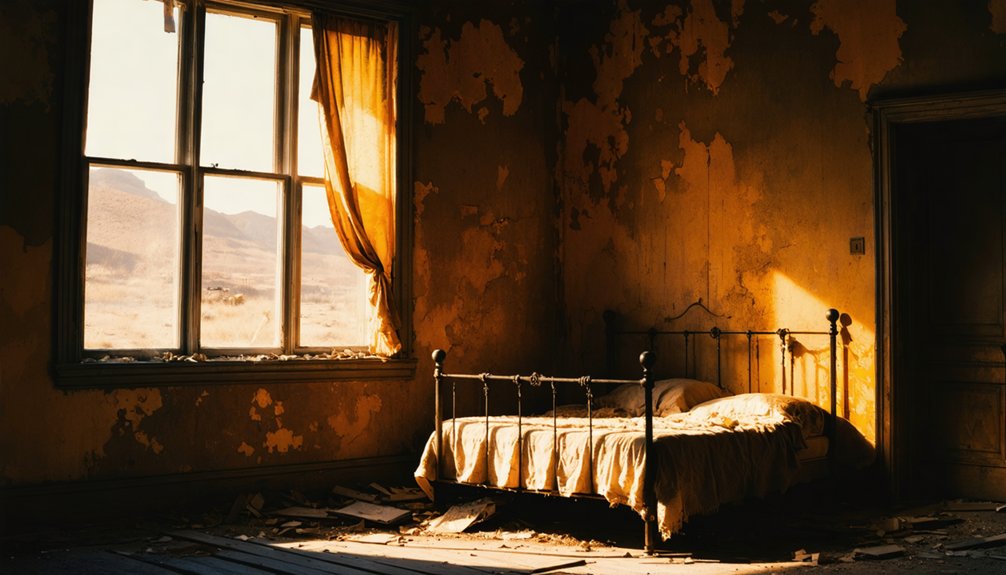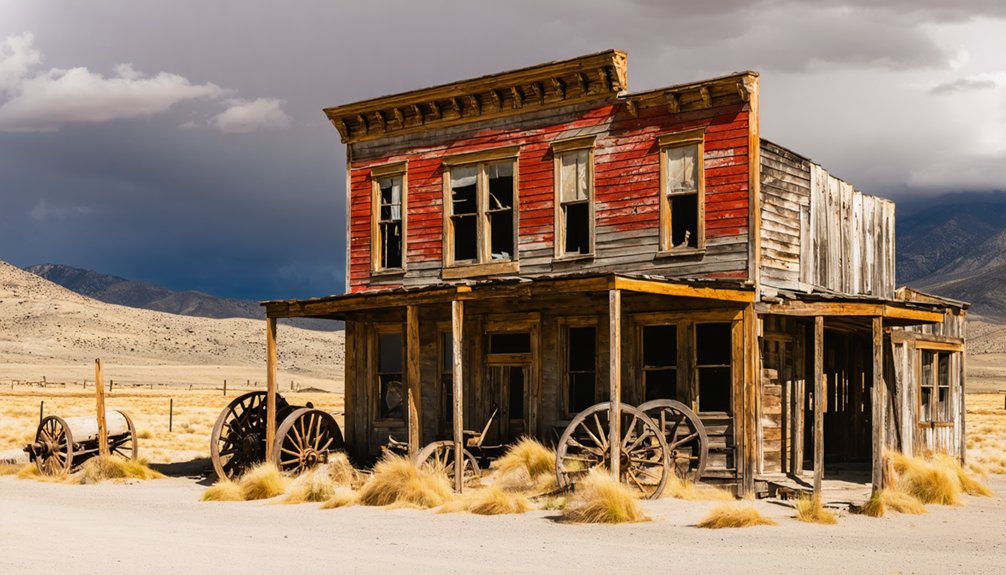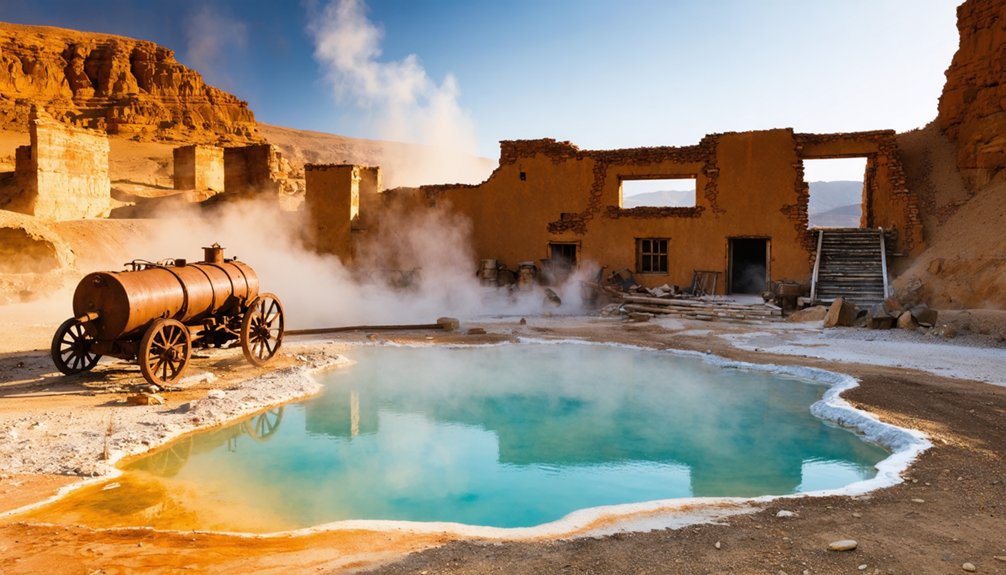
You’ll find Southwest ghost towns like Agua Caliente, Arizona, where a 22-room adobe hotel from 1897 now sits beside a drained concrete pool, and Dunton Hot Springs, Colorado, a restored miners’ camp with 108°F thermal waters along Miocene fault lines. Gold Point, Nevada preserves 50 historic buildings where desert springs once powered stamp mills. These settlements emerged where Indigenous healing sites, mineral strikes, and geothermal resources converged, creating a 275-town corridor across Arizona that collapsed when aquifers dried or mines failed—each location offering distinct layers of cultural and geological history worth exploring further.
Key Takeaways
- Agua Caliente, Arizona features a 22-room adobe hotel ruins and dry concrete pool from its 1897 health tourism era.
- Dunton Hot Springs, Colorado preserves restored miners’ cabins, dance hall, and chapel alongside 108°F thermal springs on Miocene fault formations.
- Gold Point, Nevada offers 50 historic buildings including restored saloon, showcasing dual legacy of mining operations and desert spring resources.
- Over 275 documented ghost towns form a corridor in Arizona where mineral deposits intersect with thermal water sources.
- Indigenous healing sites transformed into commercial spas, with locations like Chimayó evolving from Tewa hot spring shrines to pilgrimages.
Agua Caliente: Arizona’s Thermal Spa Ghost Town
Long before the first adobe walls rose in the desert, Apache and other Native American groups gathered at the springs they called “medicine water,” bathing in thermal pools that bubbled up from deep underground fault lines in what’s now Maricopa County, Arizona.
Spanish missionaries documented these healing waters in 1748, adding to the thermal spring folklore that would draw settlers westward. By 1897, entrepreneurs built a 22-room adobe hotel here, transforming indigenous medicinal practices into commercialized health tourism.
The resort thrived until agricultural irrigation drained the aquifer—though local legend claims dynamite used during property disputes killed the springs. Visitors once traveled by horse and buggy from nearby towns, with the Southern Pacific Railroad making Sentinel a convenient gateway to the thermal resort.
Today you’ll find empty adobe ruins, a dry concrete pool, and desert silence twelve miles north of Sentinel, accessible by dirt road to anyone seeking Arizona’s forgotten spa towns. Caretakers maintain the property, preserving what remains of this exclusive resort that once rivaled Castle Hot Springs in popularity.
Dunton Hot Springs: Colorado’s Restored Mining Camp
- Original miners’ saloon converted to communal dining hall
- Fourteen-by-twenty-foot log-lined soaking tub fed by geothermal fault
- Dance hall, chapel, and library preserving one-street camp layout
- Cabins reconstructed log-by-log along Miocene fault formations
- Pony Express building repurposed as spa and yoga studio
- Hot springs emerge at 108°F with calcium-bicarbonate composition
German investors transformed the 1990 ghost town into an exclusive retreat, channeling 19th-century thermal waters through restored bathhouses while maintaining the isolated character that once limited the camp’s commercial viability.
Gold Point and Nevada’s Desert Geothermal Corridors
Deep in Nevada’s Esmeralda County, you’ll find Gold Point—a partially occupied ghost town where about 50 historic buildings stand as evidence to silver and gold booms that peaked between 1908 and the 1930s.
The remote camp relied on nearby desert springs to power its stamp mills, situating ore-processing infrastructure directly at water sources rather than hauling precious water to mine sites.
Originally founded as Lime Point in the early 1860s, the settlement went through several transformations before becoming the Gold Point known today.
The town was renamed Hornsilver in 1902 following the discovery of rich ore deposits that temporarily revitalized the mining district.
Today, while Gold Point operates as a heritage tourism destination with a restored saloon and preserved mining structures, the surrounding basin-and-range landscape still harbors undeveloped geothermal springs that once made mineral extraction economically feasible in this arid frontier.
Historic Mining Camp Remains
Two hundred twenty-five weathered structures scatter across Gold Point‘s desert landscape, marking one of Nevada’s most intact ghost town sites along the state’s geothermal corridor.
You’ll find authentic remnants from three distinct operational periods spanning 1908 through the 1960s, with mining techniques evolving from basic hornsilver extraction to sophisticated deep-shaft gold operations.
The physical evidence tells the camp’s evolution story:
- Wood-frame buildings from the 1908 boomtown era when stores and saloons opened weekly
- Great Western Mine’s abandoned mill equipment and vertical shafts reaching 1,000 feet
- Processing facilities modified during the 1927 gold discovery shift
- Historic Dunfee Shaft collapse site from the 1960s dynamite accident
Ghost town preservation efforts maintain these structures without governmental interference, allowing you to explore Nevada’s mining heritage freely across this designated Historical Marker No. 156 site.
The town’s earlier identity as Lime Point stems from lime deposits discovered in the surrounding hills during 1868, predating the silver boom by four decades.
Walt Kremin operates local saloon and bed and breakfast facilities that provide visitors with authentic Old West accommodations amid the preserved mining camp.
Nearby Undeveloped Hot Springs
Beyond Gold Point’s mining ruins, Nevada’s geothermal corridor extends through dozens of primitive hot springs that remain largely undeveloped and off-grid.
You’ll find thermal waters emerging where tectonic plates meet and Earth’s crust thins, creating ideal hot spring geology throughout the western state.
Gold Strike Canyon near Hoover Dam offers 109°F waters flowing from cliff-face fissures where the Palm Tree and Salt Cedar faults converge, though eight difficult rope descents stand between you and these remote pools.
Carson Hot Springs draws from 35,000 feet below surface, while Warm Springs maintains consistent 100-104°F temperatures year-round.
These geothermal ecosystems feature mineral-rich waters with gypsum encrustations and carbonate formations, though some source pools reach dangerous 130°F temperatures. The canyon sits at an elevation of 1,561 feet on the Arizona-Nevada border, making it accessible to visitors from both states.
Recent AI-driven discoveries continue identifying commercially viable sites across Nevada’s desert regions. Geothermal startup Zanskar recently announced a new viable site discovery in the state, marking the first find of its kind in decades.
Arizona’s Ghost Town Belt and Natural Springs Network
Across northwest-central and southeast Arizona, a concentrated network of more than 275 documented ghost towns forms what historians and prospectors have long called the “Ghost Town Belt”—a corridor that parallels the state’s major 19th and early 20th-century mineral deposits and historic rail lines.
Arizona’s Ghost Town Belt: over 275 abandoned settlements tracking nineteenth-century mineral wealth and transportation corridors across the state’s northwest-central and southeast regions.
This ghost town geography traces changeover zones and mountain fronts where mineral resource distribution intersected with accessible water sources.
You’ll find camps clustered near:
- Perennial springs in the Bradshaw, Cerbat, and Dragoon mountain ranges
- Creek-fed valley bottoms supporting gravity-fed ore processing systems
- Stage stops and railroad sidings with spring-fed cisterns and water tanks
- Canyon seeps enabling short-lived mining operations in arid basins
Many settlements died when springs depleted or railroads diverted water infrastructure, leaving scattered ruins across Arizona’s backcountry.
Indigenous Healing Sites to Frontier Waypoints: A Layered History
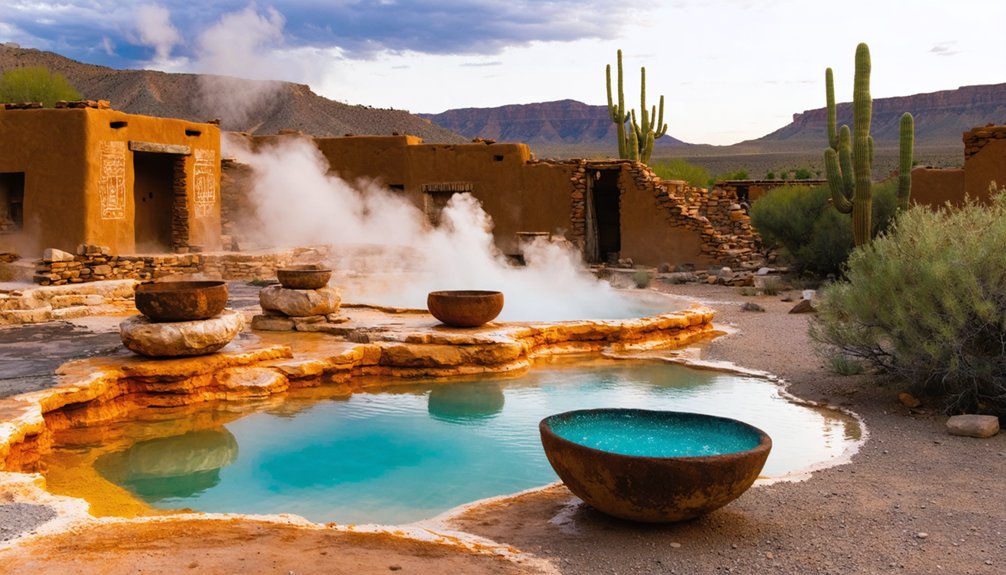
When you trace the history of hot springs in the American Southwest, you’re following a continuum that begins with Indigenous ceremonial use documented over millennia—sites like Pagosa Springs, where Ute bands performed healing rituals in what they called “sacred miracle waters.”
As Spanish colonization and later Anglo-American expansion transformed the region, these geothermal zones became layered landscapes: Chimayó’s shift from Tewa hot spring shrine to Catholic pilgrimage destination exemplifies how frontier travel routes absorbed existing Indigenous healing grounds into new networks of stagecoach stops and wellness resorts.
Sacred Waters Before Settlement
Key practices included:
- Ceremonial purification and vision seeking at thermal sites designated for prayer and offerings
- Multi-tribal pilgrimage networks drawing nations together during epidemic outbreaks
- Therapeutic bathing for chronic illness, integrating mineral waters with plant-based pharmacopoeias
- Neutral-ground truces allowing rival groups shared access to essential healing resources
Stagecoach Stops and Wellness
Long before the first stagecoach clattered along the Southwest Trail, the thermal springs that would anchor frontier waypoints had already served generations of Indigenous peoples as sites of healing and spiritual renewal.
When contractors laid out mail routes across Arkansas and Texas, they deliberately sited stations at these established water sources, transforming ceremonial grounds into commercial nodes.
Hot Springs, Arkansas exemplified this layered history—stagecoach wellness marketing built directly upon Indigenous knowledge of thermal healing properties.
The Butterfield Overland Mail’s 2,800-mile network required water every 15–25 miles, making warm springs strategic assets for both human recuperation and livestock.
Yet this appropriation came at a cost: intensified traffic disrupted Native access, erasing sacred cosmologies while frontier boosters repackaged “cures” for paying travelers seeking rheumatism relief and rejuvenation.
Mining Camps Meet Geothermal Resources
The same deep fractures that channeled metal-laden fluids into ore veins also drove thermal waters to the surface, binding extraction and healing into a single geologic heritage across the Southwest.
You’ll find volcanic calderas and rift faults where precious-metal deposits coincided with hot springs—Jemez Mountains, southwestern Colorado, Jerome.
Mining history turned sacred indigenous healing sites into industrial zones; camps exploited springs for ore processing while simultaneously marketing them as curative resorts.
When booms collapsed after decades, ghost towns preserved this dual legacy:
- Abandoned shafts and smelter ruins beside deteriorating bathhouses
- Tailings contaminating thermal outflows once used ceremonially
- Fault-controlled reservoirs demonstrating ongoing geothermal potential
- Ethnographic records documenting access conflicts and cultural loss
Today’s geothermal potential assessments retrace these same hydrothermal corridors, overlaying renewable-energy prospects onto contested ground.
Mining Booms, Geothermal Waters, and Community Baths
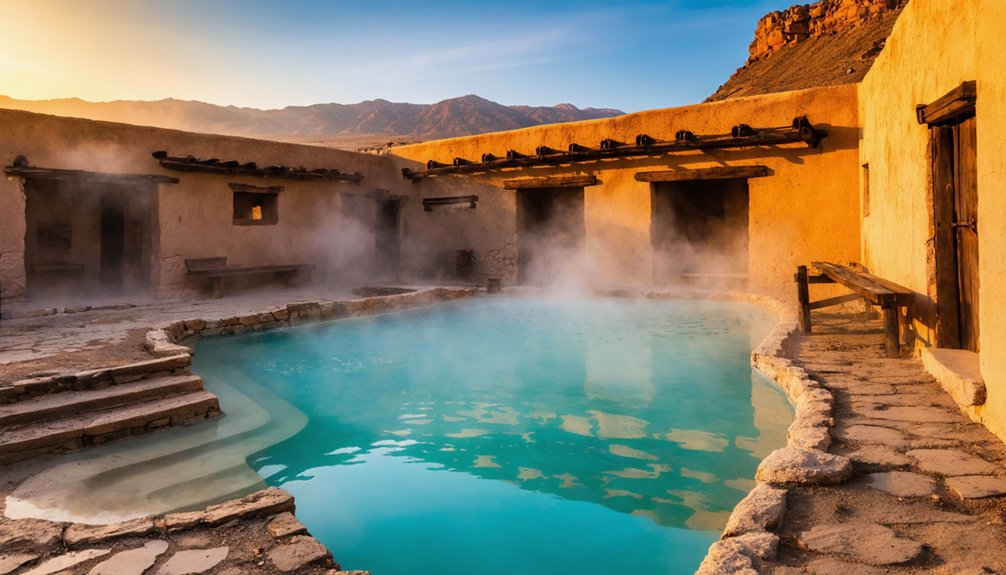
Following mineral discoveries in the 1860s and 1870s, southwestern ghost towns near hot springs developed a distinctive pattern where mining operations and geothermal features intersected to shape community life.
These towns often saw a boom in population as miners and their families flocked to the area, drawn by the promise of riches and the allure of relaxation in the warm waters. However, as mining resources dwindled, many of these vibrant communities fell into disrepair, leaving behind remnants of their former glory. Today, the abandoned structures serve as a haunting reminder of the past, attracting explorers and photographers intrigued by the history of ghost towns near hot springs.
Among these fascinating sites, ghost towns in New Mexico reveal unique stories of resilience and decline, often characterized by their desolate landscapes and historical landmarks. Visitors can explore the remnants of former saloons and general stores that once bustled with activity, now standing silent against the backdrop of the vast desert. As these towns fade into obscurity, they continue to evoke a sense of nostalgia, inviting individuals to ponder the lives of those who once called them home.
You’ll find that Hot Creek’s Welsh miners trekked steep mountain paths from Mountain View on weekends to reach thermal baths, seeking relief from grueling underground labor. These community wellness gatherings became essential social anchors in isolated camps.
Goldbelt Spring served dual purposes—Shoshone Indians had utilized its waters for generations before prospectors transformed it into a base camp for talc and asbestos operations.
Agua Caliente distinguished itself from typical mining settlements by centering around natural hot springs and stagecoach routes rather than ore deposits, demonstrating how geothermal resources could independently sustain frontier communities.
Preservation Challenges at Unmaintained Thermal Ghost Towns
Where geothermal forces meet abandoned infrastructure, preservation dilemmas intensify beyond those of typical ghost towns. You’ll encounter thermal and moisture cycling that corrodes metal, rots timber, and fractures masonry faster than arid exposure alone.
Meanwhile, uncontrolled soaking introduces phosphates and hydrocarbons that degrade fragile microbial mats, while trampling destroys riparian vegetation anchoring thermal-zone soils.
Environmental impacts and structural decay compound preservation strategies:
- Unmapped subsurface voids from historic wells risk collapse when undermined by hydrothermal alteration
- Salt crystallization within walls causes spalling where hot vapor vents through unmaintained masonry
- Unregulated pool modification can permanently alter geothermal discharge patterns
- Complex land status—checkerboard private, federal, and tribal parcels—complicates liability assignment and discourages proactive stabilization
Scalding hazards, toxic gas accumulation, and remote locations add layers typical ghost-town managers never face.
Planning Your Visit: Access, Safety, and Responsible Exploration
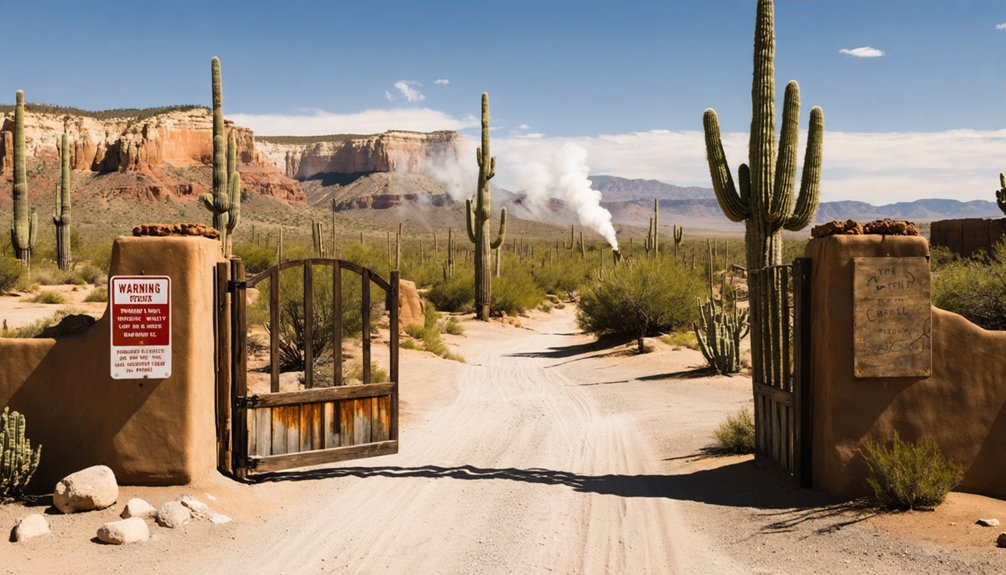
Before you venture into thermal ghost towns, you’ll need to assess route conditions, safety equipment, and regulatory requirements specific to geothermal sites.
Transportation logistics vary dramatically—while sites like St. Elmo accommodate standard vehicles, remote locations demand high-clearance four-wheel drives or ATVs available near towns like Silverton.
Spring and summer provide ideal access, though winter closes many alpine routes entirely.
Safety precautions extend beyond typical ghost town exploration. Deteriorating structures pose collapse risks, while abandoned mining shafts create hidden hazards.
High-elevation sites experience rapid weather shifts requiring appropriate gear. You’ll find limited emergency services, making first-aid knowledge and communication devices essential.
Bring adequate water supplies, as availability varies considerably.
Respect BLM oversight and National Register protections—artifact removal violates preservation protocols.
Private properties like Shakespeare require owner permission before entry.
Frequently Asked Questions
Are Any Hot Springs Near Southwest Ghost Towns Free to Access Year-Round?
No true free hot springs near Southwest ghost towns remain accessible year-round. You’ll find most historic thermal springs commercialized into resorts, privatized on gated land, seasonally closed, or dried up—liberty traded for liability and profit.
What Camping Permits Are Required Near Arizona and Nevada Ghost Town Areas?
You’ll find BLM dispersed camping near most ghost towns requires no advance permit, though organized groups need Special Recreation Permits. Expect camping regulations around historic structures and seasonal permit fees at Long-Term Visitor Areas.
Can I Soak in the Original Hot Spring Pools at Agua Caliente?
The original hot spring pools have vanished into history—you’ll soak in modern spa baths fed by the same sacred source, not the demolished 1886–1958 bathhouses where earlier generations bathed in Séc-he’s mineral waters.
Which Ghost Town Hot Springs Allow Overnight RV or Van Parking?
You’ll find overnight RV parking at primitive Fish Lake Valley Hot Springs, Nevada, where dispersed camping’s permitted near historic mining ruins. Most developed ghost-town resorts lack RV amenities and enforce strict overnight regulations prohibiting parking in their lots.
Are Guided Ghost Town and Hot Spring Combination Tours Available Commercially?
Yes, commercial operators offer guided tours combining ghost towns and hot springs, though they’re niche. Southwest Discoveries runs “Spirits of the Past” in southeastern Arizona, bundling interpretive ghost-town hikes with evening soaks at Muleshoe Ranch.
Exploring ghost towns near hot springs allows visitors to experience both the eerie remnants of the past and the rejuvenating warmth of natural thermal waters. These unique destinations often feature old mining equipment and abandoned buildings interspersed with scenic views of bubbling springs. Travelers seeking adventure can find guided excursions that delve into the stories behind these forgotten places while offering relaxing opportunities to soak afterward.
References
- https://www.arizonahighways.com/article/arizona-ghost-towns
- https://www.visitarizona.com/like-a-local/4-arizona-ghost-towns-you-may-have-never-heard-of
- https://neon.reviewjournal.com/travel/exploring-ghost-towns-of-the-southwest/
- https://www.visittucson.org/blog/post/8-ghost-towns-of-southern-arizona/
- https://www.hipcamp.com/journal/camping/arizona-ghost-towns/
- https://prestonm.com/agua-caliente-ghost-town/
- https://guide.michelin.com/us/en/article/travel/the-remarkable-history-of-dunton-hot-springs
- http://www.ghosttownaz.info/agua-caliente-ghost-town.php
- https://www.youtube.com/watch?v=IQpJxEwcJYA
- https://www.ghosttowns.com/states/az/aguacaliente.html