You’ll discover California’s most authentic ghost towns along the Eastern Sierra’s geothermal corridor, where 19th-century prospectors linked hot springs to mineral deposits. Benton Hot Springs transformed from a Paiute settlement to a 5,000-resident silver boom town by 1865, while Fales Hot Springs served miners traveling to Bodie after 1844. Scovern Hot Springs declined into abandonment before its buildings were relocated to create Silver City Ghost Town in 1971. These settlements along Highway 395 now offer preserved mining-era architecture alongside natural thermal features, revealing how geological speculation shaped Western settlement patterns.
Key Takeaways
- Benton Hot Springs near Highway 395 features mining-era cabins and private soaking tubs from its 1860s silver boom era.
- Bodie State Historic Park serves as a regional hub connecting multiple ghost towns and geothermal springs along the Eastern Sierra corridor.
- Fales Hot Springs established a hotel in 1877 along the Bodie Route, serving miners traveling to nearby gold camps.
- Silver City Ghost Town near Bodfish preserves relocated buildings from Scovern Hot Springs and other turn-of-the-century mining settlements.
- Travertine and Buckeye hot springs offer BLM-managed soaking near historic mining sites accessible from US Highway 395.
Historic Mining Settlements Built Around Geothermal Springs
When mineral prospectors first encountered hot springs bubbling through the western landscape, they recognized more than just bathing waters—they saw geological signals of subsurface treasure.
At Wilbur Hot Springs in California’s Coast Range, the 1863 discovery of mercury and gold near Simmons Hot Springs sparked intense speculation. The Elgin Mine and surrounding Sulphur Creek district exploited hydrothermal alteration zones, supporting a boom-period settlement complete with hotels and mining camps. The thermal waters emerged at temperatures reaching 152°F, signaling the intense geothermal activity that had concentrated valuable minerals in the surrounding volcanic rocks.
Similarly, Coso Hot Springs in Inyo County drew prospectors targeting silica and altered volcanic rocks, treating the thermal system as both energy prospect and mineral extraction site.
In Mono County, Benton Hot Springs evolved from a Native Piute discovery into a stage stop and relaxation center during the mining boom, eventually becoming the largest population center in the county by 1865. Even Nevada’s remote Dyke Hot Springs attracted small-scale operations, where geothermal exploration revealed subsurface heat alongside potential mineralization within the Basin and Range’s fault-fractured crust.
Benton Hot Springs: From Paiute Gathering Place to Silver Boom Town
Long before silver prospectors arrived in 1864, the Utu Utu Gwaitu Paiute had used Benton’s geothermal springs for spiritual ceremonies and medicinal bathing, establishing habitation sites around the meadows and reliable water sources.
By 1852, Euro-American travelers recognized the springs as a strategic way station between Owens Valley and Nevada mining camps, gradually displacing Indigenous residents from their ancestral gathering place.
The 1864 silver strike east of Benton transformed this modest frontier stop into Mono County’s largest settlement, with population estimates reaching 5,000 residents during the boom years between 1865 and 1890. The Carson and Colorado Railroad extended service to Benton Station in 1885, connecting the remote mining town to broader commercial networks and facilitating the transport of silver ore and supplies. Benton’s reputation as a “town without law” reflected the rough frontier character that persisted throughout its boom period, with violence and disorder frequently marking daily life in the silver camp.
Paiute Settlement and Traditions
For thousands of years before Euro-American settlement, the ancestors of the Utu Utu Gwaitu Paiute Tribe occupied the Benton Hot Springs area, establishing seasonal camps and semi-permanent villages around thermal waters that flowed at 135–140°F.
You’ll find that Paiute traditions centered on these sacred waters, which served both spiritual and practical purposes. The springs provided healing through soaking and steam, while spring-fed meadows sustained seed plants, roots, and browse within broader hunting and gathering territories.
Paiute groups engineered sophisticated irrigation systems, diverting streams to enhance food production—a practice emphasizing sustained flow and communal sharing. These intricate irrigation systems were constructed millennia before Los Angeles diverted water from the Owens Valley, demonstrating advanced water management techniques that predated Euro-American settlement by thousands of years.
This oasis west of the White Mountains formed part of a cultural landscape extending across the Eastern Sierra, where water was revered as a living, sacred element central to Paiute cosmology and environmental stewardship. By the 1860s, gold and silver discoveries would transform this landscape as Benton grew into one of the first towns in Mono County.
Silver Mining Era Boom
As gold strikes echoed through the hills above Benton in 1862, thousands of prospectors descended upon what had been a modest travelers’ stopover since 1852.
The discovery of silver in Blind Springs Hills and White Mountains the following year transformed this frontier outpost into one of Mono County’s first legitimate boom towns. By 1865, you’d have witnessed Benton claiming the largest population in the entire county—a reflection of the region’s mineral wealth.
The town’s infrastructure expanded rapidly with Wells Fargo offices, general stores, boarding houses, and numerous saloons serving miners’ needs.
Silver mining sustained the economy until 1890, despite price crashes in 1873. The Bentonian newspaper documented this era’s triumphs and struggles, while merchants like R.J. Morrison conducted thriving wholesale operations throughout the 1860s and 1870s. The post office established in 1886 provided crucial communication links for the mining community and remaining residents. In nearby Josephine County, Oregon, the Benton mine operated as the largest mine in Southwest Oregon from 1935 to 1942, producing gold and silver ore with impressive grades.
Fales Hot Springs and the Road to Bodie’s Gold Rush
When John C. Frémont and Kit Carson documented Fales Springs on January 27, 1844, they couldn’t have predicted its strategic importance to fortune-seekers three decades later.
By 1877, Henry Pitts transformed this geothermal site into Hot Springs Hotel, perfectly positioned along the Bodie Route—13 miles northwest of Bridgeport—where exhausted miners found respite in 180-degree therapeutic waters.
The resort’s infrastructure served freedom-bound travelers remarkably well:
- Man-made rock pools cooled mineral waters to comfortable 95-degree soaking temperatures
- Two-story hotel provided essential provisions and lodging during peak mining traffic
- Carbon dioxide-rich thermal springs offered medicinal benefits marketers exploited throughout operations
You’ll find the Paiutes recognized this location’s warmth near Devil’s Gate centuries before entrepreneurs capitalized on Bodie’s gold rush fever.
Sam Fales acquired the hot springs during a land rush in 1863, transforming the abandoned baths Joseph LeConte described into a thriving commercial enterprise. The stagecoach stop near the resort became essential infrastructure for the 1877 founding, as Fales built his reputation telling tall tales to weary travelers.
Scovern Hot Springs and the Birth of Silver City Ghost Town
As Kern River’s gold boom faded in the late 19th century, Scovern Hot Springs‘ mining clientele disappeared and its resort community declined into abandonment.
In the 1970s, Dave Mills began rescuing threatened structures from the site—including the historic church and Wells Fargo stage stop—relocating them to a new assemblage near Bodfish that would become Silver City Ghost Town.
You’ll find these salvaged buildings preserved in arrested decay along Lake Isabella’s shoreline, where they now illustrate the valley’s mining heritage far from their original hot springs setting.
Scovern’s Gold Rush Decline
The decline of Kern River gold production in the late 19th century dealt a decisive blow to Scovern Hot Springs’ original business model.
You’ll find that mining impact transformed the once-thriving stagecoach stop into an increasingly isolated outpost. As capital flowed toward larger strikes like the Rand district’s Yellow Aster Mine, the miners and prospectors who’d sustained the resort’s economy simply vanished.
The Scovern decline accelerated through multiple pressures:
- Transportation obsolescence: Modern road construction bypassed traditional stage routes, leaving the resort stranded off main corridors.
- Resort competition: Nearby hot springs at Democrat and Miracle diverted the dwindling visitor stream.
- Curative-springs fade: National skepticism toward mineral-water “cures” eroded the health-tourism foundation.
Relocating History to Bodfish
After Scovern Hot Springs burned in March 1971, its scattered architectural remnants faced an uncertain fate—until preservationists conceived Silver City Ghost Town as a repository for the Kern River Valley’s vanishing built heritage.
They relocated turn-of-the-century commercial buildings, the Wells Fargo stage stop, a church, and miners’ cabins from Scovern to Bodfish, creating what you’ll recognize today as a “constructed” ghost town rather than an organically abandoned settlement.
The Scovern legacy now lives within Silver City’s assembled streetscape, where original wood framing and period details remain visible in arrested decay.
You can trace the valley’s gold-rush, resort, and transportation narratives through these displaced structures—tangible links to Hot Springs Valley’s 1860s resort era and its later incarnation as a stage hub serving miners and health-seekers traveling between Old Kernville and Caliente.
Eastern Sierra’s Ghost Town and Hot Springs Touring Corridor
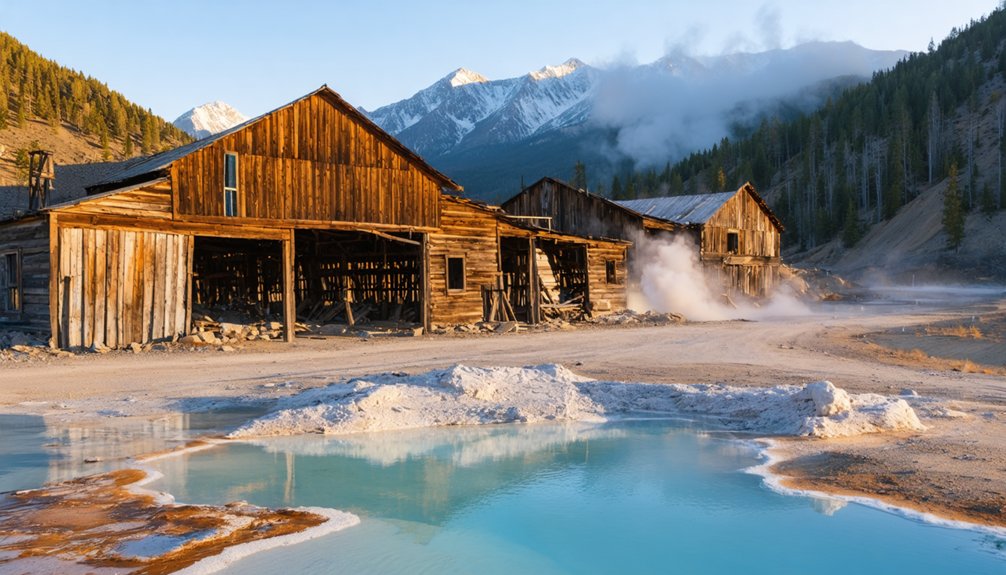
Running north–south through Mono and Inyo counties, US Highway 395 forms the backbone of one of the West’s most concentrated ghost town and hot springs touring regions, where mid-19th-century silver and gold strikes triggered settlement patterns that deliberately exploited geothermal resources for industrial, logistical, and restorative purposes.
You’ll trace hot springs history from Benton’s 1860s railroad terminus to Fales’s stage-station origins, each site documenting how miners and travelers relied on geothermal nodes for commerce and recovery.
Ghost town tourism along this corridor reveals layered narratives:
- Benton Hot Springs preserves mining-era cabins alongside eleven private soaking tubs
- Bodie State Historic Park anchors regional exploration, drawing visitors to nearby thermal sites
- Travertine and Buckeye hot springs offer Bureau of Land Management–managed soaking amid undeveloped terrain
Each stop connects extraction economies to contemporary heritage travel.
Indigenous Communities and Sacred Thermal Waters Before the Mining Era
Before Western prospectors traced gold veins through the Eastern Sierra’s volcanic terrain, Indigenous peoples established sophisticated relationships with thermal waters across a 14,000-year continuum that positioned hot springs as sacred nodes within spiritual geography, neutral territories for intertribal gathering, and therapeutic resources fundamental to seasonal migration patterns.
Indigenous Spirituality defined these geothermal sites as pathways to divine dimensions—the Crow nation termed them “bide-mahpe” (powerful water).
Tribes including the Bannock, Shoshone, Miwok, Pomo, and Wappo integrated thermal springs into annual migrations, establishing seasonal camps where Healing Practices addressed rheumatism, tuberculosis, and respiratory ailments.
You’ll find archaeological evidence—rock art, ceremonial artifacts—documenting how these waters functioned beyond physical therapy: they created demilitarized zones where conflicting nations peacefully gathered, bathed together, and honored spirits inhabiting steaming earth.
Preserving Hot Spring Ghost Towns for Modern Exploration
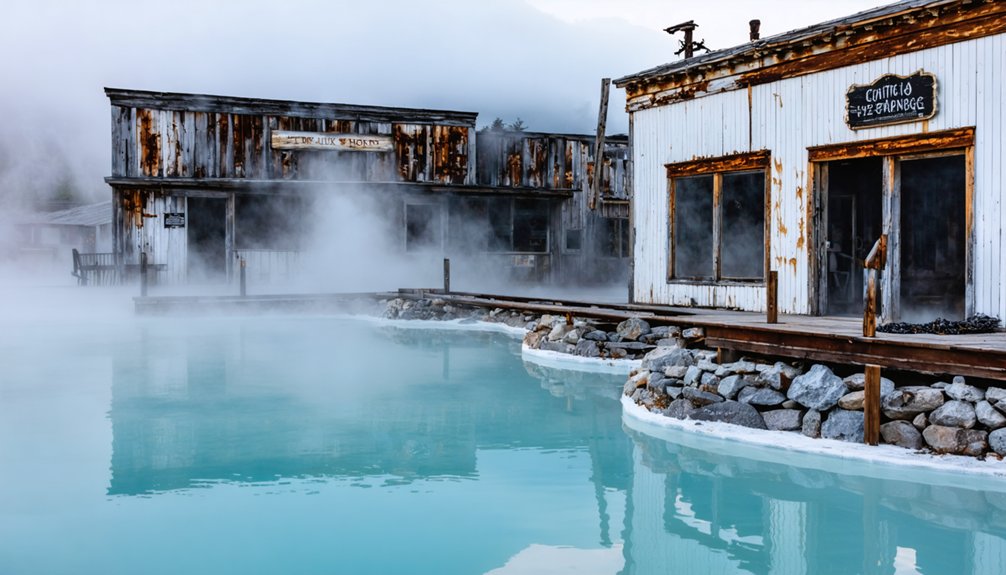
Today’s convergence of heritage tourism and outdoor recreation places unprecedented visitor pressure on the fragile intersection of ghost towns and thermal springs, compelling land managers to adopt sophisticated preservation frameworks that protect both built structures and geothermal systems.
State historic parks like Bodie employ “arrested decay” protocols—stabilizing without reconstruction—while adaptive reuse transforms select buildings into visitor centers that channel traffic away from fragile ruins.
Arrested decay preserves ghost towns as found, stabilizing structures without rebuilding while directing visitors toward reinforced spaces and away from vulnerable ruins.
Effective visitor management deploys multiple tools:
- Zoning systems separate soaking zones from no-go conservation areas, protecting foundations and subsurface artifacts
- Timed entry permits and day-use hours control volume at high-demand sites
- Boardwalks and hardened paths around geothermal features prevent erosion and structural damage
These strategies balance your exploration rights with long-term stewardship of irreplaceable mining-era and thermal resources.
Frequently Asked Questions
Can Visitors Still Soak in the Hot Springs at These Ghost Town Sites?
Soaking access varies greatly—you’ll find open public pools at Travertine, but many ghost-town springs now require reservations or prohibit entry entirely. Respect soaking etiquette and historical significance when visiting regulated sites.
What Caused Most West Coast Hot Spring Mining Towns to Be Abandoned?
Economic decline and resource depletion drove abandonment—when the 1893 silver panic struck, ore prices collapsed overnight. You’ll find most camps emptied within months once high-grade deposits played out and investors fled these remote, unprofitable hot spring settlements.
Are There Any Remaining Original Structures at Benton Hot Springs Today?
Yes, you’ll find numerous original structures with historical significance still standing, including the 1940s Inn, Wells Fargo-era commercial buildings, the stone store, historic cemetery, and authentic silver-mining-era architecture throughout Old Benton.
Which Ghost Town Near Hot Springs Is Easiest to Access Year-Round?
Dunton Hot Springs offers you the most reliable access year-round among Western ghost towns near hot springs. You’ll find maintained accessible routes and professionally managed year-round conditions, unlike most seasonal mining camps with unmaintained roads.
In addition to Dunton Hot Springs, the region is home to several ghost towns in the Pacific Northwest that captivate adventurers and history enthusiasts alike. Exploring these remnants of the past reveals fascinating stories of resilience and decline, providing a unique glimpse into the lives of those who once thrived in these now-abandoned places. From the eerie silence of deserted streets to the beautiful surrounding landscapes, each ghost town offers its own charm and allure.
Do Any Hot Spring Ghost Towns Offer Overnight Camping or Lodging?
Yes, you’ll find lodging options ranging from Dunton’s luxury cabins at $16,500 nightly to Burgdorf’s rustic $150 shelters. Ironically, “ghost” towns now impose strict camping regulations—though Benton’s tub-sites preserve frontier-style freedom.
References
- https://www.visitgreaterpalmsprings.com/blog/post/ghost-towns-of-the-california-desert/
- https://californiahighsierra.com/trips/explore-ghost-towns-of-the-high-sierra/
- https://www.atlasobscura.com/itineraries/the-wildest-west
- https://www.youtube.com/watch?v=dQxSH3XBdXY
- https://nvtami.com/2025/05/21/fales-station-hot-springs/
- https://parks.sbcounty.gov/park/calico-ghost-town-regional-park/
- https://www.avoidingregret.com/2025/04/photo-essay-silver-city-ghost-town-made.html
- https://www.tripadvisor.com/Attractions-g659472-Activities-c47-t14-California_Desert_California.html
- https://www.youtube.com/watch?v=E-yrznBe32c
- https://www.weekendsherpa.com/issues/explore-ca-ghost-towns-gold-towns-and-an-underground-garden/