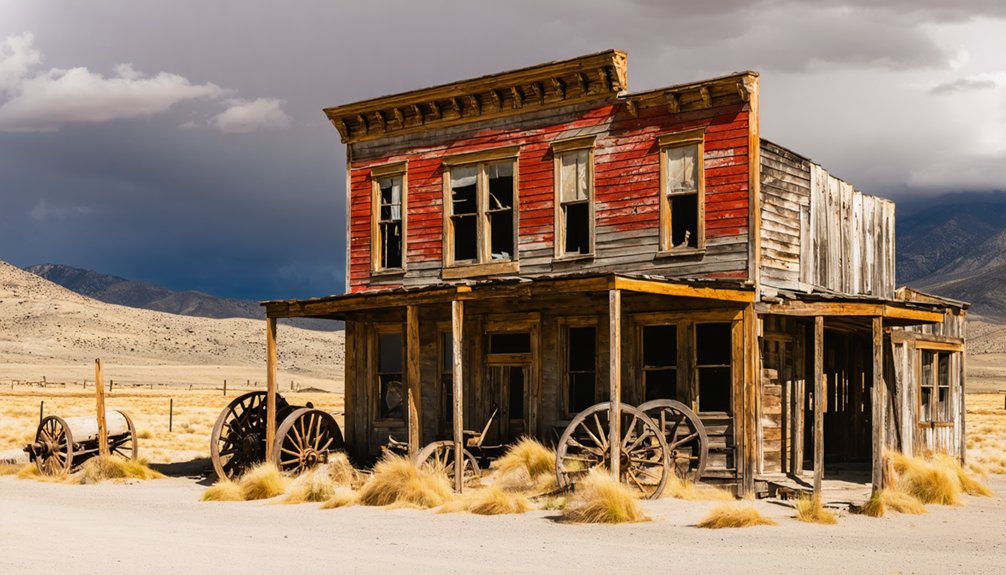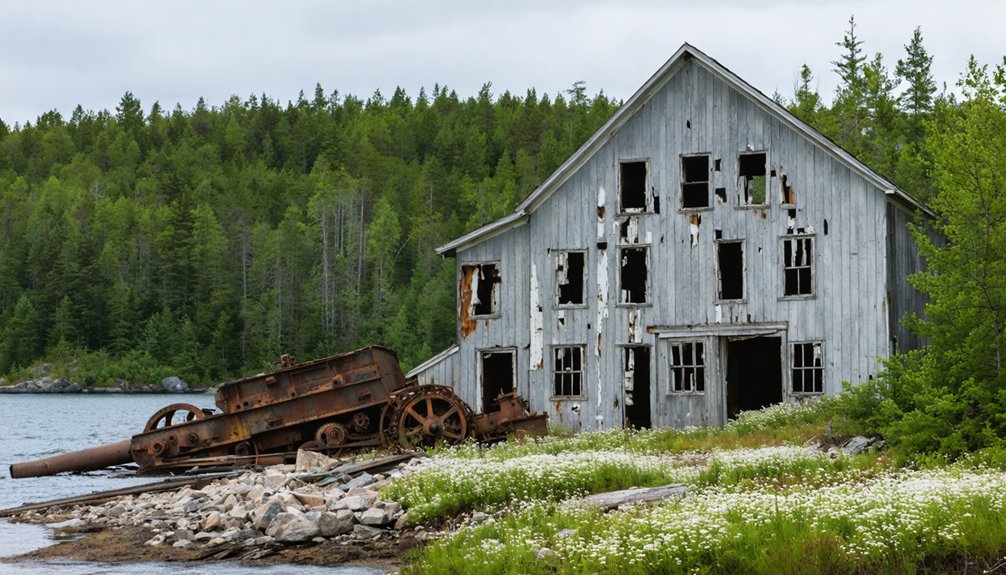
You’ll find nearly 100 ghost towns scattered across Michigan’s Keweenaw Peninsula near Isle Royale National Park, remnants of North America’s most productive native copper mining district. These abandoned settlements—including Central Mine, Clifton, Delaware, and Freda—preserve industrial ruins from the 19th-century copper boom that extracted 1.5 billion pounds of metal. Visit between late spring and fall to explore deteriorating stamp mills, company housing foundations, and mining infrastructure along US-41’s rural spurs, though you’ll need to navigate carefully around hazardous open shafts and unstable structures that harbor both historical significance and reported paranormal activity.
Key Takeaways
- Isle Royale’s Keweenaw Peninsula features nearly 100 former copper-mining settlements from the 19th-century mineral boom available for exploration.
- Clifton and Delaware represent historic mining ghost towns dating to 1845, showcasing native copper extraction ruins and failed company infrastructure.
- Central Mine operated 1854–1898, producing 52 million pounds of copper and supporting 1,200 residents before becoming an abandoned settlement.
- Freda’s Champion Mill site, operational until 1967, now features only foundations and tailings reclaimed by nature near summer cottages.
- North Manitou Island Village preserves an 1896 Life-Saving Station and abandoned dwellings within National Park Service historic district boundaries.
The Copper Mining Heritage of Michigan’s Keweenaw Peninsula
Long before European settlers arrived in the Great Lakes, Indigenous peoples recognized the Keweenaw Peninsula as a treasure house of workable metal. Between 5000 BCE and 1200 BCE, ancient miners extracted an estimated 1.5 billion pounds of nearly pure native copper using sophisticated mining techniques—fire-setting and stone hammers—to create over 5,000 pits, some reaching 26 feet deep.
Their copper artifacts traveled across North America through extensive trade networks, demonstrating the region’s importance millennia before the 1840s industrial boom. The mystery of where all this extracted copper went remains unsolved, as the scale of mining far exceeded the needs of local tribal societies and much of the copper has never been accounted for in the archaeological record.
When systematic Euro-American mining began, Michigan’s Keweenaw quickly dominated American copper production. By the late 19th century, operations like Calumet & Hecla supplied up to 95% of copper used nationwide, transforming wilderness into industrial powerhouses before eventual decline left ghost towns scattered across this historically rich landscape. The Central Mining Company, established in 1854 near Eagle Harbor, became the first Keweenaw mine to generate profit in its initial operational year, producing 83,836 pounds of copper in 1855.
Central Mine: A Profitable Pioneer in Copper Country
When the Central Mining Company purchased over 300 acres from the Northwestern Mining Company in 1854, surveyors discovered they’d acquired far more than pristine wilderness—the land harbored an ancient Native American copper pit, evidence of sophisticated extraction work completed thousands of years earlier.
This Keweenaw Peninsula operation became Michigan’s most profitable fissure mine, achieving what no other mine could:
- First-year profitability with 83,836 pounds of copper production in 1854
- 52 million pounds of total copper production from 1854–1898
- $2,130,000 in dividends on just $100,000 invested
- Operational longevity as the last fissure mine standing until 1898
Advanced mining technology including man engines and drainage adits enabled crews to reach 30 levels underground before geological faults ended this remarkable enterprise. The town’s population swelled to approximately 1,200 residents during its peak in the mid-1880s, transforming the remote mining camp into a thriving community. The mining company constructed housing for employees and essential infrastructure, establishing a settlement that would endure for decades in Michigan’s Copper Country.
Freda and the Champion Mill Ruins
Along Lake Superior’s rugged shoreline, seventeen miles west of Hancock, the skeletal remains of the Champion Stamp Mill mark where the community of Freda once thrived as a quintessential company town.
Built around 1899–1901 to process copper-bearing rock, the mill sustained roughly 500 residents who depended entirely on its operations.
Freda history reflects corporate paternalism—the mining company owned everything from housing to the post office.
The Champion Mill outlasted all neighboring facilities through technological innovation, becoming Copper Country’s last producing mill before closing in 1967.
Demolition followed in 1972, leaving only foundations and black tailings beaches as evidence.
Today you’ll find a semi-ghost town where summer cottages occupy lots once bustling with barber shops, saloons, and workers’ families—a landscape reclaimed by those seeking solitude rather than industrial servitude.
Explorers venturing further can discover ghost towns near Estes Park, where echoes of the past linger in the shadows of decaying buildings. The remnants of these once-thriving communities tell stories of adventure and hardship, inviting curious souls to wander through their silent streets. Each corner reveals a glimpse into the lives of those who sought fortune in the rugged mountains.
The ruins remain visible from a cliff overlook, though barbed wire fencing prevents visitors from accessing the weathered concrete structures and towering smokestack that once dominated the shoreline.
Dispersed camping is available within a couple of miles of the ruins, offering adventurers scenic views and access to the surrounding forestland.
North Manitou Island’s Abandoned Villages
On North Manitou Island’s west shore, you’ll find the scattered ruins of Crescent village, established in 1906 when the Smith & Hull Company built a complete logging camp—sawmill, boarding house, general store, and even a saloon-turned-schoolhouse—to support intensive timber operations that stripped the island’s western forests until 1915.
Across the island on the sheltered east side, the original settlement near Pickard’s 1850s cordwood dock evolved into a more permanent village centered on the U.S. Life-Saving Station, Cottage Row’s summer retreats, and the Manitou Island Association’s substantial farm barns. Among the historic structures, a steam-powered sawmill built in 1927 remains as Michigan’s last surviving example of this technology. The lighthouse on the southern tip, built by the United States Lighthouse Establishment, was decommissioned in 1938 and subsequently destroyed four years later.
Both villages represent distinct phases of Great Lakes resource extraction and recreation, their remaining foundations and structural remnants now protected within Sleeping Bear Dunes National Lakeshore‘s wilderness backcountry.
Crescent Village Timber Operations
The establishment of Crescent Village in 1907 marked North Manitou Island’s shift into large-scale commercial timber extraction, with A.J. White and Son relocating their sawmill operation from Cedar Run.
This Crescent history transformed 4,000 acres of pristine northwest island forestland into an industrial timber operation within today’s Sleeping Bear Dunes National Lakeshore boundaries.
The timber legacy infrastructure included:
- Railroad networks connecting remote lumber camps to processing facilities
- 600-foot shipping dock completed in fall 1908 for lumber exports
- Big wheels machinery hauling logs downslope for transport and dock construction
- Multiple work camps supporting the substantial workforce requirements
Operations spanned approximately ten years before ceasing in the mid-1910s.
The Josephine Dresden, equipped with the first auxiliary gas engine on a Great Lakes vessel, transported lumber and equipment between Crescent and mainland ports throughout the operation’s active years.
Today, little physical evidence remains of the once-bustling lumbertown, with the Crescent clearing and mill pond now reclaimed by wilderness, though ground depressions and old apple trees still mark the historical landscape.
East Side Settlement Remains
While Crescent Village dominated North Manitou Island’s northwest shore during the timber era, the island’s southeastern coastline harbored a more enduring settlement that predated commercial logging by decades and outlasted it by generations.
You’ll find North Manitou Island Village near today’s ferry landing, established in the 1850s when Nicholas Pickard relocated his cordwood fueling station to supply passing steamships.
The archaeological significance of this landscape extends far deeper—indigenous peoples occupied these sheltered eastern shores for potentially 13,000 years, making it one of the Great Lakes’ richest archaeological sites.
Today’s visible remains include the 1896 Life-Saving Station, abandoned Cottage Row dwellings, and scattered farm structures from the Manitou Island Association’s agricultural operations, all preserved within the National Park Service’s historic district boundaries.
Clifton, Delaware, and Other Historic Mining Settlements
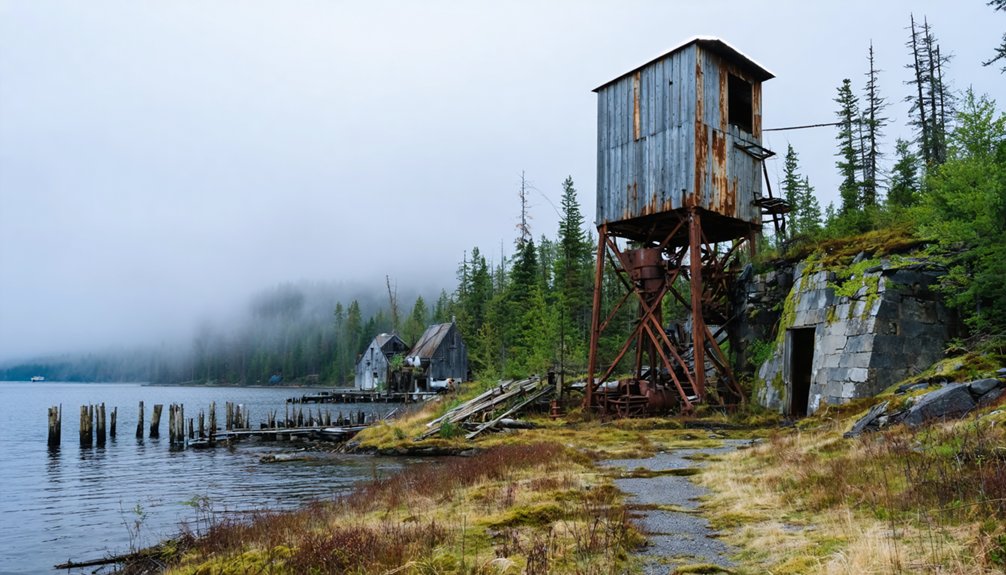
Scattered along Michigan’s Keweenaw Peninsula—Isle Royale’s mainland gateway—several abandoned copper mining settlements tell the story of the region’s 19th-century mineral boom.
The Clifton ruins near present-day US-41 mark where thousands of workers extracted native copper from 1845 onward, leaving stone foundations and stamp sand as evidence.
Delaware heritage sites further south preserve another failed company town, where low-grade ore and mounting costs forced permanent closure.
You’ll discover these ghost towns represent the same copper rush that drove Isle Royale’s mining ventures:
- Clifton’s Cliff Mine produced millions of pounds before ore depletion
- Delaware’s scattered shafts show repeated boom-and-bust cycles
- Company infrastructure included schools, churches, and boarding houses
- Archaeological remnants document early industrial copper extraction
These accessible mainland sites let you explore mining history without wilderness permits.
Jacobsville: From Fishing Village to Sandstone Quarry Hub
You’ll find Jacobsville’s distinctive history at the mouth of the Portage River, where the settlement emerged in 1887 as a dual-economy community unlike typical single-industry ghost towns.
The village’s founders established commercial fishing operations while simultaneously developing sandstone quarry infrastructure that would supply building materials across the Keweenaw Peninsula.
This strategic positioning allowed Jacobsville to extract resources from both maritime and terrestrial sources, creating a robust economic foundation that sustained the settlement through the late 19th century’s industrial expansion.
Fishing Village Origins
Before sandstone quarries transformed Jacobsville into an industrial hub, the settlement began in the 1880s as a small fishing village at the mouth of the Portage River on Lake Superior’s Keweenaw Peninsula south shore.
John Henry Jacobs established the formal townsite in 1885, building upon existing lakeshore activity. Early community growth centered on commercial fishing operations that employed traditional fishing techniques:
- Open boats powered by oars and sails navigated nearshore waters
- Gill nets hauled over gunwales were cleared of catch by hand
- Fish packed in ice and burlap bags for preservation
- Rail shipment from Portage Entry connected local fishers to regional markets
The post office operated from 1887–1964, marking the village’s evolution from waterside fishing hamlet through industrial boom to eventual decline.
Sandstone Quarrying Legacy
When John Henry Jacobs opened his major quarries in 1884, he transformed a modest lakeside fishing settlement into an industrial hub centered on extracting the distinctive red-and-white banded sandstone that would bear his name.
Workers first blasted through up to 50 feet of glacial overburden, then employed specialized quarrying techniques—cutting narrow channels four feet apart before wedging out massive blocks.
The sandstone characteristics that made Jacobsville stone prized across eastern North America included its fine grain, weather resistance, and dramatic color contrast from ancient rift sediments.
You’ll find this stone in churches, banks, and civic buildings from the Copper Country to distant Midwest cities.
At its 1883–1896 peak, up to 32 quarries operated regionwide, shipping blocks via Lake Superior’s transport routes to construction markets hungry for this durable, workable material.
Exploring the Ghost Towns: What Visitors Can Expect
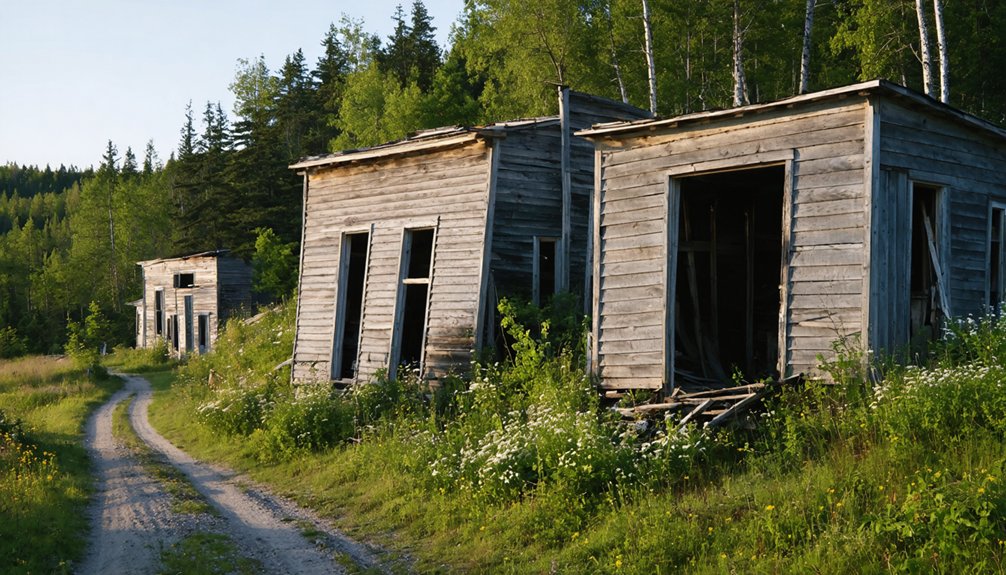
Scattered across the Keweenaw Peninsula‘s rugged terrain, nearly 100 former copper-mining settlements await exploration as ghost towns frozen in various stages of industrial decay and natural reclamation.
You’ll navigate narrow rural roads to reach rustic landscapes where forests reclaim stamp mills, smokestacks, and company housing. Sites like Central Mine and Freda offer industrial relics ranging from massive concrete foundations to overgrown rail grades.
When exploring, expect:
- Self-guided access via US-41 spurs and backcountry routes requiring cautious foot travel
- Hazardous remnants including open shafts, unstable masonry, and eroding tailings
- Near-solitude even during peak season, with ambient natural sounds replacing industrial clamor
- Ideal late-spring through fall visits when Keweenaw roads clear and autumn colors enhance photographic opportunities
You’ll find these sites pair naturally with Isle Royale trips staged from Houghton or Copper Harbor.
Paranormal and Cultural Attractions in Keweenaw’s Abandoned Towns
Beyond the physical ruins and industrial artifacts, the Keweenaw’s ghost towns harbor a parallel landscape of folklore, apparition accounts, and supernatural tradition that draws visitors seeking more than historic architecture.
You’ll encounter paranormal encounters at sites like Calumet Theatre, where actress Madam Helena Modjeska reportedly appears decades after her 1909 death, and Quincy Mine’s shafts, where miners’ spirits allegedly linger.
Cultural folklore deepens the experience: the Keweenaw Vortex’s twisted cedars draw seekers to an energetic hotspot linked to Native burial grounds, while Bete Grise’s “singing sands” embody Grey Beast legends.
Laurium Manor Inn and Central Mine weave tragic mining-era deaths into their narratives.
These layered traditions transform abandoned settlements into multi-dimensional destinations where history, myth, and reported hauntings converge.
Frequently Asked Questions
How Far Is the Keweenaw Peninsula From Isle Royale National Park?
The Keweenaw Peninsula sits 56 miles from Isle Royale’s shores. You’ll traverse Lake Superior’s wild waters via scenic routes from Copper Harbor, measuring this distance through ferry journeys that preserve your connection to untamed wilderness and historic exploration.
Can Visitors Stay Overnight Near These Ghost Town Sites?
Yes, you’ll find camping options at designated Isle Royale campgrounds and mainland parks like Fayette, plus local accommodations including Rock Harbor Lodge, Windigo cabins, and Keweenaw Peninsula lodging near preservation sites.
Are There Guided Tours Available for the Ghost Towns?
You won’t find formal guided tours at most ghost towns near Isle Royale, but you’ll discover self-guided exploration supported by interpretive signs, maps, and curated guides that reveal each site’s historical significance and mining heritage.
What Is the Best Time of Year to Visit These Locations?
Visit during July–August for peak season accessibility and stable weather, or choose early fall for fewer crowds and fall colors. You’ll need weather considerations like insect protection in spring and layered clothing for October exploration.
Are Pets Allowed When Exploring the Ghost Town Sites?
Pet policies vary wildly across ghost town sites—you’ll find pets restricted inside historic buildings and museums, though outdoor ruins often permit them. Research hiking tips and verify specific regulations beforehand to maximize your exploration freedom.
References
- https://www.nps.gov/slbe/learn/historyculture/ghosttowns.htm
- https://www.cascadevacationrentals.com/6571/isle-royale/
- https://www.visitkeweenaw.com/blog/post/our-top-7-keweenaw-ghost-towns-to-explore/
- https://www.visitkeweenaw.com/things-to-do/museums-history/ghost-towns/
- https://www.youtube.com/watch?v=7-vjuqiGWJU
- https://mikelbclassen.com/pequaming-ghost-town-baraga-county-michigan/
- https://www.uptravel.com/things-to-do/attractions/fayette-historic-state-park-townsite/
- https://www.theinnatstonecliffe.com/blog/prehistoric-copper-heist-the-vanished-billions-of-the-keweenaw-peninsula
- https://www.keweenawhistory.org/Central-Mining-Co
- https://www.nps.gov/kewe/learn/historyculture/copper-mining-timeline.htm