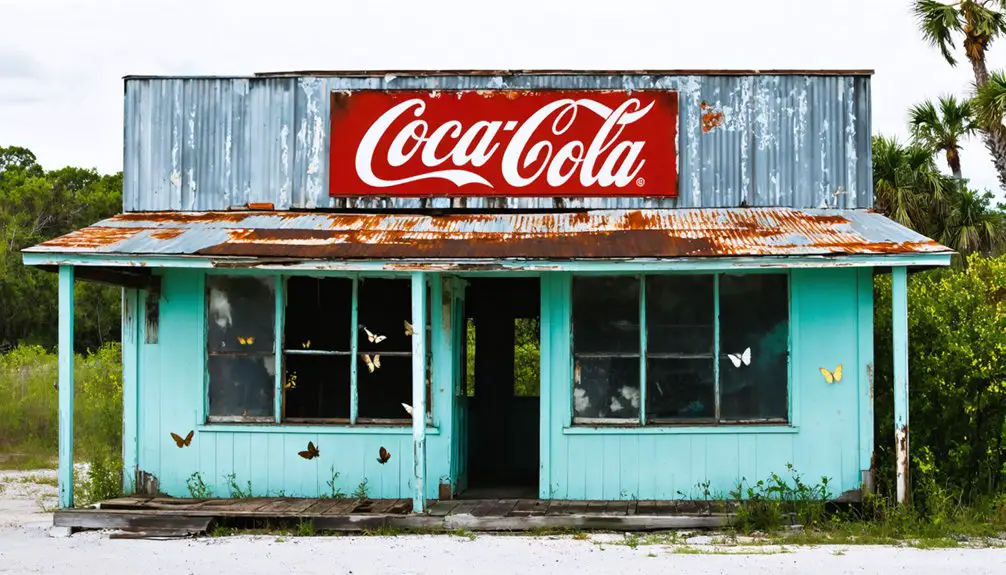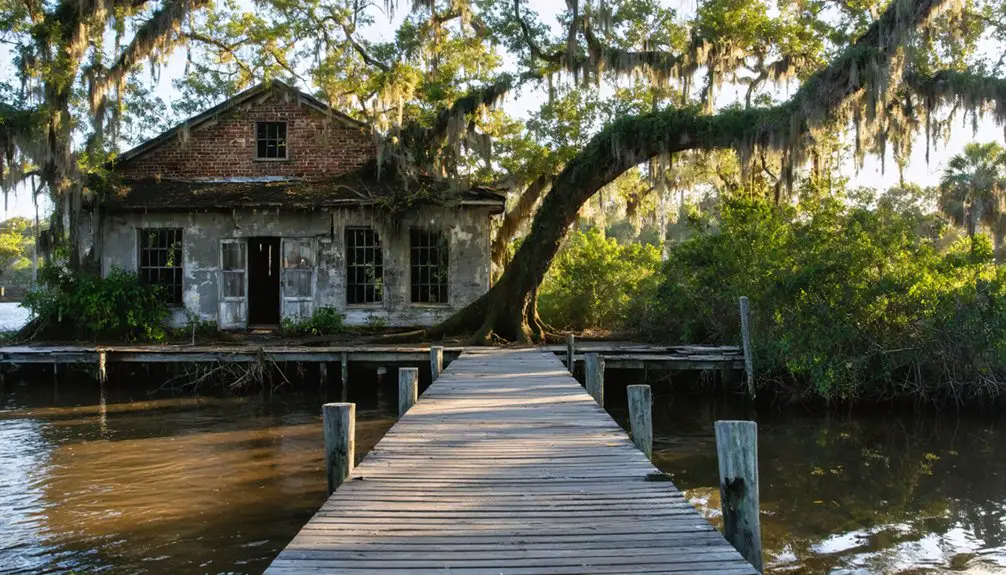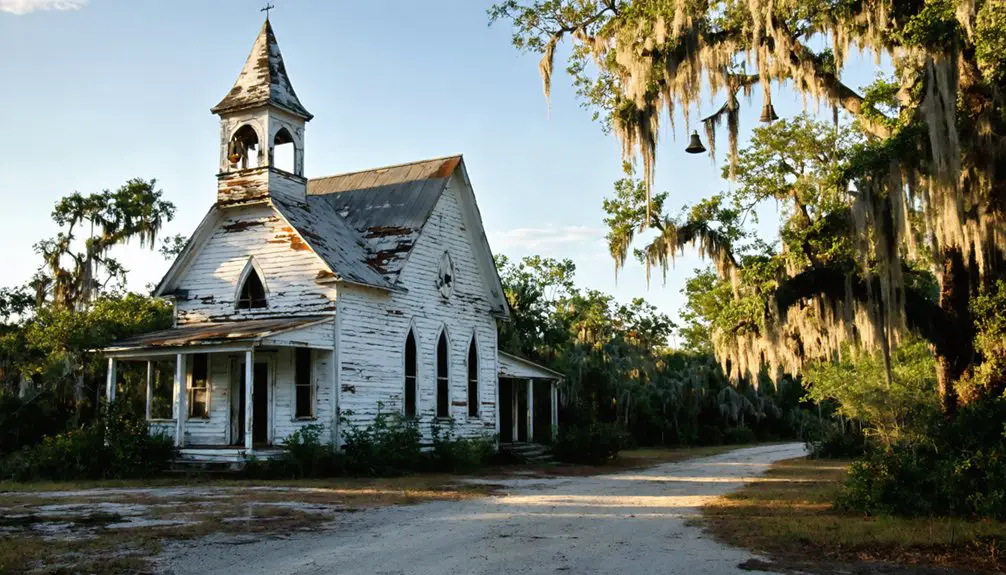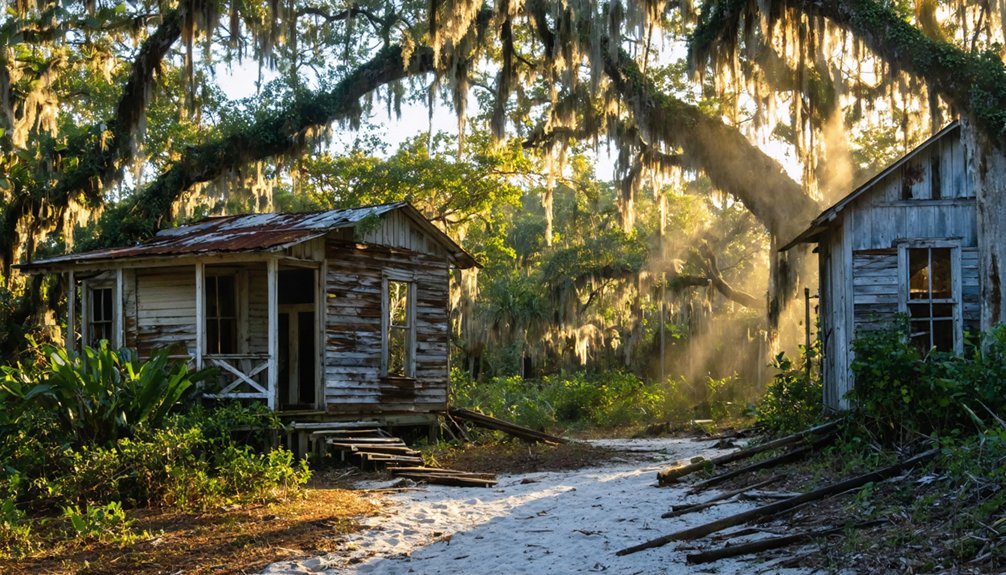
You’ll find Yukon, Jacksonville’s most accessible ghost town, just miles from downtown—a community of 200+ homes bulldozed in 1963 when the U.S. Navy declared it a flight hazard to NAS Jacksonville. Today, brick culverts, concrete pumphouses, and foundation slabs hide beneath palmetto scrub where Dewey Park once housed military families. Further afield, Ellaville’s 1861 lumber metropolis offers the rusted Hillman Bridge and building foundations, while abandoned logging camps dot North Florida’s backwoods. The infrastructure tells stories federal records tried erasing.
Key Takeaways
- Yukon, erased by the U.S. Navy in 1963, features abandoned infrastructure including brick culverts, pumphouses, and concrete slabs in reclaimed woodland.
- Ellaville, founded in 1861, peaked at 1,000 residents before declining due to mill fires and flooding, with its post office closing in 1942.
- Dewey Park subdivision was completely bulldozed after 1963 when NAS Jacksonville designated the area a flight hazard, displacing military families without replacement housing.
- Ghost towns like Genoa and Trail Ridge logging camps offer sparse archaeological traces along North Florida’s former FEC railroad route from the late 1800s.
- Explorers face trespassing penalties under Florida Statute 810.09 near NAS Jacksonville and hazards like weakened floors and asbestos in abandoned structures.
When the U.S. Navy designated Yukon as a flight and safety hazard in 1963, it sealed the fate of a community with deep roots in Yukon history stretching back to Mulberry Grove Plantation and the post-Civil War Blackpoint Settlement.
This thriving town featured paved streets, businesses, and the 300-unit Dewey Park subdivision housing Navy families. The Naval impact from adjacent NAS Jacksonville had initially fueled growth, creating a military-oriented economy.
However, proximity to flight corridors became fatal. With accident rates hitting 55 major mishaps per 100,000 flight hours in 1954, flight safety concerns triggered federal eminent domain action.
Community transformation came swiftly—homes, businesses, and an entire urban fabric vanished beneath government acquisition, erasing Yukon to protect naval aviation operations. Today, Tillie K. Fowler Regional Park preserves remnants of this lost community through its observation tower and nature center. The area experienced extreme temperature variations, with winter conditions sometimes dropping to −60°C (−76°F) during cold snaps.
At the heart of Yukon’s erasure stood Dewey Park, a 300-unit enlisted housing complex that had anchored the Navy community since its construction between 1941 and 1942.
Built during wartime expansion at NAS Jacksonville, the neighborhood operated at capacity for two decades, fostering community resilience among military families who endured constant aircraft noise overhead.
Navy investment continued into 1958 with a new water treatment plant delivering “clean, pure, soft, aerated water” to residents.
The facility drilled 900 feet into the Floridan Aquifer, increasing the base’s water supply by 1,500 gallons per minute.
Yet tragedy marked the complex—in 1943, thirteen-year-old Harry Bruce Bailey died in a house fire.
The subdivision traced its lineage to Yukon’s development, when the railroad depot served as a transportation hub connecting the community to Jacksonville’s urban core.
The historical significance of this self-contained military neighborhood vanished when closure came in 1963, abandoning infrastructure barely five years old and scattering families who’d built lives around Jacksonville’s western aviation corridor.
Exploring the Abandoned Streets and Foundations
Though decades of natural reclamation have transformed Yukon’s grid into unmarked woodland, the skeletal infrastructure of Dewey Park still punctuates the forest floor with eerie precision.
Your urban exploration reveals brick-fronted culverts where driveways once connected to 300 family homes. Concrete block pumphouses stand abandoned among Christmas ferns and greenbriers, while old iron pipes and valves deteriorate beneath tangled vines.
Brick culverts and abandoned pumphouses emerge from tangled vines, marking where 300 families once called this reclaimed wilderness home.
You’ll find doorless cisterns dropping straight into underground darkness, ringed by vegetation. Water tower foundations with sound-baffling walls remain visible through aerial photography comparisons between 1943 and 1960.
Storage tank platforms feature unusual round wall construction, now obscured by forest growth. Similar forgotten communities emerged along the FEC railroad route between Jacksonville and St. Augustine in the late 19th century. The area’s military heritage connects to nearby Naval Air Station Lee Field, established on September 11, 1940, to support U.S. Navy operations during World War II. These remnants possess historical significance as the largest evidence of organized community planning, marking where enlisted families lived before their forced 1963 displacement.
How Military Expansion Shaped These Ghost Communities
Military necessity transformed Yukon from a thriving naval community into erased landscape within a single generation.
You’ll find that military policies drove the complete bulldozing of this 300-unit Navy housing project after the March 1, 1963 closure announcement gave families just four months to vacate. The community impact was devastating—displaced personnel received no replacement federal housing despite acknowledged shortages.
Infrastructure development sealed Yukon’s fate: water towers, pump stations, and expanded runways consumed residential zones that had served Navy families since 1941.
The government’s 1939 land acquisition for NAS Jacksonville established precedent for systematic removal when strategic needs changed. Economic downturns and shifting transportation routes had already weakened similar Florida communities, making military installations vulnerable to abandonment when priorities shifted.
Strategic realignments during subsequent decades led to similar closures across Florida as military priorities evolved beyond the original wartime necessities that had established these bases.
Today, only fragmented pavement remnants mark where schools, homes, and businesses once stood, completely obliterated by naval expansion prioritizing operational requirements over community preservation.
What Remains: Infrastructure Frozen in Time
You’ll find brick-fronted culverts and abandoned roadbeds threading through second-growth forest where Dewey Park’s residential streets once ran, their alignments still traceable along 120th Street and old Norman Street.
Concrete cisterns drop vertically from the forest floor, uncapped and overgrown, while a small block pumphouse stands intact with rusted valves and iron pipes documenting the neighborhood’s vanished utility network.
Near US 17 in southwest Jacksonville, sections of Yukon’s original brick roads survive beneath leaf litter, their curbs and right-of-way clearances preserving the ghost town’s commercial corridor and early-20th-century street grid. Jacksonville’s former Union Station features brick-walled pedestrian tunnels that stretched 300 feet beneath the tracks, now flooded and largely inaccessible since the terminal’s closure in 1974.
In Greenland, a network of dirt streets named after Cedar, Pine, Elm, Magnolia, and Ash still winds through the quiet settlement, their tree-inspired names echoing the turpentine industry that once drove the community’s economy.
Abandoned Brick Roads Persist
Red bricks embedded in sandy soil mark the Old Dixie Highway‘s ghost, a 10-mile corridor through central Flagler and southern St. Johns counties.
Completed in 1916, this 9-foot-wide passage once transported over 100 tourists daily from Chicago to Florida’s wilderness. The road’s obsolescence arrived swiftly—by 1926, newer routes rendered it useless.
Today, you’ll find these abandoned highways consumed by slash pine and palmetto, their surfaces fractured by potholes and buried under drifting sand.
Similar forgotten landmarks persist at Yukon’s ghost town site, where brick roads remain visible beneath Jacksonville’s Tillie K. Fowler Regional Park.
At Dewey Park, brick culverts and driveways emerge through broom sedge, marking Navy housing built during 1941-1942.
These thoroughfares endure as cartographic evidence of communities erased.
Concrete Foundations Mark Homes
Concrete slabs emerge from palmetto thickets and volunteer oak saplings across Northeast Florida‘s abandoned residential sites, their geometric precision contrasting sharply with the organic chaos reclaiming them.
You’ll find these concrete remnants near Jacksonville’s waterways, where wood-frame houses succumbed to rot, termites, or storm damage while their reinforced foundations endured.
Foundation patterns reveal entire neighborhood layouts—rectangular pads mark main living spaces, L-shaped configurations show kitchen additions, and driveway aprons still point toward vanished sand roads.
Along the Trout River and St. Johns, elevated pier lines document flood-adapted construction before repetitive inundation forced final abandonment.
Depression-era hand-poured bases and mid-century cinder-block footers resist North Florida’s humidity with remarkable tenacity, preserving domestic floor plans as legible archaeological signatures long after walls and roofs disappear.
Utility Structures Still Stand
Beyond the concrete pads that mark vanished homes, Jacksonville’s ghost towns preserve a more specialized layer of abandonment: the utility infrastructure that once animated entire communities.
At Dewey Park, you’ll find an abandoned Navy wastewater treatment plant west of NAS Jacksonville, its tanks and control structures still standing among overgrowth. A concrete-block pumphouse survives in the woods, containing rusted iron pipes, valves, and gears that once distributed water throughout military housing.
The sound-baffling concrete wall ring that encircled pumps beneath a water tower remains visible in aerial comparisons between 1943 and 1960 imagery.
These utility relics carry historical significance beyond their engineering function—they’re fixed reference points revealing how infrastructure shaped settlement patterns and linked civilian towns to military operations.
Ellaville and Other North Florida Ghost Towns Worth Visiting
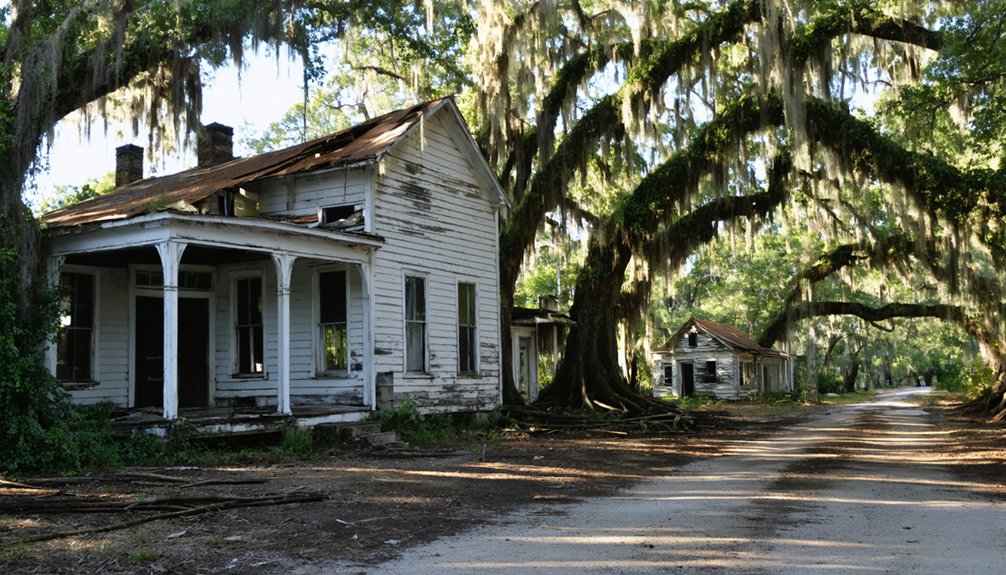
North of Jacksonville, the wooded floodplains and sandhills of the Suwannee River valley shelter some of Florida’s most evocative ghost towns, chief among them Ellaville, a once-thriving lumber metropolis founded around 1861 by George Franklin Drew—later governor—on the river’s western banks.
At its 1870s zenith, Ellaville‘s steam sawmill employed 500 workers, supporting nearly 1,000 residents across two churches, two schools, a Masonic lodge, and a railroad depot.
The 1898 mill fire, pine depletion, and flooding triggered irreversible decline; the post office closed in 1942.
Today you’ll find the abandoned Hillman Bridge (1925), rail-bridge remnants, and foundation scars where Drew’s mansion once stood.
Nearby Genoa and Trail Ridge logging camps offer similarly sparse archaeological traces, rewarding explorers seeking North Florida ghost towns beyond conventional tourist circuits.
Safety and Access Considerations for Urban Explorers
When exploring ghost towns near Jacksonville, you’ll encounter distinct challenges including proximity to active Naval Air Station Jacksonville and Camp Blanding Joint Training Center, where unauthorized entry onto military property carries federal penalties.
Abandoned structures throughout North Florida present documented hazards: floor joists weakened by decades of termite damage and moisture, asbestos-containing materials in buildings constructed before 1980, and unstable staircases missing treads or support beams.
Florida Statute 810.09 defines trespass on property other than a structure or conveyance, with penalties escalating if you ignore posted signage or enter areas where the owner has communicated prohibition through fencing, gates, or direct notice.
Although abandoned settlements and decaying structures draw urban explorers to Florida’s northeast interior, many of the region’s most evocative ruins lie within or immediately adjacent to active U.S. military installations—spaces where federal law, live-fire training, and unexploded ordnance create formidable barriers to access.
Understanding military history and community impact requires recognizing that installations like Camp Blanding and the Pinecastle Range absorbed entire settlements during World War II expansions.
You’ll find 18 U.S.C. § 1382 enforced through layered perimeter security: fencing, sensors, patrols, and controlled gates marking legal boundaries even in remote forest corridors.
The Jacksonville Range Complex spans approximately 150,000 square miles of controlled airspace and surface zones, with live-fire schedules published in Navy notices.
Crossing posted boundaries risks federal prosecution, detention, and encounter with unexploded ordnance in former impact areas.
Hazards in Abandoned Infrastructure
Beyond the legal perimeters that guard military installations, the physical fabric of abandoned structures presents layered risks that demand methodical assessment before entry.
Hazard awareness begins with recognizing that wooden floors decay rapidly and break under weight, while sagging concrete signals imminent collapse.
You’ll encounter asbestos—the primary danger for urban explorers—which becomes airborne when disturbed and causes fatal mesothelioma.
Black mold, lead paint particles, and industrial chemical residues compound respiratory threats.
Water damage accelerates structural degradation through wood rot and steel corrosion.
Exposed wiring creates electrocution risks, rusted metal breaks unexpectedly, and unseen floor voids threaten falls.
Squatters leave contaminated needles throughout buildings.
Structural safety requires respiratory protection, careful foot placement, wall-proximity when crossing questionable surfaces, and complete avoidance of flooded basements.
Legal Boundaries and Trespassing
Physical dangers inside crumbling structures carry immediate consequences, but the legal framework surrounding abandoned sites determines whether you’ll face criminal charges before you ever step through a threshold.
Florida’s trespass laws under Chapter 810 apply equally to vacant buildings and active properties—abandonment doesn’t create public access. Posted “No Trespassing” signs, fencing, or condemnation notices elevate charges from misdemeanor to more serious offenses.
Ghost towns like Yukon near NAS Jacksonville sit on federal military land, where unauthorized entry triggers separate federal statutes beyond state trespass laws.
Jacksonville’s consolidated jurisdiction means former communities within city limits remain under active code enforcement and police patrol. Entry into structures—even derelict ones—can escalate to burglary charges if prosecutors establish intent to commit any offense inside, transforming urban exploration into felony territory.
Preserving the Memory of Jacksonville’s Lost Neighborhoods
When historic neighborhoods vanish beneath highways and redevelopment projects, documentation becomes the primary tool for preserving their legacy.
You’ll find historic preservation efforts through Jacksonville History Center’s annual endangered buildings lists and National Register nominations that protect structures like John Gorrie Junior High School.
Neighborhood memories survive in Sanborn maps documenting Brooklyn’s post-Civil War Black community and LaVilla’s cultural significance.
Since 2015, volunteer organizations conduct restoration workdays at sites like Annie Lytle School, while philanthropic investments transform abandoned buildings into functional spaces.
Structures like Snyder Memorial Methodist Church and Eartha M.M. White Youth Recreation Center stand as physical testimony to communities that shaped Jacksonville’s identity.
These preservation initiatives guarantee forgotten neighborhoods remain accessible for future generations seeking historical truth.
Frequently Asked Questions
Are There Guided Tours Available for Yukon or Dewey Park Ruins?
You won’t find commercial guided tour options for Yukon or Dewey Park ruins. Both sites’ historical significance is preserved through self-guided exploration at Tillie K. Fowler Regional Park, where you’ll navigate trails independently among the remains.
Can You Legally Access the Ghost Town Sites Near NAS Jacksonville?
You’ll find “legal access” to this ghost town ironically limited: only marked trails inside Tillie K. Fowler Regional Park are permitted, while Navy-controlled Yukon/Dewey Park remnants beyond park boundaries remain federally restricted, off-limits territory.
What’s the Best Time of Year to Explore North Florida Ghost Towns?
The best season for exploring North Florida ghost towns is late fall through early spring (November–March), when weather conditions offer cooler temperatures, lower humidity, reduced insects, clearer vegetation, and drier trails for safer access.
Were Any Residents Compensated When Yukon Was Closed in 1963?
Yukon history doesn’t clearly document compensation details for displaced residents. Eminent domain legally required fair market value for property owners, but resident experiences—especially renters and Navy families—remain largely unrecorded in accessible sources.
How Do I Find Exact Coordinates for Dewey Park Housing Remnants?
You’ll need GPS tools and satellite imagery to pinpoint slab foundations along 120th Street inside Tillie K. Fowler Regional Park, then overlay historical maps from Navy-era surveys to confirm exact Dewey Park housing coordinates.
References
- https://www.florida-backroads-travel.com/florida-ghost-towns.html
- https://www.atlasobscura.com/places/the-ghost-town-of-ellaville-madison-florida
- https://www.freakyfoottours.com/us/florida/
- https://en.wikipedia.org/wiki/Yukon
- http://www.gribblenation.org/2018/02/ghost-town-tuesday-yukon-fl-abandoned.html
- https://www.jacksonvillemag.com/2024/07/16/ghost-town/
- https://abandonedfl.com/city/north-florida/jacksonville/
- https://www.thejaxsonmag.com/article/ghost-town-yukon-florida/
- https://www.thetravel.com/why-florida-ghost-town-near-jacksonville-was-abandoned/
- https://www.metrojacksonville.com/article/2008-aug-jacksonvilles-ghost-town-yukon