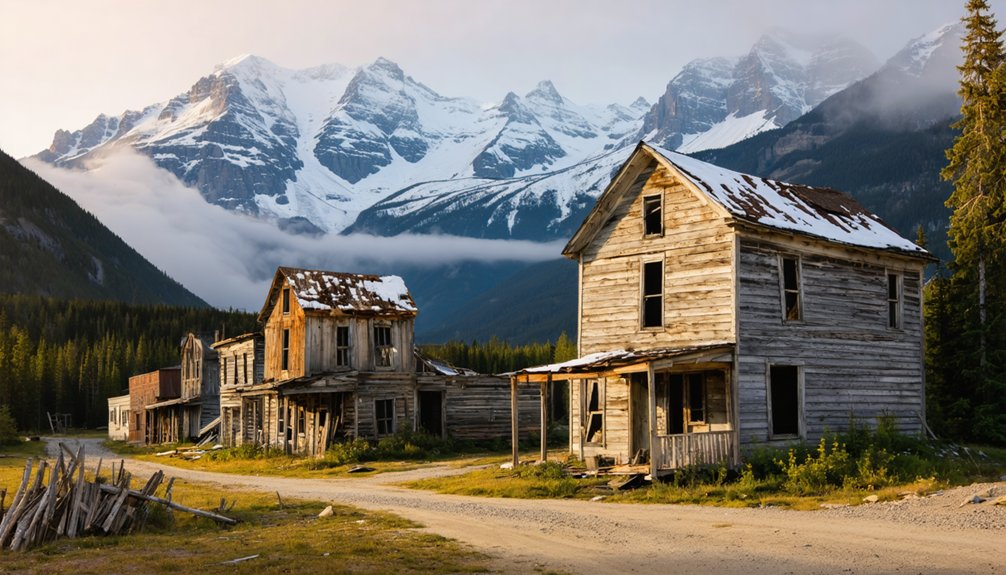
You’ll discover Alberta’s most fascinating ghost towns along the Coal Branch, a network of abandoned mining communities southwest of Hinton, just 90 minutes from Jasper. Mountain Park, founded in 1911, once housed 1,500 residents before closing in 1950. Cadomin peaked at 2,500 people before a devastating 1952 flood reduced it to fewer than 50 residents today. Luscar, Mercoal, and Lovett vanished after economic decline, leaving scattered remnants accessible off Highway 47. These sites preserve compelling stories of early 20th-century resource extraction and the resilient communities that thrived there.
Key Takeaways
- Mountain Park, founded in 1911, once housed 1,500 residents before closing in 1950, featuring a restored cemetery today.
- Cadomin, established in 1917, peaked at nearly 2,500 residents before a devastating 1952 flood reduced it to under 50.
- Luscar was completely obliterated in 1969, while nearby Mercoal and Lovett disappeared after economic decline along Highway 47.
- Robb remains a living community with active mining operations, its population doubling due to the Bryan Mountain surface mine.
- These Coal Branch ghost towns reflect early 20th-century resource booms and offer growing tourism and historical research opportunities.
Coal Branch Region: Gateway to Alberta’s Mining Past
The Coal Branch region stretches along the eastern slopes of the Canadian Rockies, east of Jasper National Park, where the McLeod, Lovett, and Embarras Rivers carved the valleys that would host one of Alberta’s most significant coal-mining corridors.
Between 1912 and the late 1940s, this remote territory became second only to Crowsnest Pass in provincial coal output, its mining heritage built on high-quality steam coal that powered Canada’s expanding rail networks.
The Grand Trunk Pacific Railway constructed 57 miles of track south from Bickerdike in 1911–1912, later adding branches to Mountain Park and Luscar.
At peak production in 1929, thousands of workers and families occupied a chain of settlements along the narrow valley line.
The scenic mountain setting now attracts outdoor recreation enthusiasts for hiking, fishing, and camping throughout the former mining corridor.
Today, you’ll find the historical significance of this once-thriving industrial landscape preserved in abandoned townsites scattered across the foothills.
Mountain Park: Ruins Among the Peaks
At 1,890 metres above sea level, Mountain Park earned distinction as the highest year-round inhabited community in the British Commonwealth during its operational decades, perched in a dramatic alpine basin where coal seams and Rocky Mountain peaks converged.
Founded in 1911 following coal discovery by the Greggs in 1895, this planned village housed 1,500 residents who built a thriving community complete with school, hospital, theatre, and library.
At its peak, Mountain Park’s 1,500 residents sustained a complete alpine town with essential services and cultural amenities against all odds.
The Mountain Park Coal Company shipped quality coal via dedicated rail until economic forces—diesel fuel conversion, flooding, and mounting debt—forced closure on June 19, 1950.
Today you’ll find only scattered foundations, crumbling mine structures, and slag heaps marking Mountain Park’s historical significance, a tribute to industrial ambition in one of Canada’s most unforgiving yet beautiful landscapes. The historic cemetery, restored in 1997 by former residents, holds the distinction of being the highest elevation graveyard in Canada and the British Commonwealth, with burials dating back to 1913. The cemetery features distinctive spirit houses over grave markers, a tradition borrowed from Russian culture to provide protection for the deceased.
Cadomin: a Semi-Ghost Town With Stories to Tell
While Mountain Park claimed altitude records, Cadomin staked its reputation on sheer industrial scale—becoming the Coal Branch’s largest community when the Cadomin Coal Company launched operations in 1917.
You’ll discover Cadomin history etched in four underground mines and a 33-foot-thick coal seam that once powered steam locomotives across Alberta. Nearly 2,500 residents called this place home before tragedy struck—a 1952 flash flood trapped and killed five miners, accelerating the town’s decline as diesel replaced coal.
Today, you’ll find fewer than 50 full-time residents among preserved cabins, concrete trestle foundations, and a half-buried mine entrance. Original buildings from the mining era still stand throughout the town, offering tangible remnants of Cadomin’s industrial past. The town’s name itself reflects its origins—Cadomin is an acronym for the Canadian Dominion Mining Company.
Yet Cadomin revival is underway. Weekend retreats are replacing company housing, while trails for riding and biking draw visitors seeking authentic mountain solitude beyond tourism’s reach.
Luscar: Echoes of a 620-Person Community
By mid-century the population vanished.
Today nothing remains—Cardinal River Coals’ 1969 open-pit operation obliterated the ghost town entirely.
Like other Coal Branch communities, Luscar emerged with the Grand Trunk Pacific Railway around 1910.
Coal mining began in 1912, primarily underground, with minimal surface disruption until the advent of diesel locomotives in 1950.
Mercoal and Lovett: Scattered Remnants of the Boom Years
Lovett’s significance lay in its strategic rail siding and compact mining camp, which served as a crucial link in the Coal Branch network.
Like Mercoal, it vanished when the economic lifeline severed.
Both sites remain accessible off Highway 47, offering freedom-seekers tangible remnants of Alberta’s industrial past.
Pocahontas operated as a mining town for about 30 years before closing in 1921, leaving behind visible remnants including a cemetery and building foundations that tell the story of this once-thriving community.
The broader Coal Branch region once supported nearly 3,000 residents across several communities during its peak years.
Robb: Where History Meets Modern Mountain Living
Unlike its neighboring settlements that faded into memory, Robb has persisted as a living community where industrial heritage remains interwoven with everyday mountain life.
The Robb history you’ll discover here traces back through three consolidated settlements, anchored by the Coal Branch rail line built in 1911–1912. When the Bryan Mine opened in 1924, it transformed a transient camp into something more permanent, though the population remained around 100 for decades.
The 1950 Bryan Mountain surface mine doubled that number, marking a shift from underground operations to modern extraction methods.
Today’s Robb community stands as proof that adaptation beats abandonment. The old Coal Branch Hotel still overlooks visible pit scars northwest of town, while ongoing mining operations continue traditions established over a century ago.
Planning Your Coal Branch Ghost Town Adventure

Reaching the Coal Branch ghost towns demands both logistical preparation and historical orientation—this isn’t a drive-through roadside attraction but a journey into remote mountain valleys where gravel roads follow century-old railway grades.
Your trip preparation should account for slower travel times on variable industrial surfaces, active haul routes near Luscar, and limited services across the 57-mile corridor from Bickerdike south.
Plan for industrial gravel roads, active haul traffic, and zero services across 57 miles of remote Coal Branch corridor.
Route navigation relies on topographic maps and GPS waypoints, since historic townsites align along the McLeod, Lovett, and Embarras river valleys without conventional signage.
Mountain Park’s 6,200-foot elevation means early snow and lingering spring pack, so check current conditions before committing.
You’re tracing a ribbon of industrial heritage through independent backcountry—plan accordingly, carry contingency supplies, and respect the absence of safety nets that defined life here a century ago.
Frequently Asked Questions
Are the Coal Branch Ghost Towns Safe to Explore With Children?
Ghost town safety for children exploration is limited. You’ll find unguarded mine shafts, unstable ruins, and remote conditions throughout Coal Branch sites. Stick to maintained heritage areas like Mountain Park Cemetery rather than uncontrolled industrial ruins.
Exploring abandoned mining towns near Joshua Tree can be equally hazardous, as many structures are dilapidated and prone to collapse. It’s crucial to prioritize safety while venturing through these sites, especially since the allure of history may tempt young adventurers to stray from designated paths. Always inform someone of your whereabouts and consider going with a knowledgeable guide to navigate these remnants of the past.
If you’re intrigued by the remnants of history, there are intriguing options such as ghost towns in Alberta for sale that offer a unique opportunity for exploration. However, be wary of potential hazards in these areas, as many buildings may be in ruins and the terrain can be treacherous. Always exercise caution and equip yourself with the necessary safety gear before embarking on any expedition into these fascinating yet risky environments.
Can You Camp Overnight Near Mountain Park or Other Ghost Town Sites?
No overnight camping’s permitted at Mountain Park Cemetery itself, but you’ll find freedom at nearby Miette Campground near Pocahontas ghost town. Remember camping regulations require staying at designated Parks Canada sites with proper overnight permits.
What Wildlife Might Visitors Encounter in the Coal Branch Region?
You’ll encounter diverse wildlife encounters including grizzly bears, bighorn sheep, gray wolves, and golden eagles. Animal sightings vary seasonally, with over 90 bird species documented alongside elk, mule deer, and even elusive mountain lions roaming these reclaimed landscapes.
Are Any Guided Tours Available for the Coal Branch Ghost Towns?
You’ll find guided tour options through local operators who lead interpretive hikes exploring the Coal Branch’s historical significance, offering expert commentary on former mining communities while traversing these remote, abandoned townsites independently accessible to adventurous explorers.
Do Cell Phones Work in the Remote Coal Branch Areas?
No, you shouldn’t expect cell phone coverage in remote Coal Branch areas. The backcountry lacks reliable infrastructure for remote connectivity, so you’ll need alternative communication plans when exploring these isolated ghost town regions independently.
References
- https://www.todocanada.ca/11-must-visit-ghost-towns-ruins-in-alberta/
- https://www.stalbertgazette.com/local-news/these-northern-alberta-ghost-towns-are-worth-a-visit-5341010
- https://en.wikipedia.org/wiki/List_of_ghost_towns_in_Alberta
- https://www.gonomad.com/5863-alberta-ghost-towns-in-canadas-badlands
- https://www.rmoutlook.com/hot-summer-guide/bankhead-ghost-town-the-coal-mine-with-the-vibrant-past-8902879
- https://www.youtube.com/watch?v=W1IN7ybUs-k
- https://www.tripadvisor.com/ShowTopic-g154922-i80-k8417144-Ghost_towns_on_drive_from_Vancouver_to_Jasper-British_Columbia.html
- https://albertashistoricplaces.com/2024/07/17/coal-mining-history-and-heritage-conservation-at-the-bellevue-mine/
- https://en.wikipedia.org/wiki/Alberta_Coal_Branch
- https://albertalabourhistory.org/coal-mining/