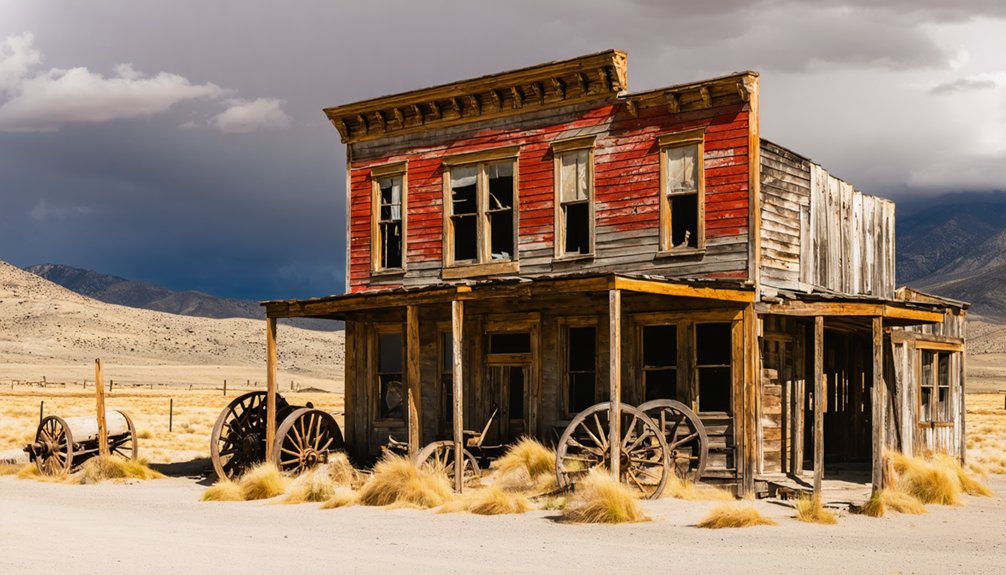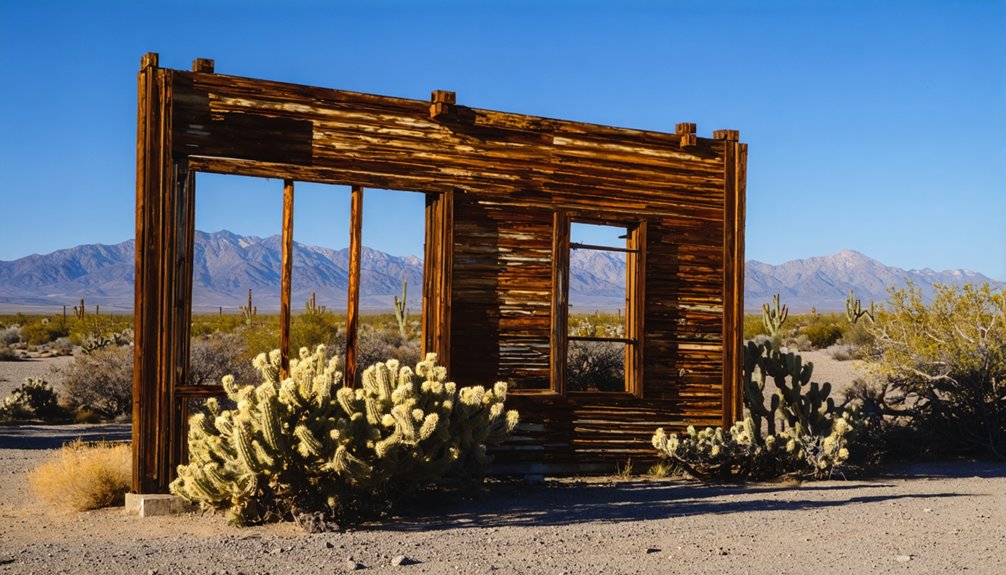
You’ll find several ghost towns near Joshua Tree National Park, including Eagle Mountain—California’s largest desert ghost town that once housed 4,000 residents during its iron ore mining operations from 1948 to 1983. Pioneertown, established in 1946 as a Hollywood movie set, hosted over 50 film productions before its 1954 financial collapse. Numerous historic mining camps dot the Mojave Desert, containing remnants from approximately 300 mines that extracted gold, silver, and tin. This thorough exploration examines these abandoned settlements’ histories, accessibility, and preservation challenges.
Key Takeaways
- Eagle Mountain, California’s largest desert ghost town, housed 4,000 residents during the 1970s mining boom before closure in 1983.
- Pioneertown, founded in 1946 as a living movie set, hosted over 50 film productions before financial collapse in 1954.
- Historic mining camps in the Ivanpah Mountains feature restored cabins near Evening Star, Morning Star, and Copper King workings.
- High-clearance or 4×4 vehicles are recommended for navigating washboard roads and sandy terrain to access ghost towns safely.
- Visit during late fall through early spring for cooler temperatures, and verify land ownership before exploring abandoned sites.
Eagle Mountain: California’s Largest Desert Ghost Town
Eagle Mountain emerged in 1948 as industrialist Henry J. Kaiser established this company town to support Southern California’s largest iron ore operation.
You’ll find remnants of a once-thriving community 13 miles north of Desert Center, where 4,000 residents inhabited over 400 homes during the 1970s mining boom.
Eagle Mountain’s history reflects post-war industrial expansion, with wide landscaped streets, a 350-seat recreation hall, and a high school serving 100 students by 1962.
Kaiser Steel’s 1983 mine closure forced complete evacuation, though the town experienced brief revival as a correctional facility from 1991 to 2003. The abandoned structures have attracted urban explorers and filmmakers, including serving as a location for Christopher Nolan’s “Tenet.”
The town celebrated shipping its 100 millionth ton of iron ore in 1977, marking the peak of its industrial success. Ghost town preservation faces uncertainty since Ecology Mountain Holdings acquired the property for $22.6 million in 2023, maintaining secretive operations regarding its intentions for this significant California desert landmark.
Pioneertown: Where the Old West Comes Alive
The brainchild of actor Dick Curtis materialized in 1946 as Pioneertown—a revolutionary concept that blurred the line between Hollywood artifice and functioning desert community.
Seventeen Hollywood investors, including Roy Rogers and Dale Evans, each contributed $500 to establish this living movie set on 32,000 acres, 125 miles east of Los Angeles.
Pioneertown History reveals strategic positioning away from urban noise, replicating seven Western states’ scenery while cutting production costs.
Mane Street’s false-front architecture concealed fully operational businesses: White’s Grocery, the Golden Stallion Restaurant, and Pioneer Bowl, where Gene Autry bowled between takes.
The Filming Legacy encompasses over 50 productions, including “The Cisco Kid” and “The Gene Autry Show.”
The Pioneertown Post Office earned recognition as the most photographed post office in the USA during the town’s heyday.
Despite financial collapse in 1954, this unconventional experiment endures as proof of frontier independence and creative ambition.
In the early 1960s, developer Benton Lefton envisioned a $400 million transformation dubbed “California Golden Empire,” complete with housing developments, an airstrip, and a golf course, but the ambitious project collapsed when securing a water supply proved impossible.
Historic Mining Camps Across the Mojave Desert
Beneath the Mojave Desert’s sun-scorched expanses lie the skeletal remains of an extractive empire that once drew thousands to remote playas and mountain flanks.
You’ll find dozens of historic cabins clustered near Evening Star, Morning Star, and Copper King workings in the Ivanpah Mountains—the preserve’s densest concentration of old mining operations.
Hart’s 1907 gold rush swelled the camp to hundreds before collapse within years.
Brannigan, Roger’s, Geer, and Riley’s restored cabins now shelter desert travelers under adopt-a-cabin programs.
Evening Star’s standing headframe marks the Mojave’s sole tin producer; Vulcan iron yielded $7 million by 1944.
Cinder mines fed Las Vegas construction through the 1990s, leaving conveyors and crushers rusting beside lava beds you’re free to explore.
Before you approach any weathered cabin or rusted headframe in the Joshua Tree backcountry, you’ll need to navigate a complex patchwork of land ownership that determines whether your visit constitutes exploration or trespass.
Private patents, BLM parcels, park inholdings, and military reservations create jurisdictional boundaries that demand verification before entry. Eagle Mountain’s periodic closures and security enforcement illustrate the consequences of assumptions about legal access.
Safety precautions extend beyond property rights. Abandoned mines harbor vertical shafts, unstable adits, and toxic atmospheres that federal guidance explicitly warns against entering.
Desert ghost towns present structural decay—rotted timbers, undermined foundations, open holes obscured by sand—alongside extreme temperatures exceeding 100°F. Historical hydraulic mining operations used high-pressure water to extract gold, leaving behind environmental damage that altered landscapes and created unstable terrain.
Remote terrain means sparse cell coverage and distant medical care, raising navigation stakes considerably. Historical topographic maps can reveal forgotten trails and homesite locations that assist in planning safer routes through these abandoned areas. Federal rules protecting cultural resources apply across jurisdictions.
From Boom to Bust: The Legacy of Desert Industry
When ore-bearing veins cut through the mountains surrounding present-day Joshua Tree National Park in the late 1800s, prospectors transformed a landscape of Indigenous subsistence into an industrial frontier tied to global commodity markets.
Roughly 300 mines—most marginal, short-lived ventures—carved shafts, adits, and tailings into desert hillsides. Lost Horse Mine alone extracted over 10,000 ounces of gold; Desert Queen operated intermittently for 75 years despite violent claim disputes and foreclosure.
You’ll find the industrial impact everywhere: stamp mills, water tanks, freight routes forming logistics networks linking remote claims to distant smelters. Mining operations employed techniques ranging from panning to hard rock mining, each leaving distinct archaeological signatures across the terrain.
When ore pinched out or costs exceeded returns, communities collapsed overnight.
Today’s cultural remnants—foundations, scattered machinery, waste rock—map boom-and-bust cycles that displaced Indigenous stewardship and imposed extractive economics onto an unforgiving terrain. The National Park Service now balances preservation of historical integrity with visitor safety protocols at these fragile sites.
Planning Your Ghost Town Adventure
Since most ghost town sites lie scattered across unpaved backcountry where infrastructure remains minimal or absent, you’ll need to approach trip planning with the same rigor early prospectors applied to their supply chains.
Effective trip preparation centers on four essentials:
Backcountry ghost town exploration requires the same meticulous preparation that once kept desert prospectors alive in unforgiving terrain.
- Desert navigation tools: Pack detailed topographic maps, GPS devices, and offline mapping apps—cell coverage fails frequently across Joshua Tree’s perimeter.
- Water reserves: Carry 3–4 liters per person daily, plus emergency stores in your vehicle.
- Vehicle capability: High-clearance or 4×4 vehicles handle washboard, sand, and ruts on remote access roads.
- Seasonal timing: Visit during cooler months (late fall through early spring) when temperatures remain manageable.
Inform someone of your route and expected return. The desert offers freedom but demands accountability.
Frequently Asked Questions
Are Any Ghost Towns Near Joshua Tree Pet-Friendly for Visitors With Dogs?
Yes, Pioneertown and Calico Ghost Town welcome leashed companions as dog friendly attractions. Follow essential pet safety tips: bring water, protect paws from scorching surfaces, avoid midday heat, and pack out waste responsibly.
What Time of Year Offers the Best Weather for Ghost Town Photography?
Late fall through early spring offers you the ideal seasons for ghost town photography, when moderate temperatures, lower sun angles, and clearer weather conditions create perfect light, texture, and visibility across abandoned desert structures.
Can You Camp Overnight Near Any of the Ghost Town Sites?
You can’t camp directly at ghost town sites within Joshua Tree National Park, but dispersed camping’s permitted on adjacent BLM lands following camping regulations—typically free, though California Campfire Permits and fourteen-day limits apply.
Are Guided Tours Available for Any Ghost Towns in the Area?
Guided tours exist primarily at Keys Ranch within Joshua Tree National Park, where rangers interpret ghost town–style mining history. Nearby Mojave sites like Goffs offer event-based educational visits rather than daily scheduled tours you’ll routinely find.
Which Ghost Town Is Closest to Joshua Tree’s Main Visitor Center?
Pioneertown’s the closest ghost town you’ll find, sitting just four miles from Yucca Valley. This town’s history dates back to Hollywood’s golden era, offering authentic frontier architecture along its weathered boardwalks.
References
- https://www.flyingdawnmarie.com/new-blog/california-ghost-towns
- https://pioneertownsun.com/pioneertown-a-ghost-town-haunted-by-people/
- https://www.islands.com/1878743/one-lagest-ghost-towns-eerily-modern-abandoned-california-mining-town-eagle-mountain/
- https://whimsysoul.com/must-see-california-ghost-towns-explore-forgotten-histories/
- https://www.photopilot.com/blog/eagle-mountain-california/
- https://www.visitgreaterpalmsprings.com/blog/post/ghost-towns-of-the-california-desert/
- https://www.tripadvisor.com/Attractions-g659472-Activities-c47-t14-California_Desert_California.html
- https://en.wikipedia.org/wiki/Eagle_Mountain
- https://www.youtube.com/watch?v=1w38RaiGdEs
- https://www.sfgate.com/travel/article/eagle-mountain-california-ghost-town-18096768.php