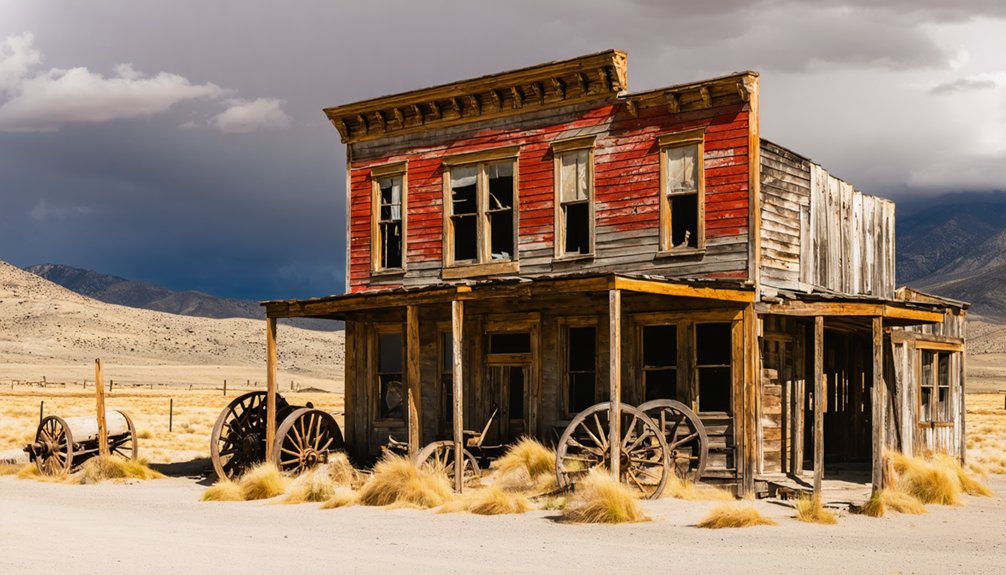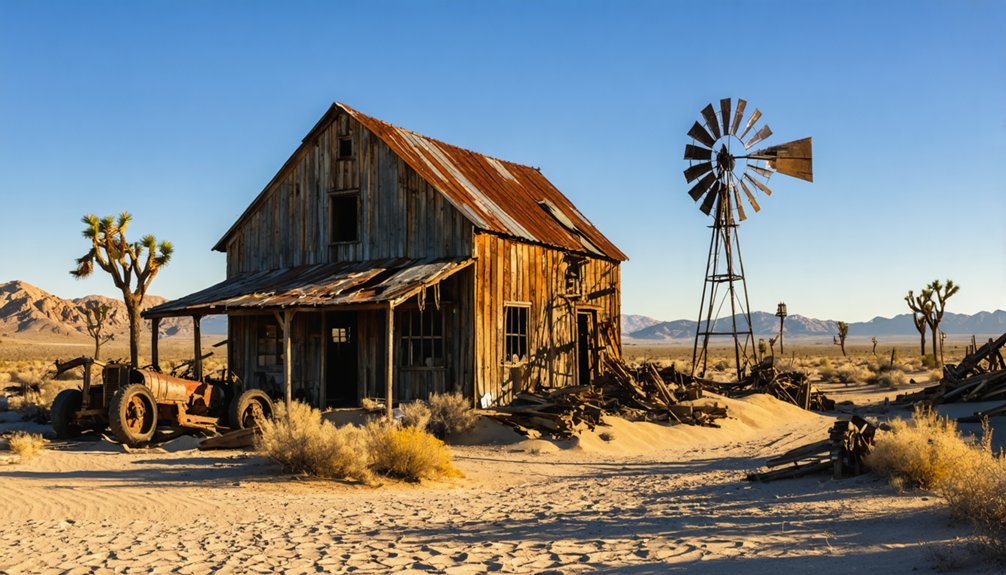
You’ll find several remarkable ghost towns within a few hours of Joshua Tree National Park, each preserving California’s mining legacy. Calico, 90 minutes north, showcases restored buildings from its 1880s silver boom that produced $20 million in ore. Randsburg remains a “living ghost town” with 45 residents among original storefronts from its Yellow Aster Mine era. Eagle Mountain, at the park’s southeastern edge, holds Henry Kaiser’s abandoned 1948 iron mining settlement. Closer still, Lost Horse Mine’s remnants lie just 1.5 miles inside the park, where you’ll discover the operational details behind these extraordinary settlements.
Key Takeaways
- Eagle Mountain, founded in 1948, sits at Joshua Tree’s southeastern edge and requires a high-clearance vehicle to access.
- Lost Horse Mine, the region’s most profitable operation, is located 1.5 miles from Keys View Road within the park.
- Pioneertown is accessible within twenty minutes from recommended base locations like Yucca Valley and Twentynine Palms.
- Calico and Randsburg are best visited as overnight excursions due to greater travel distances from the park.
- Spring and fall offer ideal visiting conditions; summer temperatures exceed 100°F and open mine shafts pose safety hazards.
Calico Ghost Town: From Silver Boom to Tourist Destination
When prospectors discovered silver in the Calico Mountains on April 6, 1881, they unknowingly triggered one of California’s most significant mining booms.
Calico history unfolded rapidly as over 3,000 fortune-seekers flooded the region, establishing 500 mines that produced $20 million in silver ore within twelve years. By 1884, the Calico district accounted for nearly 80% of San Bernardino County’s silver production.
Silver mining operations peaked when the Silver King Mine became California’s largest producer in the mid-1880s.
The boom collapsed when silver prices plummeted in the 1890s, forcing miners to abandon their claims. The town also produced $45 million worth of borax, used in various products, before those operations ceased in 1907.
Walter Knott purchased the ghost town in the 1950s, meticulously restoring its structures using 1880s photographs. His restoration efforts preserved five original buildings that authentically reflect the town’s appearance during its mining heyday.
Many hope to replicate Walter’s success by investing in similar projects, such as abandoned villages for sale in Italy. These locations offer a glimpse into the past, with their rustic charm and rich histories waiting to be uncovered. With a vision and dedication, buyers can transform these remnants into vibrant communities once more.
You’ll find this living museum operating daily as California’s official Silver Rush Ghost Town.
Bodie State Historic Park: Authentic Preservation in the Eastern Sierra
After prospectors discovered gold at the Bodie claim in 1859, the remote Eastern Sierra site remained a modest camp for nearly two decades until the Standard Mine’s rich ore strikes transformed it into one of California’s most notorious boomtowns.
By the late 1870s, 7,000–10,000 residents occupied 2,000 structures, generating over $14 million in precious metals. Violent crime defined daily life in this lawless settlement. The town’s dangerous reputation spawned the expression “a bad man from Bodie”, reflecting its association with lawlessness and violence.
Decline came swiftly after 1881. Fires in 1892 and 1932 destroyed 90% of buildings before the War Production Board halted operations in 1942.
Bodie history took a preservationist turn when California designated it a State Historic Park in 1962, implementing “arrested decay” preservation techniques.
You’ll find 110–200 structures stabilized but unrestored, interiors frozen as abandoned, with merchandise still on shelves—an internationally recognized model for authentic ghost-town conservation. The park is open daily with hours varying seasonally from 9 AM to 4 PM in winter and 9 AM to 6 PM during summer months.
Randsburg: a Living Ghost Town With Gold Rush Heritage
You’ll find Randsburg about 50 miles northeast of Mojave, where the 1895 discovery of gold at the Yellow Aster Mine sparked a boom that drew over 3,500 residents by 1899 and yielded an estimated $60 million in historical-dollar production.
Unlike California’s many abandoned camps, Randsburg maintains a permanent population—69 residents as of 2010—who preserve its early-20th-century storefronts, antique shops, and saloon as a functioning community.
This hybrid status as “California’s living ghost town” lets you walk streets where original structures still operate alongside mining relics and museums documenting the Rand Mining District’s evolution from industrial hub to time-capsule settlement. The town’s aesthetic has remained largely unchanged for over a century, with minimal modernization preserving its authentic old West character. The Yellow Aster Mine alone produced nearly $25 million in gold from 1895 to 1933, making it one of California’s richest gold mines.
Historic Yellow Aster Mine
The Yellow Aster Mine transformed Randsburg from a prospector’s camp into Kern County’s principal gold producer within months of its 1895 discovery.
You’ll find Frederic Mooers, John Singleton, and Charles Burcham traced the main vein on Rand Mountain, triggering a rush that formalized the mining district by December.
Gold production exploded—by 1897, the district yielded over $600,000 (roughly $22.7 million today), and Yellow Aster’s 1901 output hit $120,000 monthly.
The company erected a 30-stamp mill in 1899, then a massive 100-stamp facility in 1901, eliminating costly freight to distant processors.
Miners exploited high-grade quartz veins and disseminated gold within monzonite intrusions, extracting an estimated $12–20 million at historic prices through tunnels and an iconic glory hole.
By 1905, miners had created a massive cavern 100 feet in each dimension—height, width, and over 1,500 feet in length—after removing the monzonite using the square set timbering method.
The Yellow Aster mine ultimately produced nearly $25,000,000 worth of gold until operations ceased in 1933.
Active Residents and Preservation
Despite its official census-designated place status, Randsburg clings to existence with just 45 residents as of 2020—a sharp drop from 69 in 2010 and 77 in 2000.
This aging population—median age climbing from 59.1 to an estimated 70.9 years—maintains the town through community engagement centered on tourism and small-scale mining. Long-term residents operate antique shops, the general store, and saloon along the unchanged main street, drawing off-roaders and history seekers who provide seasonal revenue.
Their sustainable practices involve preserving the organic hillside layout and abandoned structures rather than modernizing infrastructure. The absence of traffic lights and chain stores isn’t neglect—it’s intentional stewardship of an authentic Old West streetscape that’s remained largely unaltered for a century, supporting both year-round habitation and the “living ghost town” economy. The town’s 100% White racial composition reflects its isolated desert location and limited new development since the gold rush era. Limited road infrastructure characterizes Randsburg, with only three paved streets serving the entire community.
Original Structures Still Operating
Walking down Butte Avenue today, you’ll encounter the same false-front storefronts and wooden boardwalks that served prospectors during Randsburg’s 1895 gold rush—not as reconstructed facades, but as continuously operating structures housing antique shops, a general store, and saloon that have maintained commercial functions for over a century.
The 1890s post office still processes mail from its original building, while The Joint saloon preserves its early-20th-century bar interior for weekend visitors.
This authentic historic preservation distinguishes Randsburg from typical ghost town tourism sites that offer only ruins or replicas.
You’re free to explore the Rand Desert Museum in its period building, examine mining equipment displayed outdoors, and browse prospecting supplies sold from the same hardware store structure that outfitted Yellow Aster miners before the operation ceased in 1933.
Goffs: Railroad Legacy in the Mojave Desert

Established in 1883 as a railroad junction where the Atlantic and Pacific Railway operated under agreement with Southern Pacific Railway, Goffs emerged from the harsh Mojave landscape fifteen miles south of the historic Mojave Road.
The location’s flatter terrain proved essential for rail infrastructure that steep mountain grades couldn’t accommodate.
Gold discoveries in the nearby New York Mountains during the 1890s cemented Goffs’ mining legacy, bringing stamp mills and prospectors to this remote outpost.
You’ll find the 1914 Mission-style schoolhouse still standing—now restored and listed on the National Register of Historic Places.
Route 66 ran through town from 1926 until its devastating 1931 realignment bypassed Goffs entirely, saving travelers eight miles but costing the community its economic lifeline.
Today’s museum preserves this railroad and mining heritage across 113 acres.
Eagle Mountain: Henry Kaiser’s Industrial Ghost Town
In 1948, Henry J. Kaiser founded Eagle Mountain as a company town supporting Southern California’s largest iron ore mine.
You’ll find this industrial outpost at Joshua Tree National Park’s southeastern edge, where 4,000 residents once sustained a vertically integrated supply chain feeding the Fontana steel mill 112 miles west.
The town’s Mining Legacy included remarkable amenities for a desert settlement:
- Over 400 company-built homes with landscaped streets, schools, churches, and recreation facilities
- Five labor unions representing mine workers in a single bargaining unit
- Healthcare programs that later helped establish Kaiser Permanente
Kaiser Steel’s board voted to shutter operations in November 1981 after consecutive losses.
Lost Horse Mine: Historical Treasures Within Park Boundaries
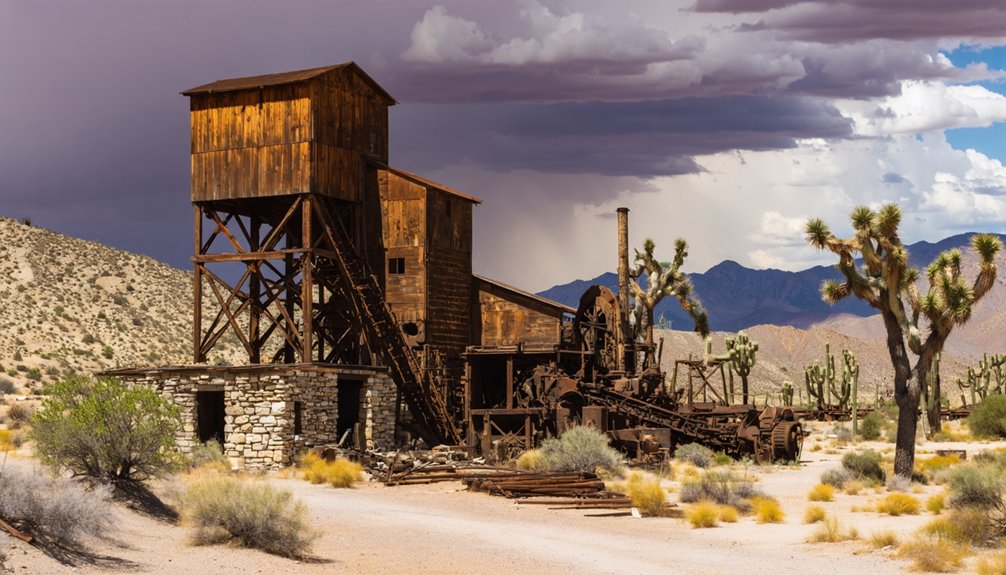
Unlike most Joshua Tree district mines that remain accessible only to dedicated prospectors, you’ll find Lost Horse Mine just 1.5 miles from a marked trailhead off Keys View Road, where the park service has preserved what was once the region’s most profitable operation—a site that yielded over 10,000 ounces of gold and 16,000 ounces of silver between 1894 and 1931.
The ten-stamp mill‘s foundation, stone walls, and partially intact wooden frames stand as evidence to the mining company’s substantial $5 million output (in today’s value), achieved through weekly 16-horse wagon convoys that hauled refined bullion 130 miles to Banning.
You’re walking through documented industrial archaeology here, not folklore—the claim filed December 29, 1893, represents one of fewer than a dozen economically significant mines among the more than 300 attempted in what’s now park territory.
Mining Operations and Discovery
The Lost Horse Mine‘s origin story reads like a Western pulime novel—cattle rustlers, stolen horses, and an outlaw gang that terrorized would-be prospectors into abandoning their claims.
When Johnny Lang and his father purchased the rights for $1,000 from “Dutch” Frank in 1893, they inherited more than mineral wealth—they acquired a piece of ghost town legends that would define Joshua Tree’s mining history.
The operation’s mining techniques evolved quickly:
- Two-stamp mill processing transformed raw ore into transportable gold bricks
- 16-horse freight wagons concealed precious metals during 130-mile journeys to Banning
- Weekly five-day expeditions balanced security concerns with supply logistics
Between 1894 and 1931, you’d witness the extraction of 10,000 ounces of gold and 16,000 ounces of silver—producing approximately $5 million in today’s currency from one of the region’s rare profitable ventures.
Preserved Structures and Trails
The Lost Horse Mine Trail grants access via a 4-mile round trip with 550 feet of elevation gain, while the longer 6.5-mile loop circles the entire mining district.
Preserved trails lead to designated overlooks where you can survey stone foundations, residential ruins, and archaeological scatter—all protected since Joshua Tree National Monument’s 1936 establishment—without compromising the site’s integrity.
Keeler: Transitioning From Mining to Marble Quarrying
Established in 1873 on the east shore of Owens Lake, Keeler served as the essential shipping point where ore buckets from Cerro Gordo’s rich silver–lead–zinc deposits descended by aerial tram over the Inyo Mountains before continuing toward smelters at Swansea and beyond.
When metal mining ceased in the 1950s after decades of decline, Keeler history took an unexpected turn. The town’s economic foundation shifted to industrial minerals, particularly dolomite quarrying from tunnels visible near Owens Dry Lake’s north end.
This change from precious metals to the marble industry offered stability without boom-bust volatility:
- Dolomite extraction supplied construction, chemical, and agricultural markets
- Small-scale operations employed mechanized concentrator plants processing roughly 17,464 tons annually
- Regional mineral diversity sustained employment where silver fortunes had failed
Planning Your Ghost Town Adventure Near Joshua Tree
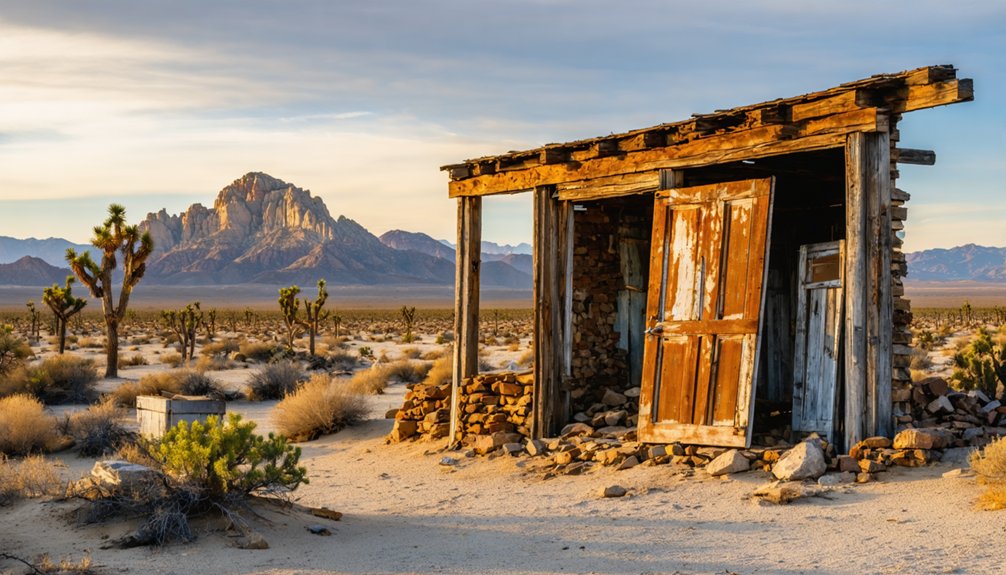
How do you transform a weekend near Joshua Tree National Park into a journey through California’s layered mining past?
Ghost town logistics begin with selecting your base—Yucca Valley, Twentynine Palms, or Palm Springs—where fuel, lodging, and services anchor longer desert expeditions.
Pioneertown sits twenty minutes northwest on paved roads; Eagle Mountain demands high-clearance vehicles and deteriorating access routes near Desert Center. Calico and Randsburg require two-to-three-hour drives, best planned as overnight excursions.
Desert safety protocols aren’t optional: carry extra water, offline maps, sun protection, and a full spare tire. Cell coverage vanishes near Eagle Mountain and remote mining districts.
Spring and fall offer tolerable temperatures; summer heat exceeds 100°F routinely. Open mine shafts around Randsburg and Eagle Mountain present serious hazards—never enter unstable workings.
Frequently Asked Questions
Are Ghost Town Visits Safe for Families With Young Children?
Ghost town visits require serious safety precautions due to unstable structures, mine shafts, and extreme heat. You’ll find family-friendly activities at supervised sites like Calico or Pioneertown, where guided tours keep children away from hazards while preserving your freedom to explore.
What Permits or Fees Are Required to Visit Ghost Towns?
Permit requirements and fee information vary: you’ll pay NPS entrance fees for park-access townsites, nothing for BLM sites, admission at commercialized ones like Calico, and face trespass charges at private Eagle Mountain without authorization.
Can You Camp Overnight Near Any of These Ghost Towns?
Camping regulations prohibit overnight stays at Eagle Mountain—private property with active security—and within Pioneertown’s commercial district. You’ll find ghost town amenities like lodging or permitted campgrounds instead; dispersed camping requires legal BLM land away from historic sites.
What’s the Best Time of Year to Visit Desert Ghost Towns?
Unless you’re auditioning for desert mummification, visit during the best months of late fall through early spring. Weather conditions stay comfortably mild (50s–80s °F), sparing you from summer’s brutal 110-degree freedom-from-consciousness experience.
Are Pets Allowed at Ghost Town Sites Near Joshua Tree?
Pet policies vary by ghost town accessibility: Pioneertown’s public streets welcome leashed dogs, while Eagle Mountain remains closed and patrolled. You’ll need explicit permission for restricted sites and must carry all supplies into these infrastructure-free desert locations.
References
- https://offroad.vegas/mojave-desert-ghost-towns-stories/
- https://whimsysoul.com/must-see-california-ghost-towns-explore-forgotten-histories/
- https://www.visitgreaterpalmsprings.com/blog/post/ghost-towns-of-the-california-desert/
- https://visitusaparks.com/parker-arizona/
- https://en.wikipedia.org/wiki/Eagle_Mountain
- https://www.tripadvisor.com/Attractions-g659472-Activities-c47-t14-California_Desert_California.html
- https://www.nps.gov/jotr/learn/historyculture/lhmine.htm
- https://events.thehistorylist.com/organizations/calico-ghost-town-yermo-california
- https://main.sbcounty.gov/2025/05/29/san-bernardino-county-history-calico-ghost-town/
- https://parks.sbcounty.gov/opinion-beyers-byways-a-brief-history-of-calico-ghost-town/