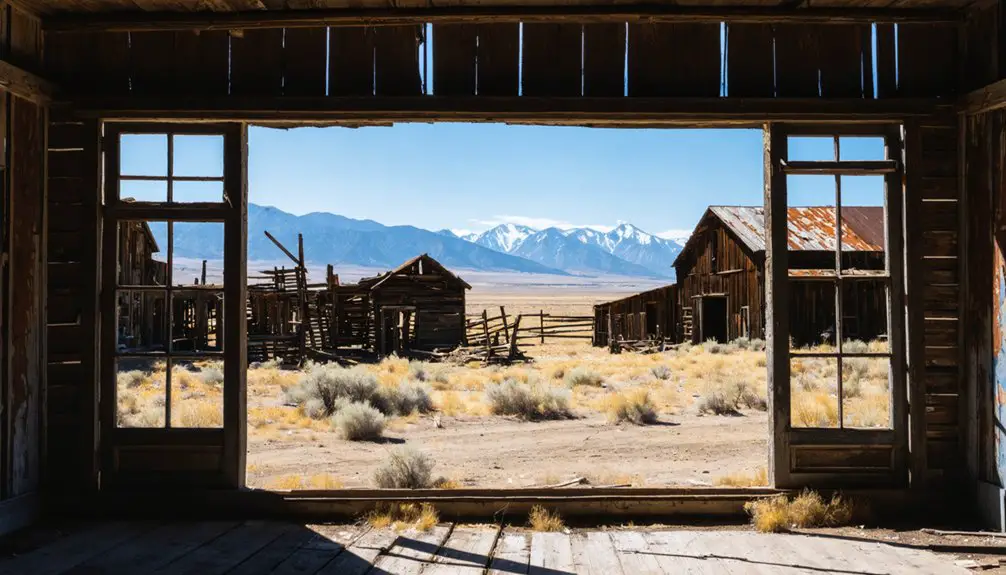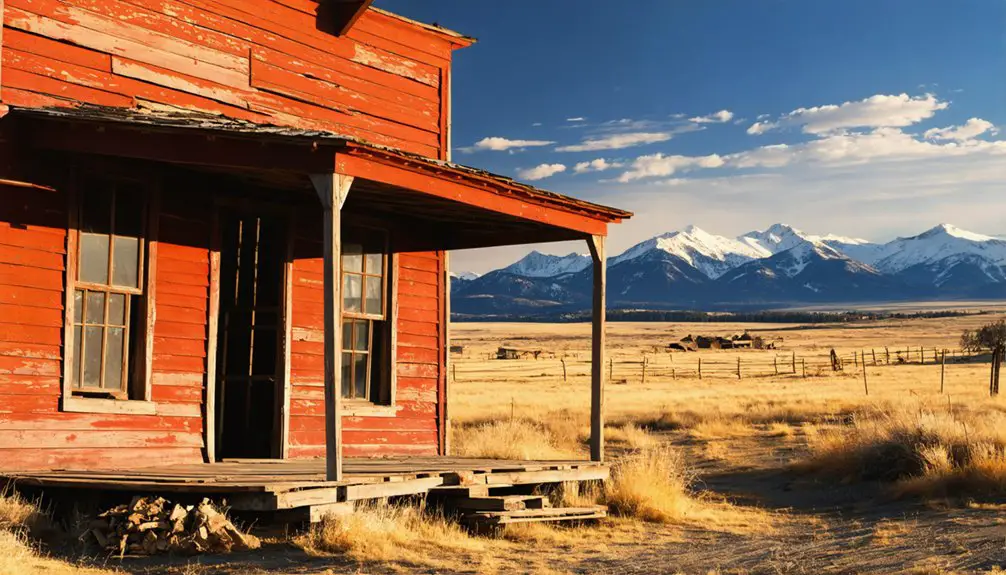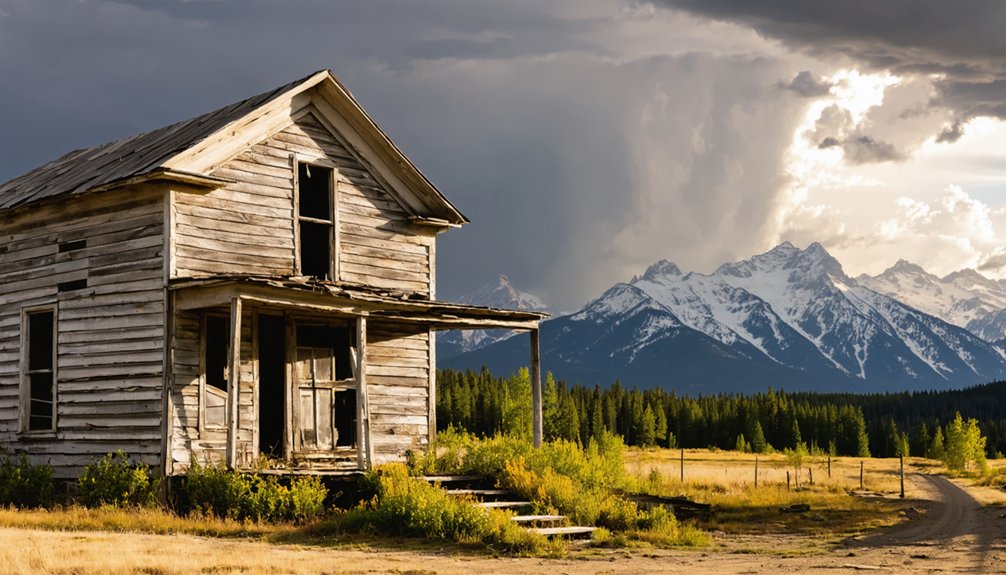
You’ll find several well-preserved ghost towns within a few hours of Kalispell, with Garnet standing out as Montana’s most intact mining settlement. Located southeast near Missoula at 6,000 feet elevation, Garnet features roughly 30 weathered structures from the late 1890s boom era. Closer to Kalispell, Keystone sits in the remote Yaak country northwest of town, where derelict cabins mark the former silver camp O’Rourke from the 1880s. The planning sections below cover essential access routes, seasonal considerations, and safety protocols for exploring these historic sites.
Key Takeaways
- Garnet, Montana’s best-preserved ghost town, sits at 6,000 feet with roughly 30 weathered structures from the late 1890s.
- Keystone, located in northwest Montana’s Yaak country, features derelict cabins from its 1880s silver and lead mining origins.
- Coloma, two miles north of Garnet, emerged during the 1865 gold rush with mining continuing until the 1950s.
- High-clearance vehicles and emergency supplies are essential when visiting remote ghost towns in Glacier Country’s rugged terrain.
- Avoid entering unstable structures or mine shafts, carry bear spray, and verify land ownership before exploring these sites.
Keystone: A Hidden Mining Relic in the Yaak Wilderness
Tucked in the rugged Yaak country of northwest Montana, Keystone began in the 1880s as O’Rourke, a silver and lead camp that drew roughly 500 prospectors and workers to one of the state’s most remote corners.
You’ll trace Keystone history through its successive names—O’Rourke, Carter, then Keystone—each reflecting new mining phases and federal recognition when the post office opened in 1890.
The camp’s mining legacy thrived on silver lodes that sustained saloons, boardinghouses, and general stores until about 1925.
The 1930s silver crash delivered the final blow, shuttering operations and scattering residents.
Today you’ll find derelict cabins along Keystone Creek, accessible via dirt roads northwest of Superior, though much sits on private land.
Among the ruins, a large house in the southern corner still displays mostly standing walls with visible plaster, evidence of wood-fired stoves, and scattered rubbish piles containing old cans and jars.
During Prohibition, John E. Hartman operated a hidden still at the Emmet mine that supplied distilled alcohol to eastern Idaho until his mysterious disappearance in 1930.
Garnet: Montana’s Best-Preserved Ghost Town Experience
High in Granite County’s mountains at 6,000 feet elevation, Garnet ranks as Montana’s best-preserved ghost town, where roughly 30 weathered structures still stand among the pines at the head of First Chance Gulch.
You’ll walk streets where nearly 1,000 residents once lived during the late 1890s boom, when the Nancy Hanks Mine and surrounding operations extracted millions in gold from hard-rock veins.
Ghost town preservation efforts maintain original hotels, saloons, and stores—small wooden buildings hastily constructed without foundations as miners focused capital on ore extraction rather than permanent settlement.
The 1912 fire gutted half the commercial district, and by 1917 depletion ended the era.
Fire consumed half the town’s businesses in 1912, while exhausted ore veins sealed Garnet’s fate just five years later.
Understanding Garnet history means recognizing its brief 1934–1940 revival before World War II restrictions finally silenced the mines permanently.
The town earned placement on the National Register of Historic Places in 2010, cementing its status as a significant historical landmark worth protecting for future generations.
The site welcomes leashed pets, making it an accessible destination for families exploring Montana’s mining heritage with their four-legged companions.
Coloma and the Garnet Range Mining Camps
Two miles north across the Garnet Range divide from Garnet itself, Coloma emerged from the same 1865 gold rush that brought 6,000 prospectors flooding into Bear Gulch, Bivins Gulch, and Elk Creek within weeks of the initial placer strikes.
Understanding Coloma history requires separating two distinct phases: the 1860s placer boom and the 1896–1897 lode discovery that triggered the camp’s main development at McGinnis Creek’s headwaters.
You’ll find Coloma’s Garnet mining legacy concentrated between 1895—when Anna Richards became postmaster—and 1908, when postal service ended.
The Mammoth Mine produced roughly $200,000 in gold over two decades, processed through ten-stamp and twenty-stamp mills before shipment to Helena, Butte, or Anaconda smelters. Major R.L. Hornbrook managed the operation with approximately 20 men in 1905. Though mining efforts persisted until the 1950s, Coloma was largely inactive by 1918.
Other Historic Settlements in Glacier Country
Beyond the mining camps that defined much of western Montana’s settlement boom, Glacier Country’s human geography encompasses Indigenous homelands occupied for centuries, early homestead corridors that preceded park boundaries, and military-transportation nodes that connected remote valleys to national rail networks.
You’ll find historic landmarks like Travelers’ Rest near Lolo, where Lewis and Clark camped in 1805–1806, and Fort Missoula, established in 1877 to oversee regional routes. The Blackfeet Nation‘s 1.5-million-acre reservation preserves cultural heritage dating back hundreds of years, while the Museum of the Plains Indian in Browning and Three Chiefs Cultural Center in Pablo interpret tribal lifeways and treaty history.
Early homesteads along the North Fork Flathead and settlements like Apgar emerged before Glacier National Park‘s 1910 establishment, creating tourism-based communities that shaped today’s gateway towns. The Great Northern Railway brought early tourists to the region, who then faced rugged river crossings and dirt roads to reach lakeside hotels. Fort Missoula later became home to the Buffalo Soldiers of the 25th Infantry Bicycle Corps, who tested mountain cycling tactics in the 1890s.
Planning Your Visit: Access, Safety, and Seasonal Considerations
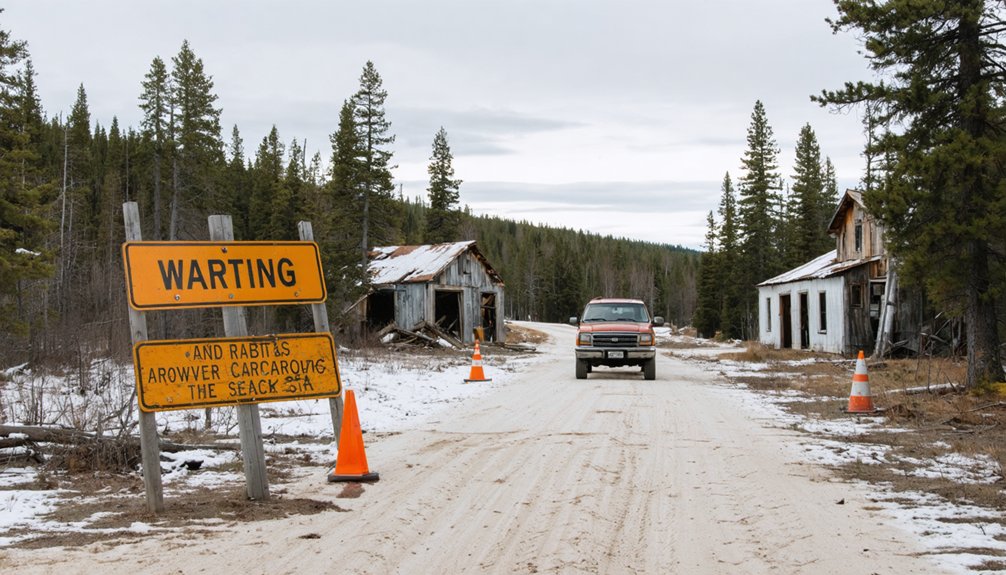
- Never enter unstable structures or mine shafts—hidden vertical drops and rotted floors kill.
- Carry bear spray and make noise—wildlife encounters with black bears, grizzlies, and moose are common.
- Check land ownership and access restrictions—locked gates and “No Trespassing” signs demand respect.
High-clearance vehicles and emergency supplies aren’t optional; they’re essential insurance in remote Glacier Country.
Frequently Asked Questions
Are Ghost Towns Near Kalispell Suitable for Family Visits With Children?
Ghost towns near Kalispell present challenges for family activities due to remote locations and hazards like mine shafts and unstable structures. You’ll need to prioritize children’s safety through close supervision and choosing managed sites with basic infrastructure.
Can I Camp Overnight at Ghost Town Sites Near Kalispell?
Overnight camping isn’t permitted inside Garnet’s historic core—only two BLM winter cabins exist—but you’ll find dispersed camping allowed nearby on public lands, respecting camping regulations while ghost town amenities remain day-use only.
What Photography Equipment Works Best for Ghost Town Exploration?
You’ll need a wide-angle lens (16-35mm) for capturing Montana’s abandoned structures, plus a fast aperture (f/1.8-f/2.8) for dark interiors. Bring a lightweight travel tripod—tripod stability guarantees sharp shots during long exposures in deteriorating buildings.
Do Any Ghost Towns Near Kalispell Allow Metal Detecting?
You won’t find legal metal detecting at ghost towns near Kalispell—no Wi-Fi needed to check that metal detecting regulations on BLM land, state historic sites, and private property strictly prohibit disturbing or removing historical artifacts without permits.
Are Guided Tours Available for Ghost Towns in the Kalispell Area?
No tour companies offer regularly scheduled guided exploration of ghost towns from Kalispell. You’ll find seasonal ghost tours at Conrad Mansion, but actual ghost-town visits like Garnet require independent travel and self-guided exploration.
References
- https://en.wikipedia.org/wiki/List_of_ghost_towns_in_Montana
- https://www.youtube.com/watch?v=BQH5LghhkVs
- https://glaciermt.com/ghost-towns
- https://my1035.com/fascinating-old-montana-ghost-town/
- https://garnetghosttown.org
- https://southwestmt.com/blog/5-haunted-places-montana/
- https://visitmt.com/things-to-do/ghost-towns
- https://www.youtube.com/watch?v=lJy7Q8kNbGU
- https://www.historynet.com/keystone-montana-ghost-town/
- https://www.youtube.com/watch?v=UZjLJD8_gbs