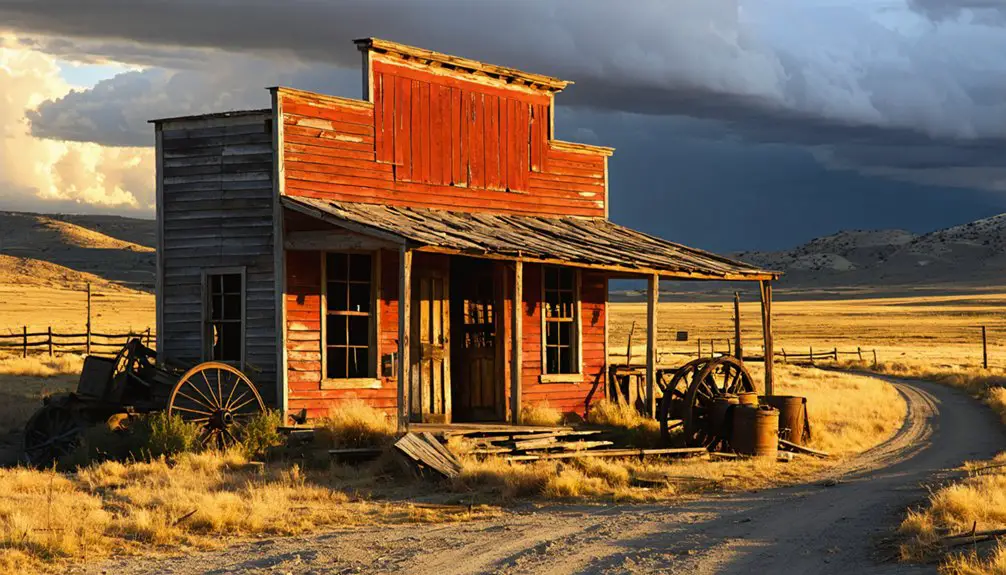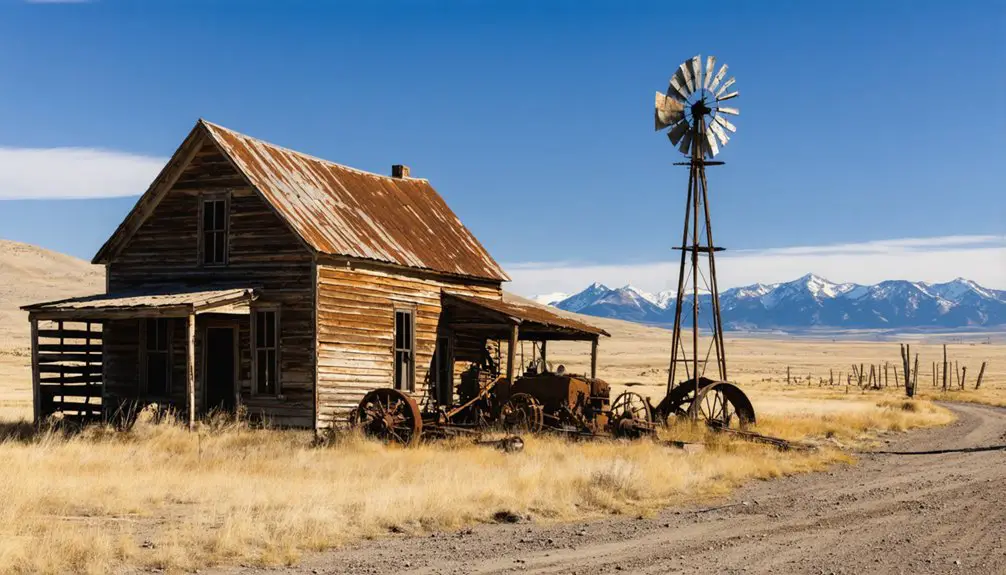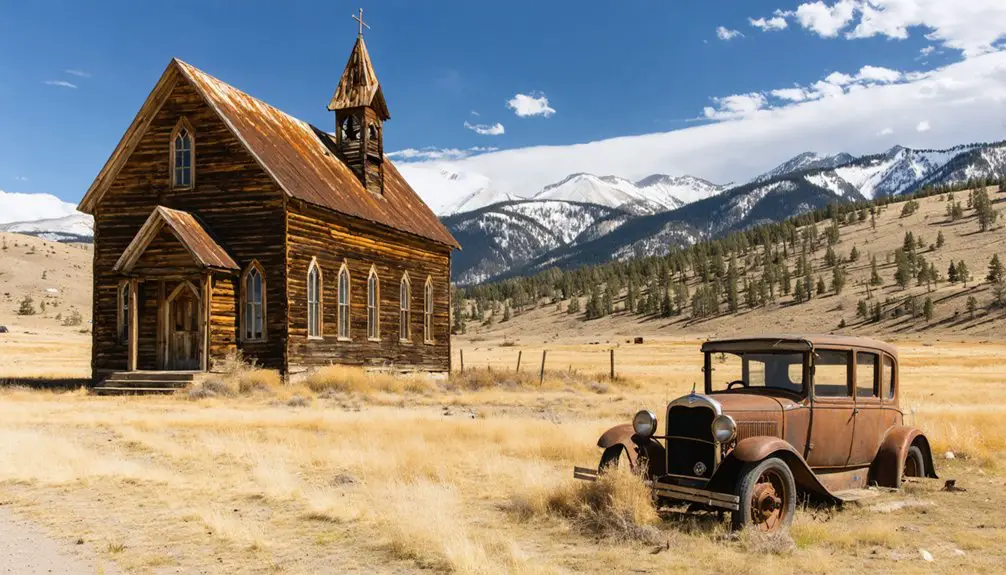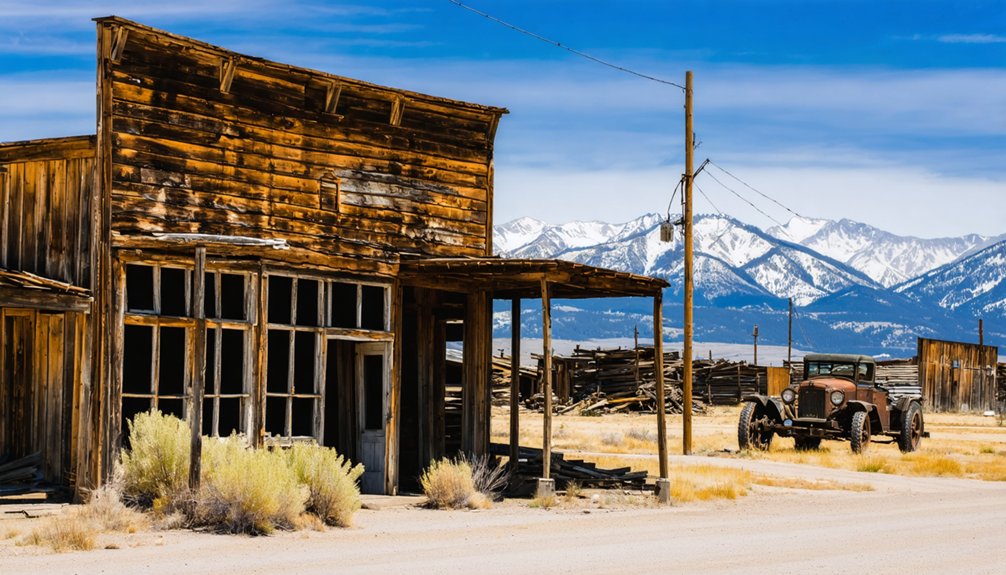
You’ll find several fascinating ghost towns scattered around Kemmerer, including Cumberland, Frontier, Sublet, and Elkol—all abandoned coal camps from the early 1900s. These settlements housed immigrant miners working underground seams discovered in 1843, but they disappeared after the 1950s when diesel locomotives replaced coal-fired trains. Smaller camps like Susie, Gomer, and Blazon vanished even faster, leaving minimal traces in the sagebrush valleys. Finding them requires USGS maps and respect for Wyoming’s cultural resource laws protecting these irreplaceable sites, where you’ll discover the full story behind their remarkable rise and dramatic collapse.
Key Takeaways
- Cumberland, Elkol, Frontier, Sublet, Susie, Gomer, and Blazon are ghost towns near Kemmerer created by coal mining operations.
- Most camps were abandoned mid-1950s when diesel locomotives replaced coal-powered trains, eliminating demand for local coal.
- Use USGS topographic maps and BLM overlays to locate ghost town sites requiring careful navigation and map work.
- Wyoming cultural resource laws protect artifacts and structures; visitors must document without disturbing or removing anything.
- Fossil Country Frontier Museum in Kemmerer provides historical context and information about abandoned coal camps and settlements.
Historical Coal Mining Operations That Shaped the Region
The coal seams that would make Kemmerer a household name in the railroad industry first caught official attention in 1843, when John C. Frémont’s expedition noted outcrops along the Green River.
Commercial extraction didn’t begin until 1867, when Union Pacific‘s arrival created demand for locomotive fuel.
By 1881, Union Pacific Coal Company opened the first underground mine near Kemmerer, establishing room-and-pillar mining technology that would dominate for decades.
The Kemmerer Coal Company, founded in 1897, operated major properties like Frontier Mine No. 1, which produced 8 million tons before closing in 1926. The company was established by Patrick J. Quealy, who served as vice-president and later founded the town itself that same year.
These operations shaped everything from wages to settlement patterns through railroad–coal company arrangements that created effective monopolies, controlling both labor relations and regional development until strip mining replaced underground methods in 1950.
The mining workforce represented eight different nationalities, reflecting the diverse immigrant communities that settled in the region’s coal camps during the industry’s peak years.
Notable Disappeared Towns and Mining Camps
Boom-and-bust cycles left a scattered constellation of ghost towns across the Kemmerer coal field, most now erased from all but the oldest maps and local memory.
Cumberland camp, located 10–15 miles east along the Union Pacific branch line, once housed hundreds of miners and families in company-owned structures before mid-century closures dismantled it entirely.
Elkol camp served as another producing settlement tied to Kemmerer Coal Company operations, though you’ll find its name only in obscure documents today.
Smaller satellites—Susie, Gomer, Conroy, Blazon, and Oakley—faded even faster, leaving subtle foundations and landscape disturbances that only researchers recognize.
These company towns rose and fell with coal demand, their physical traces now limited to scattered ruins across the Hams Fork valley. Unlike these vanished camps, Kemmerer itself survived as a town owned by individual landowners rather than a single coal company, allowing it greater resilience through economic downturns. Nearby Diamondville began as a “shack town” before its residents developed more permanent infrastructure near the mine site.
Sublet Ghost Town: A Window Into Mining History
Eight miles north of Kemmerer in the Willow Creek valley, Sublet stands as one of the region’s best-preserved company mining camps, offering visitors a tangible connection to southwest Wyoming’s coal-mining past.
When you explore this site, you’ll find remnants of Mine No. 6‘s 1913 hoist house and tipple complex, representative of early-20th-century underground coal technology.
The Sublet history reveals a classic company town where Kemmerer Coal Company controlled everything—housing, stores, and the land itself. Workers lived in rows of company-provided houses, extracting up to 1,000 tons daily at peak production.
For ghost town exploration, you’ll discover identifiable house foundations and surface works that functioned like an industrial factory system until operations ceased in 1927-1950, leaving this authentic window into mining-camp life. Today, the town’s jail is the only building that remains somewhat intact, while most other structures have been reduced to their foundations. Like other coal camps across Wyoming, many company-owned homes were sold cheaply and relocated to avoid property taxes, contributing to the town’s abandonment.
What Remains: Accessing and Exploring These Abandoned Sites
Finding these ghost towns requires careful map work—you’ll want USGS topos and BLM surface-ownership overlays to pinpoint faint townsites like Frontier and Gomer, then navigate a mix of graded mine roads and rough two-tracks that demand high clearance and landowner permission on private parcels.
Exploring the area further, you might encounter historical sites near Jackson Hole that offer a glimpse into the region’s past. Don’t forget to bring your camera, as the juxtaposition of these sites against the stunning backdrop of the Teton Range makes for breathtaking photographs. As you uncover more hidden gems, keep an eye out for informative signage that shares the stories behind these once-thriving communities.
Once you’ve located building foundations, slag piles, or cemetery plots, treat every artifact and structure as irreplaceable: Wyoming’s cultural resource laws protect these sites, and responsible photography means documenting without disturbing or removing anything.
I’ve watched too many historic remnants vanish because visitors didn’t understand that even a rusted hinge or brick fragment tells part of the coal-camp story worth preserving for the next explorer. If you explore early in the morning or at dusk, don’t be surprised if local lore suggests you might encounter ghostly headlamps near old mining sites—a phenomenon residents have reported since the 1923 disaster that claimed 99 miners. After your ghost town expedition, consider stopping at the Fossil Country Frontier Museum to view additional coal mining artifacts and historical photographs that provide context to the abandoned sites you’ve just explored.
Locating Ghost Town Sites
The windswept ridges north and south of Kemmerer hide the skeletal remains of several coal camps that once hummed with immigrant miners and their families.
You’ll find Sublet roughly 10–12 miles north—foundations, scattered debris, and mine ruins mark where a company town thrived from 1905 until the late 1920s. The Gomer Mine site shows abandoned works and camp traces typical of early coal operations.
Seventeen miles south, the Cumberland complex sprawls across multiple locations: Cumberland No. 1, No. 2, South Cumberland, and Cumberland Gap, all reduced to foundations, slag piles, and road grades. The Union Pacific Coal Company opened these mines in 1900 after engineer August Paulson discovered two coal seams in the area.
Ghost town exploration here demands patience—chimneys, cellar depressions, and rusted metal often constitute the only visible clues. Historical markers often provide context and information about the towns’ histories.
Historical site preservation remains informal; landscapes speak louder than structures.
Preservation and Photography Guidelines
For photography tips, shoot from stable ground using existing paths to avoid damaging subsurface deposits.
Document don’t disturb. Skip the urge to “clean up” or rearrange; stabilization belongs to professionals.
Capture weathered textures and sweeping vistas while maintaining safe distances from collapsing walls and open shafts.
Your images preserve history without destroying it.
The Rise and Fall of Coal Mining Communities
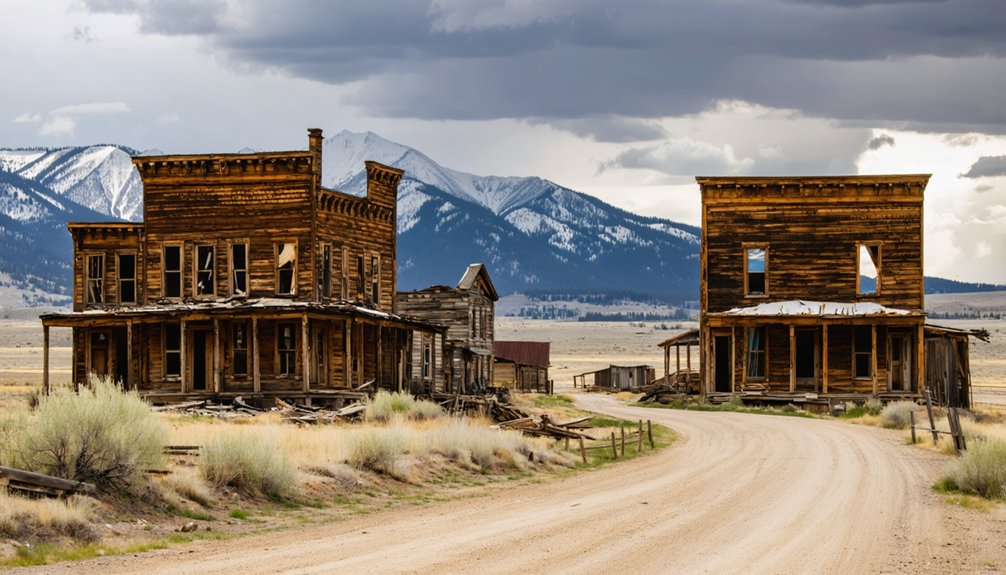
You’ll find that coal camps like Frontier and Cumberland sprang up almost overnight after the Union Pacific Coal Company opened underground mines in the 1880s, with entire company towns—housing, stores, schools—built to serve workers extracting millions of tons from rich Kemmerer seams.
These settlements boomed through the early 1900s as railroad demand soared and coal became Wyoming’s principal mineral product, drawing hundreds of families who depended entirely on mine operations.
But when disasters like the 1923 Frontier explosion killed 99 miners and underground reserves depleted, camps emptied as quickly as they’d filled, leaving behind only foundations and cemetery headstones.
Establishing Mining Camp Settlements
When coal operators first surveyed the hills around Kemmerer in the 1890s, they weren’t just plotting mine shafts—they were laying out entire towns from scratch. Camps like Frontier, Sublet, and Cumberland sprang up wherever rich seams met railroad lines, with bunkhouses clustered near mine portals and company stores anchoring each settlement.
The mining camp infrastructure dictated every aspect of life: you bought groceries on credit at the company store, lived in company housing, and sent your kids to company schools.
Meanwhile, labor force demographics reflected waves of southern and eastern European immigrants who powered the mines—136 men might clock in for a single shift.
Unlike these closed camps, Kemmerer itself offered something rare: Patrick Quealy sold lots outright, letting independent merchants compete.
Economic Boom and Expansion
Once the railroad spikes were driven and the first loaded coal cars rolled west in 1881, Kemmerer’s surrounding camps exploded into round-the-clock production centers.
You’ll find that output soared to hundreds of thousands of tons annually by the early 1900s, fueling Union Pacific locomotives and powering Intermountain communities.
The economic impacts transformed empty sagebrush valleys into thriving industrial hubs where company stores, boarding houses, and dance halls sprang up overnight.
Cultural shifts followed as European immigrants poured in—Italians, Slavs, Greeks—creating dense, polyglot neighborhoods in camps like Cumberland.
But freedom came at a price: company-controlled housing and stores kept miners perpetually dependent.
When railroad contracts dried up and mechanization arrived post-1950, those boom-time jobs vanished, leaving only wind-swept foundations where fortunes once rose from Wyoming coal.
Decline and Abandonment
The first sledgehammer blow to Kemmerer’s coal empire fell in the mid-1950s when diesel locomotives displaced steam engines across Union Pacific’s network, slashing Wyoming’s coal output by 70% between 1953 and 1958—from millions of tons to just 1.6 million annually.
You’ll find statewide mining employment collapsed from 9,192 in 1922 to below 500 by 1959, leaving only 327 coal miners by 1965. Companies dismantled entire camps to dodge property taxes, selling houses cheap and relocating structures.
Kemmerer–Diamondville’s population halved from 6,000 to 3,000 as miners fled. Each lost coal job triggered three service-sector layoffs, gutting local businesses.
What remained became fragmented ghost sites—testaments to shattered cultural heritage and the limits of community resilience when corporations owned everything.
Preserving the Legacy Through Documentation and Records
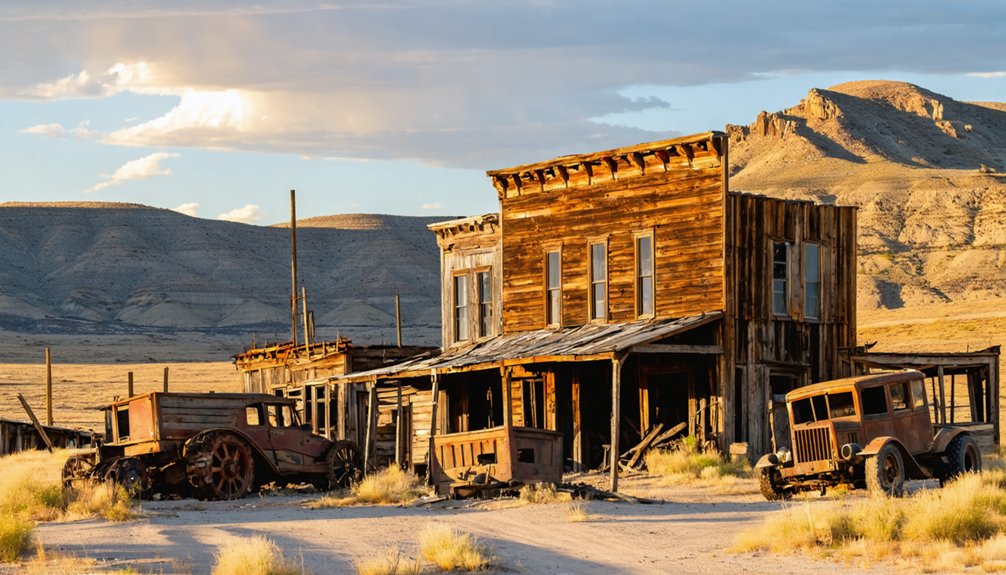
Because ghost towns vanish faster on paper than they do on the ground, documenting Kemmerer’s abandoned coal camps and railroad settlements has become urgent work for historians and archivists across Lincoln and Uinta counties.
You’ll find their archival methods range from cross-referencing mine inspector reports with census schedules to mapping coordinates against railroad alignments using GIS.
These researchers create standardized dossiers for each site—Sublet, Cumberland, Frontier—complete with elevation data, land ownership, and visible structures.
Each ghost town receives its own detailed record—coordinates, structures, ownership—preserving these vanished communities through systematic documentation.
They’re digitizing fragile company ledgers, preserving Union Pacific branch-line records, and transferring municipal documents to Wyoming State Archives.
Production statistics, payroll registers, and industrial photographs capture the historical significance of communities erased by time, ensuring their stories survive even when foundations crumble.
Frequently Asked Questions
Are Any Ghost Towns Near Kemmerer Privately Owned or Restricted?
Yes, you’ll find most ghost towns near Kemmerer sit on private ownership or industrial land requiring permission. Sublet Mine No. 6 and old coal camps like Frontier and Elkol carry access restrictions due to safety and trespass laws.
What Safety Precautions Should Visitors Take When Exploring Abandoned Mines?
Never enter abandoned mines—mine collapses and hazardous materials like unstable explosives kill without warning. Stay outside, keep kids and pets back from openings, and assume every shaft hides deadly drops or toxic air you can’t see.
Can Artifacts Be Legally Collected From Ghost Town Sites?
Generally, you can’t collect artifacts from ghost towns on federal or state land—legal regulations strictly prohibit removing historic items over 100 years old. Artifact preservation requires leaving finds in place unless you’re exploring private property with permission.
Are Guided Tours Available for Kemmerer Area Ghost Towns?
No dedicated guided tours operate for Kemmerer-area ghost towns. You’ll explore independently using your own vehicle and maps. These sites hold historical significance, but guided exploration isn’t commercially available here—you’re on your own.
What Wildlife Might Visitors Encounter at These Abandoned Locations?
You’ll likely encounter mule deer, elk, and pronghorn antelope during wildlife sightings at abandoned sites. Animal encounters might include coyotes, hawks, and rattlesnakes, so you’ll want to stay alert while exploring these remote locations.
References
- https://travelwyoming.com/blog/stories/post/5-wyoming-ghost-towns-you-need-to-explore/
- https://sites.rootsweb.com/~wytttp/ghosttowns.htm
- https://newcountry991.com/kemmerer-wyoming-sublet-ghost-town-todds-big-adventure/
- https://www.youtube.com/watch?v=GEoxbcwf8Ks
- https://tile.loc.gov/storage-services/master/pnp/habshaer/wy/wy0200/wy0256/data/wy0256data.pdf
- http://userpages.aug.com/bdobson/photos9.html
- https://en.wikipedia.org/wiki/List_of_ghost_towns_in_Wyoming
- http://www.wyomingtalesandtrails.com/kemmerer.html
- https://wyoarchives.wyo.gov/index.php/find-it-in-the-archives/records-of-wyoming-cities-towns-municipalities/57-find-it-in-the-archives
- https://cowboystatedaily.com/2025/09/27/mining-explosions-in-1920s-left-kemmerer-region-reeling/