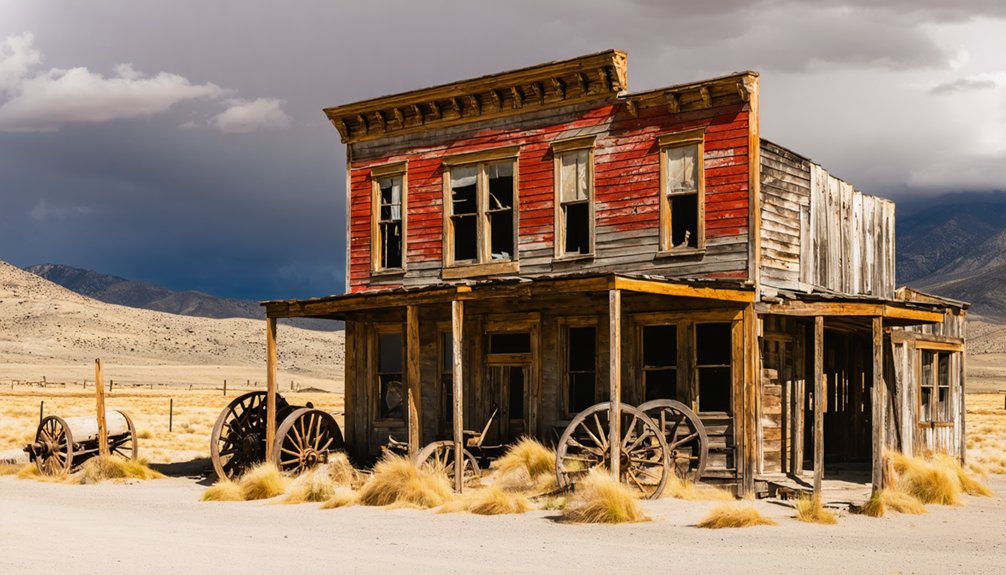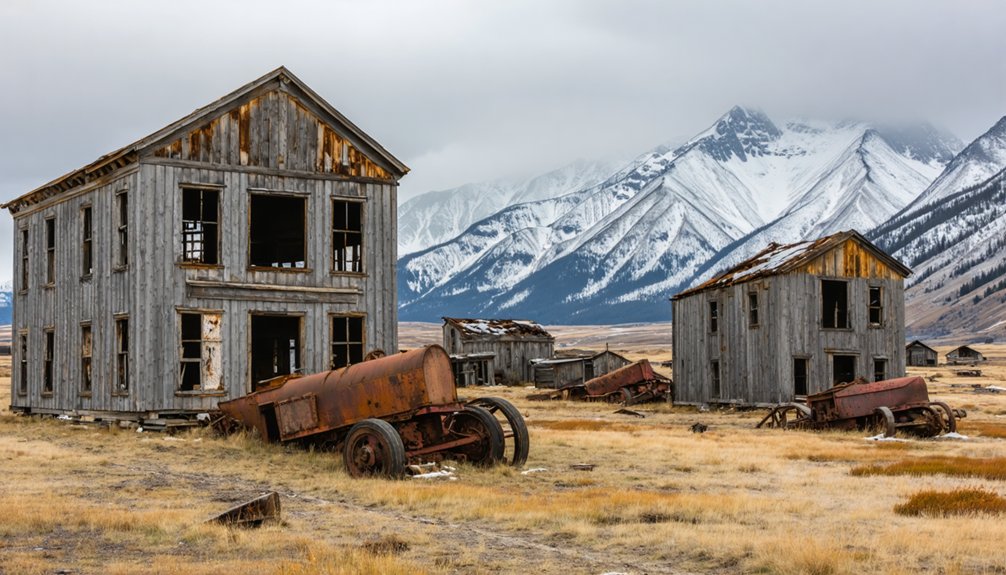
You’ll find few traditional ghost towns near Kobuk Valley National Park, as the 1898-1900 gold rush yielded minimal discoveries and left behind only scattered remains rather than established settlements. The most significant historic mining sites lie outside the park boundaries, including the Utica Gold Mine along the Inmachuk River and Independence Mine in the Willow Creek District. These locations feature weathered cabins with raised plank floors, clustered building layouts, and rusted equipment that survived Alaska’s harsh Arctic conditions. Exploration requires maneuvering complex land ownership and planning your visit during the late June through August window for ideal accessibility and safety.
Key Takeaways
- The Kobuk Valley Gold Rush (1898-1900) left minimal development, with most prospectors abandoning the area after finding only trace gold amounts.
- Historic mining camps featured raised floors, low-pitch roofs, and clustered layouts designed to withstand Arctic frost heave and harsh winters.
- Visit ghost town sites between late June and August, with late August to early September offering optimal weather and fewer mosquitoes.
- Permission from Native corporations or private landowners is required to access historic sites near the park; no park entrance fee needed.
- Mining communities declined due to depleted deposits, rising costs, population exodus, and federal conservation designations restricting new mineral leasing.
Utica: A Preserved Mining Settlement
Along the Inmachuk River south of Deering, the Utica gold mine emerged in 1903 as one of Alaska’s significant hard-rock mining operations during the territory’s early development.
The Utica settlement distinguished itself from typical placer camps through substantial infrastructure investment and advanced extraction technology. Charles D. Lane, who’d achieved success at California’s hard-rock Utica Mine, brought his expertise to this remote frontier location.
You’ll find this mining legacy preserved through remaining structures and environmental records maintained by Alaska’s Department of Environmental Conservation.
The operation contributed substantially to western Alaska’s economic transformation during the early twentieth century. Following President Roosevelt’s 1942 order, the mine ceased operations as gold extraction was deemed non-essential to the war effort.
Similar to Apollo Mine’s 60-stamp mill operations in the 1890s, hard-rock mining facilities required extensive infrastructure to process ore efficiently in Alaska’s remote locations.
Today, this former contaminated site serves as evidence to Alaska’s evolution from subsistence economy to resource-based industry, offering insights into hard-rock mining’s challenges in isolated frontier settings.
The Golden Era of Kobuk Valley Mining
The Kobuk River gold rush of 1898–1900 represented one of Alaska’s most speculative and short-lived stampedes, driven more by rumor than reality.
Approximately 2,000 prospectors arrived at Kotzebue in July 1898, with 800 continuing upriver to establish 32 winter camps. What they discovered wasn’t fortune—only trace amounts of gold existed on Kobuk tributaries.
Instead of intensive prospecting, miners spent dark Arctic winters ice skating on saw-blade skates and organizing lectures. Many stampeders from Southern California weren’t prepared for brutal conditions, resulting in deaths from exposure and disease.
By 1899, the Nome discovery drew survivors away from this frozen disappointment.
The rush’s legacy? Minimal production, marginal nearby districts in the Cosmos Hills, and a reminder that not every northern adventure yields treasure. Meanwhile, asbestos mining continued near Shungnak during the wartime period, with the Arctic Exploration Company’s mine producing the mineral as a filtering agent for blood plasma. The Kobuk River flows from Gates of the Arctic National Park toward the Bering Sea, a route that would later intersect with proposed mining development in the region.
Architectural Features of Abandoned Mining Camps
- Raised plank floors combating frost heave and ground moisture
- Low-pitch sod or metal roofs shedding heavy snow loads
- South-facing orientations capturing scarce winter sunlight
- Multi-pane windows balancing light needs against heat loss
- Clustered layouts reducing dangerous winter travel between buildings
Beyond living quarters, you’ll find gravity-fed sluice systems, timber-cribbed flumes, and rough board sheds that once housed boilers—all evidence of self-reliant engineering in America’s last frontier. Some camps expanded to include over 100 buildings as mining operations grew from the early 1900s through the mid-1920s. Artifacts like bedsprings and stoves remain scattered throughout these camps, offering glimpses into the daily lives of early 1900s miners who endured extreme isolation.
Independence Mine and Regional Mining Operations
You’ll find Independence Mine’s story exemplifies the scale and ambition of Alaska’s hard rock gold mining era, from its 1906 discovery in the Willow Creek Mining District through its peak operations employing over 200 workers in 1941.
The operation’s twelve miles of interconnected tunnels and wood-frame structures demonstrated remarkable engineering efficiency, linking housing, mill complexes, and processing facilities in the harsh mountain environment.
When World War II policies forced the mine to shift from gold to tungsten ore extraction in 1942, it marked the beginning of operational decline that ultimately led to permanent closure in 1951. The site produced a total of 34,416 ounces of gold before operations ceased entirely.
The Alaska-Pacific Consolidated Mining Company, formed through the 1938 merger of Alaska-Pacific Mines, Inc. and Wasilla Mining Company, became the second largest hard rock gold mining operation in Alaska.
Mining Operations and History
While Kobuk Valley National Park preserves Alaska’s wilderness in its remote northwest corner, the state’s mining legacy shaped many of the ghost towns scattered across its broader landscape—none more remarkably than Independence Mine in the Willow Creek Mining District.
Following gold’s discovery in 1896, the Independence operation became Alaska’s second-largest hard-rock gold mine through advanced mining techniques and corporate consolidation:
- 12 miles of underground tunnels developed between 1934–1951
- $18 million in gold output (historical dollars) demonstrating substantial economic impact
- Over 200 employees supported 22 families at 1941 peak
- Four consolidated mines operated under Alaska-Pacific Consolidated Mining Company
- Scheelite production continued through WWII after gold mining ceased in 1942
This industrial-scale operation exemplified frontier enterprise before closure. The site later transformed into a ski resort during the 1960s and 1970s, with the former bunkhouse repurposed as a lodge and dining area for winter recreation enthusiasts. Today, structures like the mess hall and bunkhouse remain well-preserved despite harsh winters causing deterioration to other buildings.
Architectural Features and Structures
The architectural legacy of Independence Mine reveals how frontier engineers adapted industrial-scale operations to one of Alaska’s most challenging mountain environments.
You’ll find 16–22 wood-frame buildings connected by elevated covered walkways that protected workers from brutal winters at 4,000 feet elevation.
The camp’s architectural significance lies in its functional design—heavy timber framing resisted massive snow loads while simple gable roofs and minimal detailing kept construction practical in this remote setting.
Historic preservation efforts now protect key structures including the sorting mill, power plants, and Manager’s House, which demonstrates how industrial communities balanced operational efficiency with livable space.
These buildings represent authentic 1930s mining vernacular, where every architectural decision served survival and productivity in Alaska’s unforgiving wilderness.
Planning Your Ghost Town Exploration
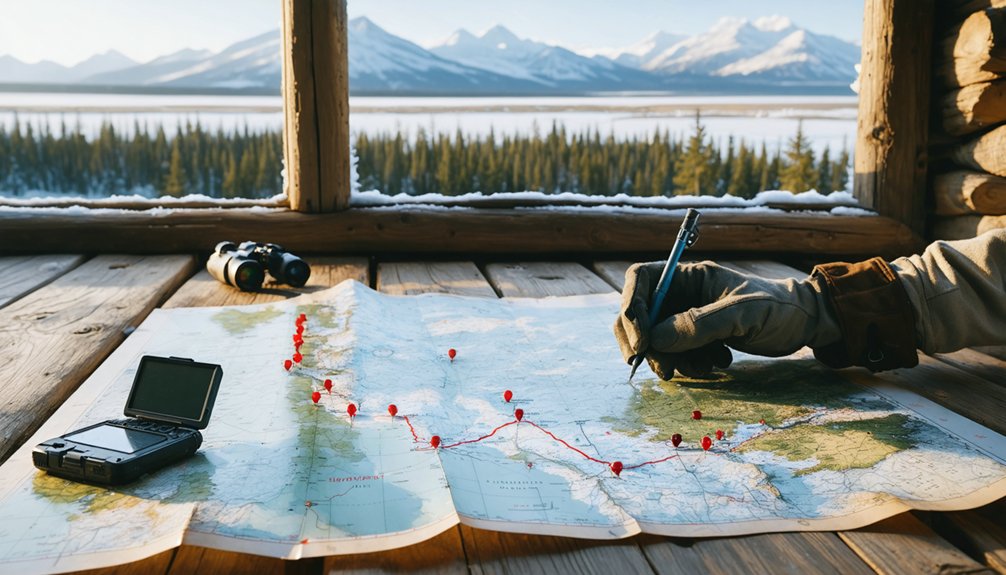
You’ll find the ideal window for exploring ghost towns near Kobuk Valley runs from late June through August, when accessible river routes and stable weather provide the safest conditions for remote site visits.
While the park itself requires no entrance fee or backcountry permit, you must obtain permission from Native corporations or private landowners before entering historic mining camps and abandoned settlements along the Kobuk River corridor.
Professional guides familiar with local jurisdictions, cultural resource laws, and Arctic navigation hazards prove invaluable for first-time visitors attempting to reach these protected historic sites.
Best Seasons for Visits
When should you tackle the challenge of reaching ghost towns near Kobuk Valley National Park? Your window is tight. Late August through early September offers the sweet spot for exploration tips: fewer mosquitoes, stable weather, and exposed gravel bars for bush-plane landings.
If you’re looking for more adventure, consider exploring ghost towns near Kings Canyon National Park. These abandoned sites provide a glimpse into the region’s history and can be fascinating stops along your journey. Plan your visit carefully, as some areas may require more effort to access, but the rewards are often well worth it.
July provides peak accessibility but brings swarming insects and crowded charters.
Key seasonal factors:
- Mid–late summer delivers the most reliable river access and ice-free conditions
- Late August combines fewer bugs with cooler temperatures for strenuous hiking
- Spring breakup creates dangerous flooding and unstable ice near townsites
- Winter demands expedition-level skills for snowmachine access
- Wildlife encounters increase during salmon runs (July–August) when bears concentrate along rivers
Choose your season based on your tolerance for insects versus cold—both shape your ghost town experience dramatically.
Required Permits and Guides
Picking the right month matters little if you can’t legally set foot on the ground. Most abandoned sites near Kobuk Valley sit on a patchwork of Native corporation, state, and private lands—not open public domain.
You’ll need written permission from the relevant landowner before exploring structures or camping near ghost towns like Utica. Commercial guide services operating in the region already hold the necessary permits and relationships with tribal councils, simplifying access considerably.
If you’re venturing independently, contact local village offices and obtain permit types specific to each parcel: research permits for documentation, special-use authorizations for filming, and landowner consent letters.
Guide services aren’t mandatory, but they navigate the legal maze and respect cultural sensitivities that protect both you and these fragile historic sites.
Natural Landscapes Surrounding Historic Sites
The natural setting around Kobuk Valley’s ghost towns presents a stark Arctic landscape where boreal forest meets tundra in one of North America’s most dramatic ecological transformations.
You’ll witness ecotone dynamics where spruce-birch taiga yields to dwarf shrubs and lichens, framing abandoned settlements along the Kobuk River’s historic corridors. The river ecosystems support essential wetlands and expose ice-rich permafrost bluffs rising 150 feet above former camps.
Key natural features surrounding these sites include:
- Active sand dunes rising 100 feet—among the Arctic’s largest dune fields near traditional routes
- Mountain-rimmed valley enclosed by the Baird and Waring ranges
- Dynamic river meanders constantly reshaping banks and burial sites
- Seasonal color shifts transforming green forest to red-gold tundra
- Permafrost features creating patterned ground and thaw slumps
Gold Dredges and Mining Equipment Remnants
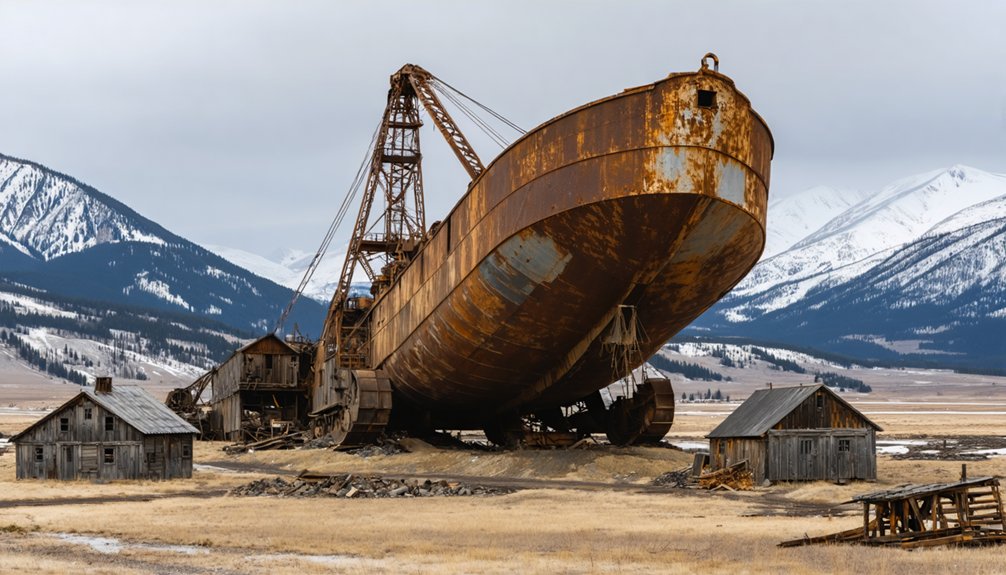
Scattered across Alaska’s remote wilderness, approximately 22 gold dredges once churned through riverbeds during peak mining operations, though none operated within Kobuk Valley National Park‘s current boundaries.
You’ll find the nearest dredge remnants in surrounding regions like Nome and the Yukon River, where massive machines once processed 3,000 cubic yards of gravel daily. These industrial giants extracted millions of ounces of gold before War Productions Board Order L-208 shut down operations in 1942.
Today’s mining machinery stands as evidence to Alaska’s extractive past. While exploring responsibly, you’ll encounter water wheels, ditches carved through permafrost, and scattered equipment from family operations.
The Kobuk River Valley’s copper-polymetal deposits attracted corporate mining interests, leaving behind archaeological traces that remind us how industrial ambition transformed this wilderness landscape.
The Decline of Mining Communities
When ore bodies ran thin and metal prices plummeted in the mid-twentieth century, Alaska’s remote mining camps began their irreversible slide toward abandonment.
You’ll find that community resilience proved impossible without economic revitalization once the primary employer shuttered operations.
Multiple forces accelerated the decline:
- Rising operational costs for fuel, labor transport, and maintenance outpaced dwindling returns from depleted high-grade deposits
- Population exodus stripped camps of schools, clinics, and retail services, forcing remaining families to relocate
- Federal conservation designations around Kobuk Valley restricted new mineral leasing and road construction
- Modern environmental standards made reactivating small historic mines economically unattractive
- Infrastructure abandonment—trails, airstrips, ports—eliminated access and discouraged reinvestment
These ghost settlements now stand as monuments to boom-and-bust cycles that prioritized extraction over sustainable livelihoods.
Seasonal Considerations for Visiting Ghost Towns

Although ghost towns near Kobuk Valley National Park promise authentic encounters with Alaska’s mining past, you’ll find that seasonal extremes dictate not only comfort but survival.
Summer (June–August) offers the safest window, with chartered boats and floatplanes accessing riverside ruins during extended daylight and milder temperatures. Yet you’ll contend with intense mosquitoes and waterlogged tundra early on.
Winter demands ski-planes or snowmachines but punishes unprepared visitors with temperatures below −40°F and minimal daylight around exposed metal structures.
Spring breakup and fall freeze-up create hazardous shifts when neither water nor ice routes prove reliable.
Throughout all seasons, wildlife awareness remains critical—caribou migrations, active bears near salmon runs, and changing food-storage needs require your constant vigilance to protect both yourself and Alaska’s fragile ecosystem.
Frequently Asked Questions
Are Overnight Stays Permitted in the Ghost Town Structures?
No, you can’t stay overnight in ghost town structures near Kobuk Valley. Ghost town regulations prohibit occupancy due to safety hazards and preservation concerns. You’ll need overnight accommodations in gateway communities like Kotzebue instead.
What Wildlife Might Visitors Encounter Near Abandoned Mining Settlements?
You’ll spot caribou, grizzly bears, moose, and wolves roaming freely through these abandoned sites. These wildlife species reclaim their ancestral territory, demonstrating nature’s resilience and the historical significance of wilderness restoration over human development.
Can Artifacts or Mining Equipment Be Legally Collected From Ghost Towns?
No, you can’t legally collect artifacts or mining equipment from ghost towns. Federal and state laws protect these items to preserve mining history for everyone’s benefit. Always leave artifacts in place for future generations to study and appreciate.
Are There Photography Restrictions at Historic Mining Sites?
You can photograph mining sites freely for personal use, but commercial shoots often need permits. Respect photography ethics by avoiding contact with structures, honoring their historical significance, and never disturbing artifacts or fragile features.
What Emergency Services Are Available Near Remote Ghost Town Locations?
Like a lifeline threading through wilderness, emergency contacts reach you via satellite—call Denali Dispatch or Alaska State Troopers. Medical facilities require helicopter evacuation to Fairbanks or Kotzebue, often hours away from ghost towns.
References
- https://www.atlasobscura.com/places/kennicott-ghost-town
- https://www.visitkeweenaw.com/things-to-do/museums-history/ghost-towns/
- https://www.alaska.org/detail/kennicott-mine-ghost-town-walking-tour
- https://wbkr.com/hidden-smokies-road-trip/
- https://en.wikipedia.org/wiki/List_of_ghost_towns_in_Alaska
- http://packrafting.blogspot.com/2017/05/kobuk-valley-national-park-june-2016.html
- https://roamingtogether.com/custer-ghost-town-idaho/
- https://www.youtube.com/watch?v=M2z81ohZ1s0
- https://www.parkcation.com/nationalparks/bigbend/study-butte-terlingua/
- https://dec.alaska.gov/applications/spar/publicmvc/csp/Download?documentID=30137&fileName=4141_FormerUticaMine.PDF