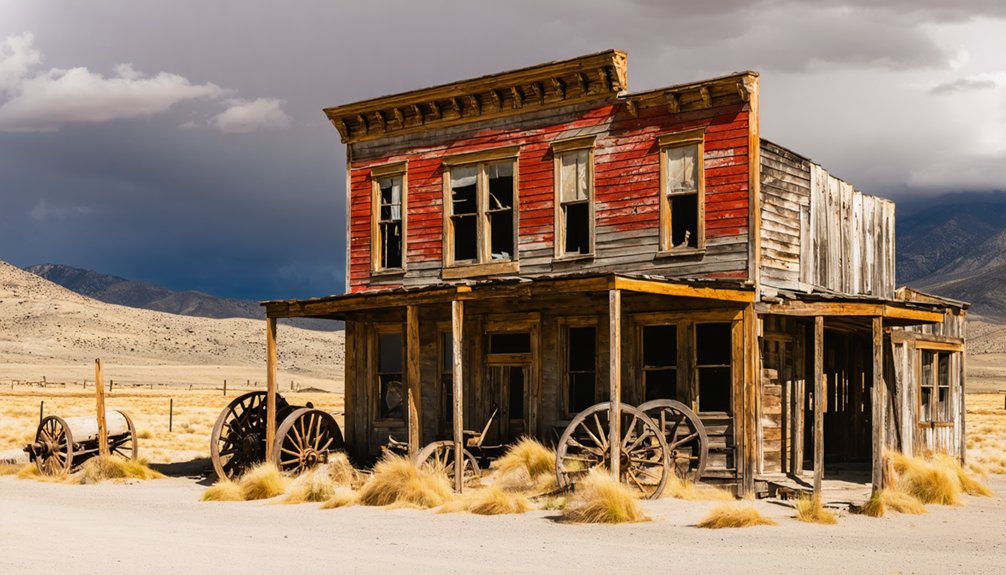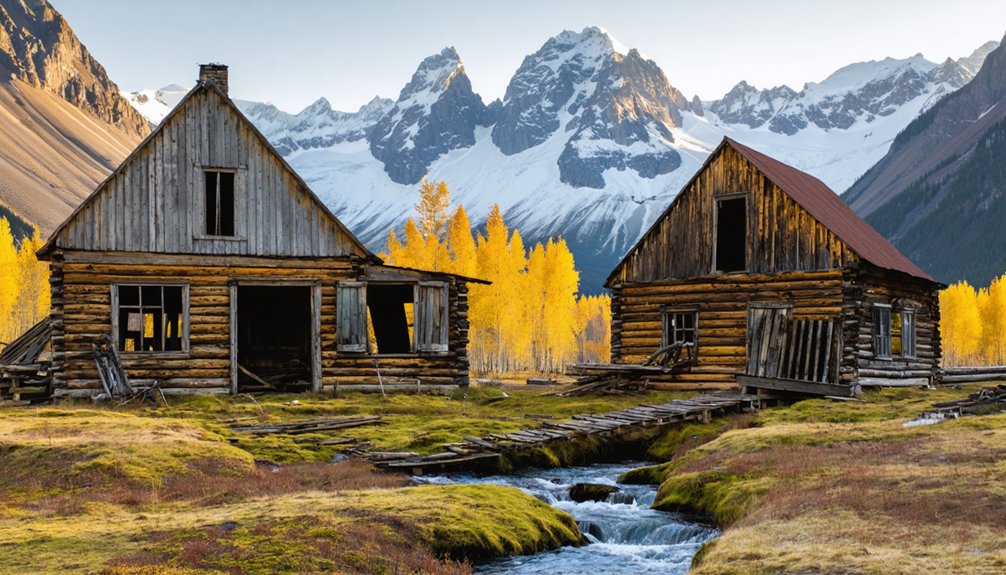
You’ll find Kijik, the most significant ghost town near Lake Clark National Park, where the Dena’ina people lived for nearly 900 years before abandoning it in 1909. Disease epidemics between 1900-1918 reduced the population by 70%, forcing survivors to relocate to Nondalton. Today, you can explore nineteen documented structural remains, including log houses and a Russian Orthodox church, all protected as a National Historic Landmark. The site’s accessed via floatplane and connects to the historic Telaquana Trail, revealing deeper stories of cultural resilience and displacement.
Key Takeaways
- Kijik, occupied for 900 years by Dena’ina people, was completely abandoned by 1909 due to disease and economic pressures.
- Disease epidemics reduced Kijik’s population by 70% between 1880-1909, killing elders and dismantling community structure.
- Nineteen structural remains including log houses, steam baths, and a Russian Orthodox church were excavated in 1966.
- Kijik became a National Historic Landmark District in 1994, holding Southwest Alaska’s largest concentration of Dena’ina archaeological sites.
- Floatplane access operates late June through early September; federal law prohibits artifact collection to preserve cultural heritage.
Kijik (Qizhjeh): The Historic Dena’ina Settlement on Lake Clark’s Shore
Before Russian explorers assigned it the name Kijik in the early 19th century, the Dena’ina people knew this lakeside settlement as Qizhjeh Vena—a place where their ancestors had gathered for nearly 900 years.
For nearly nine centuries, the Dena’ina called their lakeside home Qizhjeh Vena before Russian colonizers renamed it Kijik.
This enduring homeland offered abundant salmon runs and firewood, sustaining generations until colonial pressures dismantled everything. Russian fur hunters arrived in the 1790s, followed by Orthodox missionaries who built a church around 1889.
Disease struck hardest around 1900—measles and flu epidemics reduced the population from 91 residents to roughly 25 by 1904. Survivors relocated to Old Nondalton, leaving behind graves and empty houses. The settlement was completely abandoned by 1909, marking the end of continuous habitation at this significant gathering place.
Today, Kijik stands among Alaska’s most significant Ghost Towns, with its twelve acres designated to the National Register in 1979. The Dena’ina Heritage endures through youth camps and sacred land reclamation efforts. The Nondalton Tribal Council works to identify and mark graves throughout the site, conducting blessing ceremonies that blend traditional and Russian Orthodox practices to honor the deceased.
Archaeological Discoveries and Structural Remnants at Kijik
When archaeologists conducted systematic excavations in 1966, they documented nineteen structural remains across the main historic village—twelve log houses, two larger communal buildings, and several auxiliary features that revealed the settlement’s architectural organization.
These single-room log cabins, insulated with sod and marked by shallow floor depressions, showcase architectural styles adapted to Alaska’s harsh climate while maintaining cultural significance through their spatial arrangement.
The broader archaeological district preserves exceptional evidence of Dena’ina life:
- Steam baths and underground cache pits demonstrate specialized resource management techniques
- Russian Orthodox church remnants (circa 1889) with adjacent cemetery containing up to 200 graves
- Multiple seasonal camps spanning 800–1,000 years of occupation along Lake Clark and Kijik River
Trade beads and metal artifacts helped establish the village’s late-19th-century occupation timeline.
The site represents the largest concentration of Denaina sites in Southwest Alaska, providing researchers with unparalleled opportunities to study the complexities of Athabascan culture and its development over two millennia. The twelve acres were formally designated as a National Historic Landmark District in 1994, recognizing the exceptional archaeological and cultural significance of this Dena’ina settlement.
The Telaquana Trail: Ancient Trading Route to a Vanished Village
You’ll find the Telaquana Trail stretching roughly 51–60 kilometers between Telaquana Lake and the abandoned village of Kijik on Lake Clark, marking an ancient Dena’ina trade corridor that moved salmon, furs, and coastal goods between interior hunting grounds and seasonal fish camps.
The route functioned as a subsistence lifeline for the “Walking Dena’ina,” who traveled this unmarked path guided by ridgelines and river valleys rather than constructed tread or wayfinding markers.
Historical records show the trail enabled both economic exchange and social connection, linking scattered inland bands to the aggregation point at Kijik—a pattern that persisted until the village’s abandonment in the early twentieth century.
Kijik village, the trail’s terminus, is now designated as a National Historic Landmark district, preserving the archaeological remains of this primary Dena’ina settlement site.
Modern hikers following this ancestral route should plan for 5-7 days of travel, accounting for the challenging terrain and trailless navigation that characterizes the journey between these historic endpoints.
Trail’s Historical Trade Role
The Telaquana Trail served as the principal inland artery of a Dena’ina trade network that predated European contact by centuries, connecting Telaquana Lake to Kijik Village (Qizhjeh) on Lake Clark’s southwestern shore.
You’ll find this corridor embodied the cultural exchange that sustained interior and coastal economies through seasonal movement patterns.
The trail’s economic function centered on three rhythms:
- Summer salmon runs drew inland families to Lake Clark’s productive shores, where they dried fish and traded surplus with Bristol Bay peoples.
- Winter travel exploited frozen waterways for sled transport of furs, tools, and later metal goods.
- Year-round movement reinforced kinship obligations through gift exchange between settlements.
These trade routes represented more than commerce—they encoded ancestral knowledge, proper conduct, and spiritual relationships with the landscape itself.
By the time of Alaska’s purchase in 1867, this ancient network began to transform as increased exploration and settlement introduced new economic pressures to traditional trading patterns.
Today, modern backpackers traverse portions of this historic corridor, with charter flights crossing Cook Inlet to access the Telaquana Lake region where the trail once began.
Journey Between Two Lakes
From Lake Clark’s southwestern shore, ancient footpaths climbed northward through the Neacola Mountains toward Telaquana Lake, threading a corridor between three of Alaska’s great river systems—the Kuskokwim, Nushagak, and Kvichak.
You’ll find this 28–30 mile traverse demanded exceptional trail navigation skills, crossing glaciated peaks, alpine tundra, and hanging valleys with 11,000 feet of cumulative elevation change. Dense brush gave way to loose scree and unstable moraines, while glacial streams surged dangerously during daylight warming.
The route’s cultural significance extended beyond commerce—Dena’ina families used this landscape for hunting, fishing, and seasonal gathering, their dogs carrying packs across terrain modern backpackers access only by floatplane. Women and children established seasonal camps along the trail for berry picking and trapping squirrels, whose fur provided warm undergarments and parkas.
Traditional place names, documented through elder oral histories, mark a subsistence corridor where navigation knowledge passed between generations. Today’s guided expeditions follow this historic route, traversing Telaquana Lake, Turquoise Lake, and Twin Lakes with opportunities to spot Dall’s sheep and grizzly bears along the same ancient pathways.
Why Kijik Was Abandoned in the Early 1900s
You’ll find Kijik’s abandonment between 1900 and 1909 resulted from cascading forces rather than a single catastrophic event.
The measles and influenza epidemics of 1900–1902 reduced the population from 91 to approximately 25, while survivors simultaneously relocated toward Nondalton for better salmon access and proximity to trading posts.
Census records and USGS surveys document this gradual exodus as families dismantled their houses and consolidated southward, leaving the village site abandoned by the time federal surveyors arrived in 1909.
Economic Pull of Canneries
After 1884, industrial-scale salmon canneries in Bristol Bay and Cook Inlet transformed the economic landscape that had sustained Kijik for generations. The cannery impact introduced cash wages that far exceeded traditional fur-trade values, pulling Dena’ina families coastward for seasonal employment.
This economic shift fundamentally weakened Kijik’s role as an inland trade hub.
Key shifts included:
- Transportation routes from Lake Clark to coastal cannery zones were already well-established, easing relocation.
- Cannery company stores supplied manufactured goods directly, bypassing Kijik’s intermediary position in regional trade networks.
- Families combined limited inland trapping with extended coastal work, reorienting their entire annual economic strategy.
Gradual Population Decline Pattern
While economic forces drew families coastward, it was catastrophic disease that ultimately sealed Kijik’s fate. The 1901–1902 measles epidemic killed an estimated 300 Inland Dena’ina, slashing Kijik’s population from 91 residents in 1880 to roughly 25 by 1904.
The 1918 influenza pandemic then claimed half or more of survivors across Lake Clark villages. These demographic shifts weren’t just numbers—they destroyed the kinship networks, clan structures, and cooperative labor systems you’d need to hunt, fish, and maintain community autonomy.
When elders and key providers died, oral knowledge and ritual leadership vanished with them. By 1909, surveyors found Kijik abandoned. The 1910 census confirmed what repeated epidemics had accomplished: cultural resilience, however strong, couldn’t overcome a 70% population loss in two decades.
Regional Consolidation Toward Trade Hubs
As Kijik’s population plummeted, the economic geography of the Lake Clark region was simultaneously reshaping around trade corridors that bypassed the village entirely.
Russian and American traders concentrated operations along the Cook Inlet–Iliamna–Bristol Bay routes, establishing posts where interior Dena’ina could access metal tools, firearms, and cloth without maintaining a permanent base at isolated Kijik.
These trade dynamics fundamentally altered traditional settlement patterns:
- Nondalton and Iliamna emerged as consolidated hubs offering combined commercial, religious, and administrative services.
- Fur trappers gained direct access to buyers and freight networks by relocating closer to transport routes.
- Seasonal subsistence trips to Kijik continued, but year-round residence shifted toward market-connected villages.
How to Visit Remote Ghost Town Sites in Lake Clark National Park
Reaching the ghost town sites scattered across Lake Clark National Park demands careful coordination with bush pilots and a commitment to genuine wilderness travel.
You’ll charter floatplanes from Anchorage or Port Alsworth between late June and early September, when ice-free lakes permit landings near Kijik and other abandoned settlements.
Backcountry navigation relies on USGS maps and GPS units, since marked trails don’t exist at these locations.
File detailed travel plans with your air taxi operator, identifying extraction points and alternate landing zones for wind-affected waters.
Wildlife safety protocols are non-negotiable—brown bears frequent shoreline routes between historic sites.
Carry satellite communication devices; cellular coverage doesn’t reach these coordinates.
Federal law prohibits collecting artifacts from any ghost town.
You’re operating in trackless terrain without rescue infrastructure, so self-sufficiency isn’t optional.
Protecting Cultural Heritage at National Historic Landmark Ghost Towns
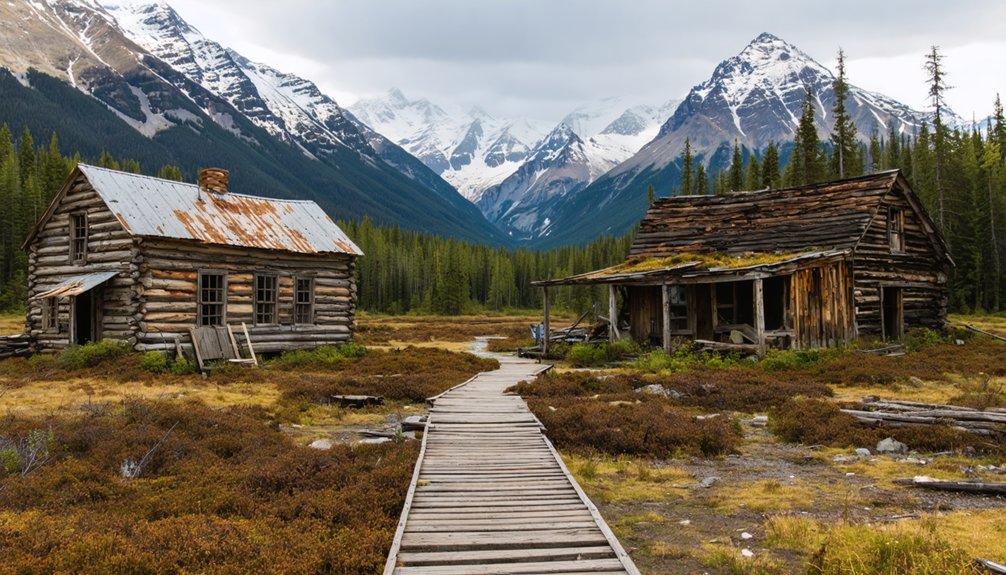
When you step onto Kijik’s wind-scoured benches overlooking Kijik Lake, you’re entering one of Alaska’s twenty-eight National Historic Landmarks—a designation that places this Dena’ina village complex under the National Historic Preservation Act’s most stringent protections.
Cultural preservation here operates through multiple overlapping frameworks:
- Section 106 review requires federal agencies to assess any project’s impact on the NHL before approval.
- ANILCA mandates protect both natural resources and subsistence patterns tied to these ancestral lands.
- Artifact ownership rules prohibit collecting—everything stays in situ for future research.
Heritage management integrates Dena’ina oral histories with systematic archeological documentation, recording house pits, cache features, and trails while leaving most deposits unexcavated.
Site confidentiality protocols restrict precise location data, reducing looting risk while honoring descendant communities’ ongoing connection to these cultural landscapes.
Other Abandoned Communities and Ghost Towns in Alaska’s Wilderness
Beyond Lake Clark’s boundaries, Alaska’s wilderness harbors dozens of ghost towns whose abandonment chronicles reveal recurring patterns: economic collapse following resource depletion, government decisions that severed communities from their land bases, and natural disasters that rendered settlements uninhabitable.
As explorers journey through the remote landscapes, they often seek out historic sites near Lake Tahoe to witness the remnants of early settlers and the rich stories they left behind. Each location offers a glimpse into the past, connecting visitors to a time of discovery and adventure. Preserving these landmarks is crucial, as they serve as educational resources that enrich our understanding of the region’s history.
Dyea history illustrates boom-and-bust cycles when railroad routing shifted commerce to Skagway, erasing an entire Klondike gateway. The Portage earthquake of 1964 forced wholesale abandonment through land subsidence, leaving ghost forests as permanent markers.
Unga fishing operations couldn’t sustain isolated populations once cod stocks declined. Ukivok culture persists despite government-mandated school closures that emptied King Island’s cliff dwellings.
These sites reward ghost town exploration with archival evidence of Alaska’s continuous negotiation between human ambition and unforgiving geography—testaments to settlements that couldn’t adapt when circumstances shifted.
Planning Your Backcountry Adventure to Lake Clark’s Historic Sites

Essential preparation includes:
- Filing detailed trip plans and carrying satellite communication for emergencies in this trail-less terrain.
- Budgeting multi-day itineraries with 10,000+ vertical feet of elevation across river fords and alpine passes.
- Timing around weather patterns that ground floatplanes and transform stream crossings into hazards.
No permit system restricts your journey, yet Leave No Trace principles and park regulations govern group size and fire use near these vanished communities.
Frequently Asked Questions
What Supplies Should I Pack for Visiting Kijik Ghost Town?
Pack hiking essentials including layered cold-weather clothing, waterproof boots, and four-season shelter. Wildlife considerations demand bear spray, bear-resistant food storage, and satellite communication. You’ll need navigation tools, water purification, and cultural-site documentation supplies for this remote archeological district.
Are There Guided Tours Available to the Kijik Archaeological Site?
Want authentic guided exploration? You’ll need to arrange specialized access through Lake Clark National Park staff or Dena’ina cultural programs like Quk’ Taz’un camp, which honor the site’s archaeological significance rather than offering conventional commercial tours.
What Is the Best Time of Year to Visit Lake Clark?
You’ll find the best conditions from early June through mid-September, when summer activities flourish and wildlife viewing peaks. This window offers ideal bear sightings, extended daylight, open services, and reliable floatplane access throughout the park.
Can I Camp Overnight Near the Kijik Ghost Town Ruins?
You can camp near Kijik’s weathered structures, though no designated sites exist. Lake Clark’s overnight regulations permit primitive Kijik camping without permits for groups under eight. Follow Leave No Trace principles and use bear-resistant storage throughout your stay.
How Much Does It Cost to Fly to Lake Clark?
Day-trip flight options to Lake Clark from Anchorage typically cost $1,065–$1,452 per person, while multi-day packages run $3,850–$5,850. The cost breakdown includes aircraft type, bear-viewing access, meals, and seasonal fuel variations.
References
- https://en.wikipedia.org/wiki/Kijik
- https://www.atlasobscura.com/places/kennicott-ghost-town
- https://coloradosghosttowns.com/chitina alaska ghost town.html
- https://www.nps.gov/lacl/learn/historyculture/telaquana-trail.htm
- https://www.nps.gov/lacl/learn/historyculture/kijik.htm
- https://en.wikipedia.org/wiki/List_of_ghost_towns_in_Alaska
- https://nvtami.com/2024/10/06/ghost-towns-are-not-theme-parks-how-to-visit-them-safely/
- https://www.youtube.com/live/M2z81ohZ1s0
- https://alaskapublic.org/news/2016-07-08/ak-the-denaina-culture-camp-of-kijik
- https://www.fs.usda.gov/rm/pubs/rmrs_p049/rmrs_p049_029_034.pdf