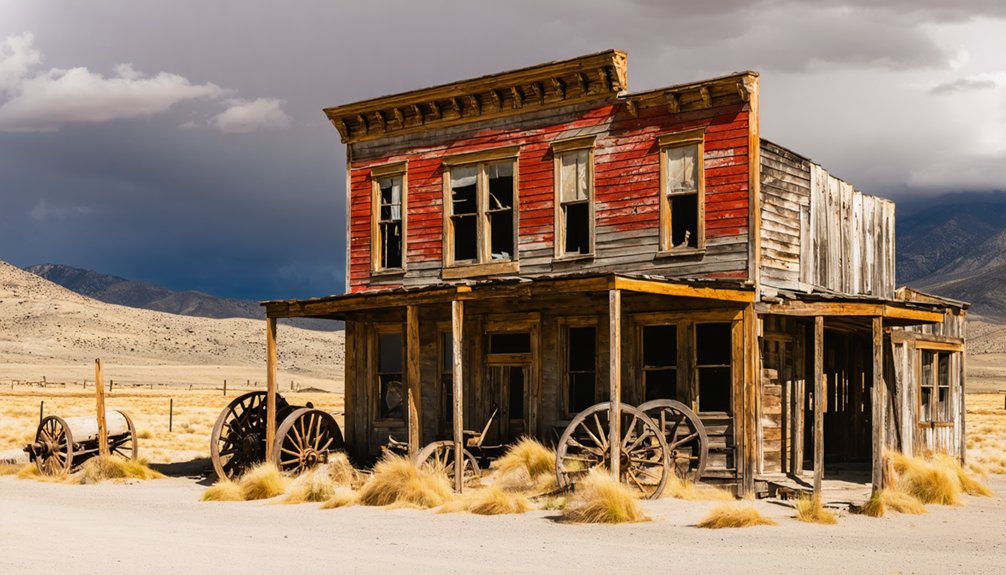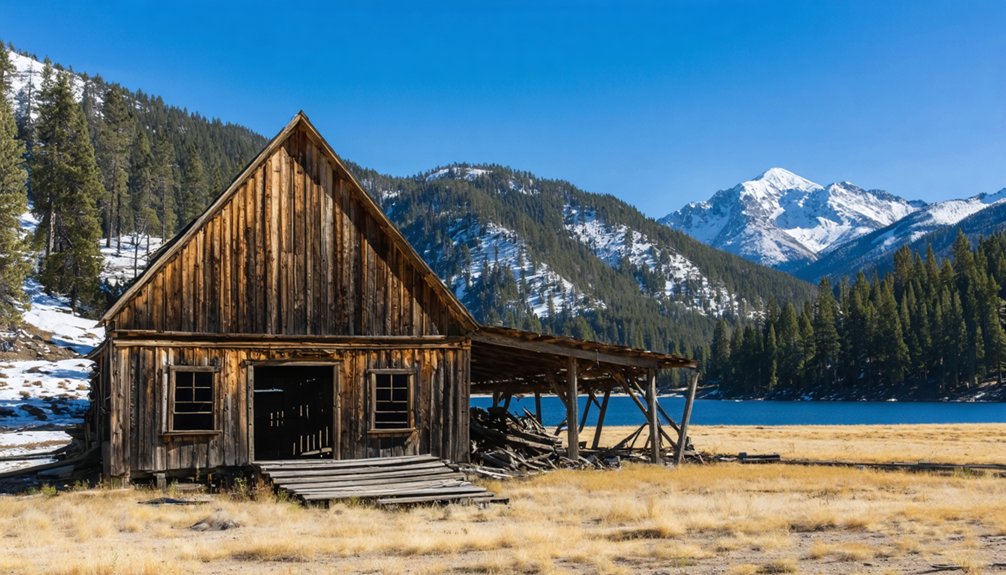
You’ll find exceptional ghost towns within day-trip distance of Lake Tahoe, led by Bodie State Historic Park—California’s gold rush relic frozen in arrested decay since 1942, preserving 110 original buildings. Virginia City offers Nevada’s most accessible Comstock-era experience, where Samuel Clemens became Mark Twain and 110 saloons once served miners. Silver City’s Pioneer Mill launched America’s first successful silver operation in 1860, while Glen Alpine Springs represents Tahoe’s own abandoned resort history from the 1860s. The region’s complete network extends to remote northwestern Nevada camps requiring full-day exploration.
Key Takeaways
- Bodie, California’s best-preserved ghost town, features 110 buildings in arrested decay from its 1880s gold rush peak.
- Virginia City offers living history with Mark Twain’s office, historic saloons, and the famous Virginia & Truckee Railroad depot.
- Silver City showcases Nevada’s mining heritage with eight historic mills and cemetery grounds documenting immigrant mining families.
- Glen Alpine Springs presents an abandoned mountain resort with 1880s structures nestled in Tahoe’s wilderness near natural soda springs.
- Northwestern Nevada features remote ghost towns like Pine Grove, Seven Troughs, and Unionville, requiring full-day trips via I-80.
Bodie: California’s Premier Ghost Town Experience
When prospector W.S. Bodey discovered gold north of Mono Lake in 1859, he couldn’t have imagined you’d walk these streets 160 years later.
Bodey’s 1859 gold discovery north of Mono Lake sparked a legendary boom that preserved an authentic snapshot of frontier California.
Bodie history transformed from rough mining camp to legendary boom town after the 1875 ore strike, swelling to 10,000 residents by 1880.
You’ll find California’s official state gold rush ghost town preserving 110 buildings in “arrested decay”—stabilized but unrestored, stocked with original furnishings exactly where miners left them.
The National Historic Landmark‘s remote high-elevation location protected it from vandalism after the last mine closed in 1942.
Bodie preservation efforts maintain this authentic time capsule through the State Historic Park, letting you experience genuine frontier life without tourist reconstructions or sanitized interpretations.
The town’s notorious reputation for lawlessness during its 1870s peak years earned it the enduring label “bad man from Bodie,” reflecting a culture of violence, gambling, and frequent shootouts.
The name Bodie has become associated with multiple related locations, including the ghost town itself, the surrounding state park, and various geographic features in the area.
Virginia City: a Living Window Into the Comstock Era
- The six-story International Hotel’s elevator—first west of Chicago
- Samuel Clemens’ Territorial Enterprise office where “Mark Twain” was born
- 110 saloons serving Irish miners and Chinese immigrants
- Virginia & Truckee Railroad depot linking mines to mints
- Philip Deidesheimer’s square-set timbering method preventing cave-ins in massive ore bodies
- The original #27 V&T Railroad steam locomotive displayed at the Comstock History Center on North E Street
Silver City and the Nevada Mining Corridor
Nestled in Gold Canyon between Virginia City and Dayton, Silver City emerged as a critical junction in western Nevada’s Comstock mining corridor after the 1859 Comstock Lode discovery transformed the region’s economy.
You’ll find evidence of pioneering industrial achievements here—the Pioneer Mill became America’s first successful silver operation in 1860, while Nevada’s first iron works relocated to support expanding Comstock mining operations in 1862.
By 1871, eight mills with ninety-five stamps processed ore through the canyon. The 1869 Virginia & Truckee Railroad bypassed Silver City, strangling its wagon-based transport economy.
Devastating fires in 1928 and 1935 accelerated decline. The Donovan Mill operated the first cyanide mill in the area from 1894 to 1959, representing the longest running facility of its kind. During its peak years, Silver City served as an important freighting center for travelers heading to Virginia City and the Comstock mines. Today you can explore historic structures, cemetery grounds documenting immigrant mining families, and intact industrial ruins that illuminate Silver City history beyond Virginia City’s shadow.
Glen Alpine Springs: Tahoe’s Abandoned Mountain Resort
A chance encounter with wandering cattle led Nathan Gilmore to discover a natural soda spring in 1863 that would transform into Lake Tahoe’s pioneering tourist destination.
By 1878, Glen Alpine Springs opened as the region’s first resort, featuring mineral water marketed for health benefits. The resort history peaked during the early 1900s with twenty-five buildings accommodating 120 guests simultaneously at $5 daily.
John Muir’s 1892 visit sparked discussions that shaped conservation impact:
- Gilmore’s 10,000-acre homestead stretched from Fallen Leaf Lake into Devil’s Basin
- Protected forest preserve designation occurred in 1899
- Former resort lands became today’s Desolation Wilderness
- Historic structures remain, including an 1889 barn and rock assembly hall
You’ll find Gilmore’s legacy endures through preserved wilderness rather than commercial development. Gilmore’s shepherding background with Angora sheep in the area led to the naming of nearby Angora Ridge, Angora Peak, and Angora Lakes. Renowned architect Bernard Maybeck designed five buildings at the resort in the 1920s, including a dining room featuring battered stone piers and industrial steel construction.
Northwestern Nevada Day Trips From the Lake
Beyond Lake Tahoe‘s immediate shoreline, northwestern Nevada’s remote ghost towns offer ambitious explorers a network of abandoned mining camps scattered across sagebrush valleys and isolated mountain ranges.
Pine Grove exploration rewards high-clearance-vehicle travelers with five distinct town sites along a 3-mile canyon, featuring stone buildings, mill foundations, and a historic cemetery from the 1866 silver boom that peaked at 600 residents.
Seven Troughs history encompasses three boomtowns—Seven Troughs, Mazuma, and Tunnel Camp—northwest of Lovelock, where stamp mills and cyanide-processing facilities still stand amid extensive tailings. Tunnel Camp’s brick office building and five-stamp mill date from 1927 when the Nevada State Mining Company constructed the settlement for cyanide mill workers.
Unionville, an 1861 silver camp once housing 1,500 miners and briefly Mark Twain himself, remains a living ghost town with fewer than two dozen residents preserving stone mercantile structures. The Old Pioneer Garden Country Inn provides modern accommodation amid this historic settlement.
Each site requires full-day commitment via I-80 through Reno, combining archival significance with genuine backcountry adventure.
Frequently Asked Questions
What Is the Best Time of Year to Visit Ghost Towns Near Lake Tahoe?
Late September through October offers you ideal conditions—seasonal weather balances warm days with snow-free access, while fall’s golden light provides exceptional photography tips for capturing eerie, atmospheric shots of abandoned structures against Sierra foliage.
Are Ghost Town Sites Near Lake Tahoe Safe for Children and Families?
Ghost town sites pose real safety concerns—Boca Townsite’s stable interpretive trails work for family activities, but you’ll face collapse risk, open mine shafts, and wildlife hazards at unmanaged ruins. Supervision and preparation aren’t optional when exploring with children.
Do I Need Special Permits to Explore Ghost Towns Near Tahoe?
You’ll generally need permits for exploration on federal lands under Forest Service jurisdiction. Historical preservation laws protect certain sites, requiring special authorization. However, many accessible ghost towns don’t require permits if you’re respectfully visiting public areas without excavating.
Can I Camp Overnight at Any Ghost Town Sites Near Lake Tahoe?
No, you can’t camp overnight at ghost town sites near Lake Tahoe. Camping regulations restrict overnight stays to designated campgrounds only; historic sites lack ghost town amenities and prohibit camping to protect cultural resources and guarantee safety.
Are Guided Ghost Town Tours Available From Lake Tahoe Hotels?
Don’t put the cart before the horse—guided tours focused on ghost towns aren’t readily available directly from Lake Tahoe hotels. You’ll need to arrange independent travel to Virginia City or seek local guides in Tahoe City for haunted-history walks instead.
References
- https://nvtami.com/top-10-ghost-towns-nevada-northwest/
- https://www.alllaketahoe.com/virginia_city_attractions/silver_city_ghost_town.php
- https://www.visittheusa.com/experience/6-nevada-ghost-towns-explore-if-you-dare
- https://californiahighsierra.com/trips/explore-ghost-towns-of-the-high-sierra/
- https://usghostadventures.com/lake-tahoe-ghost-tour/
- https://about-california.com/bodie.htm
- https://travelnevada.com/ghost-town/
- https://www.youtube.com/watch?v=FEiWdlOSoiw
- https://sierranevadageotourism.org/entries/silver-city-ghost-town/fa654570-64cd-43c2-b7f9-84ffc3a0bbd1
- https://en.wikipedia.org/wiki/Bodie