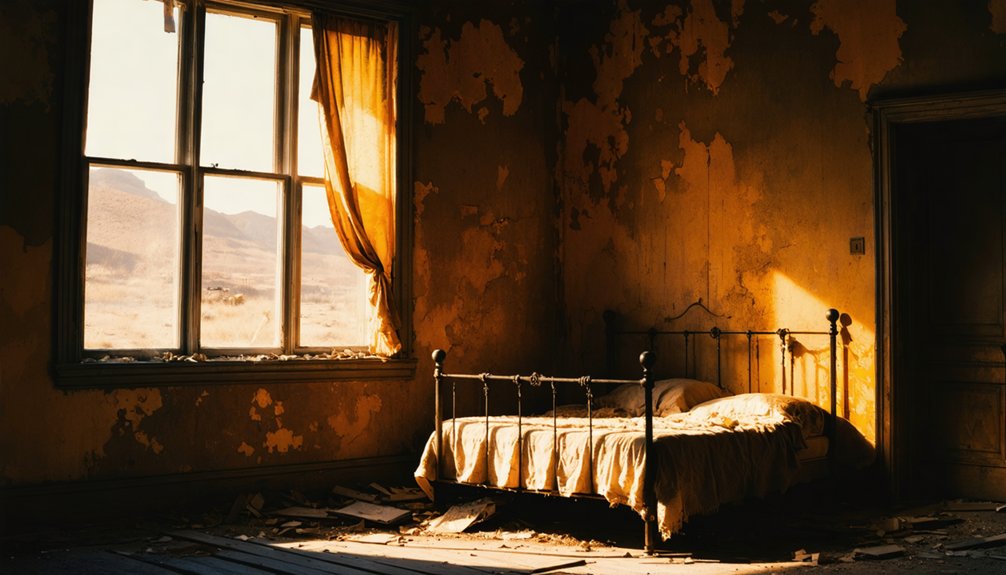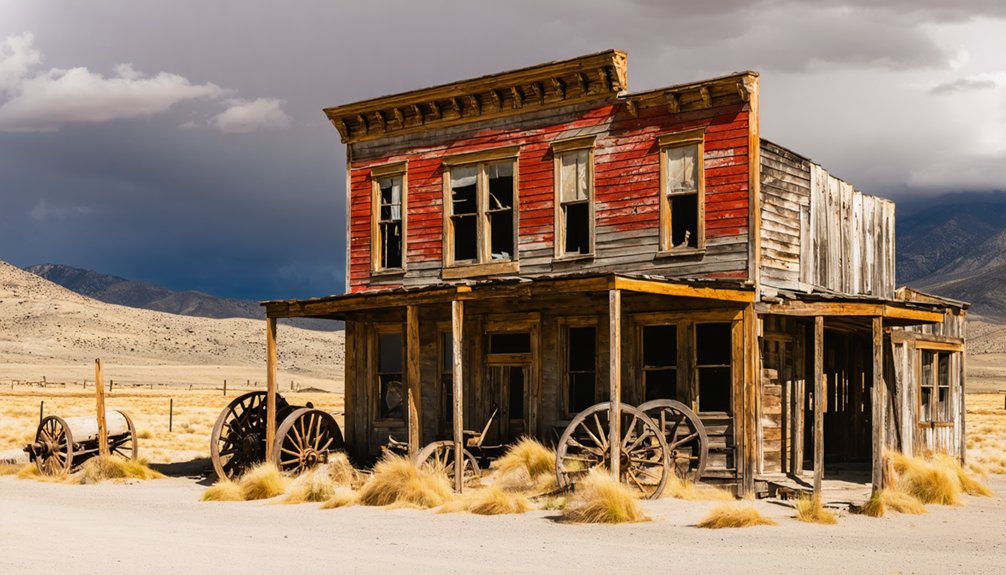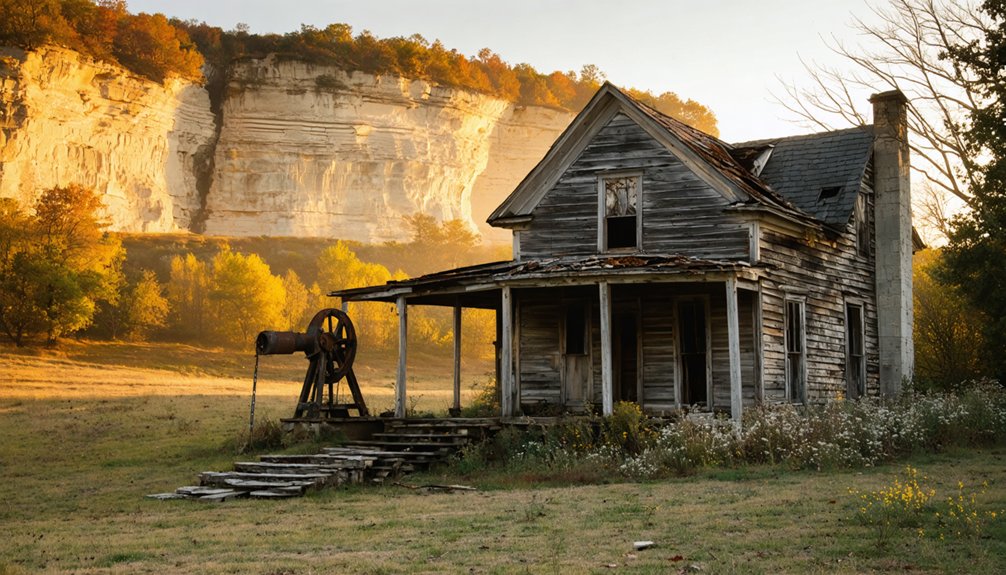
You’ll find several ghost towns and abandoned sites near Mammoth Cave National Park, shaped by the region’s boom-and-bust tourism history. Bell’s Tavern Ruins in Park City marks a legendary 1820s stagecoach stop destroyed by fire, while Guntown Mountain‘s weathered Wild West facades sit above Cave City alongside derelict roadside motels from the mid-century automotive era. Nearly 600 displaced farm families left stone foundations and forgotten homesteads throughout the park’s backcountry. The area’s complex past reveals how cave tourism created—then destroyed—entire communities around Kentucky’s famous limestone labyrinth.
Key Takeaways
- Bell’s Tavern Ruins in Park City, established around 1820–1830, was a legendary stagecoach stop destroyed by fire in 1859–1860.
- Guntown Mountain, a Wild West theme park above Cave City, operated from 1969 to 2013 with remaining chairlift cars and weathered buildings.
- Park City declined after Mammoth Cave Railroad closed in 1931, losing 40,000–50,000 annual passengers supporting local businesses.
- Nearly 600 displaced farm families left stone foundations, cellar depressions, and forgotten landscapes throughout the park area from the 1930s–40s.
- Cave City’s roadside attractions declined after Interstate 65 rerouted traffic, leaving abandoned dinosaur sites and wigwam-shaped motels.
Bell’s Tavern Ruins: Park City’s Stagecoach Legacy
At the crossroads where three early 19th-century roads converged in what’s now Park City, Kentucky, Colonel William Bell established a wood-frame tavern around 1820–1830 that would become legendary throughout the region.
You’ll find the ruins of this famous stagecoach stop serving the Louisville–Nashville route and Mammoth Cave traffic. Bell’s stagecoach hospitality earned him the title “Napoleon of Tavern Keepers,” attracting guests like Henry Clay and Charles Dickens with his renowned peach and honey brandy.
A half pint of peach and honey brandy cost approximately 12.5 cents, the same price as a quart of cider or beer or one night’s lodging.
After fire destroyed the original tavern in 1859–1860, widow Maria Bell Proctor began constructing a massive stone replacement.
From the ashes of the 1859 fire, Maria Bell Proctor envisioned a grand stone tavern that war would leave forever unfinished.
Civil War’s outbreak halted the ambitious project, leaving 15-foot walls standing incomplete.
The stone structure was designed to prevent future fires from destroying the tavern again.
Today’s archaeological findings—including burned nails, dish fragments, and domestic artifacts—reveal the site’s rich history at Bell’s Tavern ruins.
The Mysterious Slave Caves on Mammoth Cave’s Perimeter
Beyond the well-lit tourist routes of Mammoth Cave National Park, dozens of peripheral caves and remote passages preserve haunting evidence of an industrial slavery system that predated the guided tours.
During the War of 1812, approximately 70 enslaved African Americans extracted saltpeter from these remote pits, operating leaching vats and hauling earth through darkness. When mining collapsed in 1815, abandoned “slave caves” became competing tourist entrances.
Evidence of enslaved labor remains:
- Wooden hoppers, vats, and spoil piles left untouched in forgotten passages
- Carved initials and tool marks documenting individual enslaved workers’ presence
- Stephen Bishop’s maps showing cave exploration routes that connected peripheral “rival” entrances
These archaeological sites reveal how enslaved guides like Bishop transformed brutal mining operations into commercial attractions while pushing deeper into unmapped territory. The cave system extends through thick Mississippian-aged limestone, the same geological formation that made saltpeter extraction possible in these dark chambers. By the mid-19th century, Mammoth Cave had emerged as the world’s largest cave system, recognized as a popular tourist destination that relied on the expertise of enslaved guides.
Cave City’s Fading Roadside Resort Strip
When Interstate 65 opened in the late 1960s, it rerouted the lifeblood of Cave City’s economy three miles east of Highway 31W’s neon-lit strip.
What was once a five-hour journey from Nashville to Louisville became three, eliminating overnight stops.
You’ll find remnants of that golden era scattered along the old highway—abandoned attractions where families once stopped for dinosaurs, haunted houses, and wigwam-shaped motels.
Frank Redford’s Wigwam Village No. 2, built in 1937 with fifteen teepee rooms, capitalized on Mammoth Cave’s 500,000 annual visitors.
The village received historic status in 1988, recognizing its architectural significance to roadside Americana.
Guntown Mountain entertained travelers for decades before closing in 2013.
The city itself was established as a resort by the Knob City Land Company in 1853, positioning it to serve Mammoth Cave tourists for over a century before the interstate arrived.
Today, tourist nostalgia keeps a few survivors breathing—Dinosaur World, souvenir shops, and fast food chains—while empty lots mark where mom-and-pop dreams died when America chose speed over roadside charm.
Guntown Mountain: Western Ghost Village Above Cave City
Perched on a limestone hillside directly above Cave City’s tourist strip, Guntown Mountain opened in 1969 as a Wild West theme park designed to capture families heading to or from Mammoth Cave National Park.
You’d ride a chairlift gondola to the summit, where costumed performers staged gunfights and hangings along a frontier main street.
What remains after decades of operation, closure, and controversy:
- Decommissioned chairlift cars rusting visibly from the highway, marking the failed ascent to an abandoned dream
- Weathered false-front buildings standing silent where outlaws once drew pistols for cheering crowds
- Shuttle-accessible mountaintop now operating again under the original Guntown name, reviving Ghost Towns nostalgia
The site’s turbulent rebrand as Funtown Mountain collapsed amid chaos, leaving you with Kentucky’s most visible roadside resurrection story. The original structures include a small information kiosk, Haunted Hotel, and souvenir shack, all showing advanced decay. During Cave City’s 1970s tourism boom, Guntown Mountain stood among the town’s most popular attractions before economic decline reshaped the region.
Abandoned Tourist Cottages Along Historic Cave Corridors
You’ll find crumbling motor court cottages scattered through meadows south of Mammoth Cave’s main lodge, relics of the 1950s auto-tourism boom when travelers expected individual drive-up cabins along cave-country routes.
The National Park Service closed these units after consolidating lodging into centralized facilities, leaving the structures to decay in place as interpretive examples of obsolete tourism infrastructure.
Today the site remains off-limits for safety reasons, but you can glimpse the weathered exteriors from authorized trails, witnessing how quickly nature reclaims abandoned roadside architecture within park boundaries. Concrete pads have fractured from freezing and thawing cycles, allowing soil to accumulate in hairline seams where grasses and moss now thrive. These historic cottages once provided overnight stays for cave visitors before modern lodges became the standard accommodation option.
Mid-Century Motel Decay
As Interstate 65 siphoned traffic away from US‑31W during the late 1960s and 1970s, dozens of family-run cottage courts that once served Mammoth Cave’s million annual visitors began a slow decline into abandonment.
You’ll find concrete-block shells with spalling walls, collapsed metal roofs, and weathered neon frames—testaments to roadside architecture that thrived when proximity mattered more than brand recognition.
Motel nostalgia fades when you witness firsthand how building codes, chain competition, and rerouted highways rendered these independent operators obsolete.
Decay patterns you’ll encounter:
- Broken windows and stripped interiors—fixtures, wiring, and furniture scavenged or destroyed
- Overgrown driveways and collapsed picnic shelters—nature reclaiming gravel courtyards
- Faded signage still promising “Mammoth Cave Cabins”—rusted poles marking forgotten enterprises
Derelict Roadside Cabin Clusters
Between Cave City and the park boundary, narrow strips of abandoned tourist cabins line the older highway corridors like architectural fossils from the early auto-tourism boom.
You’ll find these roadside relics scattered along US-31W and KY-70, where 1920s–1940s cabin courts once thrived on cave-bound traffic. Most clusters display eight to twenty-five single-room units arranged in shallow U-shapes, built from rough lumber, fieldstone, and concrete block.
Look for collapsed roofs, boarded windows, and rusted metal awning brackets still clinging to weathered façades. The National Park Service’s post-1941 consolidation and later Interstate 65 routing starved these properties of visitors, transforming lively motor courts into overgrown graveyards.
Today’s cabin nostalgia meets hard reality: fading vacancy signs, porch failures, and trees growing through foundations mark where budget lodging once flourished.
Park City’s Decline From Gateway Rail Town to Quiet Hollow
When the Mammoth Cave Railroad closed its 9-mile spur line in 1931, Park City lost the single asset that had defined its economy for nearly half a century.
The rail decline stripped away the town’s purpose as thousands of annual tourists bypassed it for automobile-accessible Cave City.
Freight handlers, hoteliers, and staging operators watched their livelihoods evaporate as highways replaced rails.
What vanished with Park City’s rail decline:
- 40,000–50,000 annual passengers who once transferred through Glasgow Junction’s platform, filling hotels and taverns with commerce
- Four Baldwin steam engines and wooden coaches that shuttled cave-bound travelers through Diamond Caverns and Proctor’s Hotel
- A mandatory gateway identity that forced every Mammoth Cave visitor to pass through your streets, generating inevitable economic activity
Today Park City survives as a quiet hollow, its rail-born prosperity reduced to historical footnote.
Derelict Motels and Shuttered Attractions of Mid-Century Tourism
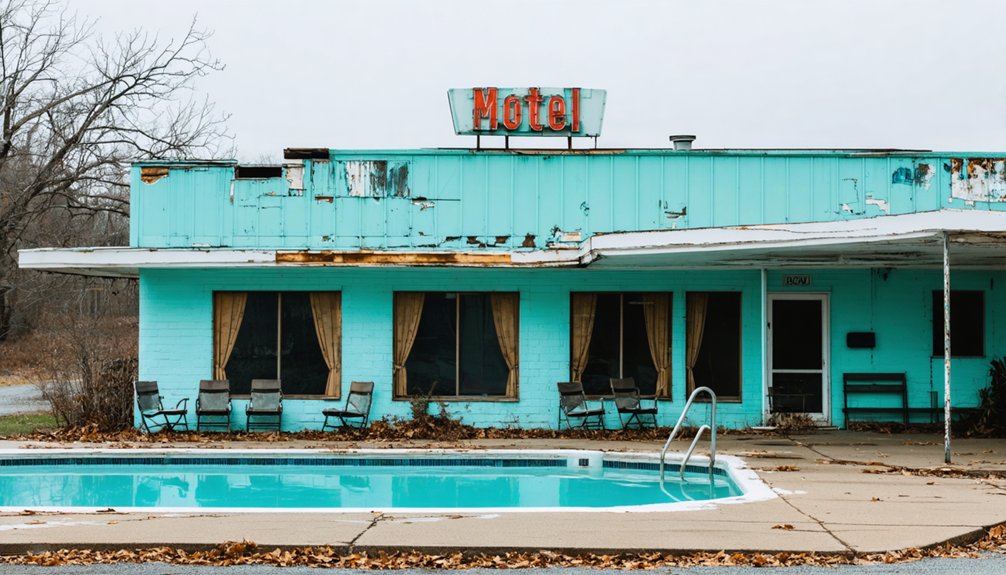
The automotive boom that rescued Mammoth Cave tourism in the 1930s left behind its own layer of decay.
You’ll find abandoned motels south of the main lodge, where compact cottages once sheltered road-trippers exploring Kentucky’s underworld. The National Park Service closed these mid-century tourism relics when consolidating services proved more efficient than maintaining scattered buildings with thin walls and rotting trim.
Unlike Cave City’s Wigwam Village No. 2, which underwent extensive restoration beginning in 2020, these structures weather in place as interpretive landscape. The park prioritizes caves and trails over peripheral buildings, letting forest reclaim what highways once made profitable.
You can view exteriors from legal paths, witnessing how managed deterioration preserves history without active restoration.
Forgotten Farmsteads and Country Stores on Backroads to the Park
Beyond the roadside motels and tourist courts, park creation erased entire rural neighborhoods. Nearly 600 farm families lost their land through eminent domain in the 1930s–40s, leaving forgotten landscapes beneath today’s reforested hills.
You’ll find their traces scattered across Flint Ridge and remote hollows—collapsed chimneys, hand-dug wells, daffodils blooming where front porches once stood.
What remains of this rural heritage:
- Stone foundations and cellar depressions hidden under thick canopy where families farmed for generations
- Abandoned country store sites at old road junctions, marked only by glass shards and porch piers
- The Bransford family cemetery on Flint Ridge, proof of Black landownership severed by park expansion
Low compensation and forced relocation bred resentment that still echoes in local oral histories today.
Blue Heron and Paradise: Kentucky’s Broader Ghost Town Context
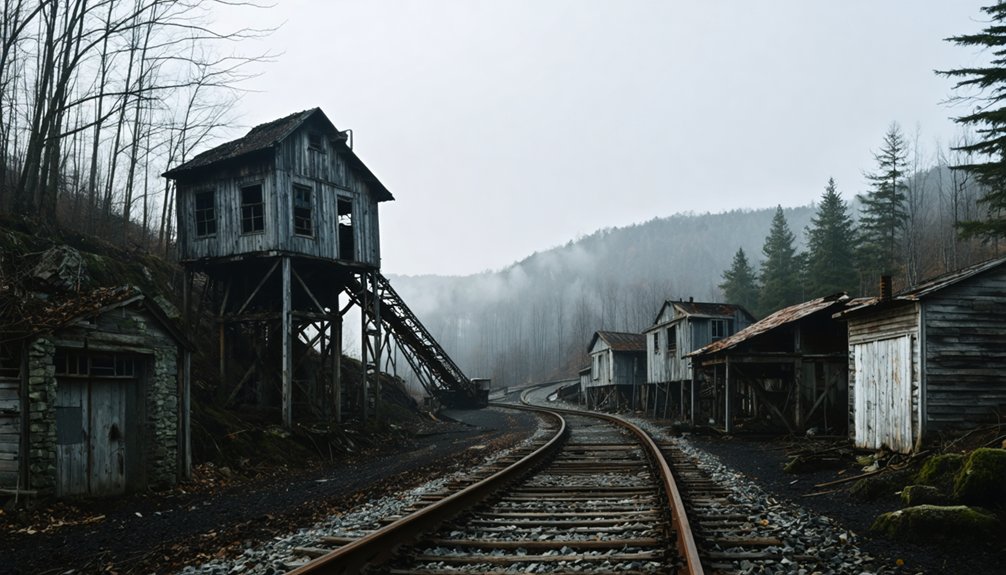
While Mammoth Cave’s displaced communities remain largely invisible to modern visitors, Kentucky’s coal country preserves its ghost towns more deliberately.
You’ll find Blue Heron, a former mining camp operated by Stearns Coal & Lumber Company from 1937 to 1962, transformed into an open-air museum with metal “ghost structures” marking where hundreds once lived.
The National Park Service recreated this Coal Mining settlement in the 1980s, placing skeletal frames on original building sites along the Big South Fork River.
You can explore the actual mine entrance, cross historic bridges, and hear recorded voices of former residents at the interpretive center.
Unlike Paradise—Kentucky’s ghost town immortalized in John Prine’s song about strip mining—Blue Heron offers tangible access to coal country’s vanished communities, letting you walk through history’s architectural shadows.
The Boom-and-Bust Cycle That Created Mammoth Cave’s Ghost Sites
When the United States declared war on Britain in 1812, Mammoth Cave‘s remote limestone passages transformed overnight into a critical munitions supply depot. Enslaved laborers worked around-the-clock shifts conducting cave mining operations, extracting saltpeter for gunpowder while the nation fought for its independence.
Post-war collapse in prices killed the industry instantly.
Three waves of speculation built—then abandoned—Mammoth Cave’s ghost infrastructure:
- War-era mining camps left behind rotting leaching vats and worker settlements when cheap foreign nitrates flooded the market.
- Dr. Croghan’s failed tuberculosis resort (1839-1849) produced stone patient huts that became tombs for desperate consumptives.
- “Cave Wars” roadside strips overbuilt motels and tourist courts during auto-tourism’s peak, only to face Depression-era tourism decline and highway rerouting that emptied entire commercial corridors.
Frequently Asked Questions
Are Any Ghost Towns Near Mammoth Cave Safe to Explore Alone?
No ghost towns near Mammoth Cave are truly safe for solo exploration. You’ll face structural hazards, legal trespassing risks, and delayed emergency response. Essential safety precautions include permission, companions, and communication—solo exploration here isn’t worth the dangers.
Can You Legally Enter the Abandoned Slave Caves Near Park City?
No, you can’t legally enter most abandoned slave caves near Park City—they’re gated federal or private property. Despite their rich abandoned cave history, legal exploration guidelines require permits or authorized tours to protect cultural resources and safety.
Which Ghost Town Site Is Closest to Mammoth Cave’s Visitor Center?
The closest ghost town to Mammoth Cave’s visitor center is the Slave Caves site near Park City, located just inside the national park’s perimeter. You’ll find Bell Mines farther into Kentucky’s hills beyond the immediate cave area.
Do Any Ghost Town Tours Operate Near Mammoth Cave National Park?
No formal ghost town tours operate near Mammoth Cave, despite Cave City’s fascinating decline from its tourism peak. You’ll find the area’s historical significance through self-guided exploration of abandoned roadside attractions scattered throughout the region.
The Mesa Verde region is rich with remnants of past communities, offering a unique glimpse into the lives of those who once thrived there. As you roam through the landscape, you can feel the eerie silence of ghost towns in Mesa Verde region, where nature has begun to reclaim what was lost. These sites serve as a poignant reminder of the cyclical nature of human settlement and abandonment.
Are There Overnight Accommodations in the Abandoned Cave City Motels?
No, you can’t stay overnight in abandoned Cave City motels—they’re closed, unsafe, and illegal to enter. For Cave City accommodations, you’ll need functioning properties like Wigwam Village or modern hotels.
References
- https://www.youtube.com/watch?v=D9gOmfCuKLs
- https://thedecorologist.com/ghost-town-cave-city-kentucky/
- https://www.freakyfoottours.com/us/kentucky/
- https://www.youtube.com/watch?v=w1btTLF2Flg
- https://fernwehtun.com/2023/07/05/cave-city-nostalgia-roadside-americana-the-historic-wigwam-village-2/
- https://kentuckyhistorictravels.com/2022/09/18/bells-tavern-tavern-history/
- https://kellykazek.com/2017/06/26/the-story-behind-the-abandoned-ruins-of-bells-tavern/
- https://www.atlasobscura.com/places/bells-tavern-ruins
- https://urbanlegendsofbarren.wordpress.com/2016/02/06/debunking-a-myth-the-truth-about-bells-tavern/
- https://www.youtube.com/watch?v=cAX8-CkYm60